You’re curled up on the couch, maybe finally getting a quiet minute, and then you notice it. Your dog twists around, grabs at his tail, spins once, then does it again. At first it looks goofy. A little dramatic, even.
Then it keeps happening.
That’s usually the moment the question changes from “what on earth is he doing?” to “why is my dog biting his tail?” And that’s a fair question, because tail biting usually isn’t random. It’s a clue.
Sometimes the clue points to an itchy skin problem. Sometimes it points to pain. Sometimes it points to stress, boredom, or a habit that has started to stick. The tail is the target, but it’s often not the true cause.
The good news is you don’t need to panic. You also don’t need to guess. A better approach is to think like a calm detective. Watch what’s happening, look for a few specific signs, and sort the problem into the right bucket so you know whether to try simple home steps or call your vet sooner.
That Worrisome Tail Chasing Moment
A lot of dogs do one playful tail spin now and then. Puppies do it. Silly dogs do it. Dogs with the zoomies definitely do it.
What worries most owners is persistence.
If your dog keeps returning to his tail, seems focused on one spot, or starts chewing hard enough to pull hair, that’s no longer just a funny little quirk. It’s more like your dog tapping you on the shoulder and saying, “Something feels off back here.”
Think of tail biting as a symptom, not a personality trait.
A dog might bite his tail because the skin is itchy. He might do it because the area hurts. He might do it because stress has him stuck in a loop. Two dogs can show the same behavior for completely different reasons, which is why random internet fixes can miss the mark.
Tail biting is a bit like a smoke alarm. The noise isn’t the problem. It tells you to go find the source.
One dog may bite only after coming inside from the yard. Another may do it every evening when the house gets busy. Another may suddenly start after being perfectly fine for months. Those details matter.
If you’ve been feeling guilty, confused, or worried you missed something obvious, take a breath. Most owners don’t know right away what they’re seeing. The helpful move is not to overreact. It’s to observe well.
Your At-Home Detective Work What to Look For
Before you jump to one explanation, spend a day or two collecting clues. Don’t hover or fuss so much that your dog gets more worked up. Just notice patterns.
Start with the behavior itself
Watch how your dog is biting his tail.
- Quick playful grab: This can look loose and silly, more like brief play than distress.
- Frantic chewing: This often suggests itch, irritation, or pain.
- Repeated nibbling on one exact area: That can point to a skin issue, a wound, or a hotspot starting.
- Only when alone or bored: That leans more toward stress or habit.
Also look at timing.
- After walks or outdoor time: Think fleas, grass, pollen, or contact irritation.
- At bedtime or during quiet evenings: Sometimes habits show up when stimulation drops.
- When you leave the house: Anxiety becomes more likely.
- After grooming or bathing: Some dogs react to shampoos or skin dryness.
Check the tail and the skin around it
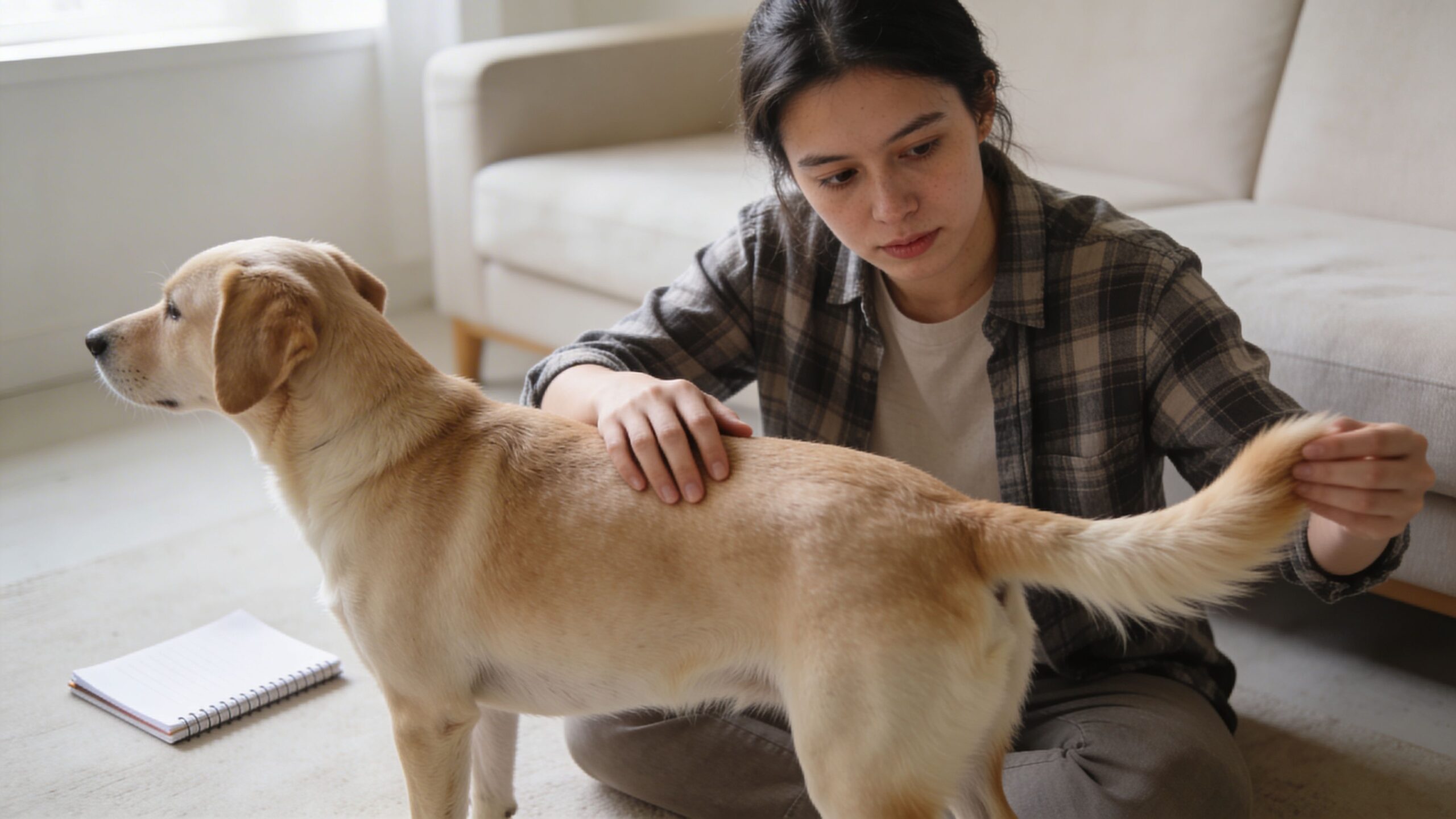
You don’t need to do a full exam. A gentle look is enough.
Part the fur, especially at the base of the tail, and check for:
- Redness
- Hair loss
- Scabs
- Bumps
- Moist or sticky skin
- A bad smell
- Any raw or bleeding spots
The base of the tail matters because that area often flares up with flea allergy and other itchy skin problems.
If your dog tenses, cries, whips around, or won’t let you touch the area, stop. That reaction itself is useful information.
Look for other body language clues
Sometimes the tail is only part of the story. Notice the whole dog.
A few things to watch:
- Scooting on the floor
- Licking paws
- Shaking the head or scratching ears
- Restlessness
- Sudden hiding or clinginess
- Trouble settling down
If you want a better read on those subtle signs, this guide on how to read dog body language can help you separate playful movement from discomfort.
Small notebook trick: Write down when it happens, how long it lasts, and what came right before it. Vets love this kind of detail because it often reveals the pattern faster than memory does.
Do a gentle flea check
Even if you’ve never seen a flea, it’s still worth checking. Fleas are tiny, fast, and easy to miss.
Use a flea comb if you have one. Focus on the base of the tail, lower back, and belly. You may not see live fleas, but you might find dark specks that look like pepper.
If you’re not sure what you’re seeing, wait before assuming. Your notes and observations will make the next step much easier.
Common Culprits The Itchy and Scratchy Reasons
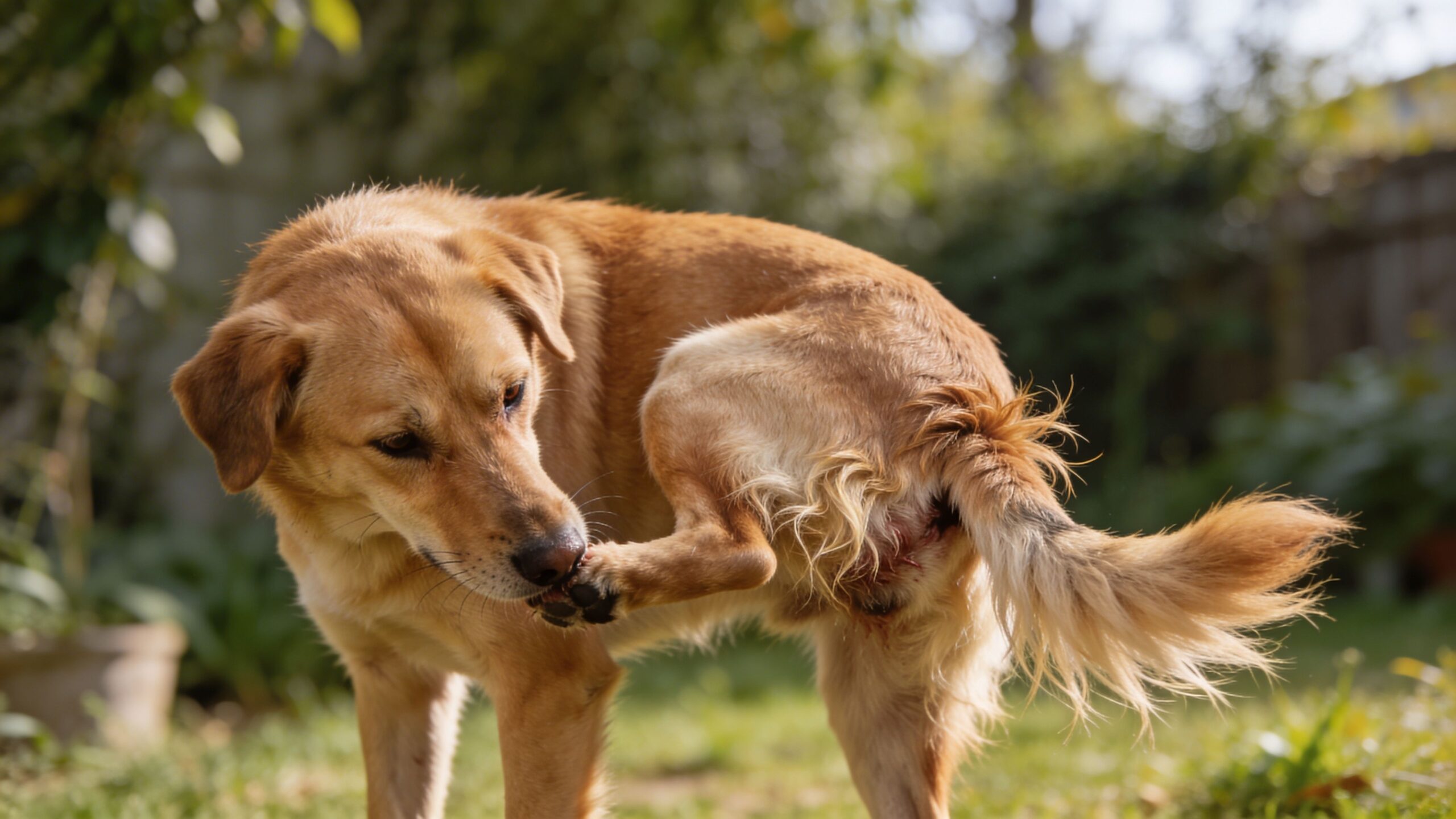
The most common reasons for tail biting are often the least glamorous ones. Something itches. And when a dog can’t scratch it well enough with a paw, he uses his teeth.
Fleas and flea allergy
Fleas are the first thing many vets consider, especially when a dog keeps chewing at the tail base.
Owners often become confused by this. They think, “I don’t see fleas, so it can’t be fleas.” But some dogs react so strongly to flea saliva that one bite can trigger intense itching. According to this veterinary overview on tail biting and chewing in dogs, flea allergy dermatitis affects approximately 5-10% of dogs in flea-endemic regions, and a single bite can set off serious chewing in a sensitive dog.
That’s a little like a person who swells up from one mosquito bite while someone else barely notices.
If you’re checking the coat and want help spotting flea dirt or other signs of external parasites, that guide can make the search less guessy.
Environmental allergies
If fleas aren’t the issue, allergies often move up the list.
Dogs can react to pollen, mites, mold, shampoos, cleaning products, and other things in their environment. The same veterinary overview notes that environmental allergies affect dogs most severely between 3 months and 6 years of age and contribute to up to 10-15% of all veterinary dermatology cases.
That irritation doesn’t always show up all over the body. Sometimes it settles into predictable hot zones, and the tail base is one of them.
Common signs that support an allergy picture include:
- Recurring itching
- Paw licking
- Ear irritation
- Seasonal flare-ups
- Red or inflamed skin
- Chewing that returns even after the skin looks better
The itch-chew-infection cycle
Here’s the part that sneaks up on people.
Your dog starts with an itch. He chews to relieve it. The chewing irritates the skin more. Then the damaged skin becomes a perfect place for infection. Once that happens, the area gets even itchier or more painful, so he chews again.
That’s the itch-chew-infection cycle.
According to the same source, if allergy-driven chewing isn’t treated, repeated chewing can create hot spots in 20-30% of allergy cases. A hotspot is a moist, angry patch of skin that can look raw fast. It may ooze, smell bad, and mat the fur around it.
A hotspot can go from “slightly pink” to “that looks awful” surprisingly quickly because dogs don’t give irritated skin much time to heal.
If you’d like to keep the coat and skin easier to inspect between vet visits, these dog grooming tips at home can help you notice changes sooner.
Skin infections and irritation
Sometimes the infection starts first. Bacteria or yeast can make the skin sore, greasy, smelly, or inflamed, and then the dog bites because the area feels miserable.
Other times, contact irritation is the spark. A new shampoo, a harsh cleaning product on the floor, burrs from a walk, or a matted patch of fur near the rear can all make a dog focus on his tail.
This short video gives a helpful visual overview of the kinds of skin and comfort issues that can make dogs chew at the tail area:
A simple way to think about it is this: if the skin is angry, your dog will try to solve it with his mouth. Unfortunately, that “solution” usually makes the skin angrier.
Deeper Discomforts Anal Glands Pain and Nerve Issues
If the skin looks fairly normal and your dog still seems fixated on his tail or rear end, it helps to widen the lens. Not every tail-biting dog is itchy on the surface.
Some dogs are trying to cope with a problem that feels deeper.
Anal glands can be the hidden issue
Anal glands are small scent sacs near your dog’s rear. Most owners don’t think about them until there’s a problem, which is understandable because they’re out of sight and not exactly dinner-table conversation.
When those glands become irritated, too full, or infected, a dog may feel pressure, burning, or a weird urge around the rear end. Since dogs can’t tell us “something feels wrong internally,” they may scoot, lick, spin, or chew near the tail base.
Clues that fit this picture include:
- Scooting across the floor
- Sudden licking under the tail
- A fishy or foul smell
- Discomfort when sitting
- Turning quickly toward the rear end
Dogs don’t always target the exact source. They often bite the nearest area they can reach.
Pain can show up in surprising places
This is one of the most overlooked parts of the whole puzzle.
A dog may bite his tail because the tail itself hurts. But he may also do it because of pain in the hips, lower back, or spine. Pain can “travel” in a way that makes the dog focus on one body part even though the root problem sits somewhere else.
Think about a person with a pinched nerve who feels tingling in the hand even though the issue starts in the neck. Dogs can have a similar mismatch between source and behavior.
A few signs that suggest pain rather than itch:
| Sign | More suggestive of |
|---|---|
| Yelping when touched | Pain |
| Stiff rising or limping | Pain in joints or back |
| Sudden tail guarding | Tail injury or soreness |
| Constant scratching without pain response | Itch or irritation |
| Trouble sitting comfortably | Rear-end discomfort |
Tail injuries and strange sensations
Tails get stepped on, caught in doors, wagged into hard furniture, and strained during rough play. A dog with a sore tail may guard it and chew because he’s trying to manage the sensation.
There are also cases where dogs seem to feel odd tingling, buzzing, or crawling sensations. Owners often describe it as the dog acting startled by his own tail. That kind of reaction can point to nerve irritation or a neurologic problem, especially if the behavior appears suddenly or looks intense and disorganized.
If your dog acts as if his tail is attacking him, don’t write it off as silliness. That behavior can reflect discomfort he can’t make sense of.
This category usually needs a vet’s hands and eyes more than home guessing. If your dog seems painful, unusually reactive, or hard to examine, it’s smart to move professional help up the list.
The Mind Game Why Boredom and Anxiety Lead to Biting
Sometimes the tail isn’t itchy and the body isn’t obviously painful. The problem lives more in the dog’s nervous system and daily routine.
That doesn’t make it “just behavioral.” It makes it real in a different way.

When stress turns into a habit loop
People bite nails, pick at cuticles, or pace when they’re stressed. Dogs do their own version of that.
They may chase, lick, or bite the tail because the repetition briefly helps them regulate themselves. The trouble is that behaviors like this can become self-reinforcing. What starts as a coping move can become a loop.
According to the 2011 BMC Veterinary Research study on tail-chasing behavior, stress, anxiety, and boredom drive approximately 30-40% of persistent tail-biting cases. The study also found that tail-chasing dogs had 37% less daily exercise and 28% fewer play sessions than non-chasers. In the US, 44% of dogs experience separation anxiety, and tail chewing can show up as a self-soothing behavior during isolation.
That’s a strong reminder that a dog’s schedule matters as much as his skin.
Common life patterns that feed the problem
Some dogs bite their tails most when the house is quiet. Others do it after long stretches indoors. Some do it after big changes, like a move, a new baby, or a different work schedule.
Look at your dog’s day as objectively as you can.
- Long alone time: Dogs who spend many hours isolated may create their own repetitive outlet.
- Not enough physical exercise: A short potty walk often isn’t enough for high-energy dogs.
- Not enough mental work: Smart dogs can get stuck when their brains have nothing useful to do.
- Too much confinement: If your dog spends a lot of time crated, comfort and space matter. Choosing an appropriate dog kennel size can help reduce stress caused by cramped confinement.
- Chaotic routine: Some dogs unravel when meals, walks, and rest times constantly shift.
When to think about compulsive behavior
If your dog seems almost trance-like, returns to the same tail-biting pattern daily, and struggles to stop even when redirected, the behavior may have become compulsive.
That means it’s no longer only about the original trigger. The behavior itself has gained momentum.
A few signs that make me think “this dog needs more than a quick fix”:
- He starts biting during predictable stress moments
- He resumes almost immediately after you interrupt him
- He seems wound up before the biting begins
- He has other repetitive habits, like pacing or flank licking
If your dog needs more engaging outlets, these best interactive dog toys can give you a practical starting point.
A bored dog doesn’t always look sad. Sometimes he looks busy. Tail biting can be that busy behavior.
Owners often feel bad when they realize routine played a role. Try not to stay there. Dogs live in the present. The helpful question isn’t “Did I mess this up?” It’s “What can I change starting today?”
When to Call the Vet A Clear Action Plan
The hardest part is usually deciding whether to monitor or make the appointment now. A simple triage mindset helps.
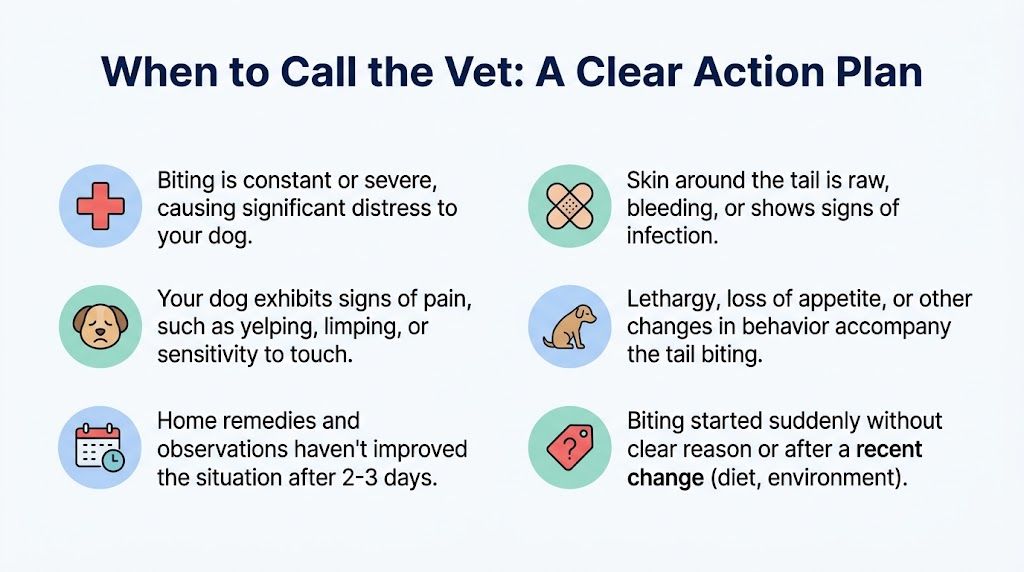
Red flags that need a prompt vet call
These signs move the issue out of the “watch and wait” category:
- Constant chewing: Your dog can’t seem to leave the area alone.
- Broken skin: You see bleeding, raw patches, discharge, or a strong odor.
- Pain signs: He yelps, guards the area, limps, or reacts strongly to touch.
- Whole-dog changes: He seems tired, off food, clingy, withdrawn, or unlike himself.
- Sudden severe onset: The behavior appears out of nowhere and looks intense.
These cases can worsen fast, especially if the skin is already damaged.
Yellow flags you can monitor briefly
Sometimes it’s reasonable to watch closely for a short time while doing basic detective work.
That usually means:
- The skin isn’t broken
- The behavior is occasional, not nonstop
- Your dog is otherwise acting normal
- You have a likely explanation, such as missed flea prevention or recent outdoor exposure
During that short monitoring window, check the coat, trim away matted fur only if it’s safe and easy, prevent more irritation, and keep notes.
A simple decision table
| What you see | What to do |
|---|---|
| Mild, occasional nibbling with normal skin | Observe closely and note patterns |
| Repeated chewing focused on the tail base | Check for fleas, irritation, and schedule a vet visit if it continues |
| Raw skin, odor, swelling, or discharge | Call the vet |
| Yelping, limping, or severe sensitivity | Call the vet |
| Behavior tied to anxiety but skin is intact | Start routine and enrichment changes, then consult your vet if it persists |
If you’re debating whether it’s “serious enough,” call. Getting guidance early is often easier than treating a bigger problem later.
Home care has limits. It can help you gather clues. It shouldn’t replace a vet when your dog is clearly uncomfortable or injuring himself.
Creating a Tail-Wagging Future Long-Term Prevention
Once you’ve dealt with the immediate problem, prevention becomes the ultimate success. Tail biting usually improves most when owners build a routine that protects both the body and the brain.
Keep the skin and coat boring in the best way
You want your dog’s skin to be uneventful.
That means staying consistent with flea and tick prevention, keeping the coat clean but not overwashed, and paying attention to seasonal patterns. If your dog tends to flare during certain months or after certain products, write that down and bring it to your vet. Patterns are useful.
Good prevention habits often include:
- Year-round parasite control
- Regular coat checks at the tail base and lower back
- Prompt care for any redness or moisture
- Working with your vet on allergies if itching keeps returning
A dog who has already had one hotspot or allergy flare can be more vulnerable to repeat episodes if the trigger isn’t addressed.
Build a routine that uses up healthy energy
Behaviorists often recommend LIMA, which means Least Intrusive, Minimally Aversive, and the idea fits beautifully here. Start with humane, practical ways to meet the dog’s needs rather than punishing the behavior.
According to this behavior-focused veterinary article on dog tail chewing, a baseline of 60 minutes of daily aerobic exercise can reduce compulsive episodes by 75%, and enrichment toys like stuffed Kongs can yield an 85% reduction in self-mutilation scores. For anxiety, fluoxetine shows a 70-80% response rate within 8 weeks when used appropriately under veterinary guidance.
That tells us something important. Prevention isn’t fluff. It changes outcomes.
Simple enrichment that actually helps
You do not need to turn your home into a canine theme park. You just need enough variety that your dog’s day has purpose.
Try rotating options like:
- Stuffed Kongs: Freeze them for longer-lasting work.
- Snuffle mats: Great for dogs who need slower, calmer engagement.
- Scatter feeding in the yard: Lets dogs use their noses, which can be very regulating.
- Short training sessions: Sit, touch, place, and recall all count as mental work.
- Predictable walks: Routine can soothe anxious dogs.
- Chew options approved by your vet: Some dogs need a safe outlet for oral behavior.
Prevention rule: If your dog only gets stimulation when he’s already acting out, he’ll keep using problem behavior to access engagement.
Reduce friction in daily life
A lot of prevention is ordinary and unglamorous.
Feed on a schedule. Keep walks consistent. Notice if your dog struggles with guests, loud evenings, grooming, or long absences. If anxiety is part of the picture, your vet may suggest a full behavior plan rather than telling you to “wait it out.”
That’s especially helpful for dogs whose tail biting has become a habit loop. They often need several supports working together. Exercise, enrichment, calmer routines, and medical help when needed.
A healthy future usually comes from small repeated choices, not one miracle fix.
Frequently Asked Questions About Tail Biting
Are some breeds more likely to bite their tails
Yes, some dogs seem more prone to repetitive behaviors than others.
The verified data notes that behavior-related tail biting can resemble canine OCD, with prevalence up to 2-4% in breeds like German Shepherds and Labs in the veterinary data summarized in the source above. Breed tendencies can shape risk, but they don’t tell the whole story. Routine, stress, exercise, and medical triggers still matter.
My puppy chases his tail. Is that always a problem
Not always.
Puppies explore everything, including their own bodies. A brief, playful tail chase with a loose body and easy stop usually isn’t alarming. What’s more concerning is repeated fixation, hard chewing, crying, hair loss, or skin changes.
If your puppy seems unable to stop or is damaging the tail, treat it like a real symptom and get it checked.
Could food be the reason
It could be, but it’s usually not something to diagnose by guesswork alone.
Food issues can show up as itchy skin, ear trouble, paw licking, or ongoing rear-end irritation. The tricky part is that food allergy can look a lot like environmental allergy from the outside. That’s why random food swaps often create confusion instead of clarity.
If you suspect food plays a role, ask your vet whether an elimination diet makes sense.
What can I use right now to stop my dog from biting his tail
Your first job is to prevent more damage.
That may mean using an e-collar or cone, supervising closely, and limiting access to the area until your vet weighs in. Some owners reach for bitter sprays right away, but those can backfire if the skin is already raw or inflamed. They may also stop the chewing without addressing the cause.
A cone is often boring but effective. It protects the skin while you figure out why your dog is targeting the tail.
Should I punish my dog for tail biting
No. Punishment usually makes this worse.
If the problem is itch, pain, or anxiety, punishment adds stress on top of discomfort. That can intensify the behavior or push it into a stronger habit loop. Redirection, treatment, and meeting the dog’s needs work much better.
If there are no fleas, can it still be a skin issue
Absolutely.
Dogs can chew their tails because of environmental allergies, skin infections, hotspots, grooming irritation, or other localized skin problems even when fleas aren’t present. “No fleas” narrows the list. It doesn’t end the investigation.
If you want more practical dog-care guides, helpful product roundups, and a warm community of fellow dog lovers, visit Setterfrens LLC. It’s a lovely spot for dog moms, readers, and everyday pet people who want caring, clear advice without the overwhelm.