You’re standing in the dog food aisle with your phone out, reading labels like you’re cramming for a final exam. One bag says “grain-free.” Another says “ancestral.” A third promises a shiny coat, happy tummy, and endless zoomies. Meanwhile, your dog would probably eat a sock and call it dinner.
That disconnect is why this topic gets messy so fast.
Most of us aren’t trying to follow a trend. We’re trying to do right by a dog we love. If your pup has itchy skin, soft stools, ear issues, or just seems “off” on their current food, grain-free starts to sound like a smart fix. And if you’ve also heard whispers about heart risks, now you’re stuck between marketing promises and scary headlines.
That’s a hard place to be.
I think of grain-free dog food the same way I think of all the fancy wellness trends humans get sold. Sometimes there’s a real use case. Sometimes it’s mostly branding. Usually, it’s more nuanced than either side admits. That’s why a calm, practical guide matters.
If you’re the kind of person who also bookmarks thoughtful dog-lover finds, this roundup of best gifts for dog owners has the same warm, useful energy. It’s the sort of thing a dog parent sends to a friend with “this made me think of you.”
What matters here is this. Grain free dog food benefits are real for some dogs, but they aren’t automatic for every dog. A food can be grain-free and still not be the best choice. A food can include grains and still be excellent. The label alone doesn’t tell the full story.
Welcome to the Confusing World of Dog Food
A lot of dog food advice sounds certain. Feed this. Avoid that. Never buy corn. Always buy grain-free. Real life rarely works that neatly.
One dog thrives on a chicken-and-rice formula for years. Another needs a carefully selected elimination diet because every meal seems to trigger itching or stomach drama. Both dogs are normal. Both situations happen all the time.
A helpful mindset: Stop asking “Is grain-free good or bad?” and start asking “Why would this specific food fit my specific dog?”
That one shift clears out a surprising amount of noise.
Why the label gets so much attention
“Grain-free” sounds meaningful because it names what’s missing. That feels simple. But the more useful question is what replaced the grains, how the recipe is balanced, and whether your dog needs that swap in the first place.
Marketing often leans into ideas that feel intuitive to us. More meat. Fewer fillers. A diet that sounds closer to “natural.” Those ideas can be emotionally persuasive, especially when your dog has a problem you want to solve quickly.
Here’s where readers usually get tripped up:
- They assume grain-free means fewer carbs. It usually doesn’t.
- They assume grain-free means better digestion for every dog. It depends on the formula and the dog.
- They assume grains are bad ingredients. That’s not supported for most dogs.
- They assume a premium price equals a better food. Sometimes yes, sometimes absolutely not.
What a balanced conversation actually sounds like
A balanced view makes room for both truths. Some grain-free foods can help some dogs. At the same time, grain-free isn’t broadly necessary for the general dog population, and there are legitimate questions about certain formulations.
That’s why this isn’t a “pro” article or an “anti” article. It’s a decision guide.
By the end, you should feel more confident reading a label, more grounded talking with your vet, and less likely to get swept up by a trend that wasn’t designed around your dog’s real needs.
What Does Grain-Free Dog Food Actually Mean
A lot of dog parents see “grain-free” on a bag and picture a meat-heavy diet with very few carbs. The label sounds simple. The formula usually is not.
Grain-free dog food still needs ingredients that provide energy, fiber, and kibble structure. So if a recipe removes grains such as corn, wheat, rice, barley, or oats, it usually replaces them with other starches or legumes, like peas, lentils, chickpeas, potatoes, or sweet potatoes.
That swap matters more than the label alone.
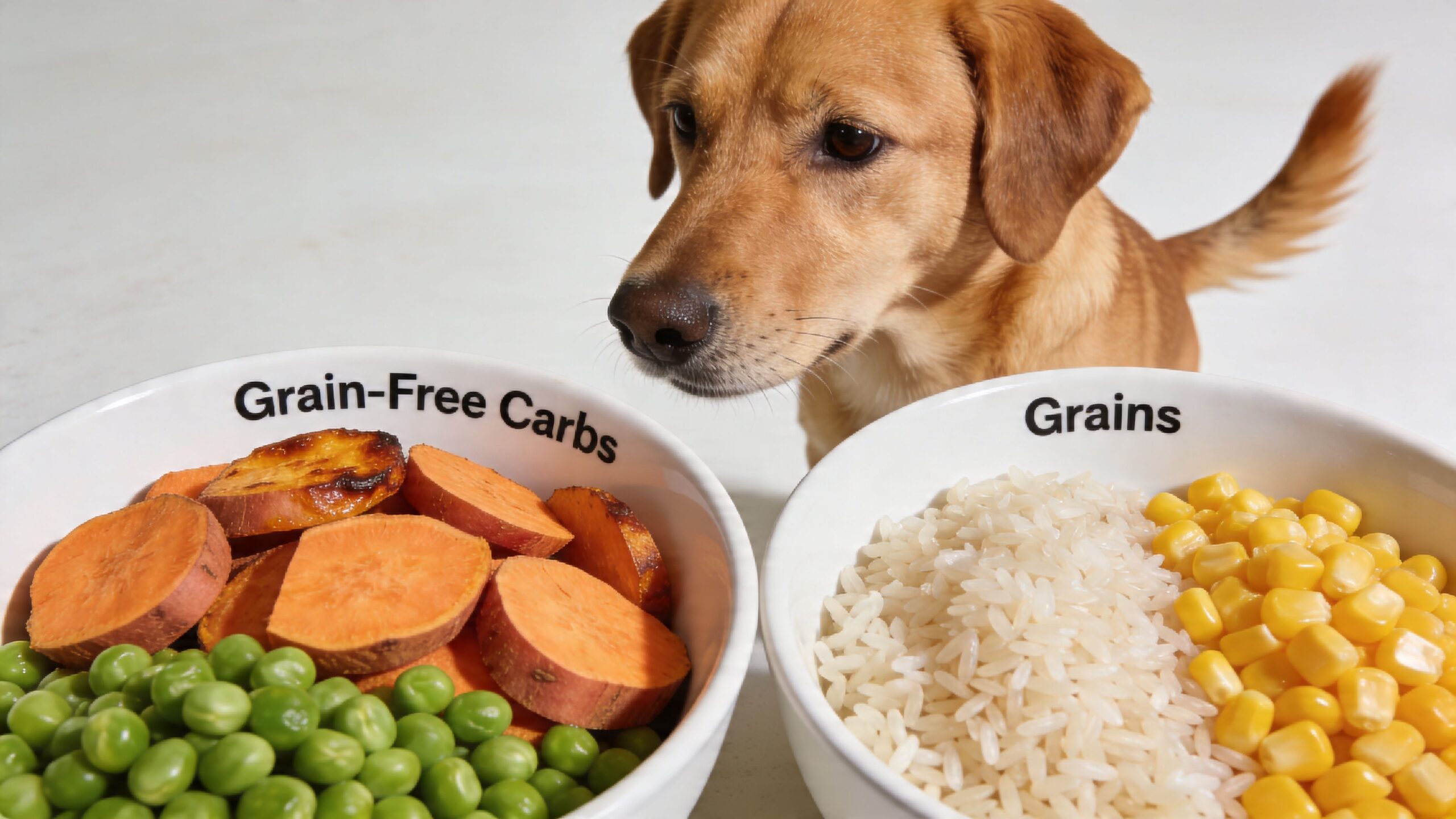
What gets removed and what gets added
Dog food recipes work a lot like a baking recipe. If you remove one major ingredient group, you still have to rebuild the recipe so it holds together and meets nutritional targets.
Here’s what that often looks like:
| Food feature | Grain-inclusive example | Grain-free example |
|---|---|---|
| Carbohydrate source | Rice, oats, corn, barley | Peas, lentils, chickpeas, potatoes |
| Fiber profile | Grain-based fibers | Legume or tuber-based fibers |
| Recipe style | Traditional kibble formulas | Often higher-protein, alternative-carb formulas |
So a grain-free kibble is not automatically lower in carbohydrates. It is usually carbohydrate-different.
That distinction clears up a lot of confusion.
Why grain-free diets were created
Grain-free diets were originally used for a narrow purpose. They gave vets and owners another option when a dog needed an elimination diet or seemed to react poorly to specific ingredients.
For the average healthy dog, grains are not automatically a problem. Many dogs digest properly cooked grains just fine, and grain ingredients can contribute protein, fatty acids, fiber, vitamins, and minerals when the full recipe is balanced.
This is also why “grain-free” should never be read as a shortcut for “better.” It only tells you what was left out. It does not tell you whether the replacement ingredients make sense for your dog.
Some newer recipes also experiment with unusual ingredient combinations, including things adjacent to hemp-based animal feed. That can be interesting, but “different” and “well formulated” are not the same thing.
What the label does, and does not, tell you
A grain-free label answers one question. Are grains included? No.
It does not answer several others that matter more in real life:
- What ingredients replaced the grains?
- Is the food complete and balanced for your dog’s life stage?
- Does the brand use qualified nutrition expertise and feeding trials, or only market-friendly wording?
- Is there a clear reason your dog would benefit from this formula?
That last question is the heart of this guide. The goal is not to sort foods into “good” and “bad” piles based on one front-of-bag claim. The goal is to make a calmer, more practical decision with your vet, based on your own dog’s symptoms, history, and risk factors.
A grain-inclusive food can be an excellent choice. A grain-free food can also be an excellent choice. The better choice depends on the dog in front of you, the quality of the full formula, and the reason you are considering a change at all.
Exploring the Potential Grain-Free Dog Food Benefits
Your dog switches foods, the scratching eases, the poop looks better, and suddenly grain-free starts to sound like the answer. That kind of change can feel convincing. The tricky part is figuring out what contributed to the improvement. Was it the lack of grains, a different protein, a new fiber mix, or a better-made formula overall?
That question matters because the potential benefits of grain-free food are real for some dogs, but they are not automatic for all dogs. A practical way to look at it is this. Start with the problem you are trying to solve, then ask whether removing grains has a clear role in solving it. That keeps you focused on your own dog instead of a trend.
Benefit one for dogs with true grain sensitivity
This is the strongest case.
True grain allergy in dogs appears to be uncommon. Veterinary guidance from MSPCA-Angell explains that food allergies are usually triggered by proteins, and grains are not among the most common culprits. That does not mean grain reactions never happen. It means they should be confirmed carefully instead of assumed every time a dog has itchy skin or an upset stomach.
A useful real-world example comes from gluten-sensitive Irish Setters. In a study indexed by PubMed, affected dogs improved on a gluten-free diet and relapsed when gluten was added back. That is a narrow finding, not a rule for every breed or every itchy dog. Still, it shows why a grain-free or gluten-free diet can be appropriate in specific medical cases.
Signs that can lead a vet to consider a food reaction include:
- Persistent itching or inflamed skin
- Recurring ear problems
- Vomiting, diarrhea, or frequent soft stools
- Symptoms that improve during a diet trial and return with reintroduction
The key idea is simple. Grain-free food helps most when grains are part of the problem.
Benefit two through a different ingredient and fiber mix
Some dogs do better on a grain-free food because the recipe changes in ways that go far beyond removing corn, wheat, or rice. The replacement ingredients may bring a different starch source, a different fiber profile, and a different overall texture in the gut.
That can affect stool quality, fullness, and how well a dog seems to tolerate meals day to day.
The WSAVA Nutrition Toolkit, available through the World Small Animal Veterinary Association, reminds owners to judge the full diet rather than one label claim. That advice is especially helpful here. Two grain-free foods can behave very differently in a dog’s digestive system if one leans heavily on legumes and another uses a very different ingredient balance.
Protein source matters too. Research in the Journal of Animal Science found that dry dog foods vary in nutrient digestibility depending on ingredient composition and processing. In plain language, your dog is responding to the whole recipe, not a buzzword on the front of the bag.
That is why one dog may have firmer stools on a grain-free food while another does better on a grain-inclusive formula with oats or rice. It is less like flipping one switch and more like adjusting several recipe dials at once.
Benefit three for some active dogs and selective eaters
Many grain-free products are formulated to be richer, often with more fat, more animal ingredients, or both. For a very active dog, that can be useful. A couch potato is a different story.
A working dog, a young high-energy dog, or a dog who burns through calories on long hikes may do well on a more calorie-dense formula if it supports weight maintenance and recovery. Some picky eaters also seem more interested in these foods, likely because of palatability rather than the absence of grains itself.
Here is the practical filter:
- If your dog needs more calories in a smaller portion, a richer grain-free formula may fit.
- If your dog gains weight easily, extra richness may create a new problem.
- If your dog is picky, better appetite does not automatically mean the food is better matched nutritionally.
Some owners also notice coat changes after a switch. That can happen, but it usually points back to the total nutrient profile, especially fat quality and essential fatty acids, rather than grain removal alone.
If you like reading about broader ingredient experimentation in animal nutrition, hemp-based animal feed is one example of how feed ingredients are being reconsidered across animal health more broadly.
What these benefits mean in real life
A grain-free food may help if your dog has a confirmed sensitivity, does better with a different fiber and starch setup, or needs a formula with a different calorie and protein profile. That is a much more useful lens than asking whether grain-free is good or bad.
A better question is, “What changed in the formula, and does that change match my dog’s actual needs?”
That question gives you something concrete to discuss with your vet.
Understanding the Grain-Free Controversy and Heart Health Risks
If grain-free dog food were only a digestion-and-allergy story, this would be a much shorter conversation. The reason owners feel uneasy is the heart-health question, especially around dilated cardiomyopathy, often shortened to DCM.
DCM is a serious heart disease. In the grain-free discussion, the concern isn’t that every grain-free food causes heart trouble. The concern is that some diet patterns, especially certain formulations heavy in legumes, may be associated with cases of diet-related DCM in dogs that weren’t expected to develop it.

What the FDA data actually showed
This is the part where accuracy matters more than hot takes.
The FDA documented 515 cases of DCM in dogs between 2014 and 2019, and 90% of those dogs were eating grain-free diets. Ninety-three percent of the reported foods contained peas or lentils, according to the ASPCA summary of the issue in its grain-free pet food explainer.
That is a serious signal. It deserves attention.
At the same time, the same source makes an important point. Causation remains unproven. In other words, the reports show a concerning association, but they don’t prove that grain-free food by itself caused every case.
That distinction can feel frustrating, because pet parents understandably want a clean yes-or-no answer. Science often gives us “here’s the pattern we need to take seriously” before it gives us “here’s the final mechanism.”
Why legumes became part of the conversation
A lot of grain-free kibble formulas replaced grains with ingredients like peas and lentils. Those ingredients can serve useful nutritional roles, but they became part of the DCM conversation because they showed up repeatedly in reported diets.
Researchers and veterinarians have considered whether certain formulations may affect taurine status or the way some dogs process nutrients important for heart health. The picture is still being worked out. It may not be a single-ingredient problem. It may be a formulation problem. It may also affect some dogs more than others.
That’s why broad statements like “grain-free is dangerous” or “grain-free is totally safe” both miss the mark.
Practical rule: If a food choice carries an unresolved heart-health question, don’t make that choice casually or because the bag sounds premium.
Why this doesn’t mean panic
Some owners hear about DCM and immediately assume any grain-free bowl is harmful. That’s not supported either.
The evidence base includes nuance. Long-term studies in Labradors fed grain-free diets for 26 weeks found no adverse effects on plasma taurine or general health in controlled settings, as summarized in the earlier veterinary reporting. Other follow-up work has also complicated the early fear that every grain-free formula creates the same risk pattern.
So where does that leave a normal dog owner?
Usually here: cautious, confused, and wanting a rulebook.
A reasonable way to think about the risk
Instead of asking whether grain-free is “safe” in the abstract, ask better questions:
- What ingredients are replacing the grains?
- Is the food from a company with strong nutritional expertise and feeding validation?
- Does my dog have a medical reason to be on this diet?
- Is my dog in a breed or family line where my vet wants to be especially careful?
- Would a different non-grain-free option solve the same problem with less uncertainty?
This short video gives a helpful overview of why the issue has stayed on pet owners’ radar:
The most grounded takeaway
The controversy isn’t a reason to ignore all potential grain free dog food benefits. It is a reason to stop treating grain-free as a casual upgrade.
If your dog needs it for a specific reason, that’s a conversation worth having with your vet. If your dog doesn’t need it, the DCM question is one more reason not to chase the trend just because the packaging feels more wholesome.
That might sound less exciting than a dramatic “always” or “never.” It’s also the kindest approach to your dog.
Deciding if a Grain-Free Diet Is Right for Your Dog
You are standing in the pet store, holding a bag that says “grain-free,” “premium,” and “ancestral diet,” while your dog is perfectly happy at home eating the food they already know. That moment can make a normal feeding decision feel strangely high-stakes.
A calmer way to approach it is to treat grain-free like a medical or practical choice, not a lifestyle upgrade.
Grain allergies in dogs are uncommon. VCA Animal Hospitals notes that true food allergies are uncommon overall, and when they do happen, the trigger is usually a protein source rather than a grain ingredient, such as beef or chicken, in their overview of food allergies in dogs. That helps explain why grain-free is often purchased for reasons other than a confirmed grain problem.
Start with the question your dog is answering
Before switching foods, get very specific about what is happening with your dog.
Is there loose stool every week? Ongoing itchiness? Ear infections that keep returning? Vomiting after meals? Or is your dog doing well, and you are just wondering if grain-free sounds healthier?
That distinction matters. A diet change works best when it is tied to a clear goal. Otherwise, it becomes guesswork with a nice-looking label.
If your dog has healthy skin, consistent stools, good energy, and no red flags from your vet, staying put may be the smartest choice. Dog food decisions can feel emotional, but your dog’s body gives better feedback than the front of the bag.
When the conversation is worth having with your vet
There are cases where a grain-free food may deserve a closer look. Usually, it makes the most sense as one piece of a plan your veterinarian is guiding.
Bring it up if your dog has:
- Recurring digestive or skin issues and your vet wants to sort out whether food could be a factor
- A history of doing poorly on a specific grain-containing food after other likely causes have been checked
- A medical or nutritional reason to try a different formula profile under veterinary supervision
The key idea is purpose.
“My dog scratches sometimes” is different from “my vet wants to run a structured diet trial and rule ingredients in or out.” Those two situations may look similar from across the room, but they are handled very differently.
If your vet suggests a diet trial, consistency matters. Treats, table scraps, flavored chews, and little “just this once” snacks can muddy the results fast.
Use a simple decision filter
A four-part filter can make this choice feel less foggy.
What problem am I trying to solve?
Name the symptom or concern in plain language.What has my vet said so far?
Are you responding to a real pattern, or to marketing and online advice?What else could explain the improvement I want?
Sometimes the helpful change is a different protein, a different fiber mix, or a better-made formula. Grain-free may not be the reason.How will I monitor the switch?
Keep notes on stool quality, itching, ears, appetite, energy, and weight. That turns “I think this helped” into something much more useful.
This works like troubleshooting a problem in your own diet. If you cut out three foods, start new treats, and change routines all at once, you cannot tell what made a difference. Dogs are no different.
Dogs who usually do not need a grain-free switch
Many dogs handle grains just fine and do well for years on balanced grain-inclusive foods. For those dogs, changing to grain-free “just in case” can create extra cost and extra confusion without solving a real problem.
That does not mean grain-free is always wrong. It means “different” should not be mistaken for “better.”
If you want one sentence to guide the decision, use this one: choose the food that best fits your dog’s symptoms, history, and veterinary guidance, not the food trend that feels most convincing in the aisle.
A Smart Shopper's Guide to Choosing Any Dog Food
The dog food aisle can make a caring owner feel weirdly unprepared. One bag says “premium.” Another says “ancestral.” A third promises clean ingredients and a shiny coat. Meanwhile, your real question is much simpler: is this food a good fit for my dog?
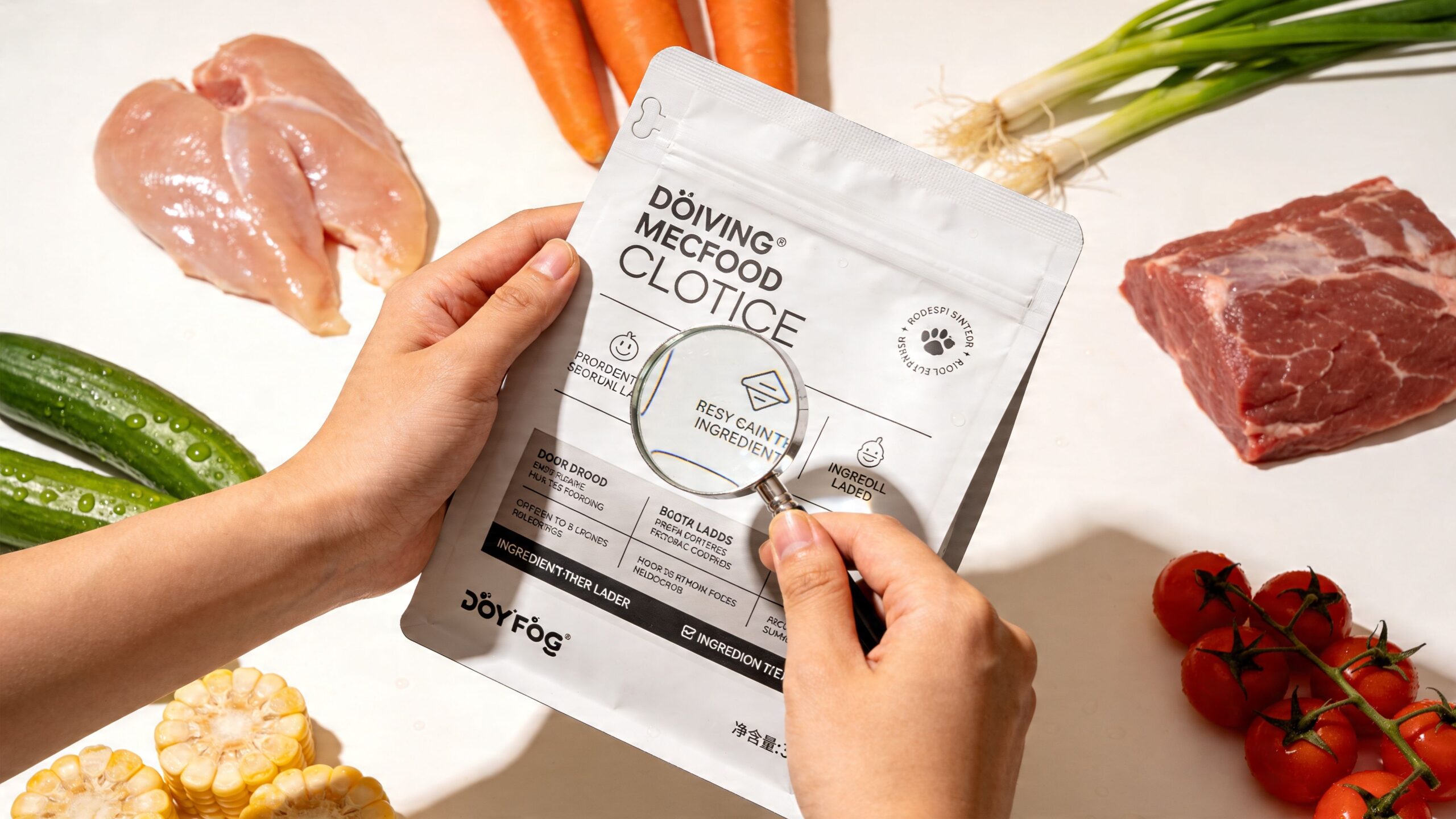
A helpful way to shop is to treat the front of the bag like a movie poster. It is designed to grab attention, set a mood, and tell a story. It is not where the most useful nutrition details usually live.
That matters here because grain-free is only one label feature. It does not tell you, by itself, whether the recipe is well formulated, tested, or appropriate for your dog’s age, health history, and symptoms. As noted earlier, most dogs digest grains without trouble, so the smarter question is broader: what evidence suggests this food is a solid choice?
Start with the basics that matter most
If you only check a few things, check these first.
AAFCO nutritional adequacy statement
Look for wording that shows the food is complete and balanced for a specific life stage or for all life stages.Life stage match
A puppy food and an adult maintenance food are built for different jobs. A good formula for one is not automatically a good formula for the other.Clear manufacturer information
You want to know who makes the food, where to ask questions, and whether the company explains how it formulates and tests its diets.A recipe that fits your dog, not a trend
If your dog has a diagnosed food allergy, sensitive digestion, kidney disease, or another medical issue, those needs should shape your choice more than marketing language.
Then look one layer deeper
Shopping gets more useful.
The WSAVA Global Nutrition Toolkit gives pet owners and veterinarians a practical set of questions to ask dog food companies, including whether they employ qualified nutrition experts, what quality control steps they use, and whether they have done feeding trials. Those questions help you judge the company behind the bag, not just the ingredient list printed on it.
That is a better filter than chasing buzzwords. A pretty ingredient panel can still sit on top of a weak formula. A less fashionable ingredient list can still support excellent nutrition.
What to look for on the label
Use this checklist when you compare foods side by side:
| Question to ask | Why it matters |
|---|---|
| Is it complete and balanced? | This is the baseline. Without it, the rest does not matter much. |
| Is it made for my dog’s life stage? | Growth, adulthood, and senior years have different nutrition needs. |
| Who formulated it? | Training and experience matter more than brand storytelling. |
| Has the food been tested in feeding trials? | Feeding real dogs adds confidence beyond meeting nutrient targets on paper. |
| Can the company answer basic quality-control questions? | Transparency makes it easier to trust what is in the bag. |
Ingredient myths can distract you
It is easy to get pulled into ingredient shorthand. Corn means low quality. Peas mean healthy. Grain-free means premium. Ancient grains mean safer.
Those shortcuts can steer you wrong because they reduce a full diet to one or two ingredients. Dog food works more like a recipe than a headline. The final result depends on balance, digestibility, formulation skill, and consistency in manufacturing.
So if you are standing in the store comparing two bags, try this calm, practical framework:
- Check that the food is complete and balanced for your dog’s life stage.
- Look for signs the company uses nutrition expertise and quality control.
- Ask whether the formula fits your dog’s actual needs, not your worry after reading the bag.
- Bring your vet in when your dog has symptoms, a medical condition, or a history that makes the choice less straightforward.
That approach gives you a way to choose, not just react. And that is the ultimate goal of this guide. Grain-free is not the only question in the aisle. The better question is whether the food in your hand is a sound, well-supported choice for your specific dog.
Frequently Asked Questions and Grain-Free Myth Busting
Some dog food myths stick around because they sound tidy. Real nutrition almost never is. Let’s clean up a few of the most common ones.
Are grains just fillers
Usually, no.
For most dogs, grains are digestible ingredients that can contribute useful nutrients. Calling them “fillers” makes it sound like they have no nutritional purpose, and that’s too simplistic. What matters is whether the total diet is balanced and well formulated.
A poor food can include grains. A poor food can also exclude them.
Does grain-free always help digestion
Not always. It changes the digestive picture. It doesn’t automatically improve it.
Research summarized in this review of canine digestive effects from grain-free feeding found that grain-free diets can alter digestive function because pulse ingredients like peas are highly fermentable. Dogs on these diets had 10% to 20% higher concentrations of short-chain fatty acids, which can affect gut health and peristalsis. That can lead to softer stools for some dogs, but softer doesn’t always mean worse, and different doesn’t always mean better.
So if your dog’s poop changed after a switch, that doesn’t automatically mean the food is failing. It may reflect a different fiber profile.
Is grain-free better for puppies or senior dogs
Not by default.
Puppies need carefully balanced nutrition for growth. Senior dogs need nutrition that fits their body condition, activity level, and medical history. In both cases, life-stage appropriateness matters more than whether the food contains grains.
If a puppy or senior dog has a specific reason to avoid grains, that should be handled with veterinary guidance, not trend-based shopping.
Will grain-free help my dog lose weight
Maybe, but not because of the label itself.
Weight loss depends on calorie intake, portion control, activity, and the nutrient density of the formula. Some grain-free foods are richer in protein and fat, which may help one dog feel satisfied, but may also make portion mistakes more costly in another dog.
If your dog needs to slim down, your best ally is a feeding plan, not a marketing promise.
What about ancient grains
This is one of those terms that sounds reassuring but still needs context. “Ancient grains” may appeal to owners looking for less processed-sounding ingredients, but the same rule applies. Judge the whole food.
The bag should not do all the thinking for you.
If a term sounds wholesome but vague, slow down and look for the actual nutritional evidence behind it.
So what’s the simplest takeaway
Here it is. Grain free dog food benefits exist, but they’re specific, not universal. Some dogs may do well on grain-free formulas, especially with targeted veterinary guidance. Many dogs do very well on balanced foods that include grains.
Your job isn’t to win the trend cycle. It’s to feed the dog in front of you.
If you love practical dog-parent guides with a warm, bookish vibe, visit Setterfrens LLC. It’s a cozy corner for dog lovers who want helpful advice, thoughtful finds, and a little extra tail-wagging joy in the mix.