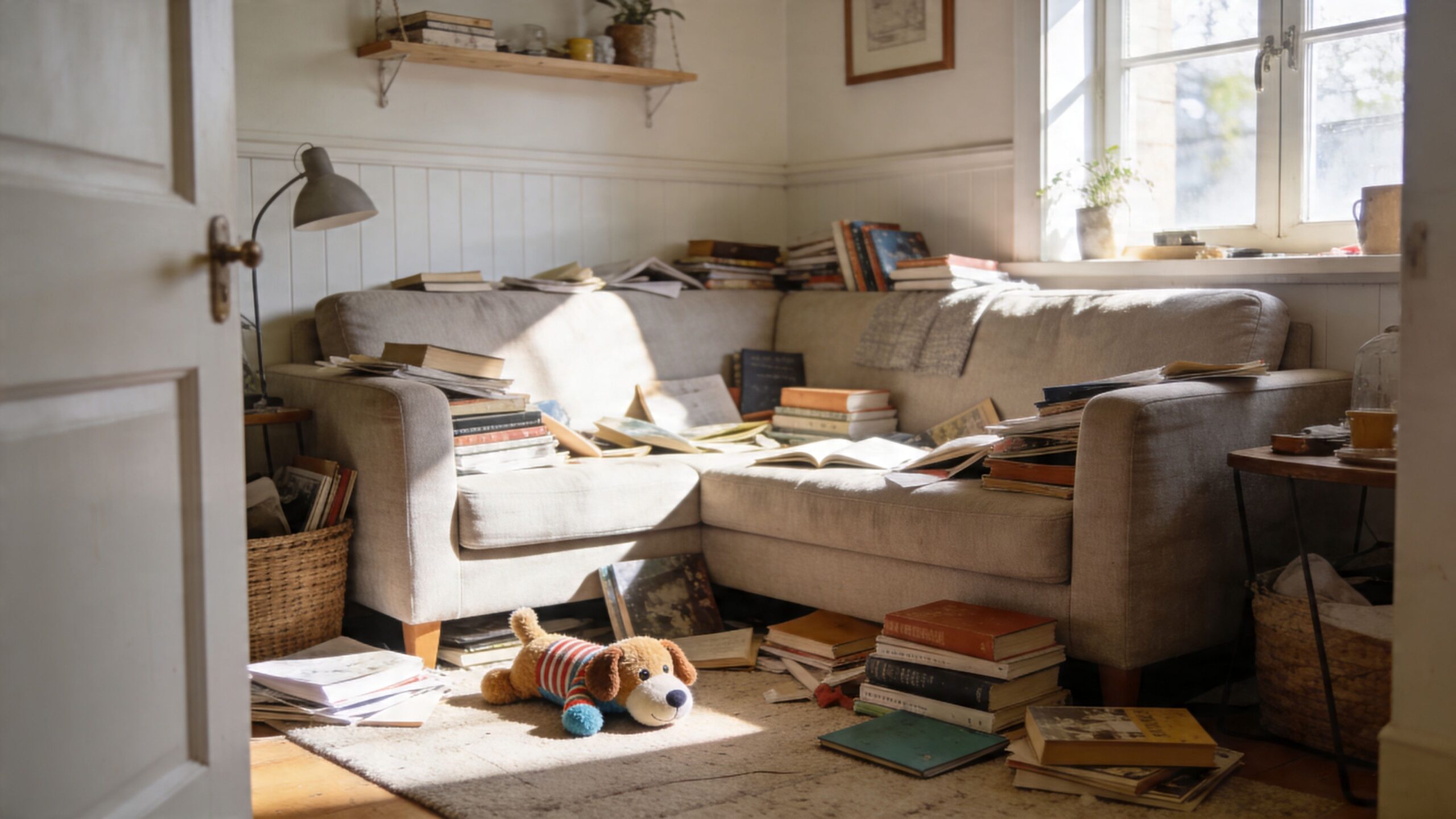
Your living room might be doing too much right now. It holds the sofa where you collapse at night, the dog bed that somehow migrates across the floor, the stack of novels by the armrest, the throw blanket, the charger, the toy basket, and maybe one guilty pile of mail.
That’s normal.
A small living room can feel warm and stylish, but only if you stop treating it like a tiny version of a large room. It needs different choices. Better proportions. Smarter storage. More discipline about what earns floor space. If you're trying to figure out how to style a small living room that works for a reader, a dog, and actual daily life, the answer isn't “buy smaller random furniture.” It's to build the room around how you live.
Your Small Space Starting Point
Shopping is often the first impulse. Bad move.
Start with a tape measure and a notepad. Small living rooms are often defined as 130 to 160 square feet, and proportion matters more in that footprint than almost anything else. The 2/3's Living Room Rule says supporting pieces like rugs or coffee tables should be about two-thirds the size of the sofa, and that proportion can make a room feel 20 to 25% larger according to Snaidero America’s living room size guide.
Measure the room before you dream about it
Don't eyeball anything. Measure the room length, width, and wall height.
Then mark these details:
- Door swing so you don't block entry
- Windows so you know where natural light lands
- Outlets and vents so lamps and furniture don't fight the architecture
- The dog path because your pup already has a preferred route
- Your reading spot because if one chair gets good afternoon light, that matters
A living room always works better when you respect movement first. You need a clean path from one side of the room to the other, and your dog needs one too. If your pup has evening zoomies, you'll notice very quickly which arrangement makes the room feel easy and which one makes it feel like an obstacle course.
Build around anchors
Pick the anchor piece first. Usually that's the sofa. Then decide what supports it.
Use this quick proportion check:
| Piece | What to do |
|---|---|
| Sofa | Choose this first and let everything else answer to it |
| Coffee table | Keep it visually lighter than the sofa |
| Rug | Size it to ground the seating area, not float in the middle |
| Art | Make it large enough to relate to the sofa, not look apologetic |
Practical rule: If a piece looks cute in isolation but awkward next to your sofa, it isn't the right piece.
Think about daily friction
Good small-room styling solves annoying little problems before they happen.
Maybe your dog likes to nap where the heat from the window hits the floor. Fine. Leave room for that. Maybe you read every night and need a lamp beside one seat, not just overhead light. Fine. Plan for that too.
The best small living rooms feel calm because they aren’t forcing every item into the center of the room. They leave breathing space. That empty space isn't wasted. It’s what keeps the room from feeling crowded.
Choose Furniture That Fits Your Life (and Your Dog)
My strongest opinion here is simple. Stop buying furniture for a fantasy version of yourself. Buy it for the dog hair, the bent pages, the coffee mug, the blanket heap, and the fact that somebody is going to jump on that sofa with muddy paws at least once.
In small rooms, oversized furniture can make a space feel 25 to 40% smaller. Experts recommend sofas around 72 to 84 inches for rooms under 160 square feet, and 60% of small-space pitfalls stem from ignoring scale according to Homes & Gardens on small living room layout rules.
Pick the right sofa, not the biggest sofa
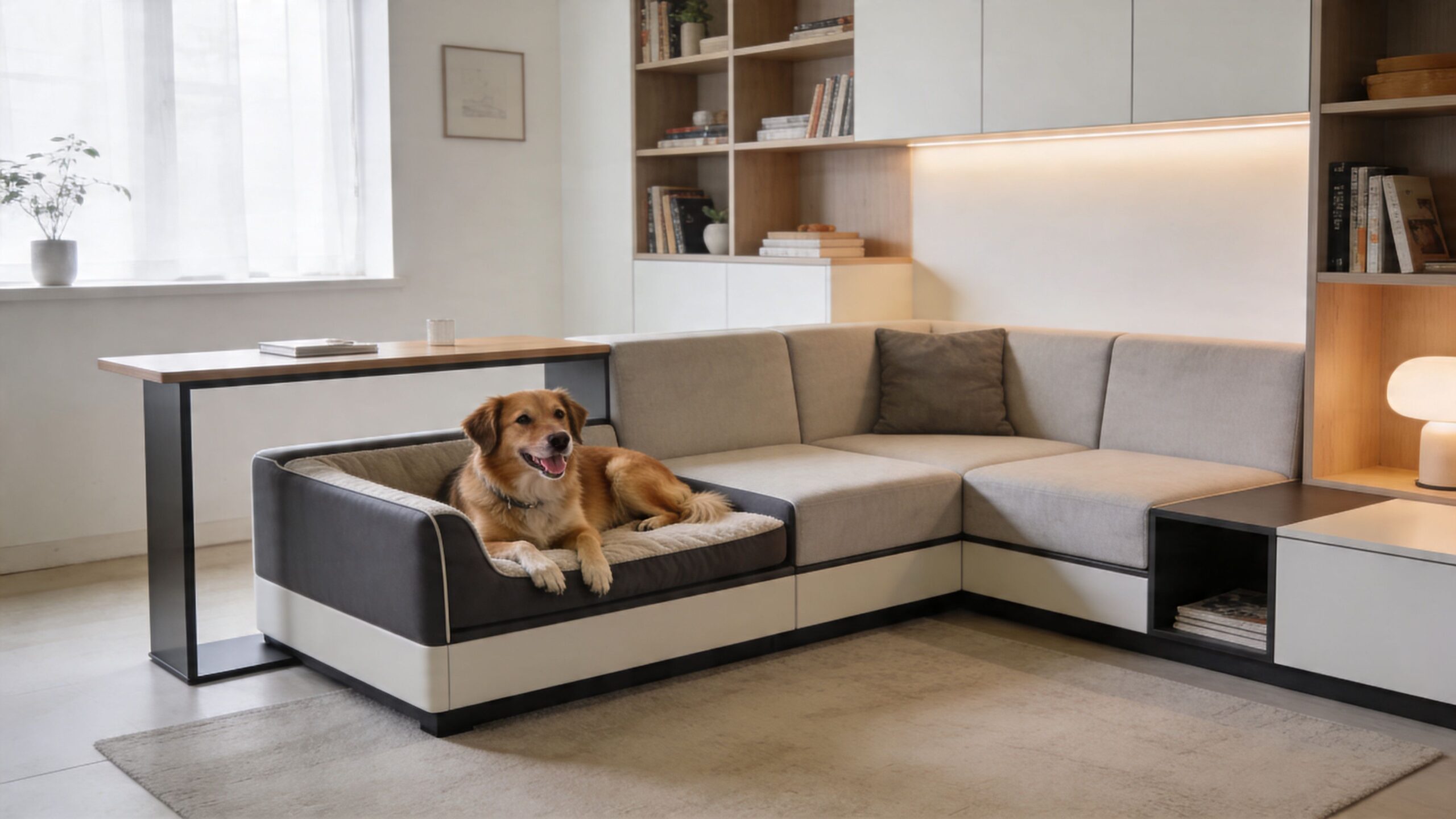
A sofa should fit the room and still let the room breathe. That means apartment-size over oversized. Slim arms beat chunky rolled arms. A slightly raised base or visible legs usually looks lighter than a sofa that drops like a solid block to the floor.
What I’d choose in a small dog-friendly living room:
- Apartment-size sofa with clean lines
- Tight back cushions if you hate constant fluffing
- Performance-style upholstery or another easy-clean fabric
- Medium tone fabric that forgives fur better than pure black or stark white
- Seat depth that supports reading instead of swallowing you whole
If your dog is allowed on the couch, and many of our dogs are, choose a fabric that can handle claws and cleanup. A living room shouldn't require panic every time your pup circles three times before lying down.
Skip fragile pieces
Small rooms get crowded faster, so every piece needs a reason to stay.
Don't waste square footage on furniture that looks pretty but can't survive daily life. That includes delicate side tables that wobble, boucle you can't clean confidently, and sharp-edged coffee tables in a room where a dog launches off the sofa like a tiny athlete.
Better choices look like this:
A rectangular coffee table with a slimmer profile
It reads cleaner than a bulky trunk and gives you a surface for books, a candle, or your tea without dominating the center of the room.
An ottoman that can multitask
Use it for feet, extra seating, or hidden storage. If your dog likes soft edges, this is often a better call than a hard table.
One useful chair
A narrow accent chair beats trying to cram in a matching pair just because a showroom did it.
A room feels finished when each piece earns its place. Not when you've managed to squeeze in a full furniture set.
Make pet-friendly look stylish on purpose
Mainstream decor advice skips the pet reality too often. That’s why I’d rather have a handsome washable rug and a durable sofa than a precious room no one can relax in.
A few key considerations:
- Choose washable or easy-care textiles whenever possible
- Avoid low, tippy decor on reachable surfaces
- Give the dog a designated resting spot so the whole room doesn't become one giant pet zone
- Store treats and tempting food well, especially if your dog is a committed kitchen bandit. If that's your household, this guide on how to keep dogs off counters will sound very familiar
This video has some helpful visual inspiration before you commit to a layout.
Let the room feel open at eye level
One trick I love is keeping the top half of the room less crowded than the bottom half. If your sofa is simple and low-profile, your walls, lamp, and shelving can do the personality work.
That balance matters. A small room gets overwhelmed when every piece is loud.
Use Color and Light to Feel More Spacious
Some small living rooms aren't too small. They're too dark, too chopped up, or too visually busy.
If you want a room to feel open, stop fighting light. Use it.
Painting walls and ceilings in light neutrals can reflect 70 to 90% more light than dark tones, increasing perceived room size by 25 to 40%. Designer analyses from 2023 to 2025 also found that mirrors and other reflective surfaces can boost a room’s feeling of openness by 35%, according to Homes & Gardens on small living room design rules.
Keep the palette calm
This doesn't mean your room has to look bland. It means the big surfaces should help the room expand instead of boxing it in.
My favorite formula is simple:
- soft white, warm cream, pale beige, or muted greige on the walls
- trim in the same family so the eye keeps moving
- color through pillows, art, book spines, and one or two accent pieces
If you love deep moody paint, save it for a larger room or use it in smaller doses. In a tight living room, dark walls plus heavy furniture can make everything feel compressed.
Light walls do more than look pretty. They give your furniture and books room to stand out without adding visual weight.
Layer the light
Overhead lighting alone is harsh and lazy. A cozy room needs layers.
Try this mix:
| Lighting type | What it does |
|---|---|
| Ceiling light | General brightness |
| Floor or table lamp | Reading and evening comfort |
| Wall light or sconce | Adds glow without using floor space |
If your room has one good window, don't bury it behind dense curtains. Use lighter window treatments that let daylight through. Your dog gets a sunny nap spot, and your room feels more alive all day.
Use mirrors with intent
A mirror helps when it reflects something useful. A window, a lamp, or a part of the room that already feels bright.
A mirror doesn't help much when it reflects clutter.
If your style leans modern or collected, you'll probably enjoy more ideas in these home decor tips to champion contemporary interiors. The main lesson still holds. A small room looks bigger when the surfaces work together instead of competing.
Control visual noise
Books are beautiful. Dogs are adorable. Their accessories are not automatically beautiful.
Keep surfaces edited. Let one stack of books feel intentional. Let one blanket live on the arm of the sofa. Let one tray hold the remote, reading glasses, and candle.
When every surface talks at once, the room feels smaller.
Smart Storage for Pups and Paperbacks
Clutter is what usually breaks a small living room. Not the square footage.
Books pile. Leashes drift. Dog toys multiply. Blankets end up on chair backs. Then the room starts looking cramped even if the furniture is technically the right size.
The fix isn't sterile minimalism. The fix is visible order and hidden utility.
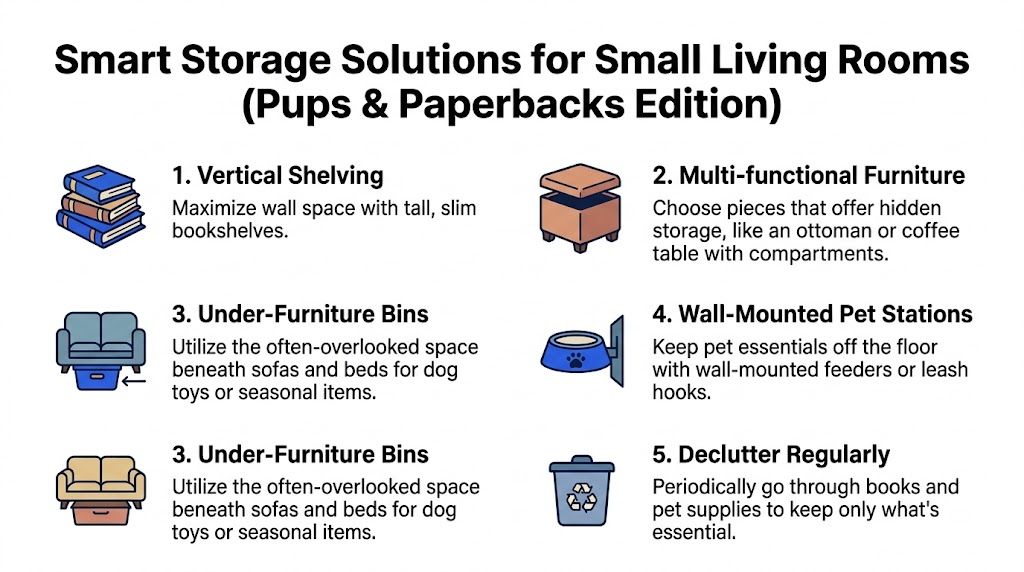
Integrating vertical storage and multifunctional furniture can free up 15 to 25% of floor area, and 85% of projects report enhanced usability after those strategies are added, according to Miller Waldrop’s guide to decorating a small living room.
Go up before you spread out
If you love books, you need to stop pretending they'll stay contained in one low basket.
Use the wall.
Tall, slim bookcases, floating shelves, and wall-mounted ledges keep your collection visible without eating your walking space. In a small room, vertical storage also helps the eye travel upward, which makes the room feel more expansive.
Store by behavior, not by category
This is the trick most organizing advice misses.
Don't store everything “book related” in one place and everything “dog related” somewhere else if that’s not how you use the room. Store things where you reach for them.
That often means:
- A lidded basket by the sofa for toys that get used in the evening
- A small shelf or end table drawer for your current reads, bookmarks, and glasses
- Leash hooks near the exit point if your living room opens toward the door
- An ottoman with hidden space for blankets, pet wipes, or chargers
The room gets easier to maintain when the storage follows your habits.
Hide the ugly, display the lovely
Dog gear can be practical without taking over the room. The same goes for your books.
Display what adds charm. Hide what creates noise.
Good visible items:
- a neat stack of hardcovers
- one handsome basket
- a ceramic jar for treats
- a folded throw
- a few favorite framed photos
Things I’d hide fast:
- backup dog food bags
- chewed toys
- tangled charging cords
- random paperwork
- every single paperback you own
If you want more examples, these small living room storage ideas are useful for seeing how other people squeeze more function out of limited square footage.
Create one small pet station
A compact pet station keeps the room from feeling like your dog exploded into every corner.
Try a simple setup:
- one basket for toys
- one washable mat under bowls if bowls live nearby
- one container for treats and grooming basics
- one bed or blanket zone that belongs to the dog
If you're working on boundaries at the same time, crate training can support a calmer room because it gives your dog a predictable home base. This guide on how to crate train dog is worth reading if your pup needs more structure indoors.
Edit your collection like a grown-up
I say this with love as a fellow book person. You do not need every book you’ve ever half-finished in the living room.
Rotate what’s out. Keep your favorites accessible. Move the overflow elsewhere. A small room looks thoughtful when your collection feels curated, not crammed.
Define Your Zones and Add Cozy Finishing Touches
A small living room feels better when it has jobs. Not a vague “living area” feeling. Actual zones.
One zone might be for conversation and TV. Another might be a reading corner. Another might belong to the dog, even if it’s only one bed tucked beside a chair.
That pet-friendly angle matters. Mainstream decor advice often misses it, even though 67% of U.S. households own pets, and practical zoning for pet beds and durable materials is one of the clearest gaps in typical small-space guidance, as noted by Jack Cooper’s roundup on small living room layout ideas.
A simple zone story that works
Think of a narrow small living room.
The sofa sits on one side. Across from it, maybe a media console or bookshelf. A rug anchors the main seating area. In the corner by the window, a compact chair and lamp create a reading spot. Beside that chair, a dog bed lives where your pup can see the room without blocking the path.
That setup feels bigger because the room isn't trying to be one big blob of furniture.
Use rugs to tell the eye where to land
A rug should connect the seating area and make it feel intentional. In a compact room, this is one of the fastest ways to create structure.
Choose a rug that can handle real life. Pattern helps. Texture helps. Washability helps even more if you have a dog who believes outside dirt is a personality trait.
If you need a little extra separation in a studio or open-plan space, lightweight room dividers can help carve out a reading corner or pet nook without making the room feel boxed in.
A room feels cozier when each area has a purpose you can name in one sentence.
Give the room one focal point
Every small room needs one place where the eye can settle. Otherwise, it just scans clutter.
Your focal point could be:
- A bookshelf styled with books, framed art, and one trailing plant
- A wall over the sofa with a few larger pieces instead of many tiny ones
- A statement chair in a warm fabric near the window
- A fireplace or media wall kept intentionally simple
What you don't want is five competing “moments.” One good focal point makes the room feel designed. Too many make it feel crowded.
Add softness without adding mess
Here, people often overdo it.
You don't need twelve pillows. You need a few good layers.
Try this mix:
- one soft throw on the sofa
- two or three pillows in different textures
- one basket for practical extras
- a pet-safe plant if you enjoy greenery
- framed photos that make the room personal, including the dog, obviously
I love rooms that feel lived in, but there’s a fine line between cozy and chaotic. If an object doesn't add comfort, function, or beauty, it’s probably just taking up space.
Your Quick Guide to Small Room Success
You don't need perfection. You need a room that works on Tuesday night when the dog's asleep, your book is open, and nothing feels in the way.
Here’s the cheat sheet I’d keep in mind every time.
Do this and skip that
| Do | Don't |
|---|---|
| Measure first | Guess and hope furniture fits |
| Choose slim, scaled pieces | Buy the deepest sofa in the showroom |
| Use vertical storage | Fill the floor with baskets and stacks |
| Create a dog zone | Let pet gear spread everywhere |
| Keep lighting layered | Rely on one harsh ceiling fixture |
| Edit decor | Cover every surface with objects |
Three layouts that usually work
Long narrow room
Put the sofa along the long wall. Use one chair instead of two. Keep the center path open. Place the dog bed at the far end or beside the chair, not in the main walkway.
Small square room
Float the sofa slightly if needed and use a compact coffee table or ottoman. Put shelving on one wall and a reading lamp in the corner. Keep the room visually balanced instead of pushing every piece to the perimeter.
Studio-style setup
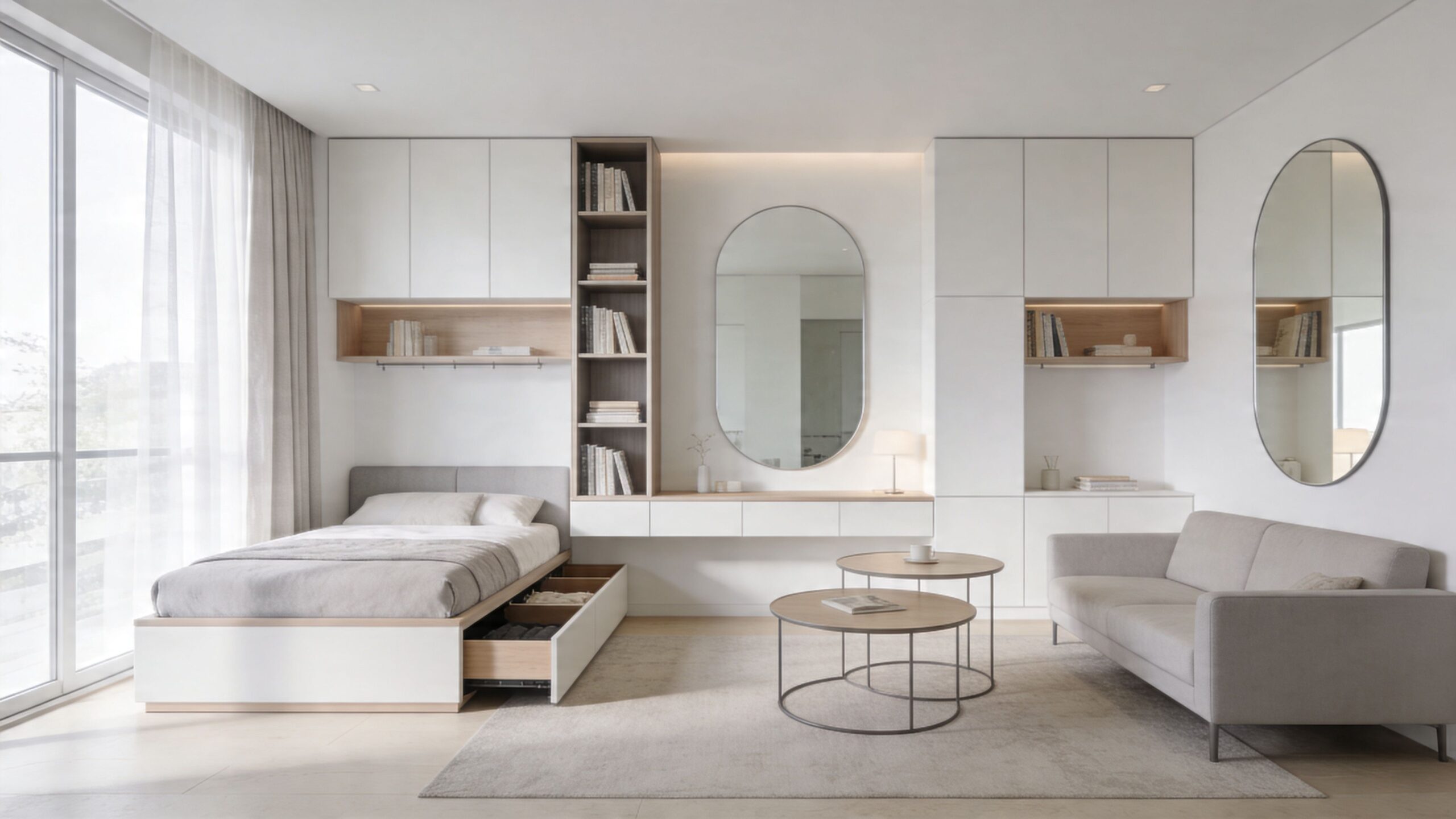
Use a rug to define the living area clearly. Let the sofa anchor that zone. Tuck the dog bed beside the sofa or under a window. Use shelving or a light divider if you need the sleeping area to feel separate.
My favorite final checks
Before you call the room done, ask yourself:
- Can I walk through it easily without turning sideways?
- Does my dog have a place to rest that isn't in the traffic lane?
- Can I reach a lamp, a drink, and my current book from my main seat?
- Are the books displayed with intention, not taking over every surface?
- Does the room feel calm when nothing is perfectly staged?
If the answer is yes, you're in good shape.
What makes a small living room feel good
It isn't expensive furniture. It isn't chasing trends. It isn't forcing a tiny room to act like a giant one.
It's proportion, light, storage, and honesty about how you live.
A cozy small living room should welcome the dog, support your reading habit, and still give your brain a place to exhale. That’s the standard. Not showroom perfection. Real comfort.
If you love building a home around dogs, books, and everyday cozy living, take a look at Setterfrens LLC. You’ll find dog-loving lifestyle content, practical guides, and a warm community made for readers who believe a good story and a wagging tail belong in the same room.