Rainy afternoon. Zoom meeting in ten minutes. Your dog has already sighed dramatically, dropped a toy at your feet, and started giving you that long, unblinking stare that says, “So what’s the plan, mom?”
If you’re searching for how to keep dog entertained indoors, you’re probably in that exact moment. Maybe it’s too wet to walk, too icy to stay out long, or you live in an apartment where indoor days happen more often than you’d like. Either way, your pup still needs something to do.
The good news is that indoor fun doesn’t have to mean chaos, expensive gadgets, or a living room that looks like a toddler birthday party. A few thoughtful games, short training bursts, and a simple rhythm to the day can make a huge difference. I’ve found that dogs do best when indoor entertainment isn’t random. It works better when it’s balanced.
That means giving your dog a mix of brain work, body movement, chewing, sniffing, and rest. It also means adjusting activities to your dog’s age, size, and personality. A busy Border Collie needs a different setup than a sleepy senior spaniel. A tiny dog in a studio apartment needs a different plan than a young Lab with kangaroo energy.
You don’t need to do everything. You just need a few reliable favorites and a schedule that feels doable in real life.
Beyond the Daily Walk Why Indoor Fun Matters
A walk is only one piece of the puzzle for many dogs. Indoor enrichment helps fill the other spaces in the day, especially when the weather is rough, your schedule is packed, or your dog still has plenty of energy after a quick potty break.
I learned that lesson with a dog who could handle a shorter outdoor day just fine, as long as something interesting happened at home. If nothing did, she made her own fun with socks, pillows, and a paperback I would have liked to finish. Boredom has a way of turning ordinary household items into projects.
Indoor fun works best when you treat it like part of your dog’s routine instead of a last-minute distraction. A good setup includes different kinds of enrichment, because dogs get tired in different ways. Some need to sniff and search. Some need to chew. Some need a short burst of movement, then a quiet activity that helps their body come back down.
It helps to picture your dog’s needs like a daily plate. Exercise is one portion. Mental work is another. Rest, chewing, novelty, and connection with you belong on that plate too. If one section is always missing, you often see the result in pacing, barking, shadowing, stealing things, or general mischief.
Why indoor enrichment helps so much
Indoor activities give dogs safe ways to use the behaviors they were built to do. Sniffing, searching, carrying, shredding appropriate items, licking, chewing, and solving simple problems all have a purpose.
That matters because a dog who gets an outlet for those urges usually settles more easily afterward.
The question to ask is not only, “How do I tire my dog out?” A better question is, “What does my dog need right now?” A young terrier who keeps grabbing blankets may need a task that involves hunting and digging. A teething puppy may need legal chewing options. A senior dog who seems clingy may feel better after a gentle sniffing game that works the brain without stressing the joints.
That personalized piece is what changes everything. The same activity can feel perfect for one dog and frustrating for another. A food puzzle that challenges a clever poodle might overwhelm a beginner puppy. Indoor fetch may suit a small dog in a hallway, while a large adolescent dog may do better with tug, nose work, and training games that do not send paws sliding across the floor.
Indoor enrichment also strengthens your routine
Dogs tend to do best with rhythm. A little movement in the morning, a chew during your work block, a short training session in the afternoon, then a calming sniffy activity after dinner can work like a balanced school day for your pup. You are not trying to entertain them every minute. You are rotating the type of effort so your dog stays satisfied instead of wound up.
That is one reason the importance of mental stimulation for canine cognitive health matters so much. Physical exercise and brain work support each other. One does not fully replace the other.
Indoor games also teach you more about your dog. You start to notice whether your pup prefers chasing, licking, sniffing, chewing, or problem-solving. Once you know that, building a realistic indoor schedule gets much easier. And it feels more fun for both of you.
A shy dog may relax during quiet scent games. A busy adolescent may finally practice self-control through structured tug. A senior may light up over a towel full of hidden treats.
That is the primary value of indoor fun. It gives your dog a day that feels full, even when you are both stuck inside.
Brain Games to Tire Out Your Smart Pup
Rainy afternoon. Your dog has already stared out the window, followed you to the kitchen twice, and dropped a toy in your lap with a level of hope that feels impossible to ignore. This is the moment brain games shine. A few minutes of sniffing, searching, or problem-solving can take the edge off in a way that feels calmer than another loop around the coffee table.
That matters because indoor enrichment is not one-size-fits-all. A young terrier who loves to investigate needs a different mental workout than a giant senior who tires quickly or a sensitive rescue who shuts down if a game feels too hard. The goal is not to cram in every clever activity you have seen online. It is to choose the kind of thinking your dog enjoys, then fit it into a balanced day.
If you want a deeper look at the importance of mental stimulation for canine cognitive health, that guide is a helpful companion read. It pairs well with the practical ideas below.
Start with Find It
If your dog is brand new to indoor games, Find It is my favorite place to start. It teaches the whole idea of “use your nose” without creating frustration. For a nervous dog, it builds confidence. For a busy dog, it gives all that mental energy a job.
Here’s the easy version:
- Show the treat. Let your dog see and sniff it.
- Toss it a short distance. Say “find it” as it lands.
- Let your dog get it. Repeat a few times so the phrase starts to click.
- Make it slightly harder. Toss the treat behind a chair leg or next to a pillow.
- Build to hiding. Once your dog understands the game, place the treat while they wait in another room.
The biggest beginner mistake is raising the difficulty too fast. If your dog looks confused, you have skipped ahead. Go back to an easy win.
How to personalize it
Once your dog gets the idea, match the challenge to the dog in front of you:
- Puppies: keep hides visible or partly visible so they stay confident
- Small dogs: use low hiding spots they can reach without climbing
- Large dogs: space hides farther apart so the search feels more purposeful
- Scent-loving dogs: use several easy hides in a row
- Dogs who frustrate easily: keep the first round almost silly-easy
Good hiding spots include:
- Behind furniture legs
- Under a towel edge
- Inside an open cardboard box
- Along a hallway baseboard
- Near, not under, a dog bed
One quick success is better than three hard failures.
Try a box search
A box search works like a beginner puzzle your dog can solve with their nose. I love this one for dogs who need a clear assignment. You set out a few boxes, hide a treat in one, and let your dog investigate.
Start small. Two boxes are plenty. If your dog charges in like a tiny detective, wonderful. If they stare at you as if to say, “Mom, what exactly is this cardboard situation?” help them by making the treat easier to find.
Use this progression:
| Step | What you do | What your dog learns |
|---|---|---|
| Beginner | Place two boxes on the floor, treat in one | Search calmly |
| Intermediate | Move the boxes farther apart | Work independently |
| Advanced | Add more boxes and lightly close lids | Persist with scent |
If your dog paws or flips boxes, lower the difficulty. Reward interest in the correct box before the game turns into box wrestling.
Let your dog sniff for a moment before you point things out. That pause is part of the workout.
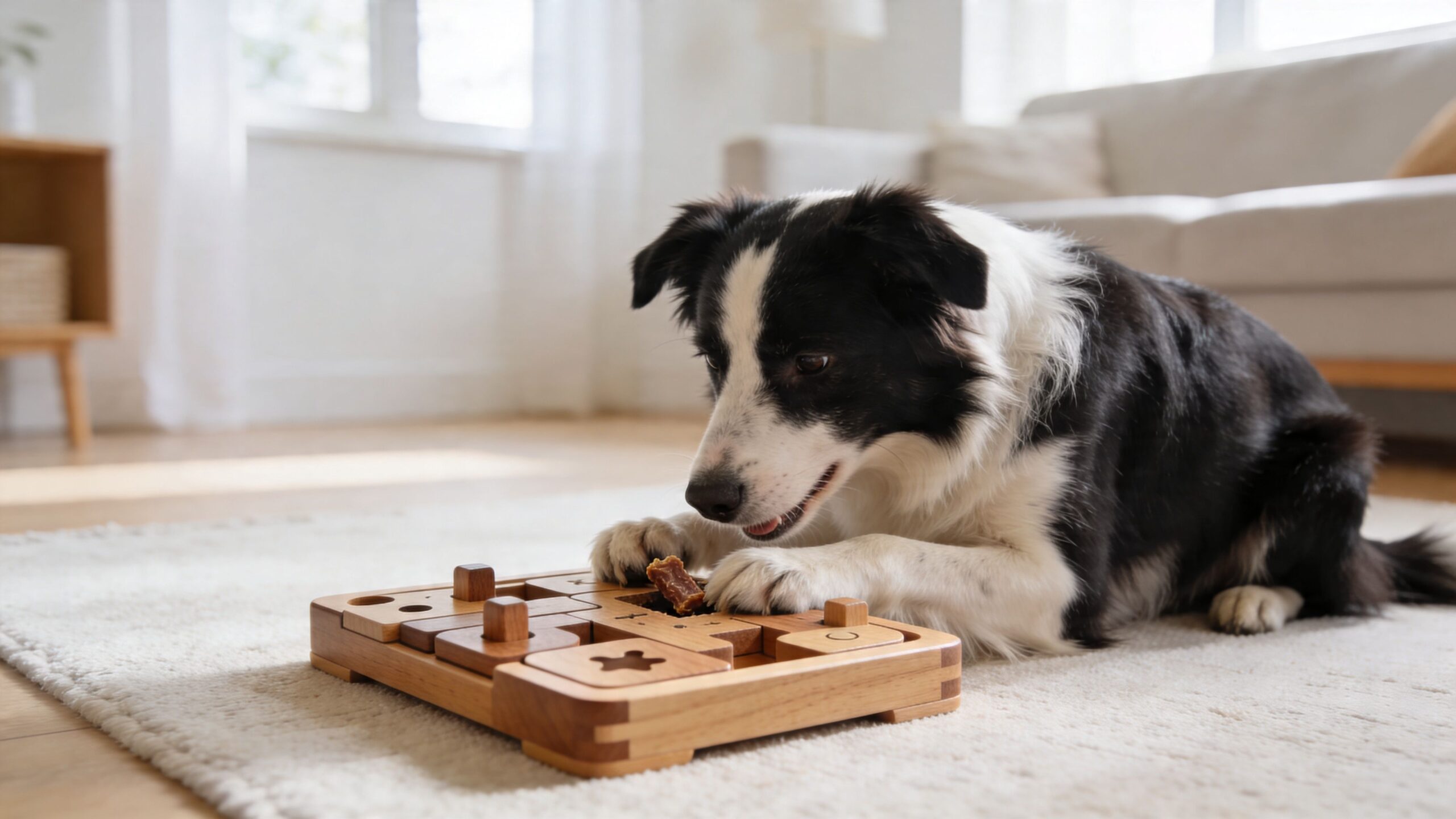
Use puzzle toys the smart way
Puzzle toys can be wonderful, but only if your dog understands how to use them. Handing over a fully loaded puzzle at the hardest setting is like giving a kindergartener a crossword and expecting confidence. Start with a version your dog can solve fast.
Teach the toy first.
Easy puzzle setup
- Use obvious rewards. Let a few pieces of kibble sit right on top.
- Choose simple movement. A KONG, wobble feeder, or sliding puzzle with exposed food works well.
- Stay nearby at first. Encourage your dog without taking over.
- End while they’re still interested. You want the toy to feel successful.
You can also match the toy to your dog’s style. Lickers often enjoy stuffed toys. Dogs who like batting things around may prefer wobble feeders. Quick problem-solvers usually need shorter sessions with more variety, while slower, thoughtful dogs often enjoy repeating the same easy puzzle until they feel fluent.
Stuffing ideas by skill level
Beginner dog
Loose kibble mixed with a soft smear near the openingConfident dog
Layers of kibble, wet food, and a little plain yogurtPower chewer who gets bored fast
Freeze the filling so it lasts longer
If your dog walks away, that is useful information. The challenge may be too hard, the reward may not be exciting enough, or your dog may need movement before settling into a food toy.
Teach one tiny trick
Five minutes of training can do a lot indoors. The secret is keeping it tiny and clear. One cue. A handful of treats. A dog who finishes feeling successful.
My favorite starter tricks for indoor days are touch and spin.
Teach touch
- Hold out your palm near your dog’s nose.
- When they boop it, mark with a cheerful “yes.”
- Reward.
- Repeat until they begin moving toward your hand on purpose.
- Add the cue “touch.”
Touch is one of those little skills that keeps paying you back. It helps with polite greetings, moving around furniture, and guiding your dog during future indoor games.
Teach spin
Lure your dog gently in a circle with a treat. Reward after the turn. Then gradually make your hand motion smaller.
This works well for dogs who need both movement and focus, but keep the circle easy for seniors, long-backed dogs, and any pup with body sensitivities.
Rotate toys so they stay interesting
Toy rotation is less about buying more and more about timing. Pulling out every toy at once often creates background clutter. Putting half of them away for a few days makes the return feel fresh.
A scent hound may stay interested in food toys longer than plush toys. A retriever may light up when a favorite carry toy comes back. A puppy may need only two or three options out at a time so the choice does not become noise.
A small rotation basket usually works beautifully. Keep a few toys available, stash the rest, and swap them every few days based on your dog’s energy, age, and preferences. That is how indoor enrichment starts feeling less random and more like a routine that fits your dog.
Get Moving Indoors Without Wrecking the House
You know that late-afternoon indoor moment. Your dog starts pacing, brings you a toy, then trots to the window, then back to you again like they are saying, “I still have gas in the tank.” That is usually your sign they need body work, not just brain work.
The goal indoors is controlled movement that fits your dog and your space. A young, leggy dog may need short bursts with clear rules. A senior or a small dog often does better with gentler games that build confidence without a lot of twisting, jumping, or sliding.
Tug works best with boundaries
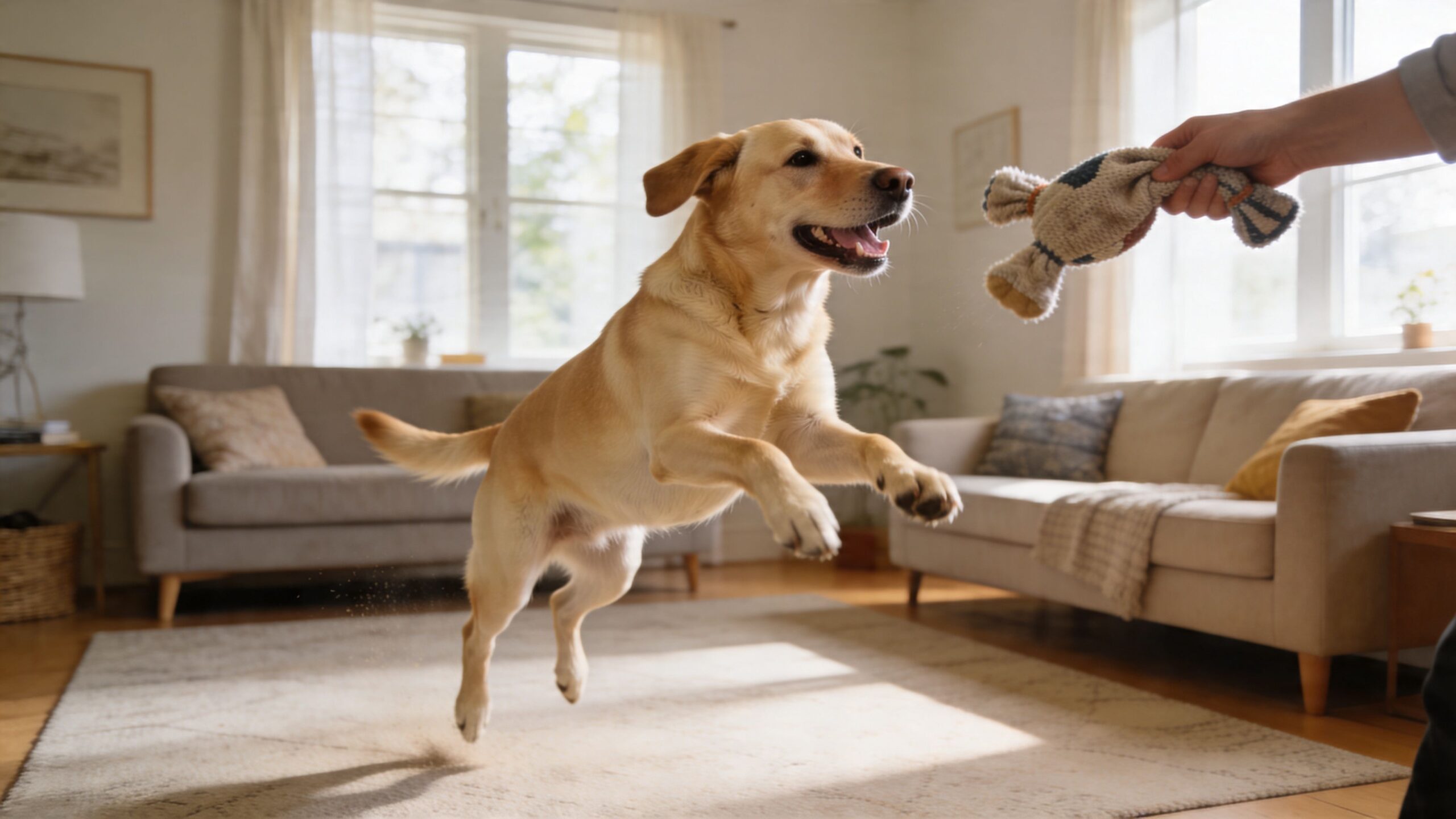
Tug can be one of the best indoor outlets because it gives many dogs exactly what they crave. Movement, interaction, and a satisfying win. The key is structure.
Short rounds usually work better than one long, frantic session. I like to treat tug like intervals at the gym. Play for a bit, pause, ask for a cue, then start again. That rhythm helps your dog stay engaged without getting too revved up.
House rules for healthy tug
- Use a designated toy. A rope toy or fleece tug makes the game clear.
- Ask for a simple cue first. Sit or down helps your dog start in thinking mode.
- Keep the toy low. This is kinder to the neck and shoulders, especially for small dogs.
- Practice drop it. Trade for a treat if your dog is still learning.
- Stop while your dog is still organized. If they start grabbing wildly or bouncing at your hands, the session has gone on too long.
Household reminder: Indoor play is easier when your space is set up for it. If you’re worried about scratches, traction, or cleanup, this guide to protecting wood floors from dogs can help you prep the room before active games start.
For puppies, keep tug soft and brief. For seniors, use gentle resistance and more frequent breaks. For big, strong dogs, focus extra hard on the start cue and the drop cue so the game stays polite.
Hallway fetch can stay calm
Indoor fetch gets messy when the setup invites chaos. A better approach is to change the mechanics of the game.
Use a hallway, a rug runner, or one open lane in the living room. Choose a soft plush toy or a soft ball, and keep your throws low. Low tosses reduce leaping and hard landings, which matters a lot for puppies, seniors, long-backed dogs, and any dog on slick floors.
A safer fetch routine
| Do this | Skip this |
|---|---|
| Roll or toss low | Throw high arcs |
| Use soft toys | Use hard balls in tight rooms |
| Play in straight lines | Encourage sharp turns on slick floors |
| Pause between reps | Throw again immediately with no reset |
That pause between repetitions matters more than people expect. It turns fetch from a pinball machine into a conversation. Ask for “sit,” “down,” or “touch” before the next toss if your dog starts getting too amped up.
A compact dog in a small apartment may love three or four thoughtful reps. A young retriever might need a slightly longer set, then a cooldown. Matching the game to the dog keeps indoor play from feeling random.
Flirt poles are great for chase-loving dogs
A flirt pole is basically a wand toy for dogs, and it can be a huge help for pups who love to stalk, chase, and pounce. Indoors, though, you want control more than speed.
Keep the toy moving in wide patterns. Avoid tight circles that encourage fast spinning. Short sessions are usually enough, especially for dogs who go from zero to sixty in seconds.
A few dogs are perfect flirt pole candidates. Adolescent herding breeds, sporty mixes, and dogs who fixate on movement often adore it. Others need a softer version. Puppies, seniors, and dogs with joint concerns usually do better with slow drags, easy catches, and very short rounds.
After a chase game, add something calming. A sniff break, a scatter feed, or a chew helps the nervous system come back down. That settle piece is what makes the activity feel balanced instead of overstimulating.
Build an obstacle course from everyday stuff
This is one of my favorite indoor options because you can scale it up or down so easily. It works like a little movement circuit for dogs. You are not training for a ribbon. You are helping your dog use their body on purpose.
Use what you already have around the house.
Simple setup ideas
- Weave around a row of stacked books or water bottles
- Step over a broom laid flat between two pillows
- Crawl under a blanket draped over two chairs
- Pause on a bath mat or folded towel
- Go around an ottoman, then return to you
Go slowly at first. Lure if your dog needs help, then reward each part. For a cautious dog, one or two obstacles may be plenty. For a confident, athletic dog, you can string several together into a short sequence.
This is also a nice way to personalize your dog’s enrichment plan. A tiny senior may enjoy stepping over rolled towels and targeting a bath mat. A teenage shepherd mix may want a few obstacle reps after tug. A shy rescue might prefer moving around one chair and earning lots of praise for bravery.
Match the intensity to the dog in front of you
Indoor exercise should leave your dog satisfied, not frazzled. I like to watch body language the same way I watch a pot on the stove. You are looking for warm and steady, not boiling over.
Signs the game is getting too intense include:
- Slipping or scrambling
- Ignoring treats they usually love
- Jumping wildly at your hands
- Getting mouthy or frantic
- Panting hard in a cool room
If you see those signs, lower the difficulty right away. Shorter rounds, softer toys, slower movement, more traction, more breaks. Sometimes the best fix is ending the active game and switching to a sniffy, calming activity.
That balance is what makes indoor enrichment work over the long haul. Some dogs need a little movement before they can settle with a chew. Others need one burst of play in the morning and another before dinner. Once you start noticing your dog’s patterns, it gets much easier to build a daily rhythm that fits their age, size, and personality.
DIY Fun Create Your Own Enrichment Toys
Rainy afternoon, damp paws, and a dog who still wants a job. DIY enrichment shines. A few simple household items can turn that restless energy into sniffing, searching, and problem-solving that fits your dog, instead of giving every dog the same toy and hoping for the best.
I love homemade enrichment because it lets you build activities the way you would build a kid’s snack plate. A little crunch, a little protein, a little color. For dogs, the mix is nose work, chewing, shredding, and easy wins. Once you know which part your dog enjoys most, you can make better choices for their age, size, and personality.
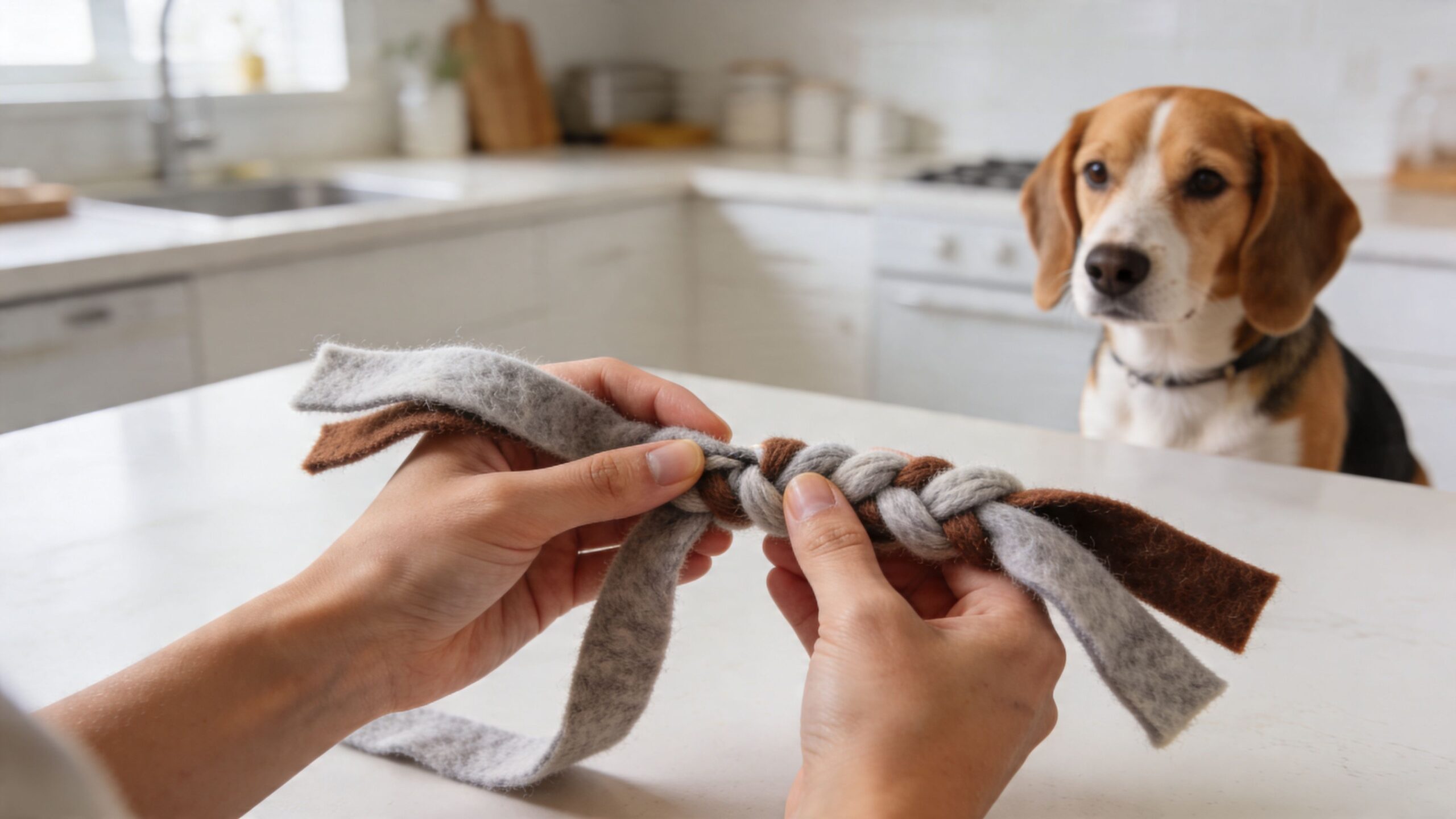
Make a snuffle mat
A snuffle mat gives your dog a safe, low-impact way to forage with their nose. It works especially well for dogs who gulp meals, get fidgety before bedtime, or need indoor enrichment that feels calming instead of exciting.
You’ll need:
- A rubber sink mat or holey doormat
- Fleece strips
- Kibble or small treats
How to make it:
- Cut fleece into strips.
- Thread each strip through a hole.
- Tie the strip so the ends stick up.
- Repeat until the mat looks shaggy.
- Sprinkle food into the fleece and let your dog sniff it out.
A few easy adjustments make this toy more personal. Use larger treats and shorter fleece for puppies and flat-faced dogs so food is easier to find. Make the fleece denser for experienced sniffers who like a bigger challenge. For seniors, keep the mat shallow and place it on a non-slip surface so the game stays comfortable.
Build a magic box
The magic box is wonderful for dogs who love rummaging through bags, laundry piles, or recycling. It gives them a legal place to dig and investigate, which can save your paper goods and delivery boxes from becoming surprise enrichment projects.
You’ll need:
- A cardboard box
- Crumpled paper, paper towel tubes, or small safe boxes
- Treats or kibble
How to do it:
- Toss a few treats into the bottom.
- Add crumpled paper.
- Add another layer of treats.
- Put in a few empty tubes or small boxes.
- Let your dog dig, nose, and search.
Start easier than you think you need to. If your dog is new to puzzles, leave treats partly visible so they learn the game fast and stay confident. If your dog is clever and persistent, bury the goodies deeper or nest a small box inside the larger one. Tiny dogs often do best with a shallow box. Big dogs may need a sturdier one with more paper to move around.
Give your dog permission to shred only the toy you built for shredding. That clear rule helps them learn which boxes are theirs and which ones are off limits.
Try a bottle spinner if your dog likes puzzles
Some dogs want to use their nose and paws like little engineers. A bottle spinner can be a nice fit for those problem-solvers, as long as they are more interested in making the toy work than in chewing it apart.
You’ll need:
- Two sturdy supports
- A wooden dowel
- Clean, empty plastic bottles with caps removed
- A tool to make holes through the bottles
Slide the dowel through the bottles and suspend it between the supports. Put a few pieces of kibble in the bottles. Your dog nudges the bottle, it spins, and food falls out.
Supervise closely. Skip this toy for strong chewers, puppies who mouth everything, or dogs who get frustrated fast. For those dogs, a snuffle mat or magic box is usually the safer and happier choice.
If you want a visual, a simple photo series or step-by-step image of the finished spinner can help. The basic idea is a bottle threaded onto a dowel that turns easily enough for your dog to tap and release kibble.
Keep DIY toys safe
Homemade enrichment works best when the toy matches the dog in front of you.
Use this quick checklist:
- For shredders, choose supervised cardboard projects
- For gentle sniffers, use fleece, towels, and hidden kibble
- For strong chewers, avoid thin plastic and loose pieces
- For puppies, keep everything simple and closely supervised
- For seniors, lower the physical effort and add non-slip surfaces
- For easily frustrated dogs, make the first round very easy so they learn how to win
You do not need a craft room or perfect knots. You need a toy your dog can understand, enjoy, and finish without getting overwhelmed. That is what makes DIY enrichment so useful. It can slide right into a balanced indoor routine, whether your dog needs a quiet sniffing task at noon or a short search game before dinner.
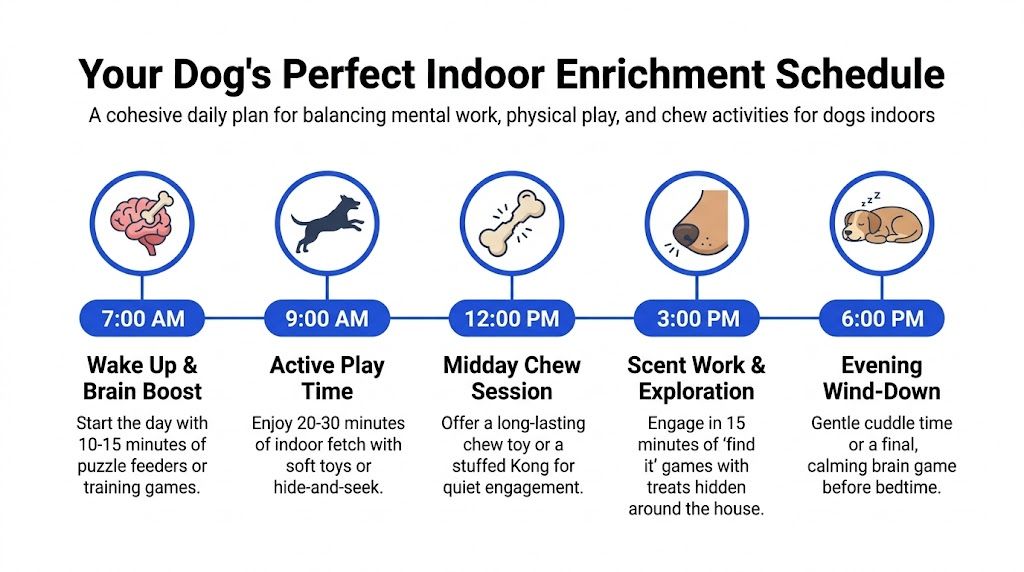
Your Dog's Perfect Indoor Enrichment Schedule
You know that moment when your dog has already had a potty break, the weather is awful, and they are still following you from room to room with that "what now?" face. That is usually not a sign that you need to entertain them for the next eight hours. A steady rhythm of activity is more helpful for many dogs than constant excitement.
What works best indoors is balance. A little brain work, a little movement, a little quiet solo time, and enough rest between all of it. I like to think of it the way I plan a good day for myself. Coffee, focus, a walk around the house, lunch, a break, then something calming at night. Dogs often do well with that same kind of flow.
A simple daily template
Start with categories, not a strict timetable. You are building a rhythm your dog can count on, not running a summer camp.
Morning
Begin with mental work. A puzzle feeder, a few easy cues, or a short sniff search gives many dogs a job right away and helps the day start on a calmer note.Mid-morning
Add movement if your dog wakes up ready to go. Tug, soft fetch down a hallway, or a few reps on an indoor obstacle path fit well here.Midday
This is a good spot for quiet, independent enrichment. A chew, stuffed KONG, lick mat, or simple foraging activity lets your dog settle while the house slows down.Afternoon
Bring in another round of thinking. Try scent work, a box search, or a DIY toy that asks your dog to problem-solve without getting too wound up.Evening
Keep the mood softer. Light training, grooming, a sniffy game, or a relaxed settle with you often works better than high-energy play close to bedtime.
The balance that usually works
Short sessions are often easier for dogs to enjoy and easier for real life to support. Two or three focused activity periods across the day can do plenty, especially when each one meets a different need.
Here is the general pattern I use at home:
| Need | Good indoor options | Best time |
|---|---|---|
| Mental effort | Find It, box search, puzzle feeder, training | Morning or afternoon |
| Physical outlet | Tug, flirt pole, soft fetch, obstacle course | Earlier in the day |
| Solo calm time | Stuffed KONG, chew, snuffle mat | Midday or evening |
| Bonding | Trick training, grooming, cuddle settle | Evening |
That mix matters because one kind of activity does not do the whole job. A dog who has done only chase games may still feel mentally busy. A dog who has done only puzzle toys may still want to move their body. The sweet spot is a day that includes both, followed by enough downtime for your dog to settle.
Indoor Activity Planner by Dog Type
The best schedule is not the most impressive one. It is the one your dog can enjoy without getting frustrated, overtired, or overexcited.
| Dog Profile | Best Mental Games | Recommended Physical Fun | Important Considerations |
|---|---|---|---|
| Puppy, low energy | Easy food scatter, touch, simple snuffle mat | Gentle toy chase, short tunnel crawl | Keep sessions very short, supervise everything, stop before puppy gets cranky |
| Puppy, high energy | Basic Find It, beginner puzzle toy, short recall games | Soft tug, low obstacle path, controlled play breaks | Avoid repetitive jumping, favor short bursts and naps between activities |
| Adult, low energy | Box search, frozen KONG, easy shaping games | Slow hallway fetch, step-over exercises | Low-key dogs still need mental work, even if they do not ask for it loudly |
| Adult, high energy | Advanced scent work, trick chains, rotating puzzles | Tug with rules, flirt pole, longer obstacle sequences | Build in pauses so excitement stays manageable |
| Senior, low energy | Snuffle mat, hand target, treat search in one room | Gentle walking loops indoors, mat work, light stepping over towels | Watch footing, vision changes, and fatigue |
| Senior, still playful | Scent games, easy puzzle toys, cue review | Controlled tug, low-impact course, short fetch rolls | Use non-slip surfaces and avoid sharp turns |
| Small dog in apartment | Hide treats in blankets, mini box search, touch | Hallway games, weaving around objects | Be careful with furniture jumping and repeated launch-and-land play |
| Large dog in small home | Scent work, stuffed KONG, place training | Tug, flirt pole if space allows, body awareness course | Focus on traction, calm starts, and simple movement paths |
A good schedule fits your dog's body, age, and personality. It does not need to look like anyone else's routine.
How to personalize the routine
If you are not sure where to start, watch your dog the way you would watch a kid at a playground. What do they choose first. Running, sniffing, solving, chewing, staying close to you. Their preferences tell you how to build the day.
Ask yourself these four questions:
- Does my dog settle better after sniffing or after movement?
- Do they enjoy figuring things out, or do they get stuck and give up?
- What reward matters most to them: food, toys, praise, or interaction?
- How much recovery time do they need after activity?
Those answers help you shape the order of the day, not just the activities. For example, a busy young dog might do best with sniffing in the morning, active play before lunch, a chew in the afternoon, and a calm training session at night. A senior dog may prefer one gentle search game, one short movement block, and longer rest periods between both.
Give the routine a week before you judge it. Patterns show up fast when you stop looking for the perfect activity and start watching your dog. Some are morning thinkers. Some need a chew after any exciting game. Some want five minutes of training and then a long nap like they just finished a full-time job.
That is the goal. A daily schedule that meets your dog's needs and still feels doable for you.
Your Indoor Entertainment Questions Answered
Once you start doing indoor enrichment regularly, practical questions show up fast. These are the ones I hear most often.
What if my dog isn’t food-motivated
A lot of people assume all enrichment has to involve treats. It doesn’t.
Some dogs work harder for toys, tug, praise, or access to you. If your dog isn’t excited about kibble in a puzzle feeder, try these:
- Use part of a favorite toy as the reward after a short search
- Turn the game social by making find-you hide-and-seek the prize
- Try smell-rich rewards if your dog likes sniffing but not dry treats
- Train before meals when interest may be stronger
Food is convenient, but it isn’t the only motivator that counts.
How do I entertain two dogs at once without chaos
You usually don’t, at least not at first.
Two-dog enrichment works best when each dog understands the game separately. Start by teaching one dog while the other relaxes behind a gate, on a mat, or with a chew. Then switch.
For shared activities, choose structure:
- Parallel snuffle mats
- Turn-taking tug with one dog at a time
- Two handlers for hide-and-seek
- Separate box searches in different spaces
If one dog always crowds the other, solo sessions are kinder and usually more effective.
My dog destroys every toy
That doesn’t mean your dog is “bad” at enrichment. It means their play style needs different materials and more supervision.
Choose activities based on the kind of destruction:
| If your dog does this | Try this instead |
|---|---|
| Rips plush toys instantly | Cardboard search boxes under supervision |
| Chews apart plastic puzzles | Frozen food toys designed for chewing |
| Guards high-value items | Lower-intensity sniff games with space |
| Gets frustrated and quits | Easier puzzles with fast wins |
Many dogs who “destroy everything” love dissecting. Give them legal shredding projects in a controlled way.
Are there good indoor options for dogs with limited mobility
Absolutely. Enrichment is not only for athletic dogs.
A dog with limited mobility may still enjoy:
- Snuffle mats
- Treat searches in one room
- Touch training
- Nose targeting objects
- Lick mats
- Gentle grooming and massage
For these dogs, the win is engagement, not exertion. Let them work at their own pace.
What about blind or deaf dogs
Blind dogs often excel at scent games because their noses do so much of the work. Keep furniture layout predictable, use clear scent placement, and avoid cluttering pathways.
Deaf dogs often do beautifully with hand signals, touch cues, and visual markers. A flashlight flicker or floor vibration may help get attention, but consistency matters more than complexity.
The common mistake is assuming these dogs need less enrichment. They don’t. They just need enrichment designed for the senses they use best.
My dog gets too hyped indoors
That’s common, especially with chase games.
If every activity ends with your dog racing laps around the couch, shift the balance:
- Choose more sniffing and chewing
- Shorten active games
- Add a pause cue between repetitions
- End with a calming task, not another exciting one
Arousal stacks. Calm can stack too.
A Happy Dog is a Busy Dog
Indoor entertainment isn’t about filling every minute. It’s about giving your dog meaningful things to do so they can relax, learn, and feel good in their own home. A little scent work, a short tug session, a homemade puzzle, and a steady daily rhythm can change the whole mood of the day.
If you try a few of these ideas, start small and notice what your dog loves most. That’s where your best routine begins.
If you love cozy dog life, practical pup tips, and heartwarming bookish fun, visit Setterfrens LLC. You can explore dog-themed books, discover helpful guides and product picks, join the Puppicino Club, and keep up with the pack on social for more tail-wagging inspiration.