So, what exactly is puppy socialization?
Think of it less like a free-for-all playdate and more like a carefully curated introductory course to the human world. It's the process of gently and positively introducing your puppy to all the new sights, sounds, smells, people, and other animals they'll encounter in life. You're their guide, showing them that the world is a wonderful, safe place.
Why Socialization Is Your Puppy’s Superpower

Welcome to the amazing, sometimes messy, world of having a new puppy! You’ve probably heard the term "socialization" thrown around, and it's easy to picture a park full of puppies tumbling around. While that’s definitely part of the fun, true socialization goes so much deeper.
Imagine your puppy's brain is a brand-new sponge. During their first few months, it's soaking up every single experience, forming opinions that will stick with them for the rest of their life. Socialization is the curriculum you create for them, designed to build a happy, confident dog who will one day be your perfect companion for all of life's adventures.
Building a Foundation of Confidence
This isn't just about teaching your puppy to be friendly. It's about building genuine emotional resilience. A well-socialized dog learns that the loud rumble of a garbage truck, a person wearing a big floppy hat, or even the slippery floor at the vet’s office are all just normal, non-scary parts of life.
This early education is your best tool for preventing future behavior problems. By carefully creating positive, happy associations with a huge variety of experiences, you're essentially teaching your dog how to handle novelty without resorting to fear or aggression.
The end goal is a dog who is:
- Brave: Able to face new things without panicking.
- Friendly: Curious and calm when meeting new people or animals.
- Well-Adjusted: Comfortable and confident in different environments.
The most crucial time for this learning is what experts call the critical socialization period. This is a very short window, from about 3 to 14 weeks of age, when a puppy’s mind is wide open to new experiences and they're naturally less fearful.
Getting this part right is everything. Studies have shown that puppies who don't get enough positive exposure to people before 14 weeks can develop lasting fear issues that make it incredibly difficult for them to form normal social bonds later. The effort you put in now truly sets the stage for a lifetime of happy companionship. You can learn more about all the crucial puppy development stages and how they shape your dog's future.
Understanding the Critical Socialization Timeline
When it comes to socializing a puppy, timing isn't just important—it's everything. There's a truly magical period when your puppy's brain is wide open and ready to learn about the world. Getting a handle on this timeline means you can make the most of these precious early weeks.
Think of your puppy's development like a flower that blooms for a very short season. During this time, it's primed to soak up new experiences and grow strong. For puppies, this season is the critical socialization window, which typically lasts from about 3 to 16 weeks of age.
The Golden Window of Opportunity
During these few weeks, your puppy’s natural curiosity is sky-high, while their sense of fear is still developing. This unique combination makes them incredibly receptive to new things. Every positive encounter—whether it's with a new person, a different place, or an odd sound—gets filed away in their brain as "safe and normal."
This is why bringing your puppy home around 7 to 8 weeks is often considered the sweet spot. It puts them in your care right in the middle of this golden window. Research from Finland, where this is common practice, has shown that puppies adopted at this age tend to be less fearful of strangers later in life. On the flip side, those weaned and adopted after eight weeks sometimes show more fearfulness, likely because they missed out on some key learning opportunities. You can dive deeper into these early weaning and socialization findings to learn more.
This visual timeline is a great way to picture these key developmental stages for your new pup.
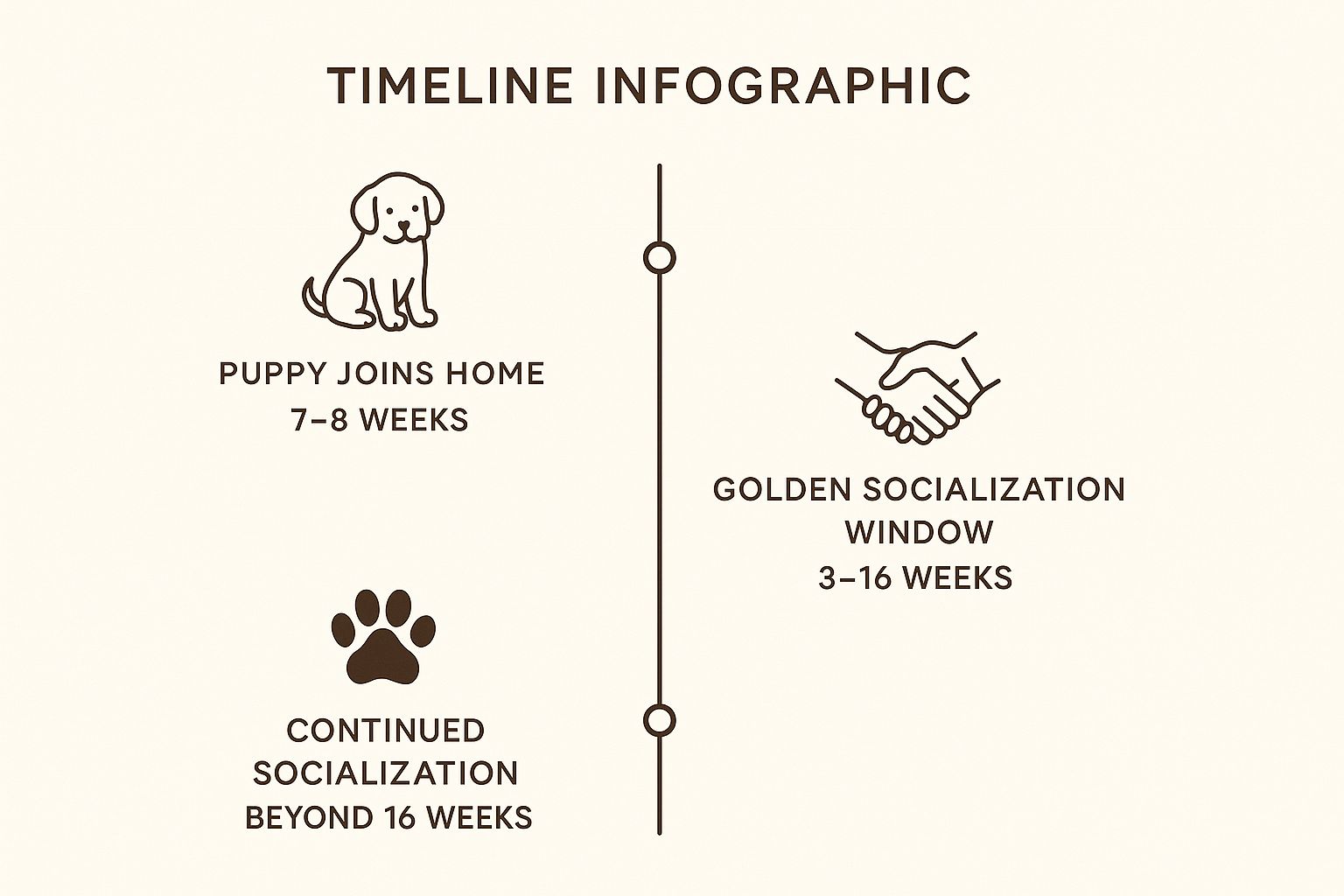
As the infographic shows, that 3-to-16-week period is a concentrated timeframe where your positive influence can make the biggest difference in their future confidence.
Beyond the First Four Months
So, what happens after 16 weeks? Does the window just slam shut? Not quite, but the way they learn definitely changes. After this point, a puppy’s natural caution starts to kick in, and they become a bit warier of unfamiliar things.
It’s much easier to build a foundation of positive experiences during the golden window than it is to change a fearful reaction later on. Early, gentle socialization is a proactive way to prevent future anxiety.
Think of it this way: socializing a puppy before 16 weeks is like writing on a blank slate. After 16 weeks, you might find yourself trying to gently erase and rewrite some of their first impressions, which just takes more time, patience, and care.
Socialization doesn't just stop; it evolves. The lessons your puppy soaks up during this critical period become the bedrock for navigating their teenage years and adulthood. All that early effort creates a confident companion who is ready to join you on life’s adventures, whether it's a trip to a dog-friendly café or just curling up with you and a good book on the couch.
How to Socialize Your Puppy Safely and Joyfully
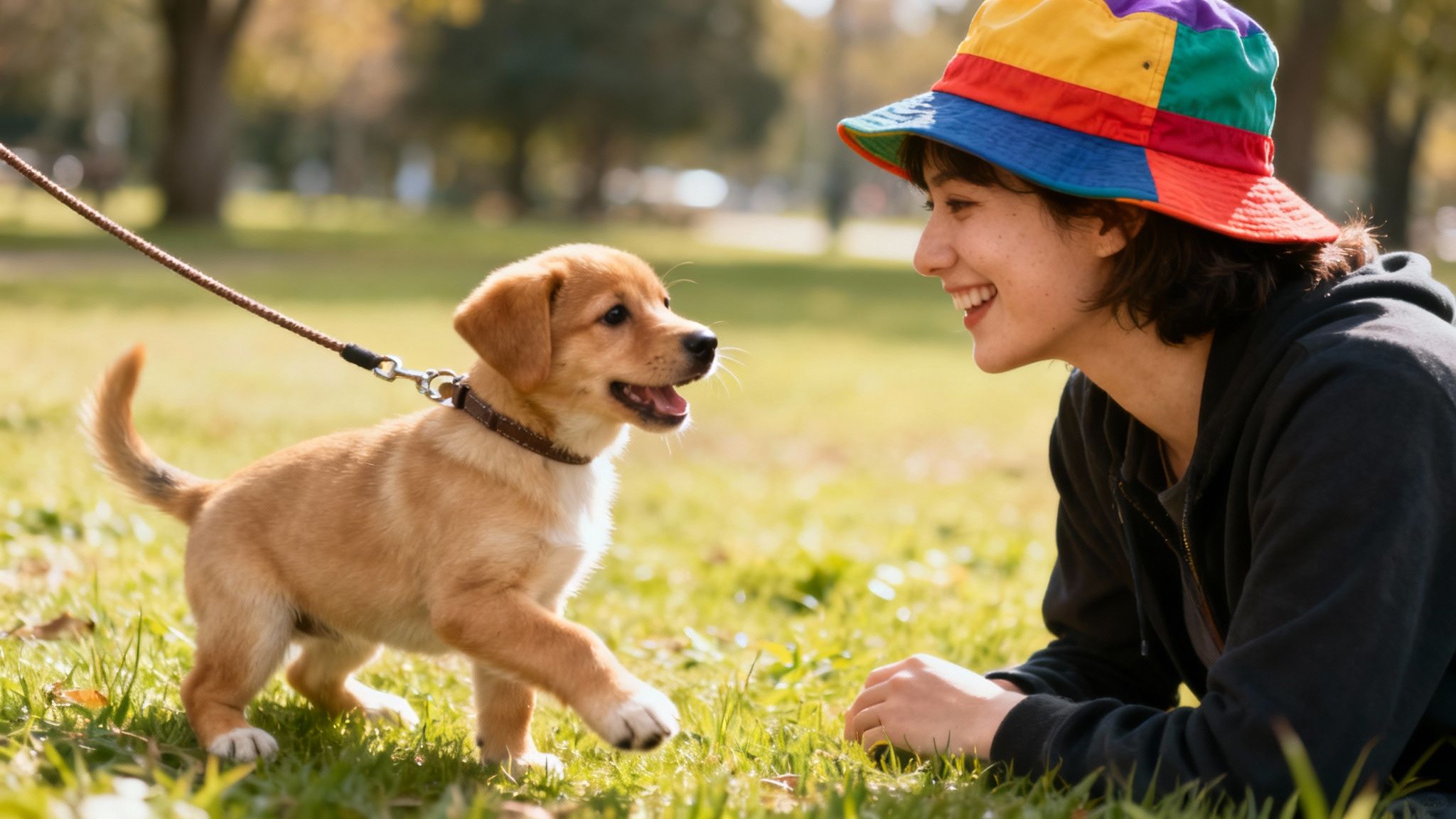
Alright, let's get into the good stuff—actually getting out there and socializing your puppy! This is where all the theory turns into real-world fun. The secret isn't just what you expose them to, but how you do it.
Your new job title? Puppy Party Planner. Your mission is to make sure every new introduction is a fantastic experience, filled with their absolute favorite things. Think high-value treats, that squeaky toy they love, and lots of happy praise. A happy puppy is a confident puppy.
The Golden Rule: Quality Over Quantity
It’s tempting to try and cram everything into a single weekend, but that's not the goal. We're aiming for positive associations, not just checking items off a list. One calm, happy stroll through a pet-friendly store is worth a thousand times more than a frantic, overwhelming trip to a crowded festival.
You have to become an expert in reading your puppy's body language. A wiggly body and curious nose? That's a green light! But if you see that tail tuck, a lot of stress yawning, or an attempt to hide behind your legs, that’s your cue. It's time to slow down, create more space, and dial back the intensity.
A successful socialization adventure is one where your puppy leaves feeling braver and more confident than when they arrived. Always end on a high note!
Ultimately, you are your puppy's biggest advocate. That means you have to be comfortable politely telling a well-meaning stranger, "Sorry, he's a little shy right now," or simply turning around and leaving a situation that feels like too much. Protecting their confidence is one of the most important things you can do to build a rock-solid bond. These first steps are a huge part of your new life together; for more on navigating those early days, check out our guide on how to care for a new puppy.
The Ultimate Puppy Socialization Checklist
Ready to plan some adventures? The key is to think about variety. Gently introduce your puppy to a wide range of sights, sounds, and textures, always pairing them with something wonderful.
Here’s a checklist to get your creative juices flowing and help you build a fun, well-rounded plan.
| Category | Examples of Experiences |
|---|---|
| People | Meeting folks of all different ages, shapes, and sizes. Think people wearing hats, sunglasses, uniforms, or carrying bulky backpacks. |
| Places & Surfaces | Exploring different spots like a quiet park, a friend’s (puppy-proofed) house, or a pet-friendly cafe patio. Let them feel different textures under their paws, like grass, pavement, carpet, and wood floors. |
| Sounds | Gently introducing everyday noises like the vacuum cleaner (from another room at first!), the doorbell, or a hair dryer. Keep the volume low to start and reward them for staying calm. |
| Objects | Letting them safely investigate harmless but new items. An umbrella opening and closing, a skateboard rolling by (from a distance), or a crinkly plastic bottle can all be great learning moments. |
| Handling | Making future vet visits and grooming sessions less scary. Gently touch their paws, look in their ears, and lift their lips at home, always following up with a super tasty treat. |
Just remember, this isn’t a race. Every puppy learns at their own pace, so follow their lead and celebrate the small wins. Each positive experience is like a deposit in their confidence bank, helping you raise a happy, well-adjusted dog who’s ready to take on the world with you.
Navigating Common Socialization Bumps in the Road
Even with the best game plan, your puppy's socialization journey is going to have its own unique twists and turns. Every single puppy is an individual, and you're bound to run into challenges that call for a little extra patience. That’s completely normal, so don't get discouraged!
The first few weeks of your puppy's life—long before you even bring them home—have a massive impact on their worldview. Their very first impressions are shaped by their mom, their littermates, and the care they received from the breeder or shelter staff. A safe, stimulating environment right from the start usually gives you a more curious and resilient pup.
But some puppies get a rougher start. Studies have shown that puppies from commercial breeding facilities, for instance, can be more likely to develop issues like aggression, anxiety, and fear later in life. Behavioral problems like being overly sensitive to touch or constantly seeking attention can often be traced back to poor early socialization. You can dive deeper into how a puppy's background can impact their adult behavior in this detailed research.
All this means is that if you've brought home a shy or fearful puppy, your job as their patient, reassuring guide is more important than ever.
Helping a Timid Puppy Blossom
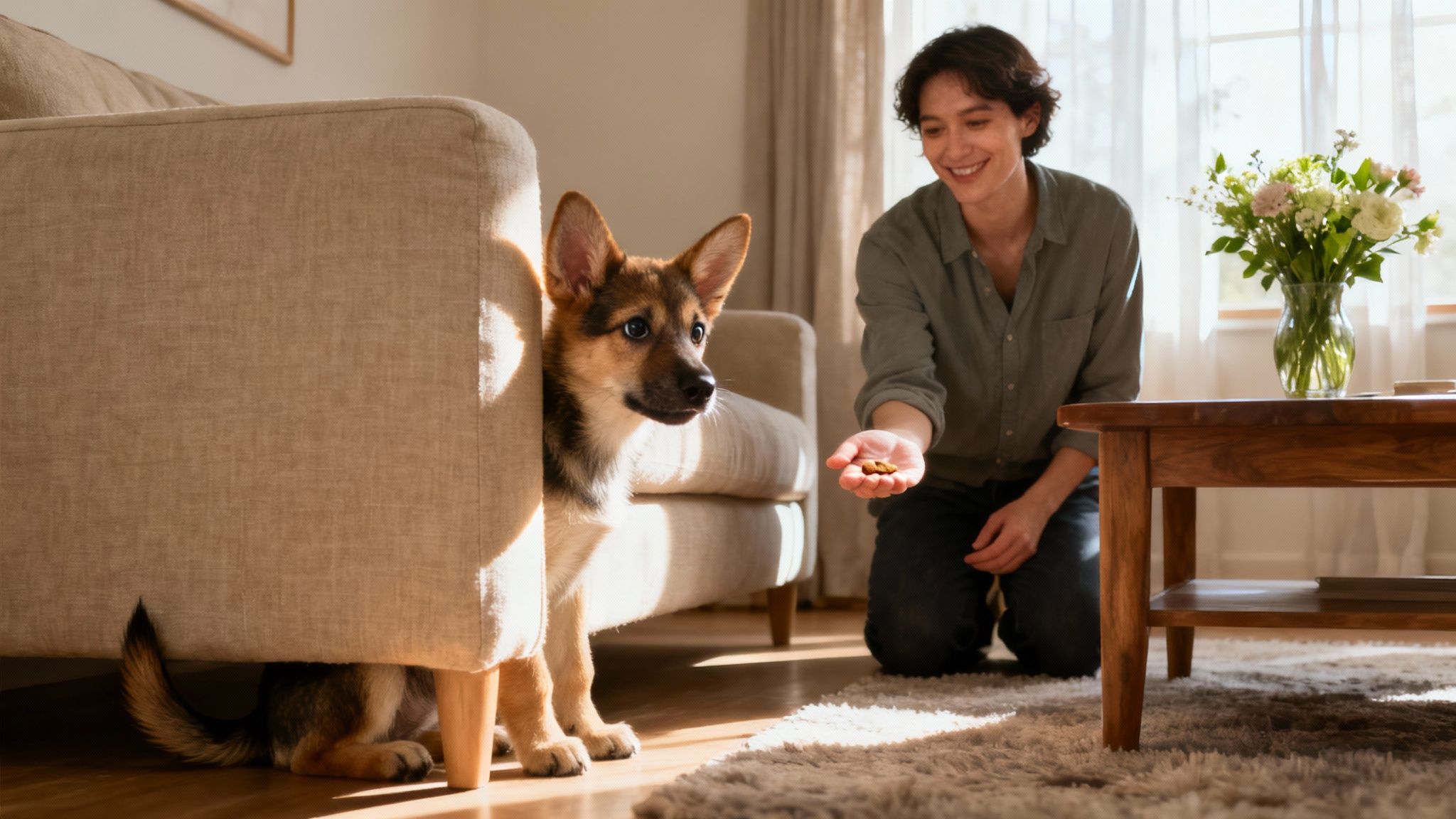
If your puppy seems more reserved than rowdy, you just need to tweak your approach. Think of yourself as their personal confidence coach. The goal isn't to shove them out of their comfort zone but to gently expand it, one tiny, happy step at a time.
Throwing a shy puppy into a loud, busy situation will only backfire. It confirms their belief that the big wide world is a scary place. Instead, our mission is to create experiences that are predictable, positive, and entirely on their terms.
Your puppy's emotional well-being is the top priority. Progress is measured in wagging tails and curious noses, not in how many new things you can introduce in a day.
Practical Tips for Building Confidence
Working with a shy puppy is like a delicate dance of observation and encouragement. Here are a few compassionate ways to help them feel safe and build up their courage:
- Go at Their Pace: Let your puppy be the one to decide when to approach something new. If they're content to watch the mail carrier from the living room window instead of the porch, that's a win! Reward that curiosity from whatever distance feels safe to them.
- Create Predictable Routines: For a nervous pup, knowing what comes next is incredibly comforting. Sticking to consistent feeding times, potty breaks, and quiet cuddle sessions helps build a foundation of security.
- Focus on Positive Reinforcement: This is where you break out the good stuff! Use extra-special, high-value treats to create positive associations. If the sound of the vacuum is terrifying, toss them a piece of chicken every time it turns on.
- Control the Environment: Start small. Invite one calm, dog-savvy friend over instead of throwing a big party. Visit a quiet park during off-peak hours rather than a chaotic farmers market on a Saturday morning.
Remember, every dog has its own personality. Some breeds are naturally more outgoing, while others tend to be a bit more reserved. Understanding the typical personality traits of breeds like the Irish Setter can give you some helpful context, but always pay closest attention to the individual puppy right in front of you. Your patience is the greatest gift you can give them—it’s what builds a lifetime of confidence.
Puppy Socialization Mistakes to Gently Avoid
Even when we have the best intentions, it's surprisingly easy to make a few wrong turns on the puppy socialization journey. Learning what not to do is just as important as knowing what to do. The whole point is to build a confident, happy dog, not accidentally create fear, so let's walk through a few common pitfalls to sidestep.
One of the biggest blunders is overwhelming a puppy. In the dog training world, this is called flooding—exposing a pup to way too much, way too fast, with no way out. Think of it like throwing someone who can't swim into the deep end and expecting them to figure it out.
Imagine taking your quiet little puppy to a huge, loud family party. For us, it’s a blast. But for them? It's a terrifying storm of new faces, booming voices, and hands reaching down from every direction. That kind of experience doesn't build confidence; it just teaches them that new things are scary and best avoided.
Forcing Unwanted Interactions
Another classic mistake is pushing a puppy into a situation they're clearly not ready for. You're their person, their trusted advocate. A huge part of that job is learning to read their signals.
A tucked tail, ears pinned back, a lot of yawning (when they aren't tired), or trying to hide behind your legs—these are all your puppy's way of saying, "I'm not okay with this." Forcing them to "say hi" to a big, bouncy dog or letting a stranger pet them while they're cowering just breaks their trust in you. The golden rule is to let your puppy set the pace and choose to engage when they feel safe and ready.
Your puppy is constantly communicating with you through their body language. Learning to listen to their whispers—a tucked tail, a lip lick—means you won't have to hear them shout with a bark or a growl later on.
This approach is vital for all dogs, but it's especially important when raising a larger dog. For more tips on setting them up for success, our guide on how to take care of larger breeds of dogs has some great advice that goes hand-in-hand with good socialization.
Over-Relying on the Dog Park
Ah, the dog park. It seems like the perfect place for socialization, right? In reality, it's often an unpredictable, high-stakes environment for a young pup. It's more of an advanced-level activity, not a starting point.
Here’s why it can be a risky choice for a puppy:
- Unknown Histories: You have no idea about the temperament or play style of the other dogs. One bad run-in with an aggressive or poorly socialized adult dog can be deeply traumatizing.
- Overwhelming Environment: The sheer number of dogs and the chaotic energy can easily overwhelm a puppy, turning a fun outing into a nightmare.
- Poor Play Habits: Puppies can pick up some pretty rude behaviors from other dogs if the interactions aren't well-managed.
Instead of hitting the dog park right away, focus on controlled, positive one-on-one playdates with a friend's well-behaved, vaccinated adult dog. A well-run puppy class is another fantastic option. These experiences help you build that solid foundation of what puppy socialization truly is: creating positive, safe, and happy moments that will last a lifetime.
Got Puppy Socialization Questions? We've Got Answers
Alright, we’ve covered the what, why, and how of getting your puppy comfortable with the world. But let's be real, you probably still have a few questions buzzing around your head. That’s completely normal!
Think of this as your go-to guide for those "what if" moments. The goal here is to feel prepared, not perfect.
Can I Socialize My Puppy Before They're Fully Vaccinated?
This is the big one, and the answer is a resounding yes! In fact, you absolutely must. The most critical learning period for your puppy starts to close around 16 weeks, which is usually before their final shots are done.
It's a bit of a balancing act, for sure. But most experts agree that the risk of a puppy developing lifelong behavioral issues from a lack of socialization is far greater than the risk of them getting sick, as long as you're smart about it. You just need to create a little safety bubble for their adventures.
Here are a few ways to do that safely:
- Be Their Chauffeur: Carry your puppy in your arms or in a sling when you run errands. They get to see, smell, and hear all the new things from a safe vantage point.
- Host a VIP Playdate: Invite a friend's calm, friendly, and fully vaccinated adult dog over to your house or a secure yard. A one-on-one session is a fantastic, low-pressure introduction.
- Find a Good Puppy Class: A well-run puppy class is a game-changer. Look for one that requires proof of initial vaccinations and keeps the space squeaky clean. These are controlled, safe environments designed for this exact purpose.
Is It Too Late to Socialize an Older Dog?
While that prime puppy window has closed, it is never too late to help an older dog feel more confident and secure. You just have to change your approach. With an adult dog, it's less about a firehose of new experiences and more about carefully changing how they feel about specific things that worry them.
The technical terms are counter-conditioning and desensitization. In simple terms, you’re slowly helping your dog build a new, positive association with something they find scary (like a person in a hat) by pairing it with something they truly love (like bits of cooked chicken). This takes a ton of patience, and you have to celebrate the tiny wins. If your dog has deep-seated fears, your best bet is to team up with a certified professional dog trainer.
Here’s a good way to think about it: With a puppy, you're pouring a brand new foundation. With an older dog, you're carefully renovating a foundation that might have a few cracks in it.
How Can I Tell if My Puppy Is Actually Scared?
Learning to read your puppy’s body language is like learning their secret language. A cautious puppy is just gathering information—they might approach something new with a soft, wiggly body and a low, sweeping tail wag.
A genuinely fearful puppy, on the other hand, is sending out an S.O.S. signal. Look for these signs of distress:
- Tail tucked firmly between their legs
- Ears pinned back flat against their head
- Cowering, shaking, or actively trying to hide
- Lip licking or yawning over and over (when they aren't tired)
If you spot these signals, your puppy is shouting, "I'm overwhelmed!" The best thing you can do is calmly and quietly increase the distance between them and the scary thing. Let them chill out before you even think about trying again, and next time, start from much, much farther away.
At SetterFren, we believe a well-socialized puppy is the start of a beautiful friendship because life's just better with a wagging tail. For more practical how-to guides, honest reviews of our favorite dog products, and to join our cozy community, explore everything we have to offer at https://setterfren.com.