At its heart, positive reinforcement dog training is all about rewarding your dog for doing something right. When they perform a good behavior, you give them something they love—a treat, a favorite toy, or even just a good scratch behind the ears.
Simple, right? This reward makes them more likely to repeat that behavior in the future. Instead of punishing them for what they do wrong, you’re teaching them what you want them to do by making it a fun and rewarding experience.
Building a Joyful Partnership with Your Dog
Here at SetterFrens, we believe that life’s just better with a wagging tail and a good book. Positive reinforcement is the secret sauce to creating those joyful moments. Think of training less like a strict drill sergeant barking orders and more like a fun game you play together.
When your dog sits patiently, they earn a delicious treat. When they dash back to you after being called, they get showered with praise and affection. It's a simple, powerful exchange that builds a deep well of trust and turns learning into something your dog actually gets excited about.
This approach flips the script on training. It stops being a chore and becomes a shared activity you both genuinely enjoy. You’re not just demanding obedience; you're encouraging a willing partner. By focusing on the good stuff, you’re raising a confident, happy companion who truly wants to work with you. This foundation of trust is everything, especially in the early days. You can learn more about building it in our guide to puppy socialization.

To get a quick handle on the core ideas, here’s a simple breakdown.
Positive Reinforcement at a Glance
| Principle | What It Means for Your Dog |
|---|---|
| Reward Good Behavior | When your dog does something you like (sits, stays, comes), they get a treat or praise immediately. |
| Ignore Unwanted Behavior | Instead of scolding for minor issues like jumping, you might turn away until they have all four paws on the floor. |
| Motivation is Key | You're using what your dog already loves (food, toys, attention) to encourage them to learn. |
| Builds Trust | Training becomes a positive, predictable experience, strengthening the bond between you and your pup. |
This table shows just how straightforward and intuitive this method really is. It’s all about clear communication and positive vibes.
Why This Method Creates Lasting Results
Positive reinforcement isn’t just a feel-good trend; it’s backed by solid science and proven results. It works because it empowers dogs to become active, thinking participants in their own learning.
A fantastic real-world example is the Guide Dogs for the Blind Association. After they switched their training program to focus on reward-based techniques, their trainee pass rate skyrocketed from 50% to an incredible 80%. That’s a massive leap, especially for dogs learning such complex and life-saving skills.
This kind of success proves that rewarding good choices is a powerful and reliable way to shape behavior for the long haul. You’re not just teaching commands; you’re looking after your dog’s emotional well-being and making your connection stronger, which is what being part of the SetterFrens pack is all about. For those who want to dive deeper, you can read more about the evidence for positive reinforcement training and its history.
How Reward-Based Training Actually Works
Ever wonder what’s really going on in your dog’s head when a single treat or a happy "Good boy!" gets them to sit on command? It’s not magic, though it can feel like it. The whole process is actually a pretty straightforward and elegant system based on how animals have learned for millennia.
At its heart, it’s all about creating a positive association. When your dog does something you like—let’s say they sit politely instead of jumping all over your guest—and you immediately follow it up with a high-value treat, their brain forges a powerful connection: "Hey, when I do this, I get that!"
That simple "if-then" link is the entire foundation of positive reinforcement. The reward isn't just a snack; it's clear, immediate communication that tells them, "Yes! That's exactly what I wanted you to do." Before you know it, your dog starts offering those good behaviors all on their own, hoping to cash in on that awesome prize again.
The Power of Positive Feedback
Think of it like playing a video game with your dog. When your pup nails the right 'move'—like a speedy recall—they instantly get a 'point' in the form of a treat, a favorite toy, or even just some enthusiastic praise from you. This positive feedback loop makes them want to keep playing the game and try that winning move again.
This constant stream of good feedback does so much more than just teach basic commands; it actively creates a dog who is excited to learn. They're not just going through the motions. They’re an engaged participant in the training process because it’s fun, predictable, and rewarding. They start thinking, "What can I do to make my human happy and earn that reward?"
Positive reinforcement creates a feedback loop where the desired behavior is followed by a rewarding consequence, which in turn increases the likelihood of that behavior happening again. This turns your dog from a passive student into an eager and confident partner in the learning process.
The scientific term for this is operant conditioning, where an animal learns to associate a voluntary action with a specific outcome. But you don't need a degree in psychology to see it work—you just need a pocketful of your dog's favorite treats and a bit of good timing.
Building Confidence with Every Success
One of the most incredible (and often overlooked) benefits of this method is the massive boost it gives your dog's confidence. Every time they figure out the puzzle and get it right, it's a small win that builds them up.
These little victories stack up, creating a dog who isn't afraid to try new things. Instead of worrying about making a mistake and getting a harsh correction, they feel safe and empowered to experiment. This is absolutely critical for their emotional well-being and for building a rock-solid bond between you.
Your training sessions transform from moments of potential conflict into fun, cooperative games. It fosters a relationship built on mutual trust and clear communication—something we value deeply here in the SetterFrens cozy online community.
The Real Benefits of Positive Training Methods
Deciding how to train your dog is a huge deal. It sets the tone for your entire relationship, and the effects last a lifetime. Sure, getting a solid "sit" or "stay" is great, but the real magic of positive reinforcement is what happens beyond the basic commands. This is about more than just obedience; it's about raising a happy, confident friend.
One of the biggest wins here is the massive boost to your dog's emotional well-being. When you focus on rewarding what they do right instead of correcting what they do wrong, you create a safe space for learning. There's no fear, no anxiety—just a dog who feels secure enough to try new things and looks to you for guidance, not because they're scared of messing up.
A Stronger Bond Built on Trust
Think of it like this: every time you reward your dog for a good choice, you're making a deposit in your relationship's trust fund. That little piece of chicken, that happy "Good boy!", or that scratch behind the ears is your way of saying, "When you're with me, good things happen."
This constant stream of positive feedback builds an incredibly strong foundation. Your dog starts to see you as a reliable source of fun and safety. This fosters a true partnership where your dog genuinely wants to work with you, making everything from a simple walk to a lazy afternoon on the couch feel more connected and joyful.
This little diagram shows that simple, powerful loop in action.
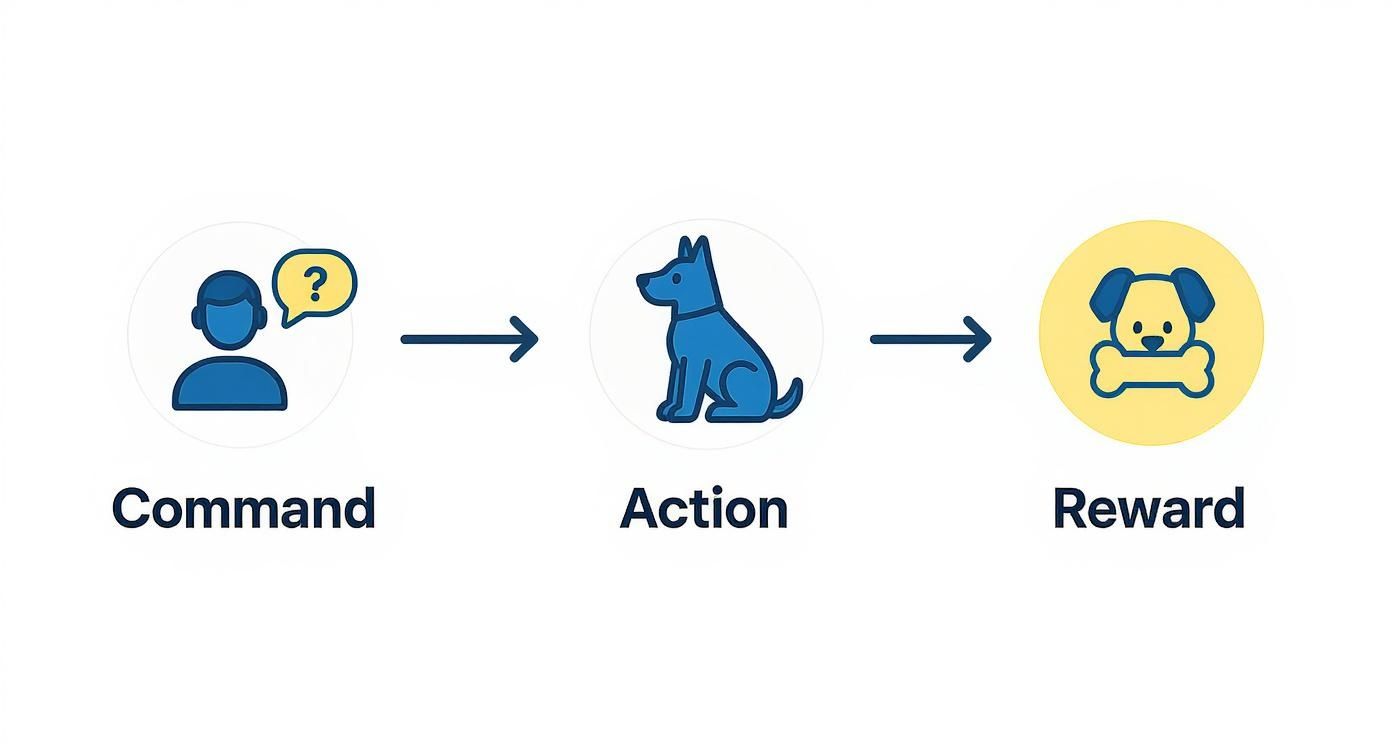
It’s a straightforward cycle: you ask, they do, they get rewarded. And just like that, the behavior gets stronger.
Training Methods Compared: A Dog's Perspective
To really understand the difference, let's step into our dogs' paws for a moment. How do these two approaches feel from their end of the leash?
| Training Aspect | Positive Reinforcement | Aversive-Based Methods |
|---|---|---|
| Motivation | "I want to do this to get something good!" (treats, praise) | "I have to do this to avoid something bad." (pain, fear) |
| Emotion | Joy, excitement, confidence, eagerness to learn. | Anxiety, stress, fear, confusion, potential aggression. |
| Relationship | Builds a strong bond based on trust and mutual respect. | Can damage the bond, creating a relationship built on fear. |
| Problem-Solving | Encourages creativity and a willingness to try new things. | Suppresses behavior but doesn't teach what to do instead. |
It's pretty clear which column leads to a happier, more well-adjusted dog. One method builds them up, while the other can create a constant state of stress.
Reduced Stress and Happier Dogs
The difference in a dog's state of mind isn't just something we feel; it’s backed by science. Punishment-heavy techniques often lead to nervous, uncertain dogs. On the flip side, positive reinforcement builds a dog's confidence with every single successful try.
A landmark study found that a staggering 65% of dogs trained with aversive methods showed signs of stress. In contrast, that number dropped to just 8% for dogs trained with positive reinforcement.
This research really shines a light on how a reward-based system helps create a calmer, more balanced companion.
It also opens up the lines of communication. The same study discovered that positively trained dogs show a greater "social gaze"—meaning they look to their owners for cues more often. This focus doesn't just make training easier; it deepens the connection you share. You can dig into the findings on positive reinforcement's effectiveness to see the data for yourself.
Ultimately, positive reinforcement is about so much more than just getting results. It’s a whole philosophy built on kindness, clear communication, and mutual respect. It’s how you raise a dog who isn’t just well-behaved but is truly happy—the kind of heartwarming partnership every one of us dreams of having.
Getting Started with the Right Training Tools
You don’t need to rush out and buy a bunch of fancy, expensive gadgets to get started with positive reinforcement dog training. Honestly, the best approach is often the simplest one. Let's walk through the essential tools that will help you build a fantastic, fun relationship with your dog.
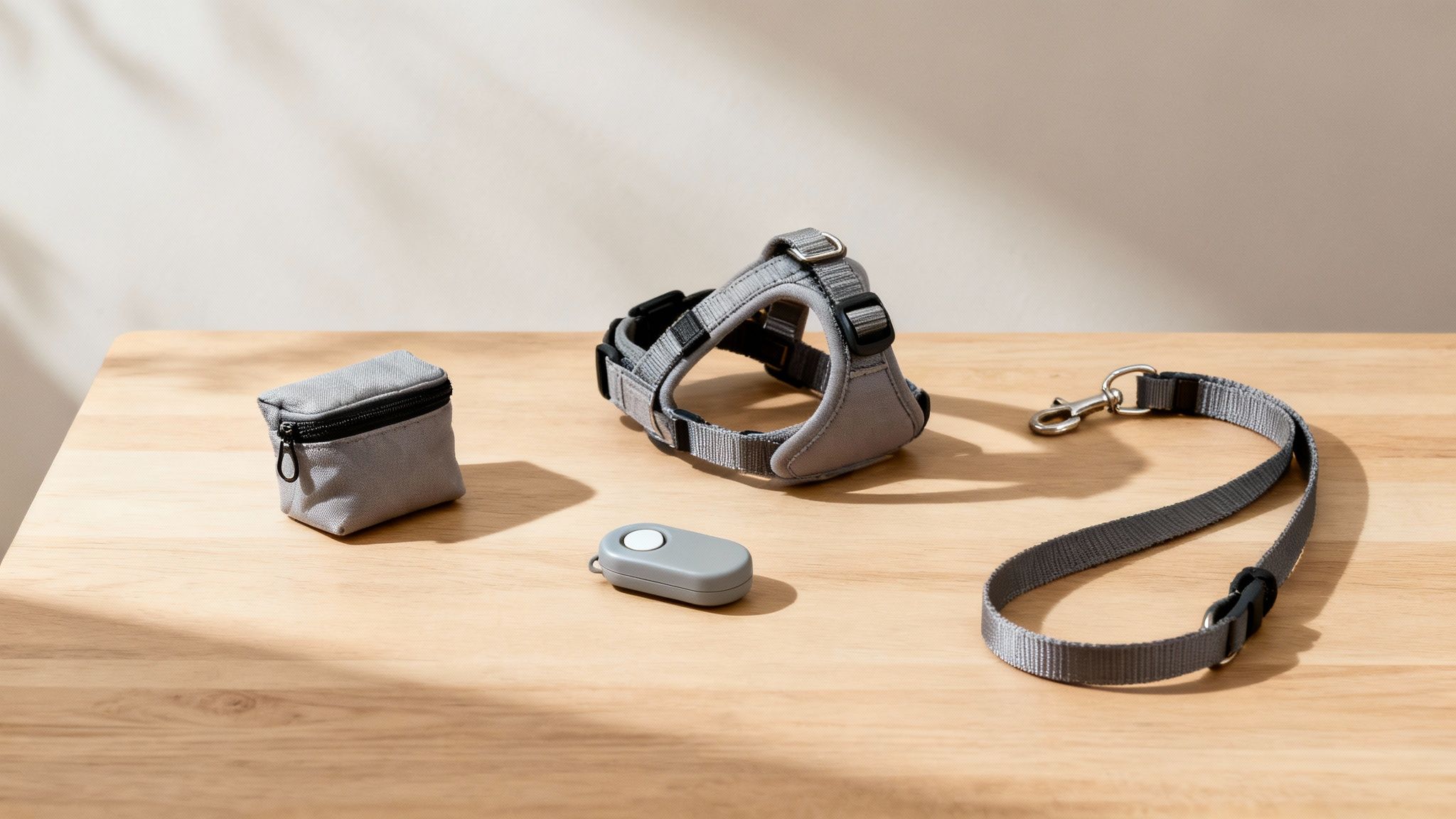
The right gear isn't about control; it's about communication. It helps you make things crystal clear for your dog and gets them genuinely excited for your next training session together. It’s all about creating happy vibes from day one.
High-Value Treats and Rewards
The engine of reward-based training is, you guessed it, the reward! For the vast majority of dogs, nothing beats a tasty snack. But here's the secret: not all treats are created equal in your dog's mind.
High-value treats are the really good stuff—the special, delicious morsels your dog doesn't get all the time. Think tiny bits of plain cooked chicken, small cubes of cheese, or freeze-dried liver. These are your "jackpot" rewards that make your dog’s eyes light up and get them eager to figure out what you're asking.
- Size Matters: Keep the treats tiny, about the size of a pea. This way, you can give lots of rewards during a session without filling up your dog's tummy too quickly.
- Variety is Key: Mix it up! Rotating through different types of treats keeps your dog engaged and guessing. The hot dog bits that were amazing yesterday might be old news today.
If you need some inspiration, check out our favorite homemade dog treats recipes for some healthy and dog-approved ideas.
Markers: A Clicker or a Word
How do you communicate to your dog, "YES! That right there! That's exactly what I wanted!" in the split second they do it? You use a marker. A marker is a quick, sharp signal that pinpoints the exact moment your dog does the right thing and, crucially, promises a treat is on its way.
Think of a marker as taking a snapshot of the good behavior. It's instant feedback that tells your dog, "That's it!" which helps them connect the dots and learn so much faster.
You’ve got two fantastic options here:
- A Clicker: This is a small, simple tool that makes a distinct "click" sound. That sound is always the same and doesn't carry any emotional tone, making it a super clear and consistent signal for your dog.
- A Marker Word: Don't want another thing to hold? No problem. A short, sharp word like "Yes!" or "Good!" works just as well. The key is to always say it with the same quick, upbeat tone.
Before you start training a behavior, you have to "charge" the marker. Just click or say your word, and immediately give your dog a treat. Do this 10-15 times in a row. Pretty soon, your dog will hear that sound and instantly look to you for a reward. That's when you know you're ready to start training
Getting Started: Your First Positive Reinforcement Exercises
Alright, enough with the theory—let's get to the tail wags! This is where the magic happens, where you get to see the concepts click for your dog and watch your bond grow stronger with every successful attempt. We'll start with two absolute classics that form the bedrock of training: "Sit" and "Come."
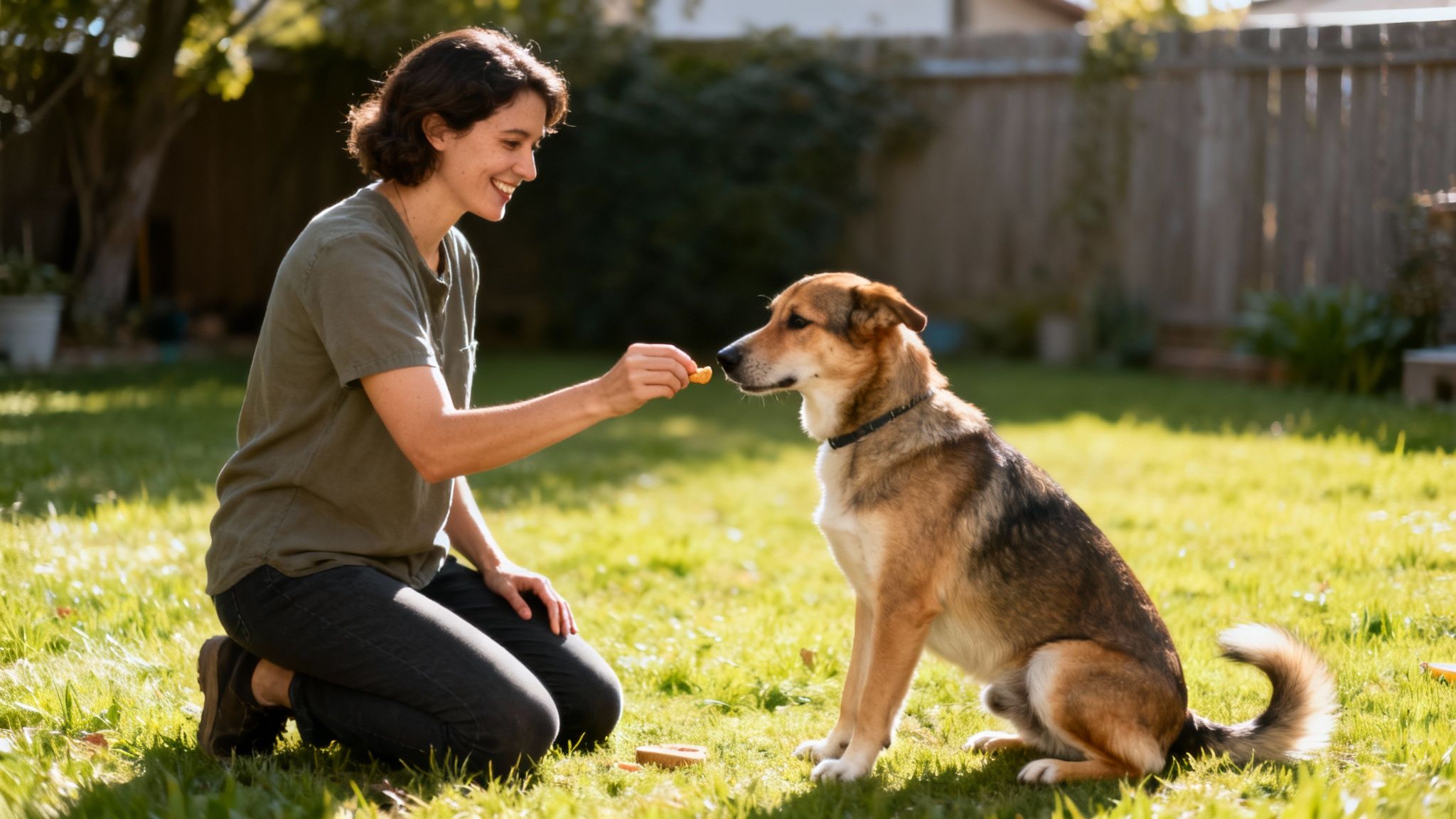
These two skills are perfect for dipping your toes into training. They're simple for your dog to grasp and build a fantastic foundation for more complex cues down the road. Just remember the golden rule: keep sessions short and sweet! A few minutes a couple of times a day is way more effective than one long, boring session.
Teaching a Simple “Sit”
There's a reason "Sit" is the first thing most people teach. It’s an amazing default behavior you can ask for in almost any situation to help your dog feel calm and focused.
Here’s how to get that little bum on the floor:
- Prep Your Lure: Grab a smelly, high-value treat and hold it right in front of your dog's nose. You want them to know you've got something delicious.
- Guide the Motion: Slowly lift the treat up and back over their head, like you’re drawing an arc. As their nose goes up to follow it, their rear end will naturally drop down. Physics!
- Mark and Reward: The exact second their bottom hits the ground, click your clicker or say your marker word ("Yes!") and immediately pop that treat in their mouth.
- Repeat and Fade: Do this a few times in a row. Once your dog is getting the hang of the movement, start saying "Sit" just before you begin the hand motion. Eventually, you can phase out the hand lure so they respond to the word alone.
Keep it light! If your dog gets distracted or doesn't sit, no big deal. Just reset and try the lure again. Every single successful sit is a win that builds their confidence. For a deeper dive into these crucial first weeks, check out our complete guide on how to train a puppy.
Practicing an Enthusiastic “Come”
A dog that comes running when you call them isn’t just impressive—it’s safe. A solid recall is non-negotiable, and our goal is to make coming to you feel like the best decision your dog has ever made.
The secret to a lightning-fast recall is making it a promise of good things. The "Come" cue should always mean treats, praise, or a favorite game—never something scary like a nail trim or the end of playtime.
Here’s how to build a recall that’s full of joy:
- Start Easy: Pick a quiet spot without a lot of distractions, like your hallway or living room. You can have a friend gently hold your dog or just wait for them to wander a few feet away.
- Get Excited: Use your happiest, most inviting voice and call out, "Come!" or "[Dog's Name], here!" As you say it, crouch down, pat your legs, or even back away a little to encourage them to run to you.
- Throw a Party: The moment they reach you, make a huge deal out of it! Shower them with praise, pets, and give them a "jackpot" of several tasty treats, one after the other. Make them feel like they just won the doggy lottery.
Protect this cue at all costs. If you need to call your dog for something they don't love (like heading inside from the yard), don't use your recall word. Just walk over and gently get them. This keeps the "Come" cue pure, positive, and powerful.
Debunking Common Positive Training Myths
As you start looking into positive reinforcement, you're bound to stumble upon a few persistent myths. With so much conflicting advice out there, it’s easy to get confused. Let's clear the air and tackle these misconceptions head-on so you can train with total confidence.
One of the biggest hang-ups people have is the idea that positive reinforcement is just bribery. They picture themselves forever attached to a treat pouch, unable to get their dog to do anything without waving a cookie first. But there’s a world of difference between a bribe and a reward. A bribe is what you show a dog to coax them into doing something. A reward comes after they’ve already done it.
A reward isn't a bribe; it's a paycheck. It’s fair compensation for a job well done, reinforcing the connection between your dog’s good choice and a positive outcome.
That simple shift in timing—from before to after—is what makes all the difference. The treat stops being a crutch and becomes an incredibly powerful teaching tool.
It Won’t Work on My "Stubborn" Dog
I hear this one all the time: "That's great, but it won't work for my stubborn bulldog/husky/beagle." People worry this friendly approach isn't tough enough for certain breeds. But here's the thing: positive reinforcement works for all dogs, no matter the breed, because it’s based on the fundamental science of how all animals learn.
A dog we label as "stubborn" is usually just a dog who is either confused about what we're asking or completely uninspired by the reward we're offering. The secret is finding what truly motivates your individual dog. It might be a tiny piece of chicken, a squeaky toy, or a quick game of tug-of-war. Once you find their high-value currency, you unlock a powerful desire to work with you. This is about motivation, not breed.
You Can Never Say "No"
Finally, there’s a big misconception that positive training is permissive parenting. People think it means letting your dog get away with everything and never setting boundaries. Nothing could be further from the truth.
Positive training is all about teaching your dog what you want them to do instead of the unwanted behavior. It's about proactive guidance, not a free-for-all.
- Instead of yelling at your dog for barking, you teach and reward a "quiet" cue.
- Instead of pushing them off when they jump, you teach them that keeping four paws on the floor earns them attention.
While about 55% of owners use a mix of different training styles, a growing number are seeing just how powerful this approach is. In fact, studies show that up to 57% of owners find reward-based training to be the most effective, leaving harsher methods in the dust. You can read the research on training method effectiveness for yourself and see how clear, positive guidance builds a wonderfully behaved dog without ever needing to rely on fear or intimidation.
Got Questions? We’ve Got Answers!
It’s totally normal to have a few questions pop up as you get started. Let's tackle some of the most common ones we hear from fellow dog lovers, so you can feel confident and ready to go.
How Long Should a Training Session Last?
Think short, sweet, and fun. For most dogs, especially puppies with their short attention spans, aiming for a few 5 to 10-minute sessions spread throughout the day is far more effective than one long, drawn-out session.
This keeps things exciting and prevents your dog (and you!) from getting frustrated or bored. Training should feel like a game, not a chore.
What if My Dog Doesn’t Care About Treats?
That’s a fantastic question, and it gets to the heart of what positive reinforcement is all about: finding what your dog truly values. A reward isn't just about food.
If your dog isn't food-motivated, what do they go nuts for?
- A special squeaky toy that only comes out for training?
- A quick, energetic game of tug-of-war?
- Enthusiastic praise and a good belly rub?
The "right" reward is whatever makes your dog's tail wag uncontrollably. Experiment and see what they'd work hardest for.
The best reward is the one your dog would choose for themselves. Pay attention to what they love, and you’ll find the perfect motivator to make training a blast.
Do I Have to Use Treats Forever?
Nope! This is a common myth. Once your dog has a command down cold and can perform it reliably, you can start phasing out the constant stream of treats.
You’ll want to switch to what's called an "intermittent" or "variable" reward schedule. This just means you reward them sometimes, but not every single time. You might give a treat for the first sit, then not for the next two, then reward the fourth one. It’s a bit like a slot machine—that unpredictability actually makes the behavior even stronger! Just be sure to always keep the verbal praise and affection coming.
At SetterFrens, we're all about celebrating the incredible bond we share with our dogs. For honest reviews of top dog products, practical how-to guides, and our curated selection of dog-themed books, come hang out with us at SetterFrens.com. Join our Puppicino Club for member perks and follow @setterfrens on TikTok and Instagram to see our growing pack