If you've ever heard a teacher mention that your child is reading at a level 'F' or 'M' and felt completely in the dark, you're not alone. Think of guided reading levels as training wheels for a new bike rider. They’re a way to find books that are 'just right'—challenging enough to build new skills but not so hard that they cause a total meltdown (or a case of the zoomies from frustration!).
This isn't about labeling kids. It's about empowering them by matching them with stories that build confidence and, hopefully, a lifelong love for reading—with a furry friend curled up by their side, of course.
The Purpose of Guided Reading Levels
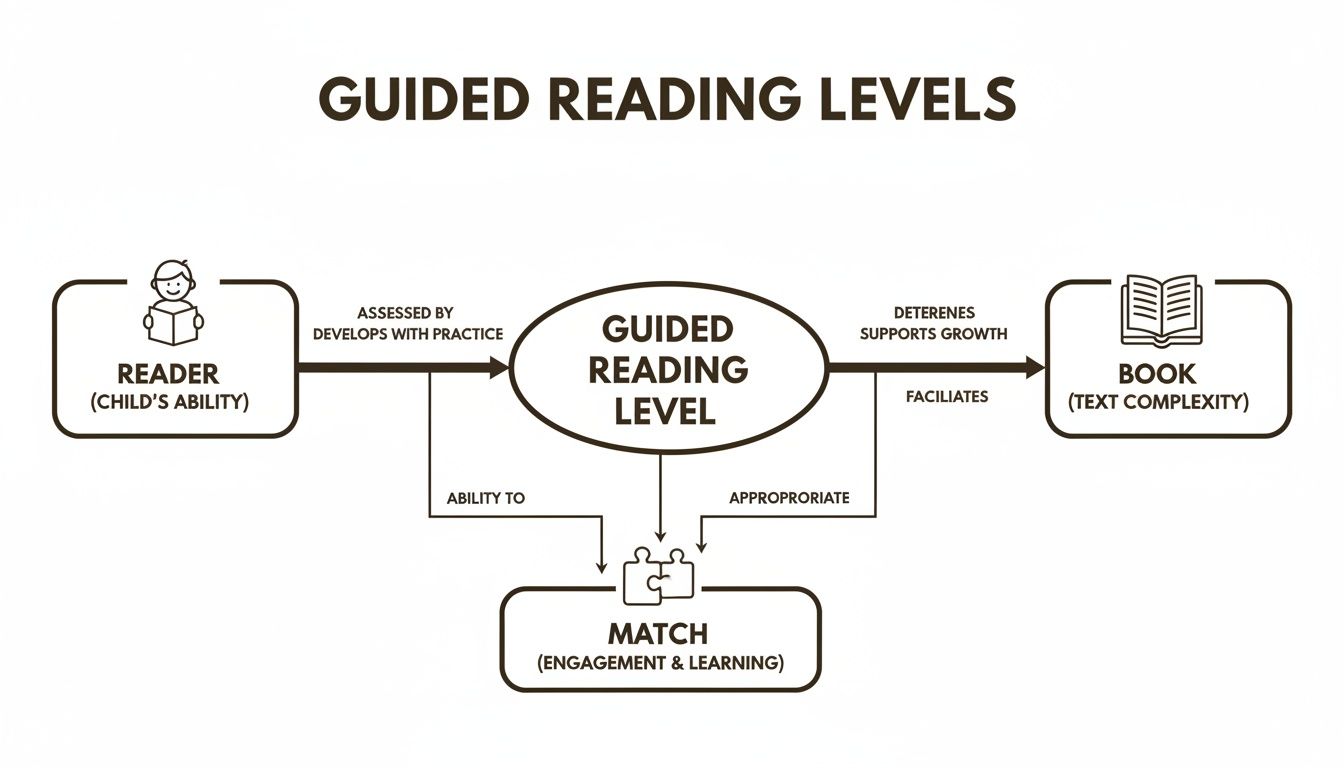
At its heart, a guided reading level is simply a tool educators use to connect a student with a book that hits that sweet spot. You want a little bit of a challenge to encourage growth, but not so much that the child gives up.
It’s like teaching a puppy to fetch. You wouldn't start by launching a heavy frisbee a hundred yards. You’d probably roll a soft ball just a few feet away and get super excited when they bring it back. Reading levels apply that same logic to literacy.
This system gives us a roadmap to make sure a child is practicing their skills at an appropriate difficulty. It helps us avoid the two biggest roadblocks in learning to read: books that are too easy, which lead to boredom, and books that are too hard, which just lead to frustration.
The whole point is to create a positive cycle where finishing a book feels like a win.
Finding the Sweet Spot for Learning
This idea of a "just-right" challenge is key to how kids learn anything. When a book is at a child’s instructional level, they can typically read it with 90-94% accuracy. This means they know most of the words on the page but still hit a few tricky ones that make them stop and think, using the strategies they’ve been learning.
That's where a teacher or parent steps in to offer a bit of support—that's the "guidance" in guided reading! Helping a child sound out a word or figure out what a sentence means is how they become stronger, more confident readers. It's not just about getting the words right; it's about building problem-solving skills and really understanding the story. To learn more about these foundational abilities, it’s helpful to understand what early literacy skills are.
The ultimate aim of guided reading is to help children become independent, strategic readers. The levels are simply a tool to chart the course, ensuring the journey is smooth and empowering.
Beyond Word Recognition
It’s also really important to know that these levels aren't just about how long the sentences are or how many big words are in the book. A lot more goes into it. To keep moving up the levels, a reader constantly needs to improve comprehension skill.
Here are a few other things that determine a book's level:
- Text Structure: Is the story a simple, repeating pattern ("The brown bear sees a red bird…") or does it have a more complex plot with twists and turns?
- Language and Literary Features: Is the language very direct, or does it use more playful or figurative language, like metaphors?
- Themes and Ideas: Are the concepts in the book straightforward and familiar (like getting a new puppy), or do they touch on more abstract ideas that require deeper thinking?
By looking at all these pieces together, the leveling system gives us a much richer picture of a book's true difficulty, helping us find that perfect match for our readers.
The Three Main Reading Level Systems
Walk into any elementary school, and you'll likely hear teachers talking about reading levels. But what exactly are they talking about? Most of the time, they're referring to one of three big systems: Fountas & Pinnell (F&P), the Developmental Reading Assessment (DRA), or Lexile Measures.
Think of them like different mapping apps for a road trip. They all want to get your child to the same destination—becoming a strong, confident reader—but they use slightly different routes and landmarks to guide the journey.
Getting a handle on these systems will help you decode teacher-speak and turn those mysterious letters and numbers into a practical tool for helping your child grow. Let's break down what makes each one tick.
Fountas & Pinnell Guided Reading Levels
The Fountas & Pinnell (F&P) system is probably the one you'll encounter most often, especially in the early grades. It uses a simple A-Z scale. Level A books are for our newest readers, filled with simple, repetitive text, while Level Z books are complex enough for skilled middle schoolers.
What makes F&P so popular is its holistic approach. It’s not just about how long the sentences are. F&P dives deep into ten different text characteristics, asking questions like:
- Book Layout: How is the text organized? Do the pictures give strong clues?
- Language: Are the words and sentences familiar, or are they more complex?
- Story & Structure: Is the plot straightforward, or does it have twists, turns, and multiple characters?
- Themes: Are the ideas concrete and easy to grasp, or do they require more abstract thinking?
By looking at the whole picture, an F&P level gives a really nuanced view of a book's difficulty, which is exactly what teachers need to find that "just right" book for a small group.
Developmental Reading Assessment (DRA)
Next up is the Developmental Reading Assessment (DRA). While F&P is all about the book, the DRA puts the spotlight squarely on the reader. Instead of letters, this system uses numbers, typically from A1 up to 80.
When a teacher gives a DRA, they’re watching and listening for very specific reading behaviors. They’re tracking a student’s accuracy (how many words they get right), their fluency (how smooth and expressive they sound), and, most importantly, their comprehension.
The final DRA level tells a teacher not just if a child can read the words, but how well they can understand and talk about the story. This makes it an amazing diagnostic tool for pinpointing exactly where a student might need a little extra help.
This is the whole idea behind reading levels in a nutshell: finding that sweet spot where a book is challenging enough to help a child grow but not so hard that it becomes frustrating.
It's all about building momentum and keeping reading a positive, successful experience.
The Lexile Framework for Reading
Finally, we have the Lexile Framework for Reading. This is the system you’re more likely to see on standardized tests or in big library databases. The big difference? Lexile gives a score to both the book and the reader.
A book gets a Lexile measure like 450L, which is calculated based on things like sentence length and word frequency. A reader gets their own Lexile score from a test, and the goal is to find books within their personal "Lexile range"—usually from 100L below to 50L above their score. This ensures the book is tough enough to learn from but not so tough it's a struggle.
Lexile's real power is its massive scale. It measures everything from the simplest picture books to dense scientific articles, giving readers a consistent benchmark throughout their entire academic career. It's less about moment-to-moment teaching and more about empowering students and parents to find great-fit books for independent reading.
Comparing Popular Reading Level Systems
It can be a lot to keep straight! This table breaks down the key differences between the three major systems at a glance.
| System | Level Format | Primary Focus | Commonly Used For |
|---|---|---|---|
| Fountas & Pinnell (F&P) | Letters (A-Z) | Holistic text complexity (10 characteristics) | Small-group instruction in elementary classrooms. |
| Developmental Reading Assessment (DRA) | Numbers (A1-80) | Reader's observable behaviors (accuracy, fluency, comprehension) | Diagnosing individual reader strengths and needs. |
| Lexile Measures | Numbers + "L" (e.g., 450L) | Objective text complexity (sentence length, word frequency) | Matching readers with independent reading books; standardized tests. |
At the end of the day, no single system is "better" than the others. They’re just different tools for the same important job. And as a teacher or parent, managing a library with all these different levels can feel like a puzzle, but there are some fantastic classroom library organization ideas to help keep everything in order. Each system offers a unique perspective, but they all point toward the same goal: helping every child discover the joy of reading.
Connecting Reading Levels to School Grades
Okay, so we’ve unpacked the big three: Fountas & Pinnell’s A-Z scale, the DRA’s focus on reader behaviors, and Lexile’s two-part measurement. But what do all those letters and numbers actually mean in the real world?
The next logical step is to connect these systems to something we all get: school grades. This is where the codes stop being abstract and become a genuinely helpful tool for parents and teachers.
Mapping these levels to grades helps you visualize a child's reading journey. Think of it as a general roadmap showing the typical path a reader takes from the first day of kindergarten through the end of elementary school. It helps you see, for instance, what Fountas & Pinnell level is common for a first-grader who’s just getting excited about chapter books, or the typical Lexile range for a fourth-grader building the stamina for longer novels.
But here’s a friendly and incredibly important reminder: every child's path is unique. This is a guide, not a rulebook. Some kids will race ahead, while others might take a more scenic route—and both journeys are perfectly wonderful.
A Grade-by-Grade Look at Reading Levels
To make this all crystal clear, we've put together a simple chart that lines up the three major systems with typical grade-level expectations. It’s like a translation guide, helping you understand the different “languages” of reading assessment. You'll be able to see how a Level 16 in the DRA system is in the same ballpark as a Level I in F&P—both common milestones for the end of first grade.
This kind of visual can be a huge relief, especially when you're heading into a parent-teacher conference or browsing the library shelves. It cuts through the jargon and puts the focus right back where it belongs: supporting your young reader.
A child’s reading level is a snapshot in time, not a permanent label. It’s a tool for finding 'just right' books that build skill and confidence, helping them grow into a reader who is not just capable, but also joyful.
Below is a general look at how reading levels often correlate to grade levels. Just remember, these ranges cover an entire school year. Kids will naturally start at the lower end in the fall and grow toward the higher end by spring.
Guided Reading Levels By Grade
| Grade Level | Fountas & Pinnell (F&P) | DRA Level | Lexile Range |
|---|---|---|---|
| Kindergarten | A – C | A1 – 4 | Up to 250L |
| 1st Grade | D – I | 6 – 16 | 190L – 530L |
| 2nd Grade | J – M | 18 – 28 | 420L – 650L |
| 3rd Grade | M – P | 30 – 38 | 520L – 820L |
| 4th Grade | Q – S | 40 | 740L – 940L |
| 5th Grade | T – V | 50 | 830L – 1010L |
Seeing it laid out like this really helps put things into perspective, doesn't it? You can see the steady, gradual progression and understand why a book at Level C is a world away from one at Level M.
Bringing Reading Levels to Life with Real Books
Sometimes, the best way to understand what guided reading levels really mean is to see them in action with books you already know and love. A letter or a number can feel abstract, but connecting it to a familiar story makes it all click.
Let's look at a few classics to get a feel for what these levels look like on the bookshelf.
Levels A-C (Kindergarten): Think Brown Bear, Brown Bear, What Do You See? by Bill Martin Jr. These books are all about repetition, strong picture clues, and often just one simple line of text per page. Perfect for brand-new readers.
Levels D-I (1st Grade): This is the sweet spot for beloved series like Arnold Lobel's Frog and Toad stories (around Level K) or the charming Clifford the Big Red Dog books. The plots are a bit more involved, there are a few characters to track, and the sentences get longer—but the language is still familiar and comforting.
Levels J-M (2nd Grade): A perfect example here is the Magic Tree House series by Mary Pope Osborne (around Level M). These early chapter books introduce kids to more complex story arcs, new vocabulary, and the skill of tracking information across multiple chapters.
Levels Q-S (4th Grade): By this point, readers are ready for the richness of a book like Charlotte's Web by E.B. White (around Level R). These novels dig into sophisticated themes, use beautiful descriptive language, and explore an emotional depth that requires more advanced thinking.
Placing these familiar titles on the map helps anchor the whole system in reality. It’s a great reminder that the goal isn't just about climbing a ladder of letters and numbers. It's about unlocking the ability to enjoy richer, more wonderful stories at every single step.
How Teachers Find Your Child's Reading Level
Have you ever wondered how your child's teacher comes up with that specific letter or number for their reading level? It’s not some big, scary standardized test. Instead, it's a much more personal and thoughtful process that helps them understand your child as a unique reader.
Think of it less like a final exam and more like a gentle dog trainer watching a puppy to see their natural strengths and find the perfect ways to help them grow.
The main tool for this is an assessment called a running record. It's a fantastic way for teachers to listen in on a child's reading process as it's happening. The goal isn't a perfect score; it's all about gathering clues to provide the best possible support.

The Running Record in Action
During a running record, a teacher sits down one-on-one with your child. They'll have a short book or a passage that they think is right around your child's "just right" level and will ask them to read it aloud.
As your child reads, the teacher is like a detective, following along on their own copy and using a kind of shorthand to track what's happening. It’s a way of looking "under the hood" to see how their reading engine is running.
Here’s what they’re listening for:
- Accuracy: They're keeping a tally of every word the child reads correctly. The sweet spot they’re looking for is about 90-94% accuracy—that's the "instructional level" where a child is challenged but not frustrated.
- Errors (or Miscues): When a child says a different word, the teacher jots it down. But more importantly, they analyze the type of error. Did they say "pony" instead of "horse"? That's great! It shows they're thinking about the story's meaning. Did they say "hat" instead of "has"? That shows they're using the letters to figure out words.
- Self-Corrections: This is a huge win! When a child makes a mistake, realizes it doesn't sound right or make sense, and goes back to fix it, that’s a sign of an active, thinking reader. Teachers love to see this.
- Fluency: It’s not just what a child reads, but how they read it. Is their reading smooth and expressive, or is it slow and choppy? Fluency tells the teacher a lot about a reader's confidence and comfort with the text.
The real magic of a running record isn't about counting mistakes. It’s in understanding the why behind them. This reveals the amazing problem-solving strategies a young reader is already using to make sense of print.
Checking for Understanding
Of course, reading the words correctly is only half the battle. The real goal is understanding the story! After the reading is done, the teacher will chat with your child about what they just read. This conversation is just as crucial as the reading itself.
The teacher will ask questions to see if the child can:
- Retell the story in their own words, remembering the important parts.
- Answer specific questions about the characters, the setting, or what happened.
- Make smart guesses (inferences) about why something happened or what might happen next.
- Talk about the big ideas or the author's message.
By putting together the clues from the running record and the insights from the comprehension chat, the teacher gets a rich, complete picture of your child as a reader. This lets them find that just-right instructional level and, most importantly, plan exactly how to help your child take the next exciting step in their reading journey.
Using Reading Levels as a Guide, Not a Rule
Reading levels are a fantastic tool, but they work best when you think of them as a helpful map, not a rigid set of directions. This is all about using them to open doors for young readers, not to box them in.
The most important thing to remember is that a child’s passion is a powerful engine for learning. If your little one is obsessed with dinosaurs, they might happily tackle a book that's technically a level or two "too hard." Their excitement and existing knowledge give them a huge boost.
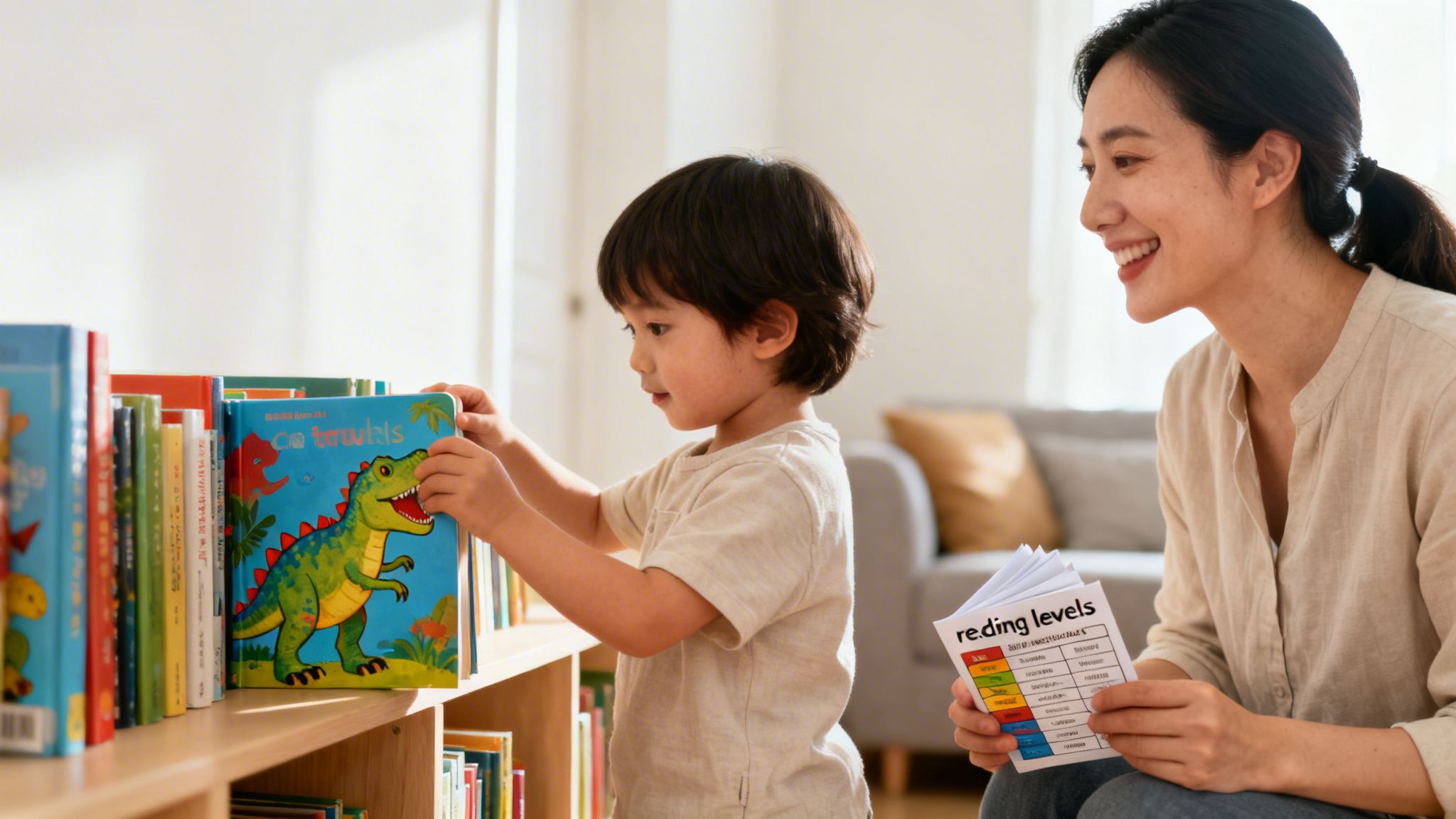
Embrace Flexibility and Follow Your Child's Lead
Think of a guided reading level as a starting point—a great suggestion for a book that will likely build skills without causing too much frustration. It should never become a restrictive label that limits a child's choices or squashes their curiosity.
Here are a few quick "dos and don'ts" to keep in mind:
- DO use levels to find a good selection of "just right" books that build confidence.
- DON'T ever forbid a child from picking a book they're excited about, even if it seems way too difficult.
- DO encourage a mix of reading: some easy books for fun, some "just right" books for skill-building, and some challenging books (read together) for stretching their minds.
- DON'T define your child by their reading level. It's just a temporary snapshot, not a permanent identity.
The ultimate goal is to foster a genuine love of reading. Sometimes that means letting them reread a simple favorite for the tenth time, and other times it means helping them sound out words in an ambitious book about space. Both experiences are incredibly valuable.
Recognizing the Limits of Reading Levels
While helpful, it’s just as important to understand what a reading level doesn't tell you. A level is a useful shortcut, but it’s far from the whole story.
For instance, a letter or number can't measure a child's background knowledge. A young soccer fan might breeze through a nonfiction book about the sport that's technically above their level, simply because they already know all the vocabulary and concepts.
A reading level is a measure of a text's complexity, not a measure of a child's potential. A child's interest and background knowledge can often overcome challenges presented by a text that is technically above their assigned level.
On top of that, a child's reading ability can vary a lot between different types of text. A student who has no problem with a narrative fairy tale might struggle with a nonfiction book full of diagrams and captions, even if they're at the same designated level. In fact, one study found that only 43% of students in K-2 and just 26% of students in grades 3-8 read at the same F&P level for both fiction and nonfiction. It’s a great reminder that a single level doesn't capture a reader's full range of skills.
Putting It All Together for a Balanced Reading Life
So, how do you find the right balance? You use the level as your guide, but you let your child's interests and your own judgment have the final say. Understanding your child's guided reading level is a crucial first step; however, it's just as important to know how to use this information to genuinely improve reading comprehension skills.
This balanced approach is what builds confident, motivated readers. If you're looking to support this journey at home, check out our guide on the best books for early readers for titles that are both engaging and skill-appropriate.
Ultimately, our mission is to help you use levels to find books that build confidence while gently stretching skills, creating a positive and joyful reading experience for your child.
Common Questions About Reading Levels, Answered
Alright, now that we've dug into the different reading level systems, let's talk about the real-world questions that come up all the time. Think of this as your go-to guide for those "what do I do when…?" moments on your child's reading journey.
"My child only wants to read easy books. Should I be worried?"
Not at all! In fact, you should celebrate it. When a child grabs a familiar, easy book, they're taking a victory lap. This is how they build real fluency—that smooth, confident reading style that’s so crucial for understanding the story.
Think about it like a puppy who loves chasing the same old tennis ball. It’s not flashy, but it builds mastery and pure joy. Comfort reading boosts their confidence and reminds them that reading is supposed to be fun, not a struggle. A great reading diet has a mix of everything, and these "easy reads" are a key ingredient.
"Should I stop my kid from trying to read a book that's way too hard?"
Definitely not! A child's curiosity is a powerful thing. If they're obsessed with dinosaurs, they might just push through a text you thought was miles above their level. That passion can be the fuel they need to tackle tricky words and new ideas.
Instead of shutting it down, jump in and make it a team effort. This is a perfect opportunity for a shared reading experience.
- Read it aloud to them so they can just soak up the story.
- Take turns reading pages—they get practice, but you're there as a safety net.
- Help them sound out tough words, showing them how strong readers figure things out.
Tackling a "stretch" book together introduces them to richer vocabulary and more complex sentences in a low-pressure, supportive way. The goal is to keep the experience positive and avoid frustration.
"How can I find books at my child's level?"
You've got a ton of fantastic resources available, so you're never on your own with this. Finding the right books can feel like a fun treasure hunt.
Your first and best stop is always the school or public librarian. These folks are masters at connecting kids with books they’ll love and can quickly point you to the right shelves. Many libraries even sort their early reader sections by level, which makes browsing a breeze.
Here's the real secret: The best way to find the right book is to let your child help choose. When they have a say, they're already bought in and excited to start reading.
There are also some great online tools you can use from home. Websites like the Scholastic Book Wizard and Lexile's "Find a Book" tool let you filter books by level, grade, or even topic. You can build a list of titles to look for on your next library trip.
Ultimately, follow your child's lead. Their excitement is the best guide you'll ever have.
At SetterFrens, we know every reading adventure is one-of-a-kind. For more tips, book lists, and to connect with a community that loves dogs and a good story, check out all our resources at https://setterfren.com.