Welcome to the magical world of kindergarten literacy! This is where the foundational building blocks for reading, writing, and communication are laid, one playful activity at a time. Forget monotonous drills and endless worksheets. True literacy blossoms through joy, hands-on exploration, and memorable fun that sparks genuine curiosity. In this guide, we’ve gathered eight fantastic, teacher-approved kindergarten literacy activities designed to captivate your child’s imagination and build essential skills without them even realizing they’re learning.
From energetic letter sound scavenger hunts that get little bodies moving to cozy shared reading sessions with giant, colorful books, these ideas are practical and effective for both the classroom and living room floor. And here at SetterFren, a cozy online community for dog lovers who believe life’s better with a wagging tail and a good book, we know all about the magic of storytelling. These activities aren’t just about learning letters and sounds; they’re about creating positive, engaging experiences that foster a deep, lifelong love for reading. Let’s dive into these simple yet powerful activities and make learning an unforgettable adventure for your little one.
1. Letter Sound Scavenger Hunt
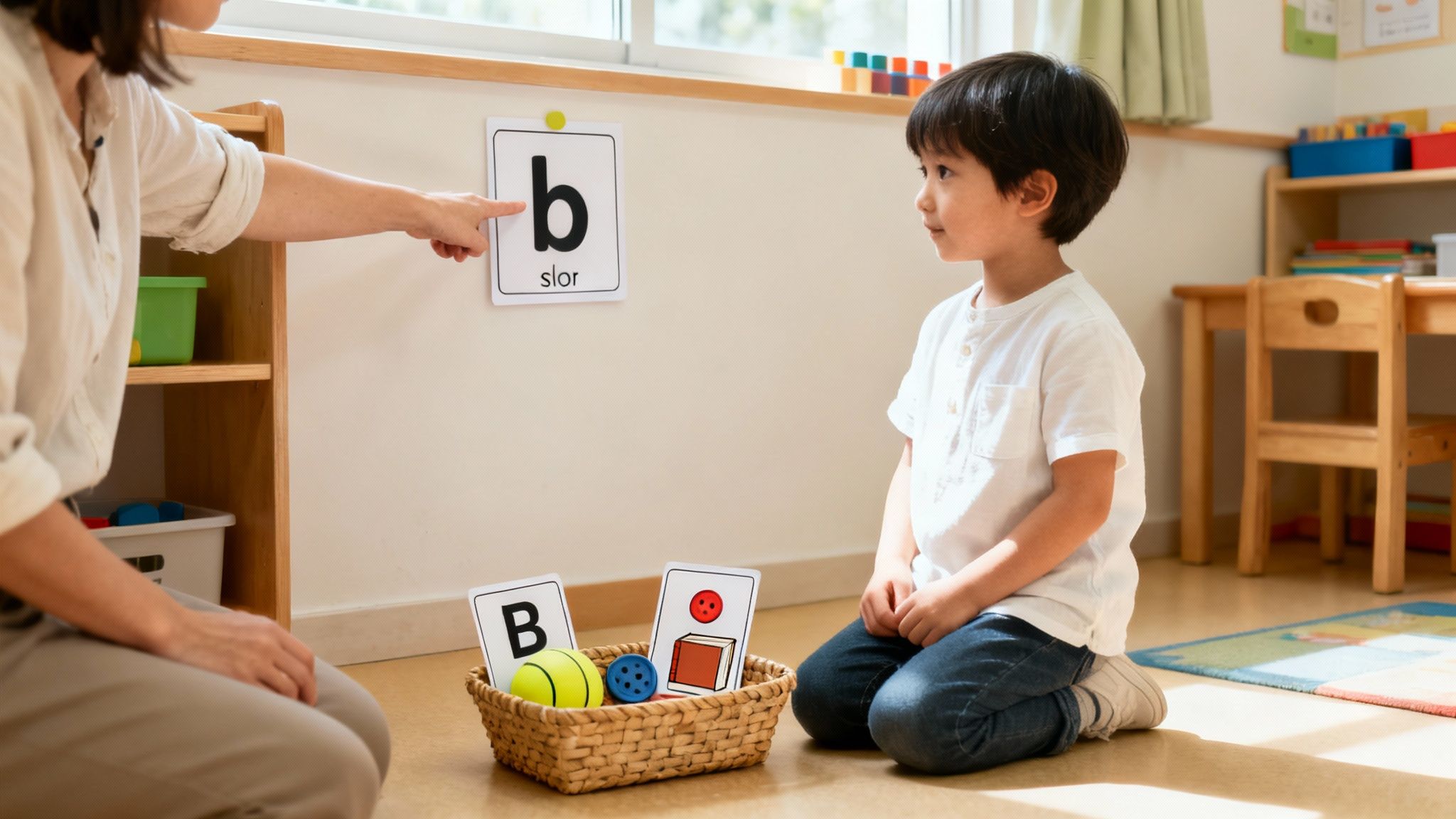
Turn your classroom or backyard into a thrilling phonics adventure! The Letter Sound Scavenger Hunt is a fantastic, hands-on kindergarten literacy activity that gets kids moving while they learn. It directly connects abstract letter sounds to tangible, real-world objects, making learning both meaningful and fun. Simply introduce a target letter sound, like the /b/ sound for the letter ‘B’, and send your little learners on a quest to find items that start with that sound.
This activity is a cornerstone of play-based learning and aligns with proven phonics methods. By combining kinesthetic learning with phonemic awareness, it helps cement sound-symbol relationships in a child’s mind. Children aren’t just hearing the sound; they are seeing, touching, and thinking about it in their immediate environment.
How to Implement It
Getting started is easy. Announce the “sound of the day” and give each child a small bag or basket. For the sound /b/, children might excitedly hunt for a ball, a book, a blue block, or a plastic banana. You can adapt this for any setting:
Indoor Hunt: Use classroom objects, toys, or even pictures cut from magazines.
Outdoor Hunt: Head outside to find a branch, a bug, or something brown.
Themed Hunt: Create a “Zoo Animal” hunt for sounds like /l/ (lion) and /t/ (tiger).
Actionable Tips for Success
To make your scavenger hunt a roaring success, try these tips:
Set the Stage: For younger learners or less common sounds, strategically place a few “easy win” items around the area to build confidence.
Use Visual Cues: Hold up a large letter card or a picture card (like an apple for the /a/ sound) to remind students of their target.
Sort and Share: After the hunt, gather everyone in a circle. Have students present their treasures one by one, repeating the initial sound. This reinforces learning and builds speaking skills.
Why it Works: This approach transforms a foundational skill, phonemic awareness, from a rote memorization task into a dynamic and engaging game. It’s one of those kindergarten literacy activities that feels more like play than work, which is the sweet spot for early childhood education.
2. Guided Shared Reading with Big Books
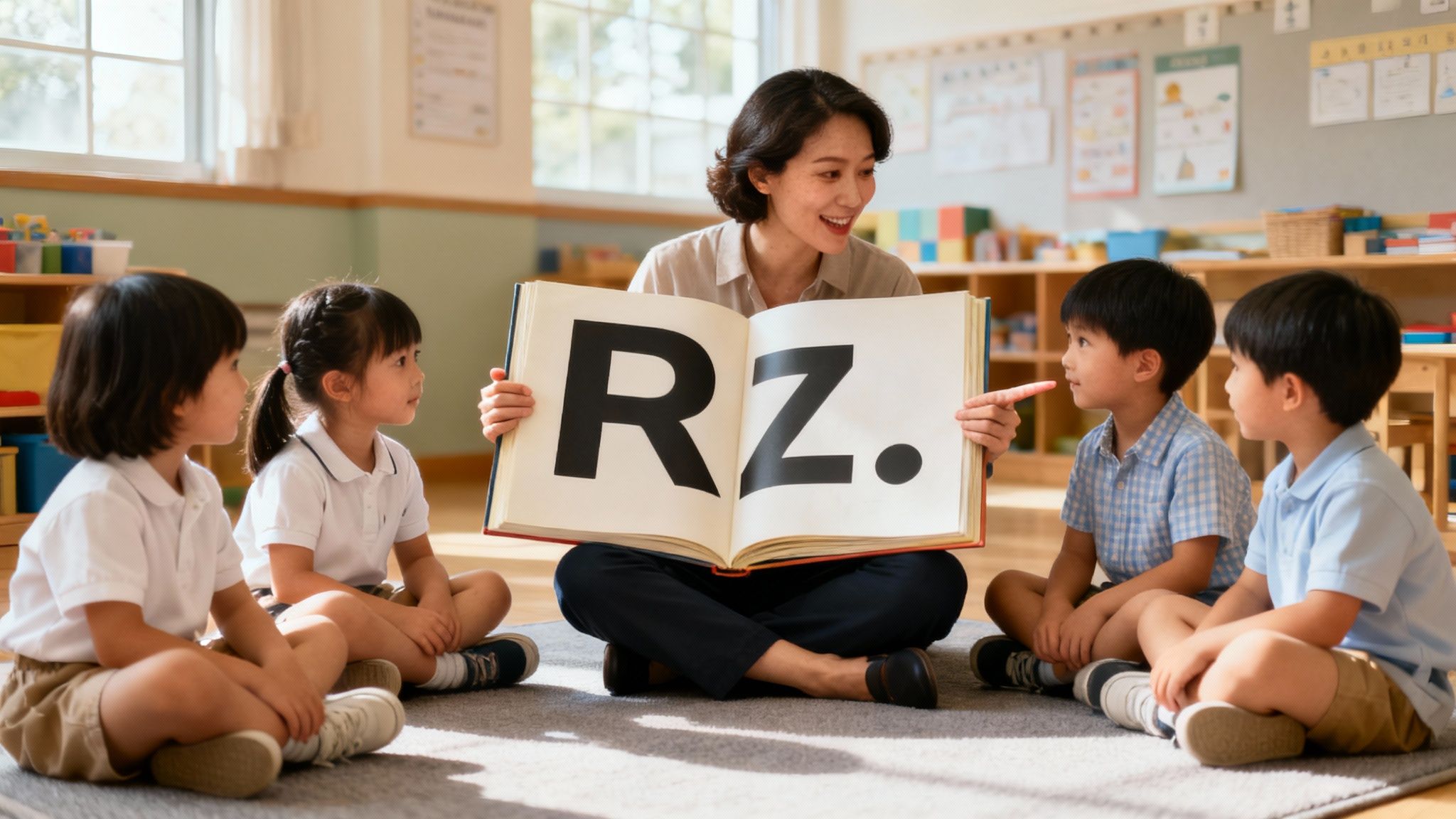
Gather your students for a cozy and captivating storytime that builds powerful literacy skills. Guided Shared Reading with Big Books transforms reading into a joyful communal event. By using oversized books where everyone can see the words and pictures, you create an inclusive experience that models fluent reading, introduces concepts of print, and sparks rich conversations about stories.
This method, a cornerstone of effective kindergarten literacy activities, makes the reading process visible. As you point to each word, children learn about left-to-right directionality, the concept of a word, and the connection between spoken and written language. It’s an interactive, teacher-led approach that boosts everything from vocabulary and listening comprehension to a genuine love for reading.
How to Implement It
Leading a shared reading session is all about interaction and modeling. With the Big Book propped up for all to see, you can guide students through a variety of literacy-rich experiences. Use classic, predictable texts that invite participation:
Pattern and Prediction: With a book like Brown Bear, Brown Bear, What Do You See?, pause to let children predict the rhyming animal on the next page.
Counting and Concepts: Use The Very Hungry Caterpillar to reinforce counting, days of the week, and the life cycle of a butterfly.
Interactive Storytelling: Share Dear Zoo and ask students to guess which animal is in the crate based on the descriptive words and illustrations.
Actionable Tips for Success
To make every shared reading session magical, try these simple strategies:
Track the Text: Use a pointer or your finger to slide under the words as you read. This simple action is crucial for teaching print awareness.
Encourage Participation: Pause at predictable parts and invite children to chime in with the missing word or phrase. This builds confidence and makes them active readers.
Use Expressive Voices: Bring characters to life with different voices and tones. Your enthusiasm is contagious and keeps little learners engaged.
Re-read Favorites: Don’t be afraid to read the same book multiple times. Repetition builds fluency, deepens comprehension, and reinforces vocabulary.
Why it Works: Shared reading provides a low-pressure, supportive environment where all children can feel like successful readers. It demystifies the reading process by making it a shared, observable activity, fostering a strong foundation for independent reading and a lifelong love of stories. Looking for engaging books for young readers? Check out the curated selection of dog-themed books at SetterFren.com to find your next classroom favorite.
3. Interactive Word Wall Activities
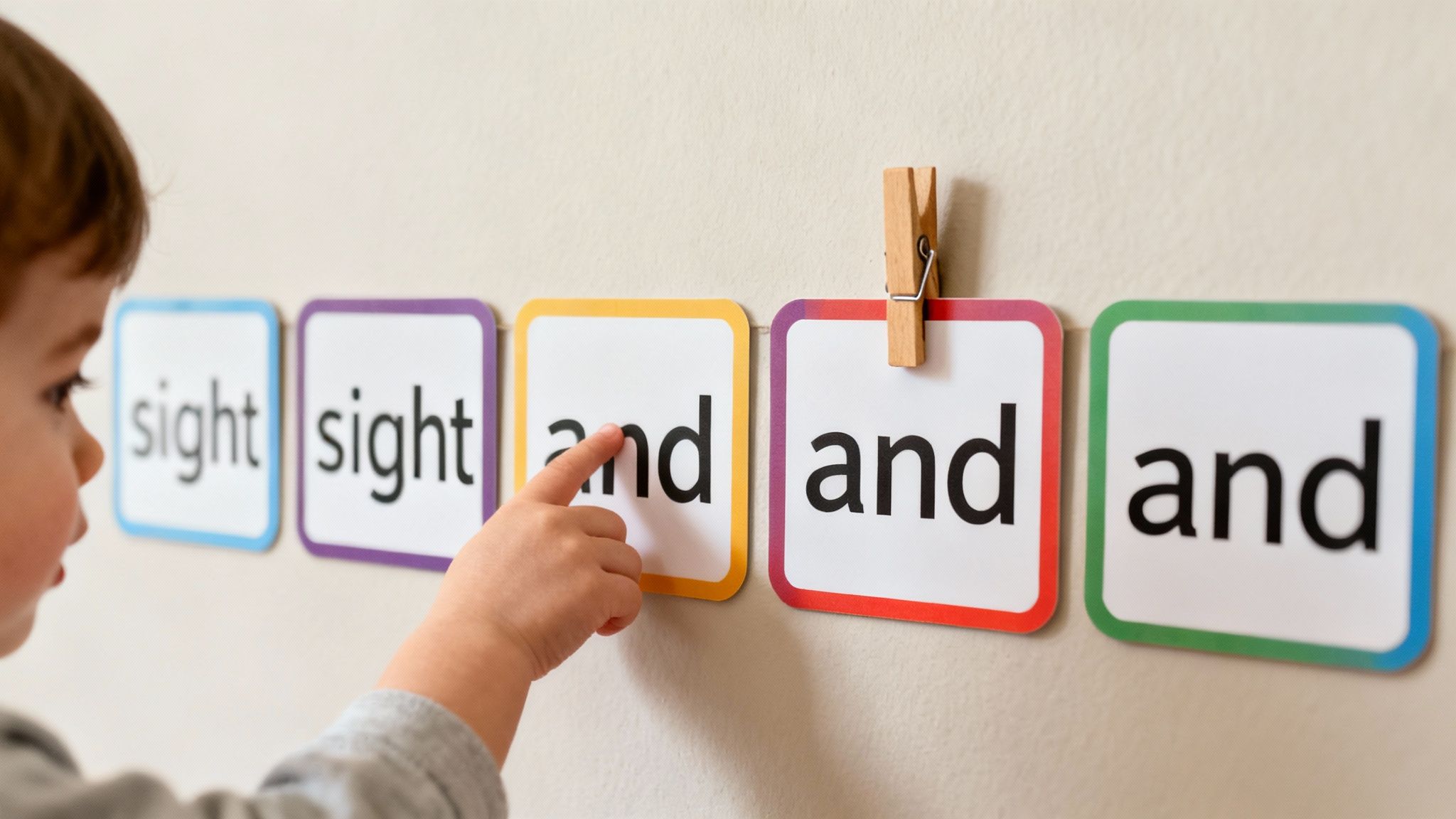
Transform a simple classroom display into a powerhouse of learning with an interactive word wall. More than just a list of words, this kindergarten literacy activity is a dynamic tool that builds a strong foundation for reading and writing. By displaying high-frequency words, sight words, and thematic vocabulary in a large, organized way, you create a constant reference point that empowers young learners to become more independent.
This method, championed by literacy experts like Pat Cunningham and Debbie Diller, moves beyond passive viewing. The goal is for children to actively engage with the words daily through songs, games, and hands-on manipulation. This consistent interaction helps make word recognition automatic, which frees up cognitive energy for comprehension and more complex reading tasks.
How to Implement It
An effective word wall is built with and for the students. Begin the year with a few essential words and add new ones collaboratively each week. Keep it lively and engaging by incorporating daily routines that get kids out of their seats and pointing, chanting, and interacting with the words.
Sing and Chant: Start your literacy block with a song like Debbie Diller’s “Word Wall Song,” pointing to each word as you sing.
Play Word Detective: Give clues like, “I spy a word that starts with the /t/ sound and rhymes with ‘hen’.” Students then hunt for the word ten.
Word Building: Pull words from the wall and use them to build simple sentences on a pocket chart or whiteboard.
Actionable Tips for Success
To ensure your word wall is a hub of learning, not just a decoration, try these strategies:
Introduce Words Gradually: Add just 3-5 new, high-relevance words each week to avoid overwhelming students.
Get Kinesthetic: Make learning physical. Have students clap the syllables, jump for each vowel, or trace the words in the air with their fingers.
Use Pointers and Tools: Provide fun pointers, magnifying glasses, or highlighters for students to use when locating and reading words.
Connect to Writing: Constantly refer students to the word wall during writing activities, encouraging them to use it as a personal dictionary.
Why it Works: An interactive word wall makes abstract sight words concrete and accessible. By engaging multiple senses through games, songs, and movement, it caters to diverse learning styles and solidifies word recognition in a way that feels like pure fun, not practice.
4. Alphabet Sensory Tubs and Letter Exploration Stations
Engage multiple senses at once with one of the most hands-on kindergarten literacy activities out there. Alphabet sensory tubs and letter exploration stations invite children to dive into tactile learning, connecting the physical feel of forming a letter with its shape and sound. This multi-sensory approach is powerful for young learners, as it helps build strong neural pathways for letter recognition and pre-writing skills.
This method is a hallmark of play-based philosophies like Montessori and Reggio Emilia. By providing different materials, you allow children to discover letters on their own terms. They aren’t just memorizing a shape; they are building it, tracing it, and feeling it, which deeply embeds the concept in their memory.
How to Implement It
Setting up these stations is all about variety and exploration. You can have several tubs or areas dedicated to different letters or materials, allowing for small group rotations. The goal is to let children feel the curves and lines of each letter.
Sand or Salt Trays: Children use their fingers to trace letters in a shallow tray of colored sand or salt.
Playdough Creations: Students roll “snakes” out of playdough to form letters, strengthening hand muscles.
Shaving Cream Fun: Spread shaving cream on a tabletop or tray for large, satisfying letter-tracing movements.
Rice Bin Discovery: Hide magnetic letters or laminated cards in a bin of rice for children to find and identify.
Actionable Tips for Success
To ensure your sensory stations are effective and manageable, consider these strategies:
Provide Visual Models: Place large, clear letter cards at each station so children have a reference for proper formation.
Start Big, Go Small: Encourage large motor movements first (like tracing in shaving cream) before moving to finer motor tasks (like forming with playdough).
Incorporate Sounds: As children form a letter, encourage them to say its name and sound out loud. For example, “I’m making a ‘B’! Buh, buh, buh.”
Establish Routines: Clearly explain the rules for each station and use timers to help manage smooth transitions between activities. You can find more practical how-to guides at SetterFren.com to help you care for your pup like a pro while your little ones learn.
Why it Works: This activity transforms letter formation from a pencil-and-paper chore into a joyful, sensory-rich experience. It meets children where they are developmentally by using touch and movement to teach abstract concepts, making it a truly effective and memorable literacy tool.
5. Guided Sentence Building and Oral Storytelling
Bridge the gap from single words to complete thoughts with this powerful, teacher-led activity. Guided Sentence Building and Oral Storytelling helps children understand how words work together to create meaning. It’s a foundational kindergarten literacy activity that directly models sentence structure, syntax, and the narrative arc of a story in a collaborative and supportive setting. By building sentences together, children learn the architecture of language.
This method, central to approaches like the Language Experience Approach (LEA), makes the abstract concept of a sentence tangible. When children arrange word cards to form “The dog is running,” they see, touch, and say a complete thought. This interactive process boosts comprehension and gives them the confidence to transition from speaking in sentences to writing them.
How to Implement It
You can easily integrate this into your daily routine with word cards, a whiteboard, or magnetic letters. Start by telling a simple story or showing a picture, then guide the class to describe it.
Simple Sentences: Begin with a sentence frame like “I see a ______.” and have children fill in the blank with picture or word cards.
Action Sentences: Use action photos or have a child perform an action. Build sentences like, “The boy is jumping.”
Oral Storytelling: Retell a familiar story like The Three Little Pigs. Pause and invite children to chime in with repetitive phrases (“Not by the hair of my chinny-chin-chin!”). Use puppets or props to bring the narrative to life.
Actionable Tips for Success
To make your sentence-building sessions dynamic and effective, try these tips:
Start Small: Begin with two- or three-word sentences and gradually add more words, such as adjectives or details.
Use High-Frequency Words: Focus on building sentences with common sight words to reinforce recognition and reading fluency.
Act it Out: After building a sentence, have students act it out. This kinesthetic connection helps solidify the meaning of the words. For example, after building “The dog wags his tail,” everyone can pretend to be a happy pup from one of our SetterFren books!
Create Class Books: Write down the sentences the class creates on separate pages and illustrate them. Bind them together to make a class-authored book that can be read again and again.
Why it Works: This activity demystifies the writing process. It shows children that the stories they tell and the sentences they speak can be captured with written words. It transforms them from passive listeners into active authors and storytellers.
6. Print Concepts Games and Activities
Help children crack the code of reading by explicitly teaching them how books work! Print Concepts Games and Activities are structured, teacher-led kindergarten literacy activities that make the rules of reading visible and understandable. These hands-on lessons teach foundational concepts like reading from left-to-right and top-to-bottom, understanding the difference between a letter and a word, and recognizing punctuation marks.
This approach, popularized by literacy experts like Marie Clay, demystifies the reading process. Instead of expecting children to passively absorb these rules, these games actively engage them in discovering how print carries meaning. By using enlarged text, pointers, and even physical movement, you transform abstract rules into concrete, memorable experiences.
How to Implement It
Integrating print concepts into your daily routine is simple and powerful. During shared reading with a Big Book, use a pointer to track the words as you read, clearly demonstrating the left-to-right flow. You can also play interactive games to reinforce specific skills:
Letter vs. Word Sort: Create cards with single letters and simple words. Have children sort them into two piles, a “Letter” pile and a “Word” pile.
Sentence Puzzles: Write a simple sentence on a strip of paper and cut it into individual words. Students then work to put the sentence back in the correct order.
Movement Game: Make learning kinesthetic! Have students jump when you point to the jirst word in a sentence and squat when you get to the last word.
Actionable Tips for Success
To ensure these concepts stick, try these effective strategies:
Use Consistent Language: Always use clear, consistent terms like “top,” “bottom,” “left,” “right,” “first letter,” and “last letter.”
Exaggerate for Emphasis: When creating your own materials, use exaggerated spacing between words and oversized punctuation to make these features stand out.
Make it Personal: A child’s own name is a powerful teaching tool. Use it to point out the difference between letters and the whole word.
Practice Daily: Briefly touch on a print concept during every reading session, whether it’s with a poem, a morning message, or a storybook.
Why it Works: These activities build the essential “rules of the road” for reading. By making the invisible structure of language visible, children gain the confidence and foundational knowledge needed to become successful, independent readers. To dive deeper into how stories can reinforce these skills, unlock member perks and book updates by joining the Puppicino Club. You can learn more and get a free book on SetterFren.com.
7. Rhyme and Phonological Awareness Games
Tune your students’ ears to the music of language with games that build phonological awareness. These playful, often song-like kindergarten literacy activities are critical for developing the ability to hear and manipulate the sounds in spoken words. From identifying rhymes to clapping out syllables, these games lay the essential groundwork for future reading success by training the brain to notice the sound structure of language.
This auditory-focused approach, heavily influenced by literacy experts like Marilyn Jager Adams, is a non-negotiable part of early literacy. Before children can connect letters to sounds (phonics), they must first be able to hear those individual sounds. These games make that learning process joyful, interactive, and deeply effective, turning abstract sound concepts into a fun group activity.
How to Implement It
Integrating these games into your daily routine is simple and requires minimal prep. The goal is to make sound play a natural part of the kindergarten day. You can easily sprinkle these activities into circle time, transitions, or dedicated literacy centers:
Rhyme Match: Use picture cards and have students find pairs that rhyme, like a hat and a cat, or a pig and a wig.
Syllable Clapping: As you say children’s names or words from a story, have the class clap the number of syllables they hear (e.g., “Jes-si-ca” gets three claps).
“I Spy” with Sounds: A classic game with a phonological twist. Say, “I spy with my little eye, something that starts with the /m/ sound.”
Actionable Tips for Success
To get the most out of these sound games, keep the energy positive and engaging:
Make it Musical: Use rhythm instruments like shakers or tambourines to help students feel the beat of syllables and rhymes.
Start Simple: Begin with very obvious rhymes (e.g., bat/cat) before moving to more subtle ones (e.g., eight/late).
Use Names: Children are highly motivated when their own names are part of the game. Use them to identify initial sounds or count syllables.
Incorporate Nursery Rhymes: Regularly recite and sing classic nursery rhymes, which are naturally rich in rhyming and rhythmic patterns.
Why it Works: These games build a strong foundation of phonological awareness, which is the single best predictor of later reading ability. By making sound manipulation fun and game-like, this approach helps children develop critical pre-reading skills without pressure or anxiety, setting them up for a confident start to their literacy journey.
8. Writing Conferences and Guided Handwriting Practice
Move beyond group instruction and provide the personalized attention young writers crave. Writing conferences are powerful one-on-one or small-group sessions that allow teachers to guide handwriting, discuss ideas, and nurture a child’s confidence. This kindergarten literacy activity meets each student exactly where they are, offering tailored support for everything from pencil grip to forming their first letters.
This method, championed by frameworks like Lucy Calkins’ Units of Study, transforms writing from a daunting task into an exciting conversation. By observing a child’s process directly, you can provide immediate, encouraging feedback that addresses their specific needs, whether it’s distinguishing between ‘b’ and ‘d’ or simply learning to write their name with pride.
How to Implement It
Setting up writing conferences is simple and flexible. While the rest of the class is engaged in independent writing stations or literacy centers, call one child or a small group over for a 5-10 minute session. Focus on one or two specific goals per conference:
Letter Formation: Use a small whiteboard to model how to form a tricky letter, like ‘S’ or ‘g’. Have the child trace it with their finger, then try with a marker.
Name Writing: Guide the student in writing their name, focusing on correct starting points and directionality for each letter.
Story Transcription: Encourage a child to tell you a story about their drawing. Write down their words for them, pointing to each one as you read it back. This shows them that their spoken words can be written down.
Actionable Tips for Success
To make your writing conferences truly impactful, try these strategies:
Start with Fun: Before picking up a pencil, warm up fine motor skills by having children trace letters in sand, shaving cream, or even a shallow tray of sprinkles.
Model Everything: Explicitly and frequently model the correct “tripod” pencil grip. Use verbal cues like “pinch the pencil with your pointer and thumb, and let it rest on its bed.”
Document Growth: Keep a simple notebook with a page for each student. Jot down quick notes during each conference to track progress and plan future goals.
Keep it Positive: Celebrate every attempt, from the first scribble to a recognizable letter. The goal is to build confident, happy writers.
Why it Works: This personalized approach validates a child’s efforts and provides just-in-time support. It demystifies the writing process by breaking it down into manageable steps, making it one of the most effective kindergarten literacy activities for building foundational skills and a lifelong love of writing.
As we’ve journeyed through this list of engaging kindergarten literacy activities, a clear and exciting picture emerges: learning to read and write doesn’t have to be a chore. It can be a vibrant, playful adventure filled with discovery and joy. From a thrilling Letter Sound Scavenger Hunt around the house to the collaborative magic of building sentences together, each activity is more than just a lesson; it’s a building block for lifelong literacy.
The true power of these activities lies in their ability to meet children exactly where they are. Whether your little learner is just beginning to explore the shapes and sounds of the alphabet in a sensory tub or is ready for guided handwriting practice, the goal remains the same. We are fostering a positive, confident relationship with words. Remember that consistency and a lighthearted approach are your most valuable tools. A few minutes of a rhyming game or a shared story can have a profound impact.
Key Takeaways for Your Literacy Toolkit
Let’s recap the core principles that tie all these wonderful activities together:
Make it Multisensory: Involve touch, sight, and sound. Activities like Alphabet Sensory Tubs and interactive word walls engage more of the brain, creating stronger neural connections and making learning stick.
Emphasize Play: Kindergarteners learn best when they don’t even realize they’re learning. Games, hunts, and creative storytelling transform foundational skills practice from a task into a treat.
Celebrate Progress, Not Perfection: The journey from scribbles to sentences is a marathon, not a sprint. Acknowledge and praise every small victory, whether it’s identifying the first letter of their name or successfully rhyming two words. This builds the confidence they need to tackle bigger challenges.
Connect to Their World: Use their interests, their favorite toys, and even the family dog as inspiration for storytelling and writing. When learning is personal and relevant, it becomes meaningful and exciting.
Your Next Steps on the Reading Path
Feeling inspired? The best way to start is to simply pick one activity that seems like the most fun for you and your child and give it a try this week. You don’t need to implement everything at once. Maybe you start with a shared reading session before bed using a big, colorful book, or you set up a simple writing station with fun crayons and paper.
The ultimate goal of these kindergarten literacy activities is to open doors. We are equipping our children with the foundational skills they need to explore new worlds, express their unique ideas, and connect with others through the power of language. Every story they hear and every letter they form is a step toward becoming a curious, capable, and confident communicator. Cherish these moments of discovery, and watch with pride as your little one’s love for reading and writing blossoms.
Ready to find the perfect book to inspire your new reader? Setterfrens LLC curates a delightful collection of dog-themed children’s books that are perfect for shared reading and sparking a love for stories. Visit Setterfrens LLC to explore our bookshop and be sure to follow @setterfrens on TikTok and Instagram for heartwarming dog moments and product tips from our growing pack