When you’re trying to train a dog who just won't listen, it’s easy to get frustrated. But what if we told you the secret isn't to push harder, but to shift your perspective? At SetterFren, we believe that understanding your pup is the first step. Stop seeing defiance and start looking for the intelligence and motivation driving their actions.
The real key is getting to know your dog's unique personality and breed traits. Once you understand what makes them tick, you can turn training into a rewarding game they actually want to play—and we're here to help you do just that.
Why Your Dog Isn't Stubborn, Just Smart
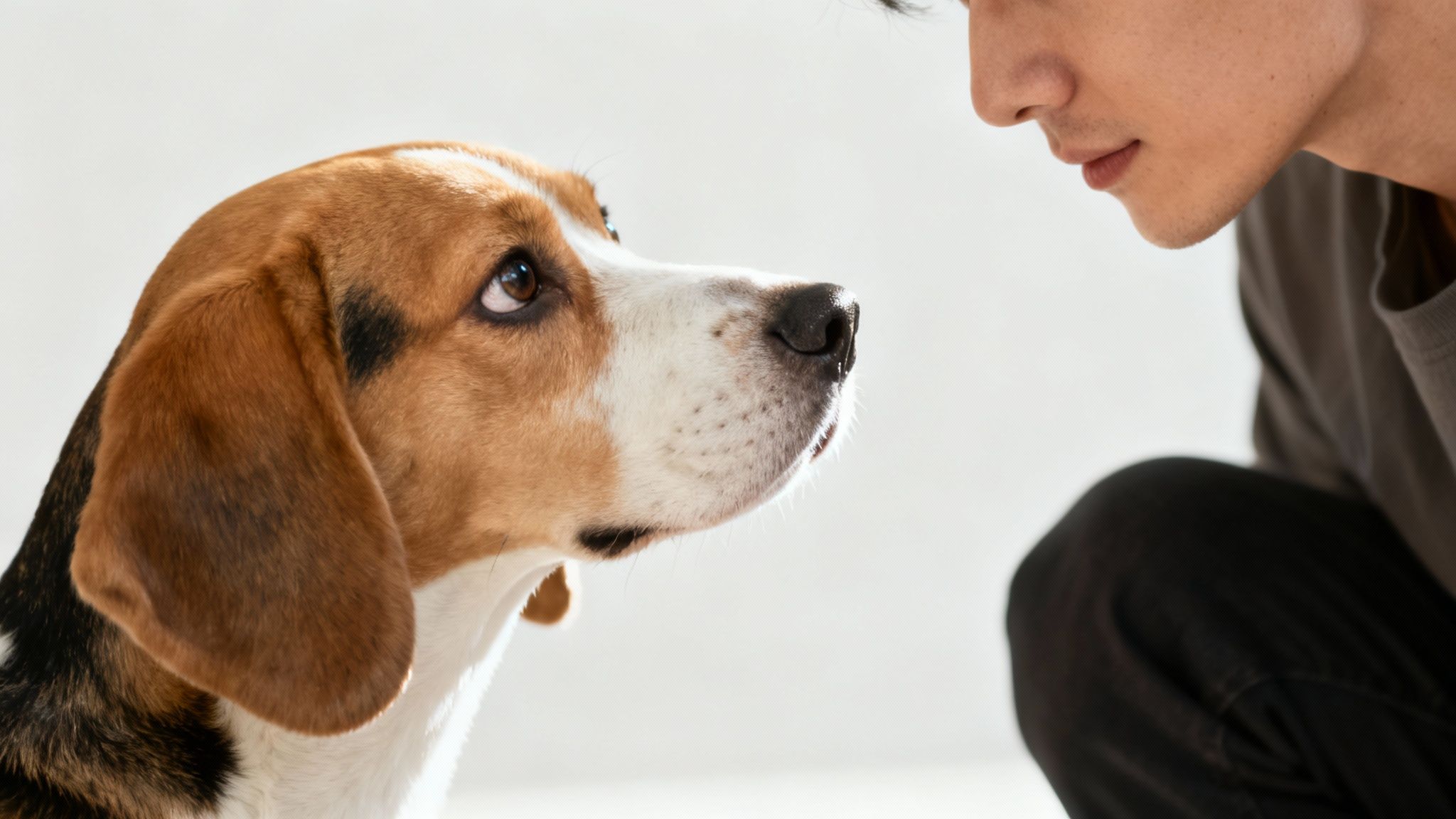
We’ve all been there. You’re at the park, repeatedly calling your dog’s name, and they shoot you a look that clearly says, "I'll get back to you on that." It’s so tempting to slap the "stubborn" label on them and call it a day.
But that one word misses the whole story. What if that so-called resistance is actually a sign of a highly intelligent, independent thinker?
Before we jump into training tactics, let's try to reframe the problem. That dog you think is being defiant is often just misunderstood. Seeing the world through their eyes is the single most important step toward building a training plan that finally clicks.
Uncovering the Real Reasons for Resistance
So many behaviors we call "stubborn" are actually hardwired into our dogs' DNA. For centuries, we've bred them for specific jobs that required them to think on their own, often miles away from any human telling them what to do.
Think about it: a Beagle who ignores your "come" command isn't being naughty. Their world-class nose has just locked onto an incredible scent, and every instinct is telling them that following that trail is their most important mission.
Likewise, a Jack Russell Terrier who’s digging up your prize-winning petunias isn't doing it out of spite. Their DNA is practically screaming at them to hunt for vermin. These aren't acts of disobedience—they're just your dog showing off their natural-born talents. Recognizing this is a game-changer.
It’s Not Always About Instincts
Breed traits are a huge piece of the puzzle, but not the only one. More often than not, a dog’s reluctance to follow a cue comes down to one of three things: they're confused, they're scared, or you just haven't made it worth their while.
-
A Communication Breakdown: Are you being consistent with your cues? If you switch between "come," "here boy," and "let's go," you might be confusing your pup. They aren't ignoring you on purpose; they genuinely don't understand what you want.
-
Environmental Overload: Ever notice how your dog has a perfect "sit" in the living room but completely ignores you at the busy park? They're likely overstimulated. The overwhelming sights, sounds, and smells make it impossible for them to focus on you.
-
A Motivation Mismatch: Sometimes, the reward just isn't good enough. A boring, dry biscuit probably won't convince a Hound to abandon the thrilling scent of a squirrel. You have to find what they find valuable.
If you’re struggling with your dog’s behavior, trust us, you are not alone. A study from Texas A&M found that over 99% of dogs show at least one moderate to severe behavioral issue. This just goes to show that these challenges are the norm, not the exception. You can find more canine behavior insights from that study to see how common these issues are.
The most cooperative dogs are the ones who understand what we want and believe that doing it is in their best interest. Stubbornness is often just a sign that one of those two elements is missing.
To help you get inside your dog's head, let's break down some common behaviors. This table helps you see past the 'stubborn' label and understand what your dog is likely communicating.
Decoding Your Dog's Behavior
| What You See (The 'Stubborn' Behavior) | What Your Dog Is Really Thinking or Feeling |
|---|---|
| Ignoring the "come" command at the park | "Wow, that squirrel is way more interesting than you right now!" or "I'm overwhelmed by all these new smells and sounds." |
| Pulling on the leash despite training | "I have to get to that fire hydrant! It's so important!" or "Walking at your pace is so boring." |
| Refusing to lie down on a wet or cold floor | "This surface is uncomfortable and I'd rather not." or "My joints are a little achy today." |
| Barking excessively at the window | "I'm doing my job! I'm alerting you to a potential threat outside!" |
| Not dropping a "stolen" item | "This is an amazing high-value prize! I don't want to give it up." |
Seeing these behaviors as communication rather than defiance is the first step toward finding a solution that works for both of you.
From Frustration to Understanding
The best path to training a strong-willed dog starts with a little empathy. Instead of seeing training as a battle of wills, try to see it as a collaborative puzzle you and your dog are solving together.
Your dog isn’t trying to undermine your authority. They're just communicating their needs, instincts, and feelings in the only way they know how.
When you shift your mindset from "I have a stubborn dog" to "I have a smart dog who needs clearer instructions," you build a solid foundation for success. This simple change turns training from a chore into a chance to deepen your bond, celebrate your dog’s incredible intelligence, and finally become a real team.
Finding Your Dog's Unique Motivation
If there's one secret weapon in your training arsenal, this is it. The key to working with a smart, independent dog isn't about showing them who's boss. It's all about connection and positive reinforcement.
This whole approach flips the script on old-school, punishment-based training, which often just causes a sensitive or clever dog to shut down completely. Instead of correcting what they do "wrong," we're going to enthusiastically reward the behaviors you want to see. This little shift in mindset is what turns a reluctant student into an eager partner.
Thankfully, modern dog training has moved on, and force-free methods are now the gold standard. This change comes from a much better scientific understanding of how dogs learn and what we, as owners, really want for our furry family members. You can actually read more about trends in dog training services and see just how much positive reinforcement has taken over.
Becoming a Motivation Detective
Your first job is to put on your detective hat and figure out what truly makes your dog tick. Every single dog has their own version of a winning lottery ticket—that one thing they find so irresistible they’ll happily work for it.
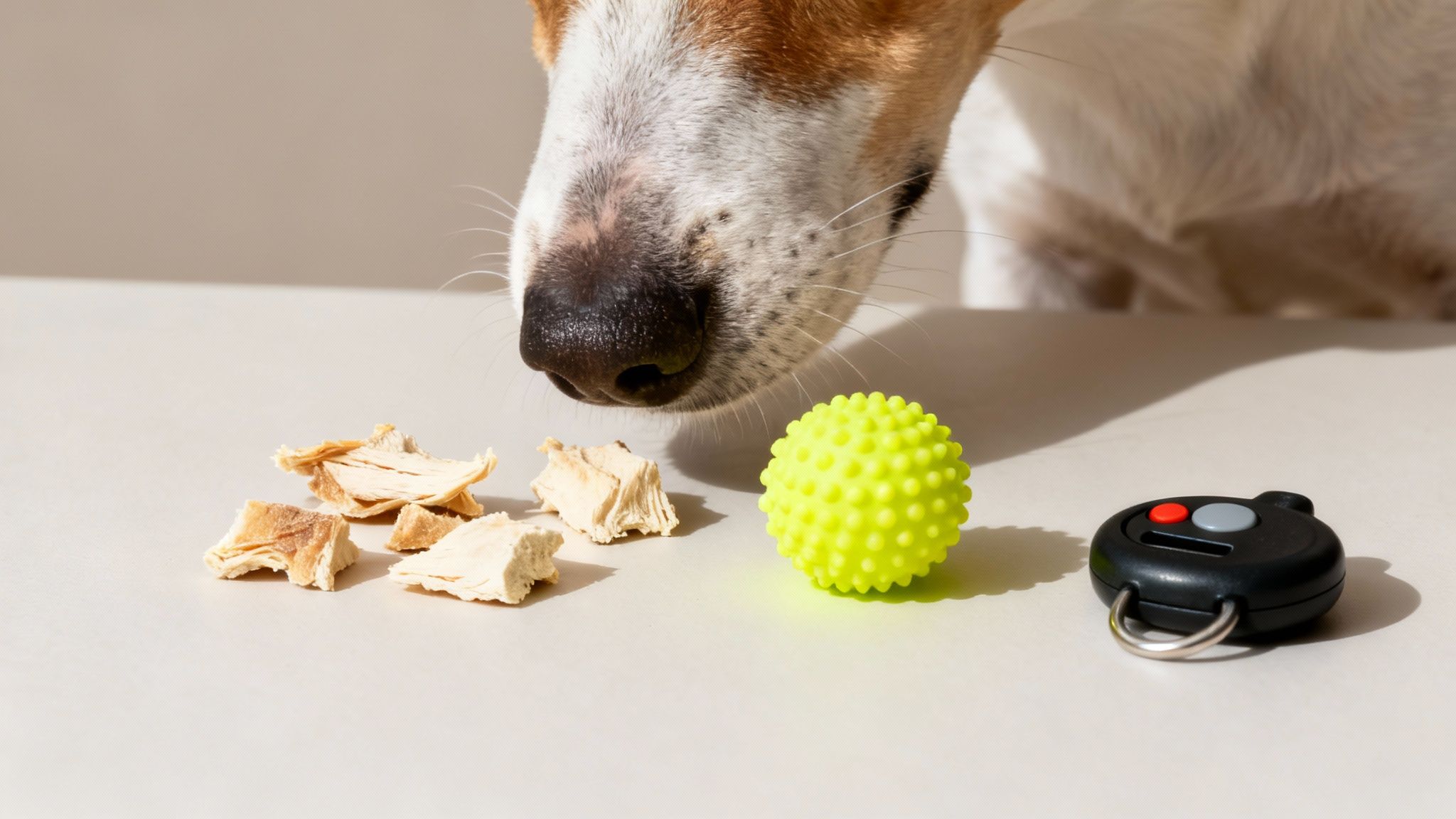
This "high-value currency" is different for every pup. For one of the dogs in our SetterFren pack, it’s a tiny piece of freeze-dried chicken. For another, it’s the chance to chase his favorite squeaky ball for ten seconds. For some dogs, it’s simply heartfelt praise and a good ear scratch. Don't just assume you know what your dog loves most, especially in a training situation.
The only way to know for sure is to experiment. Offer up a few different potential rewards and watch their reaction like a hawk. Do their eyes light up? Do their ears perk up and their focus sharpen? That’s the jackpot.
Understanding the Reward Hierarchy
Let’s be honest: not all rewards are created equal. You’d probably work a lot harder for a big promotion than for a free cup of coffee, right? Your dog is the same way, valuing things on a sliding scale. Getting a handle on this hierarchy is crucial for training a so-called stubborn dog.
It helps to create a mental list (or even write one down!) of your dog's motivators, ranking them from "meh" to "OMG, I'll do anything for that!"
- Low-Value Rewards: This is usually their standard kibble or a dry biscuit. These are fine for reinforcing skills they already know well in a quiet room with no distractions.
- Mid-Value Rewards: Think softer, smellier treats or a favorite chew toy. These work well when you're practicing commands with a few mild distractions around.
- High-Value Rewards: This is the good stuff! We're talking tiny bits of real meat, cheese, or that special toy that only comes out for training. These are your secret weapons for tackling brand-new skills or working in really distracting places, like the park.
One of the biggest reasons training sessions fail is using a low-value reward when a high-value one is needed. Why on earth would your dog come running back to you from chasing a squirrel just for a boring piece of kibble? It’s simply not a fair trade.
Think of high-value rewards as your dog's paycheck. If the job is tough, the pay needs to be great. Matching the reward to the difficulty of the task is a cornerstone of successful training.
How to Use Rewards Effectively
Once you've figured out what your dog truly loves, the next step is learning how and when to use it. Timing is everything. The reward has to happen immediately after the good behavior—we’re talking within a second or two—for your dog to connect the dots.
This is where a little tool called a clicker can be a game-changer. A clicker just makes a distinct "click" sound. You "charge" it by clicking and immediately giving a high-value treat, over and over, until your dog's ears perk up at the sound. From then on, you can use that click to mark the exact moment your dog does something right, then follow it up with the treat.
This precise timing clears up any confusion. Your dog learns that the click means, "YES! That's exactly what I wanted! A prize is on its way!"
Here are a few more tips to get the most out of your rewards:
- Keep It Short and Sweet: Aim for brief training sessions, maybe 5-10 minutes at a time. It's way better to have a few short, fun sessions throughout the day than one long, frustrating one. And always, always end on a high note!
- Mix It Up: Keep your dog on their toes by varying the rewards. Sometimes it's a treat, sometimes it’s a quick game of tug, and sometimes it's just a burst of excited praise. This unpredictability keeps them engaged and wondering what awesome thing they’ll get next.
- DIY High-Value Treats: Store-bought treats are convenient, but sometimes nothing beats the homemade stuff. Making your own lets you control the ingredients and find the perfect flavor combo that your dog will go absolutely nuts for. You can find some great ideas in our guide to simple and healthy homemade dog treat recipes.
By focusing on what drives your dog, you're doing more than just teaching commands. You're building a shared language based on trust, fun, and teamwork. This positive foundation is the most reliable way to train any dog—especially one with a wonderfully independent spirit.
Becoming a Five-Star Communicator
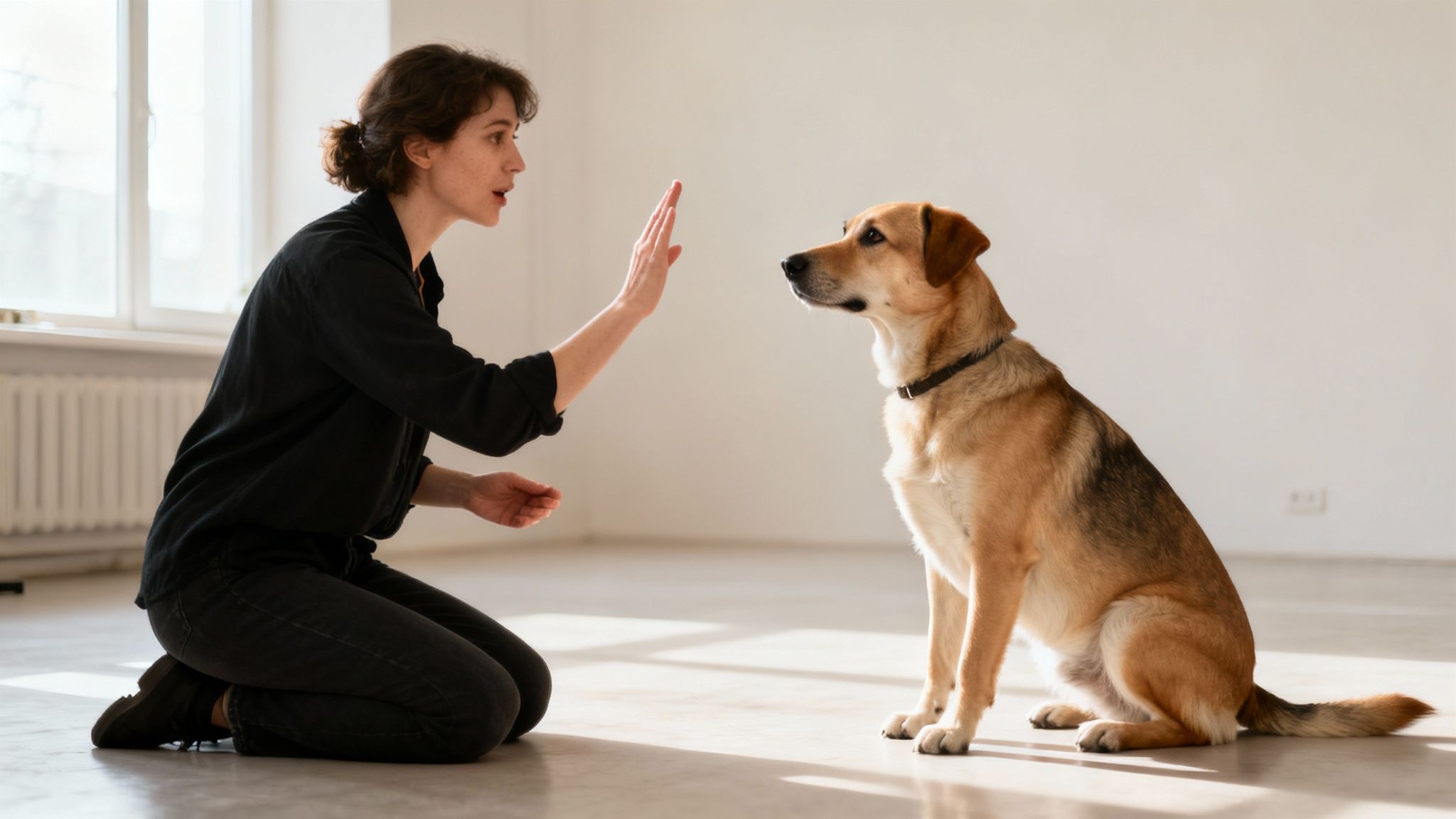
It's amazing how often a dog’s so-called "stubborn" streak just melts away the second they actually understand what we're asking. Try to think of yourself less as a trainer and more as a communication partner. Your main job is to make your requests so crystal clear that your dog can't help but succeed.
This isn’t about being louder or more forceful—it's about being more precise. A dog who seems defiant is often just lost in translation, trying to piece together our mixed signals. When you fine-tune how you communicate, you eliminate the guesswork, which makes it far easier and more rewarding for them to follow your lead.
Speak Their Language with Consistency
Consistency is the absolute bedrock of clear communication with a dog. Seriously. Imagine if the word for "hello" changed every day—you'd get confused and frustrated pretty fast. It’s the exact same for your dog.
Using the same verbal cue for the same command, every single time, is non-negotiable. If you want your dog to come, pick one word—like "Come" or "Here"—and stick to it like glue. Switching between "Come on," "Here boy," and whistling just muddies the waters.
The most cooperative dogs aren't necessarily the most obedient; they're the ones who have the least amount of confusion about what their human wants. Clear communication builds trust and eagerness.
This rule has to apply to everyone in the house, too. Make sure all family members are on the same page with the command words. This united front creates a predictable world for your dog, which makes a huge difference in how quickly they learn.
Add Hand Signals for a Power-Up
Want to really level up your communication? Pair each verbal cue with a distinct hand signal. Dogs are incredibly visual animals and often pick up on our physical movements much faster than our words. A consistent hand signal is like a secret decoder ring for them.
For example, our SetterFren community loves these simple starters:
- For "Sit": A simple, upward motion with your open palm.
- For "Down": Pointing a single finger straight toward the ground.
- For "Come": A big, sweeping motion with your arm toward your body.
Always use the same gesture with the same word. Before you know it, many dogs will respond to the hand signal alone. This is a lifesaver in noisy parks or as your dog gets older and their hearing might not be as sharp. You're giving them two ways to understand you, which is always better than one.
Learn to Listen with Your Eyes
Communication is a two-way street. While we’re so focused on sending clear signals, it's just as vital to learn how to read the signals our dogs are sending back. Their body language is a constant broadcast of their emotional state.
Little things like a quick lip lick, a yawn when they aren't tired, or turning their head away can all be calming signals. This is their way of saying, "I'm feeling a little stressed here," "I don't get it," or "I really need a break."
If you just push through when you see these signals, you’re setting you both up for frustration. Instead, take a step back. Ask for a simple behavior they know well, like "sit," reward them for it, and end the session on a high note. Learning to spot these tiny cues prevents them from getting overwhelmed and completely shutting down.
Your Own Body Language Speaks Volumes
Finally, don't forget that your own posture and tone of voice are huge communication tools. A dog isn't going to feel great about coming toward someone who is leaning over them, staring intently, and using a harsh tone. To them, that can feel intimidating or even confrontational.
Instead, make yourself inviting. When you call your dog, try crouching down and turning your body slightly to the side. Use a happy, upbeat tone of voice. This non-threatening posture and positive energy make you seem fun and safe to approach. By becoming this kind of five-star communicator, you'll find that many of the problems you chalked up to stubbornness simply disappear.
Turning Training Sessions Into Playtime
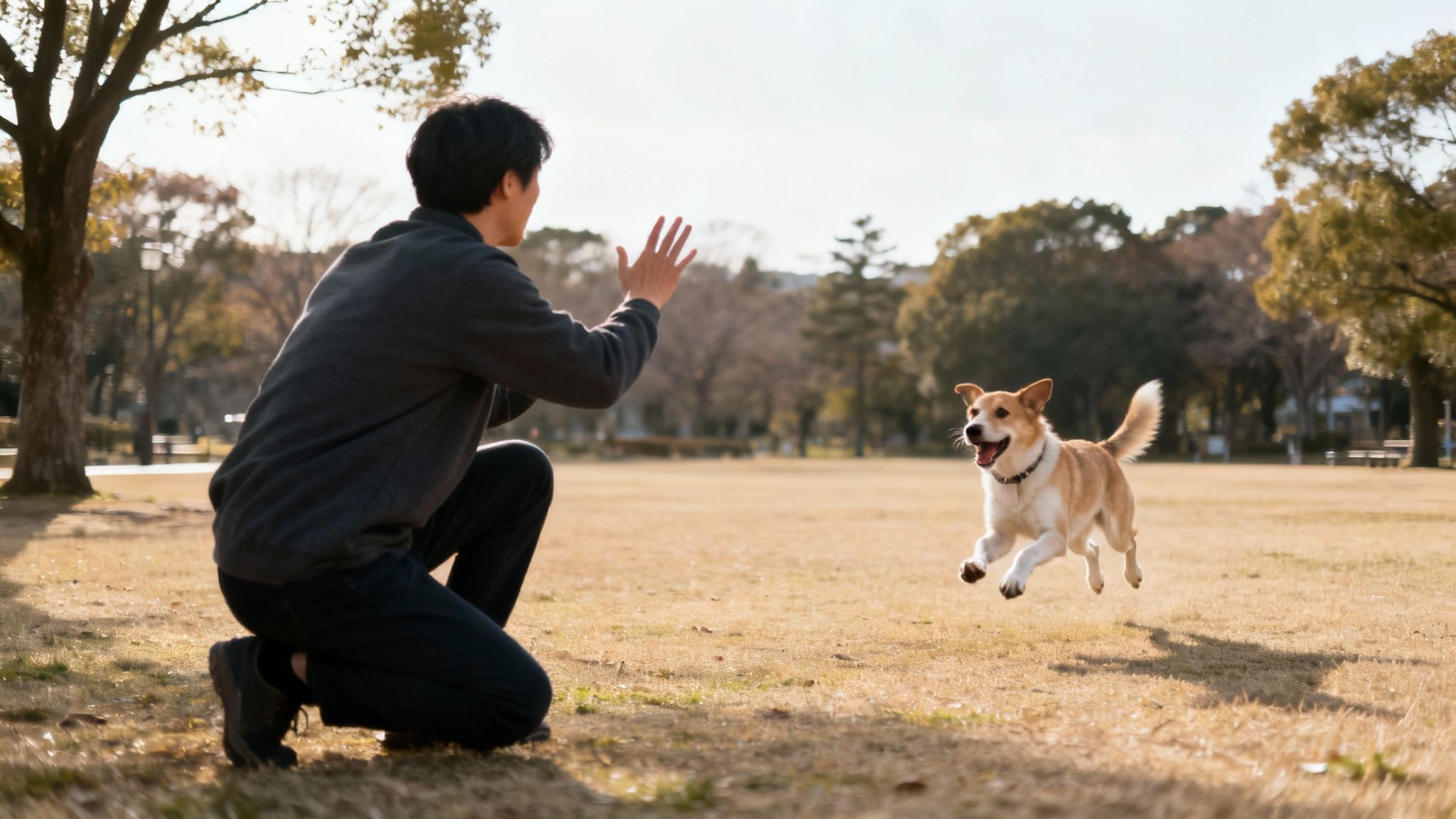
If you're dealing with a dog who has a big personality, you’ve probably discovered that repetitive drills are the fastest way to lose their interest entirely. The "sit, stay, treat" routine can become a total snoozefest for a clever dog who craves a real challenge.
It's time to stop the drills and start the games. The real secret to keeping your independent pup engaged is to make training the best game you play together. By weaving commands into activities they already love, you transform learning from a chore into an exciting adventure. This isn't just about having fun; it's about tapping into their natural drives and intelligence.
The Power of the Premack Principle
There’s a fantastic concept in dog training known as the Premack Principle, and it’s a game-changer for so-called stubborn dogs. The idea is wonderfully simple: use a high-probability behavior (something your dog absolutely loves to do) to reward a low-probability behavior (something you want them to do).
In plain English? You let your dog do what they want after they do what you want first. It’s like telling a kid they can have dessert after they finish their vegetables. This simple switch can completely transform your training dynamic from a power struggle into a true partnership.
Instead of fighting against your dog’s desires, you start using them as the ultimate reward. This is how you show them that listening to you leads directly to all the best things in life.
Creative Ways to Gamify Training
Ready to give it a shot? Here are some real-world examples of how to turn classic commands into your dog's new favorite games.
-
The "Sniffari" Walk: Does your dog live to sniff every single blade of grass on a walk? Instead of yanking them along, use it as your reward! Ask for just 10-15 seconds of loose-leash walking. The moment they give you that slack, say "Go sniff!" and let them have a full minute to explore that fascinating bush.
-
Hide-and-Seek Recall: Ditch the boring "come" command in the backyard and turn it into an exciting game. Have a family member gently hold your dog while you go hide behind a tree. When you're ready, call their name in your most excited voice. The moment they find you, throw a party with tons of treats and praise.
-
Puzzle Toy "Stay": This is a great way to reinforce a solid "stay." Ask your dog to stay, then place a food-stuffed Kong or puzzle feeder on the floor a few feet away. After a few seconds, release them with an enthusiastic "Okay!" to go get their prize. This teaches impulse control in a way that’s incredibly satisfying for them.
The goal is to make your dog think that cooperating with you is their own brilliant idea. When training feels like a game they can win, their eagerness to participate skyrockets.
Structuring Play for Maximum Learning
While making training fun is the primary goal, a little structure ensures you're still making progress. Remember that dogs with independent minds often have short attention spans for structured activities, so plan accordingly.
Keep your game-based sessions short and sweet—think 5 to 10 minutes at most. It's way more effective to have a couple of fun, short sessions throughout the day than one long, drawn-out training block where they might get bored or frustrated.
And most importantly, always end on a high note. If you're trying a new game and they're not quite getting it, switch back to a simple one they know and love. Let them have an easy win, shower them with rewards, and then end the session. This guarantees their last memory of "training" is a positive and successful one, making them excited for the next round.
Integrating these playful sessions can even prepare them for more social settings. You can learn more about the benefits of group activities in our look at the rise of dog social clubs. This whole approach builds a dog who doesn't just obey commands but actively looks for ways to engage with you, waiting for the next fun challenge you'll present.
Hitting a Wall? How to Troubleshoot Your Training
Let’s be real. Even with the best intentions and the tastiest treats, training isn’t a straight line. One day your dog is an A+ student, and the next, it’s like they have no idea what "sit" means. This is totally normal, especially with a strong-willed dog. Don't throw in the towel.
These bumps in the road aren't failures; they're just part of the process. They’re your chance to get creative, rethink your strategy, and actually build a stronger connection with your dog. Let's dig into some of the most common training snags and how to work through them.
What to Do When Their Favorite Treat Stops Working
You were sure you’d found it—the magic bullet. That smelly piece of freeze-dried liver that could get your dog to do anything. But today? They just give it a sniff and walk away. What happened?
Welcome to the world of treat fatigue. It's a real thing, particularly for clever dogs who get bored easily. When their go-to reward loses its sparkle, it's time to shake things up.
- Build a Reward Roster: Don't rely on just one high-value treat. Keep a few heavy hitters on rotation—bits of cheese, boiled chicken, salmon jerky—to keep things fresh and exciting.
- Check the Environment: Think about where you are. A treat that’s amazing in your quiet living room might be totally uninteresting when there's a squirrel taunting your dog from a tree branch. You often need to up the value of the reward to compete with big distractions.
Sometimes, it's not about the food at all. If your dog is stressed out or way too wound up, their desire to eat can vanish. In those moments, a quick game of tug or tossing their favorite squeaky toy might be the reward they actually want.
Tackling Distractions in the Real World
Nailing a "stay" in the hallway is one thing. Trying to get the same result at a busy park is a whole different ball game. For an independent-minded dog, the world is a buffet of fascinating sights and smells, and your cues can easily get lost in the noise.
The secret is to start small and build up slowly. You have to manage the environment to set them up for a win. Don't jump from practicing recall in your living room straight to an off-leash park. Start in your fenced yard. Once they're rocking it there, try it on a long line in a deserted corner of a park during a quiet time of day.
Think of it this way: Expecting your dog to focus in a chaotic place before they're ready is like asking a kid to do their homework at a carnival. It’s just not fair to them.
If your dog gets particularly reactive or lunges at other dogs on walks, you're dealing with a more specific challenge. For a deep dive into that, our guide on handling leash reactivity and dog aggression offers some fantastic, targeted advice.
Knowing When It's Time to Call a Pro
You've tried it all. You've switched up the treats, made training a game, and kept your sessions short and sweet, but you're still stuck. Sometimes, the smartest move you can make is to bring in a professional. There's zero shame in asking for help.
In fact, you're in good company. The global market for dog training services hit USD 36.46 billion in 2024 and is expected to keep growing. That's a whole lot of dog owners looking for expert guidance. You can discover more about the growth of dog training services and see just how common it is to seek professional help.
So, how do you know it's time to make that call?
- You're Going Backwards: Your dog had a skill down pat, but now they're consistently blowing it off, or old, bad habits are creeping back in.
- You're Feeling Burnt Out: If your patience is worn thin and you feel yourself getting frustrated or resentful, a trainer can provide a fresh perspective and support for you, not just your dog.
- The Behavior Is Scary: Any signs of aggression, resource guarding, or intense fear need a professional's eye, and fast. This is about keeping everyone safe.
- You've Hit a Plateau: You've made some great progress, but now you feel like you're just spinning your wheels and can't break through to the next level.
A certified trainer or veterinary behaviorist can spot subtle things you might be missing. They'll give you a game plan designed specifically for your dog's personality and your family's situation, helping you finally get over that hurdle.
Got Questions? We've Got Answers
You're not alone in this. Training a dog with a mind of their own brings up a lot of questions. Here are some of the most common ones we hear from our SetterFren community, along with some straight-up advice.
When you're dealing with a particularly tough training puzzle, it's easy to feel like you're the only one. But trust us, the questions you're asking are the same ones countless other dedicated dog owners are thinking about. Let's tackle a few of them head-on.
What Are the Biggest Mistakes People Make When Training a Stubborn Dog?
This is a big one. By far, the most common pitfall is letting frustration take over and falling back on punishment or force. This is a surefire way to break down trust. Instead of a willing partner, you end up with a dog who is anxious, fearful, and even less likely to cooperate.
Another classic mistake is being inconsistent. Dogs thrive on clear rules. If "off the couch" means "off the couch" sometimes, but not when you're tired, your dog gets confusing mixed signals. When one person lets them jump up and another scolds them for it, the dog will eventually just tune out the noise.
A huge misstep is writing a dog off as 'dominant' or just plain 'bad.' Their behavior is communication. They're telling you they don't understand, they're scared, or that the reward you're offering just isn't worth their time.
Finally, a surprisingly common error is making training sessions too long. A clever dog gets bored fast. Your goal should be to end the session while they're still having fun, not when they've already checked out. Keep it short, keep it fun, and they'll be eager for the next round.
How Long Until I Actually See Some Progress?
Ah, the million-dollar question! The honest-to-goodness answer is that every dog learns at their own pace. There’s no set-in-stone timeline, especially when you’re working to reshape habits that have been around for a while. It all comes down to your dog's unique personality, their past experiences, and how consistent you are.
That said, if you stick with short, positive sessions—we're talking just 5-10 minutes a couple of times a day—you’ll likely notice small but significant changes within a few weeks. It might just be that they start looking to you for direction more often or offer a "sit" without you having to ask five times.
For the really tricky behaviors, it’s more of a marathon than a sprint. The real goal isn't to achieve perfection overnight. It's about celebrating those small victories and building a stronger, more communicative relationship. The big results will come from that foundation.
Can You Really Teach an Old, Stubborn Dog New Tricks?
Yes, a thousand times yes! That old saying is one of the biggest myths in the dog world. An older dog might have some deeply ingrained habits, and they might not pick things up as quickly as a puppy, but they are absolutely capable of learning.
In fact, training is an incredible way to keep a senior dog's mind engaged and their spirits high. The approach is the same as with any dog:
- Patience is your absolute best friend.
- Find extra-tasty, easy-to-chew treats to keep them motivated.
- Keep your sessions short and sweet to match their energy.
- Pile on the gentle praise and affection.
Training your senior dog is a beautiful way to connect with them in their golden years. It reinforces your bond and proves that it’s never too late to learn something new together.
Here at SetterFren, we believe life's better with a wagging tail and a good book. For more practical how-to guides, honest reviews of top dog products, and to join our Puppicino Club for member perks, check out all our resources at https://setterfren.com.