
Welcome to SetterFrens, a cozy online community where we believe life is always better with a wagging tail and a good book! A well-trained dog isn't just about obedience; it's about building a language of love, respect, and trust that deepens your bond and makes daily life more enjoyable for everyone. Whether you're welcoming a new puppy into your pack or refining an old pro's skills, the right approach makes all the difference. This guide cuts through the noise to bring you our favorite dog training tips and tricks that are practical, positive, and proven to work.
We've packed this listicle with practical how-to guides you can start using today. You'll learn the core principles behind successful training, from harnessing the power of positive reinforcement and clicker training to establishing the consistent routines your pup craves. We'll also dive into specific techniques for tackling common challenges, such as impulse control, fear-based reactions, and proper socialization. Our goal is to help you care for your pup like a pro, turning potentially frustrating training sessions into fun, rewarding experiences. Ready to transform your training journey and unlock your dog's true potential? Let's get started!
1. Positive Reinforcement Training
Positive reinforcement is more than just a training method; it's a way to build a strong, trusting relationship with your dog. This scientifically-backed approach focuses on rewarding the behaviors you want to see, making your dog an enthusiastic participant in their own learning. Instead of correcting "bad" behavior, you actively teach and reward the "good" behavior, increasing the chance your dog will repeat it.
This technique is incredibly effective because it makes learning a fun game for your pup. They learn that good things happen when they perform specific actions, like sitting politely or coming when called. It’s the cornerstone of modern, humane dog training and one of the most essential dog training tips and tricks for any owner to master.
How to Use Positive Reinforcement
- Reward Immediately: Deliver the reward (a dog-friendly treat, praise, or a favorite toy) within two seconds of the desired behavior. This timing helps your dog connect the action with the reward.
- Start with High-Value Treats: When teaching a new skill, use extra-special treats to keep your dog highly motivated. For some inspiration, you can explore recipes for delicious homemade dog treats your pup will love.
- Keep Sessions Short: Hold brief, frequent training sessions of 5-10 minutes. This prevents your dog from getting bored or frustrated and keeps them excited for the next lesson.
- Be Consistent: Ensure everyone in your pack uses the same commands and rewards to avoid confusing your dog. Consistency is key to clear communication and faster learning.
This approach builds confidence and strengthens your bond, turning training from a chore into a joyful, shared activity.
2. Clicker Training
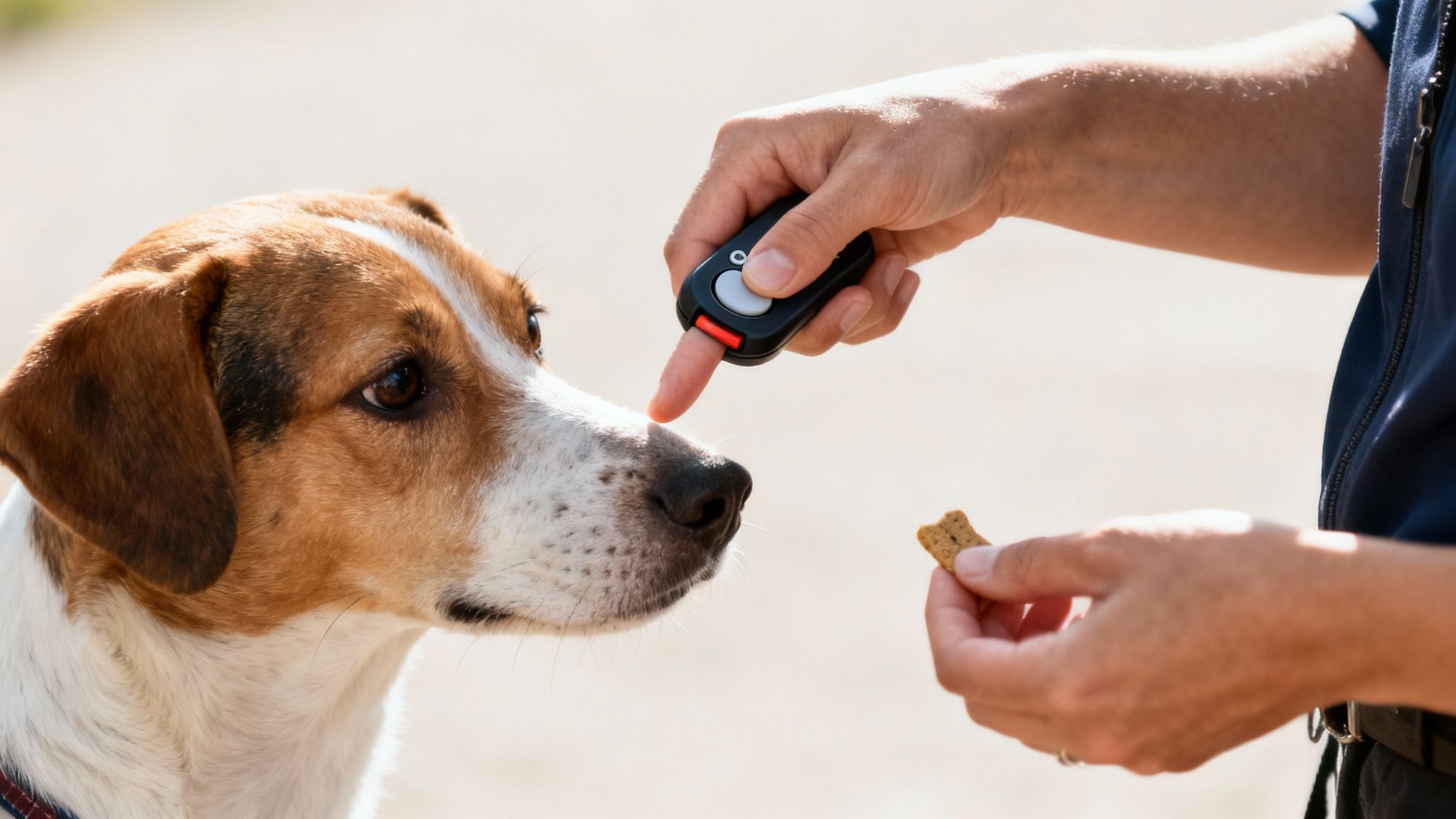
Clicker training is a powerful form of marker training that uses a distinct sound to pinpoint the exact moment your dog does something right. This technique, popularized by trainers like Karen Pryor, uses a small handheld device that makes a "click" sound. The click acts as a clear signal, or "bridge," telling your dog, "Yes, that's exactly what I wanted!" before they receive their reward.
This method transforms training by creating crystal-clear communication. Because the click is faster and more consistent than a verbal marker like "good boy," it captures the precise behavior, helping your dog learn complex actions with remarkable speed. It's a fantastic tool and one of the most effective dog training tips and tricks for teaching new skills, from basic commands to heartwarming tricks.
How to Use Clicker Training
- Charge the Clicker: First, teach your dog that the click means a treat is coming. Simply click the device and immediately give your dog a high-value treat. Repeat this about 10-15 times until your dog looks for the treat upon hearing the click.
- Click for Behavior: Once your dog understands the click, start using it to mark desired behaviors. The instant your dog sits, lies down, or offers another action you want, click that exact moment and then give the treat.
- Keep It Quick and Positive: Sessions should be short, fun, and held in a low-distraction environment to start. This keeps your dog engaged and eager to learn without becoming overwhelmed.
- One Click, One Treat: Every single click must be followed by a reward, even if you clicked by accident. This maintains the power and reliability of the clicker as a positive signal.
By providing instant, clear feedback, clicker training builds your dog's confidence and makes them an active, thinking partner in the training process.
3. Consistency and Routine
Imagine trying to learn a new language where the rules change every day; it would be incredibly confusing. For your dog, consistency is the language of learning. Establishing predictable patterns, rules, and responses creates a clear and stable environment where your dog understands what is expected of them, which dramatically speeds up the training process.
Dogs thrive on predictability, from mealtimes to training commands. When every family member uses the same cues and enforces the same rules, your dog isn't left guessing. This clarity reduces anxiety and builds confidence, making them more receptive to learning. Applying a consistent structure is one of the most effective dog training tips and tricks because it lays the foundation for all other training efforts to succeed.
How to Implement Consistency and Routine
- Create a Household Rulebook: Write down the rules and commands (e.g., "off" for the couch, "wait" at the door) and post them where everyone can see. This ensures all members of your pack are on the same page.
- Establish a Predictable Schedule: Set fixed times for meals, potty breaks, walks, and training sessions. A predictable schedule helps regulate your dog's energy levels and expectations throughout the day.
- Use Identical Command Words: Decide on one clear verbal cue for each action and stick to it. If one person says "down" and another says "off" for the same behavior, it creates confusion.
- Be Consistent with Boundaries: If a rule is no jumping on guests, it must apply to all guests, every single time. This same principle is crucial for successful crate training; for more guidance, explore our detailed guide on how to crate train a dog.
This commitment to routine turns your home into a secure, understandable world for your dog, allowing them to learn and grow with confidence.
4. Desensitization and Counter-Conditioning
This powerful two-part technique is designed to change your dog's emotional response to something they find scary, stressful, or overly exciting. Desensitization involves gradually exposing your dog to their trigger (like other dogs, loud noises, or the vacuum cleaner) at a very low intensity, while counter-conditioning works to replace the negative feeling with a positive one, usually by pairing the trigger with high-value treats.
Instead of just managing a reaction, you are actively changing your dog's underlying feelings from "scary" to "safe" or even "good." This is one of the most effective and humane dog training tips and tricks for addressing fear, anxiety, and reactivity. It empowers your dog to feel more confident and secure in situations that once caused them distress.
How to Use Desensitization and Counter-Conditioning
- Identify the Threshold: Find the exact distance or intensity where your dog notices a trigger but doesn't react negatively. This is your starting point. Forcing them closer will only make the fear worse.
- Pair with Positives: The moment your dog notices the trigger from their safe distance, immediately give them a super high-value treat, like a small piece of chicken or cheese. The dog-friendly treat stops when the trigger disappears.
- Progress Slowly: Keep sessions very short (just a few minutes) and end on a positive note. Gradually decrease the distance or increase the intensity of the trigger over many sessions, always staying below your dog's reaction threshold.
- Manage the Environment: In between training sessions, do your best to avoid situations where your dog will be pushed over their threshold. This prevents them from rehearsing the fearful behavior.
This method is particularly crucial for addressing issues like fear-based reactivity on walks. For a more detailed guide, you can learn more about managing dog aggression on leash on setterfren.com.
5. Capture Training
Capture training is a brilliant, low-pressure way to teach your dog new behaviors by simply rewarding them for things they do naturally. Instead of luring or prompting your dog, you "capture" a desirable action the moment it happens. This passive method empowers your dog to think independently and offer behaviors on their own, making them an active partner in the training process.
This technique is especially powerful because it teaches your dog that good things can happen anytime, not just during formal training sessions. It encourages them to experiment and repeat behaviors that have earned them a reward in the past. Mastering this is one of the more subtle yet effective dog training tips and tricks that can accelerate learning and build your dog’s confidence.
How to Use Capture Training
- Be Prepared: Always have treats handy around the house. You never know when your pup will spontaneously offer a perfect sit, a cute head tilt, or a calm lie-down that you’ll want to reward.
- Mark the Moment: Use a clicker or a verbal marker like "Yes!" the instant your dog performs the desired action. For example, if your dog sits politely while you're cooking, mark the moment they sit and immediately give them a treat.
- Stay Patient and Observant: This method requires you to be a good dog-watcher. Pay attention to your pup's natural behaviors. You might capture them lying on their mat, making eye contact, or even offering a paw without being asked.
- Keep it Spontaneous: The beauty of capture training is its organic nature. Don't turn it into a high-pressure session. Simply reward the good choices your dog makes throughout the day to reinforce those behaviors naturally.
By capturing these moments, you communicate to your dog exactly what you like, encouraging them to repeat those behaviors more often and turning everyday life into a fun learning opportunity.
6. Luring and Shaping
Luring and shaping are two powerful, hands-off techniques for teaching your dog new behaviors, from simple sits to complex tricks. Luring involves using a high-value treat or toy to guide your dog into a specific position, while shaping involves rewarding small, successive steps that build toward a final, more complex behavior. Both methods empower your dog to think and problem-solve independently.
These techniques are brilliant because they make training feel like a puzzle your dog gets to solve, with a tasty reward at the end. By encouraging your dog to figure things out, you build their confidence and make learning a proactive, engaging experience. Mastering these methods will add some advanced tools to your collection of dog training tips and tricks.
How to Use Luring and Shaping
- Start with a Visible Lure: Begin by holding a treat in your hand to guide your dog. For example, to teach "lie down," lure their head down from a sit position by moving the treat toward the floor between their paws.
- Fade the Lure Gradually: Once your dog understands the motion, start doing it with an empty hand (a "ghost lure") and reward them from your other hand. The goal is to transition to a simple hand signal.
- Shape in Small Steps: When shaping, break the target behavior into tiny, achievable increments. To teach a "bow," you might first reward a head dip, then a slight shoulder drop, and slowly build up to the full position.
- Introduce Verbal Cues: Once the behavior is reliable with your hand signal, start saying the command word just before you give the signal. Your dog will quickly associate the word with the action.
7. Impulse Control and 'Wait' Training
Teaching your dog impulse control is like giving them the superpower of patience. This training focuses on building their ability to pause and resist the urge to react immediately to exciting things like food, an open door, or a favorite toy. Instead of lunging for what they want, they learn to wait for your permission, which is a foundational skill for safety and good manners.
This technique is a game-changer because it addresses the root of many behavioral issues, such as jumping, bolting, and resource guarding. A dog with good impulse control is calmer, more focused, and easier to manage in distracting situations. Mastering this is one of the most practical dog training tips and tricks for creating a well-behaved and reliable companion.
How to Teach Impulse Control
- Start with the Food Bowl: Place your dog’s food bowl on the floor but keep your hand on it. Ask them to "Wait." The moment they look away from the bowl and at you, release them to eat with an "Okay!" cue.
- Master the Doorway: Ask your dog to sit and "Wait" before you open an outside door. Only allow them to go through after you give a release word. This prevents dangerous bolting into the street.
- Practice with Toys: Hold a favorite toy and tell your dog to "Wait." When they pause instead of trying to grab it, reward them by initiating a game of fetch or tug.
- Keep It Short and Sweet: Begin with waits of just one or two seconds and gradually increase the duration as they succeed. Keep sessions positive and end on a high note.
This skill translates to nearly every aspect of your dog's life, strengthening their focus and reinforcing your role as a calm and consistent leader.
8. Socialization and Exposure Training
Socialization is about more than just letting your puppy play with other dogs; it's the process of carefully exposing them to new sights, sounds, and experiences in a positive way. This crucial training, especially effective before 16 weeks of age, helps your dog build confidence and develop into a well-adjusted adult who is less likely to react with fear or aggression to unfamiliar situations.
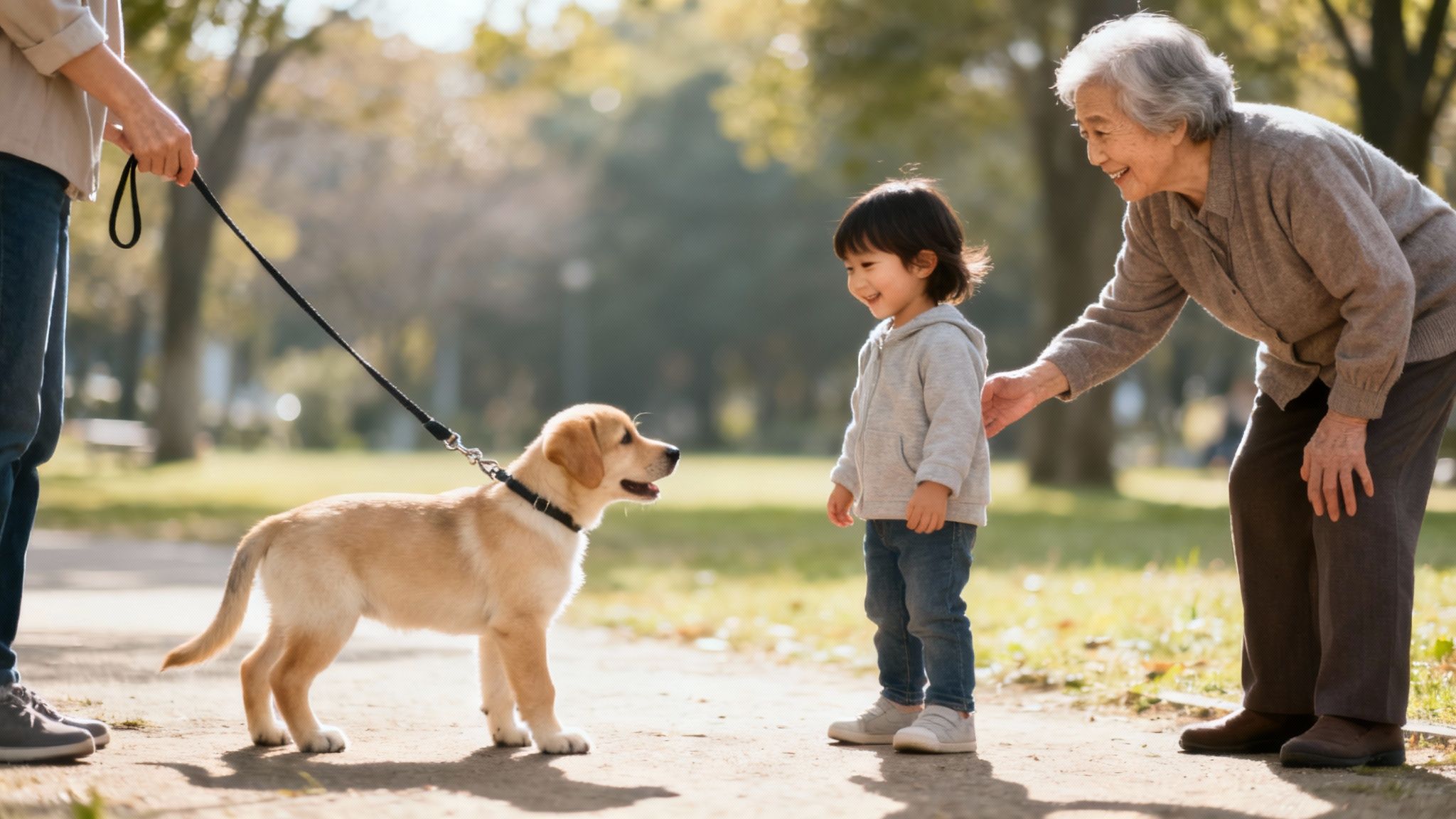
Proper exposure training helps your dog understand that the world is a safe, exciting place rather than a scary one. It involves introducing them to various people, surfaces, noises, and environments in a controlled manner, making it one of the most proactive dog training tips and tricks for preventing future behavior issues.
How to Use Socialization and Exposure Training
- Start Early but Safely: Begin socialization as soon as your veterinarian gives the okay, typically after the first round of vaccinations around 8 weeks old. The critical window for socialization closes around 16 weeks, so early, safe exposure is vital.
- Keep It Positive and Brief: Every new experience should be paired with something your dog loves, like high-value, dog-friendly treats or praise. Keep interactions short and sweet to prevent your pup from becoming overwhelmed or fearful.
- Go at Their Pace: Never force your dog into a situation that makes them uncomfortable. If they show signs of stress (tucking their tail, yawning, lip licking), calmly remove them from the environment and try again later from a greater distance.
- Create Diverse Experiences: Aim to introduce your puppy to a wide variety of stimuli. This can include walking on different surfaces like grass, pavement, and carpet; hearing household sounds like vacuums and blenders; and safely meeting people of all ages and appearances.
This foundational training helps shape a calm, confident companion who can handle life's adventures with a happy, wagging tail.
9. Establishing Leadership and Clear Boundaries
Establishing clear leadership is not about dominance; it's about being a calm, consistent, and trustworthy guide for your dog. When your dog sees you as a reliable leader, they feel more secure and understand their place within the family structure. This sense of order reduces anxiety and unwanted behaviors by providing a predictable environment where the rules are clear.
This approach involves creating structure through consistent rules and predictable responses. By setting and maintaining firm boundaries, you teach your dog self-control and respect. This is one of the most fundamental dog training tips and tricks because it forms the foundation for a well-behaved companion and a peaceful home life, ensuring everyone knows what to expect.
How to Establish Leadership and Boundaries
- Create Structured Routines: Maintain consistent feeding, walking, and sleeping schedules. Predictability helps your dog feel secure and understand that you are in control of valuable resources.
- Teach "Wait" at Thresholds: Have your dog sit and wait for your permission before going through doorways, getting out of the car, or eating their food. This simple exercise reinforces your role as the decision-maker.
- Ignore Demanding Behavior: If your dog barks, paws, or nudges for attention, ignore the behavior until they are calm. Reward them with praise or a pat only when they are settled, teaching them that polite behavior gets results.
- Be Calm and Confident: Your dog mirrors your energy. Use a calm, confident voice and body language when giving commands. This reassures your dog that you are a capable and dependable leader they can trust.
10. Redirect and Substitute Behavior
Redirecting and substituting behavior is a powerful, proactive training technique that teaches your dog what you want them to do, rather than just punishing what you don't. Instead of simply saying "no" to an unwanted action like chewing on a shoe, you guide your dog toward an acceptable alternative, like a chew toy, and then praise them for making the right choice. This method transforms a potential conflict into a positive learning moment.
This approach is one of the most effective dog training tips and tricks because it prevents unwanted habits from forming and reinforces good ones. It empowers your dog to make better choices on their own, building their confidence and problem-solving skills. By showing them the correct outlet for their natural instincts, you create a clear path to success and a more harmonious home environment.
How to Use Redirection and Substitution
- Anticipate and Intervene: Watch for signs your dog is about to engage in an unwanted behavior. For example, if your puppy starts sniffing the leg of the coffee table, calmly redirect them to their toy basket before they start chewing.
- Make the Alternative More Appealing: Ensure the substitute is more exciting than the forbidden item. A high-value chew toy or a quick game of tug is often more enticing than a boring piece of furniture.
- Reward the Switch: When your dog successfully redirects their attention to the appropriate item, reward them enthusiastically with praise or a small treat. This reinforces their good decision.
- Practice in Calm Moments: Don't wait for a problem to arise. Practice redirecting your dog’s attention during calm moments to build a strong foundation, making it easier for them to respond when they are overexcited or distracted.
This strategy effectively replaces "bad" habits with "good" ones, teaching your dog the house rules in a positive, encouraging way.
Comparison of 10 Dog Training Methods
| Method | 🔄 Implementation complexity | ⚡ Resource requirements | ⭐📊 Expected outcomes | 💡 Ideal use cases | Key advantages |
|---|---|---|---|---|---|
| Positive Reinforcement Training | Medium — needs timing & consistency | Medium — treats, time, handler attention | ⭐⭐⭐⭐⭐ — reliable obedience, low stress, strong bond | All ages; general obedience & behavior change | Humane; fast learning; versatile |
| Clicker Training | Medium — requires precise timing practice | Low — clicker + treats; keep accessible | ⭐⭐⭐⭐ — very precise marking, accelerates learning | Complex behaviors; service, performance, agility | High precision; consistent across trainers |
| Consistency and Routine | Medium — requires household commitment | Low — planning, time, coordination | ⭐⭐⭐⭐ — faster generalization; fewer problems | Puppies, multi-handler homes, daily management | Reduces confusion/anxiety; easy to maintain |
| Desensitization & Counter‑Conditioning | High — threshold control; gradual progression | High — time, controlled exposures, possible pro help | ⭐⭐⭐⭐⭐ — long-term fear reduction; root‑cause change | Fear, phobias, reactivity, aggression cases | Addresses underlying emotion; lasting change |
| Capture Training | Low — observational patience required | Low — treats, constant readiness | ⭐⭐⭐ — builds voluntary behaviors; slower to schedule | Shy/anxious dogs; shaping novel or spontaneous behaviors | Encourages problem-solving; boosts confidence |
| Luring & Shaping | Medium — skill to shape and fade lures | Medium — treats/toys, repeated sessions | ⭐⭐⭐⭐ — quick for basic to complex behaviors | Teaching commands, tricks, agility sequences | Predictable; efficient for visual learners |
| Impulse Control / "Wait" Training | Medium — needs consistent practice & generalization | Low–Medium — time, frequent short sessions | ⭐⭐⭐⭐ — improves safety; reduces many incidents | Doorways, feeding, greetings, service tasks | Preventative foundation; increases handler control |
| Socialization & Exposure Training | High — planned, time‑sensitive, controlled | High — varied environments, health precautions | ⭐⭐⭐⭐⭐ — confident, adaptable dogs; prevents fear | Puppies (critical period), under‑socialized dogs | Best preventive measure; broad behavioral impact |
| Establishing Leadership & Clear Boundaries | Medium — requires behavior change from humans | Low — consistency, routine, management | ⭐⭐⭐⭐ — clearer expectations; reduced uncertainty | Household structure, multi-dog homes, resource control | Provides security; complements positive methods |
| Redirect & Substitute Behavior | Medium — anticipation & quick response needed | Low — alternative toys/items, management | ⭐⭐⭐ — replaces unwanted actions when timely | Jumping, chewing, leash reactivity, attention-seeking | Teaches acceptable alternatives; less punitive |
Continue Your Journey with SetterFrens
As we wrap up our deep dive into these essential dog training tips and tricks, it's clear that building a strong, positive relationship with your canine companion is a beautiful blend of art and science. From the precision of clicker training to the patient application of desensitization and counter-conditioning, each technique is a tool in your belt, ready to help you communicate more effectively with your best friend. The journey isn't about achieving perfection overnight; it's about celebrating the small wins and fostering a bond built on mutual trust and understanding.
Remember, the core principles we've explored are designed to work together. Positive reinforcement is the foundation, creating a joyful and motivating learning environment. Consistency and routine provide the structure and predictability your dog craves, while techniques like luring and shaping help break down complex behaviors into manageable, achievable steps. By mastering concepts like impulse control and establishing clear boundaries, you're not just teaching commands; you're teaching your dog how to navigate the human world confidently and safely.
Your Actionable Path Forward
So, what’s next? Don't let this be just another article you read and forget. It's time to put these dog training tips and tricks into action.
- Start Small: Choose one or two techniques that resonate with you and address a specific challenge you're facing. If your dog jumps on guests, focus on redirecting their behavior and practicing the 'Wait' command. If they're nervous around the vacuum cleaner, begin a gentle counter-conditioning process.
- Create a Plan: Dedicate just 5-10 minutes, two or three times a day, to focused training sessions. Short, frequent sessions are far more effective than long, draining ones. Write down your goals and track your progress to stay motivated.
- Stay Patient and Positive: Your energy is contagious. If you become frustrated, your dog will sense it, and the training session will become counterproductive. Always end on a high note with a successful command or a fun game of tug. Every interaction is an opportunity to strengthen your connection.
This journey is a marathon, not a sprint. Embracing these methods means you're investing in a lifetime of clear communication, fewer behavioral headaches, and a profoundly deep connection with your dog. The effort you put in today will pay off for years to come, resulting in a well-behaved companion who is a true joy to have as part of your family. Keep learning, stay consistent, and most importantly, have fun with your amazing pup.
Ready to dive even deeper into the world of canine companionship? At Setterfrens LLC, we celebrate the unique bond between people and their dogs through our curated selection of dog-themed books, honest reviews of top dog products, and practical how-to guides just like this one. Join our Puppicino Club to unlock member perks, book updates, and dog-friendly treats. Visit Setterfrens LLC to learn more, and stay part of the fun by following @setterfrens on TikTok and Instagram for heartwarming dog moments and behind-the-scenes content from our growing pack
