
So, you're thinking about bringing an Irish Setter into your life. Fantastic choice! The journey to finding your new best friend starts with a big decision: do you go through a reputable breeder or give a deserving dog a second chance through adoption?
Both paths lead to the same wonderful place—a home filled with wagging tails and unconditional love.
Starting Your Irish Setter Adventure
Welcome to the SetterFren family! Deciding to add an Irish Setter to your home is a huge, exciting step. These stunning, high-energy dogs are incredible companions, but figuring out how to do it all responsibly can feel like a lot to take on.
Don't worry, we're here to walk you through it. This guide is your roadmap to avoiding common pitfalls and starting this adventure with confidence.
We're going to cover everything you need to know to make a smart choice for both you and your future furry family member. Think of it as your personal checklist for making sure you get this right.
By the end, you'll understand:
- The key differences between working with a breeder and adopting from a rescue.
- How to spot a genuinely ethical breeder who puts their dogs' well-being first.
- The essential questions you absolutely have to ask before committing.
- The true costs involved, from the initial price tag to all those first-year necessities.
Deciding Your Path: Breeder or Rescue?
The first fork in the road is choosing between a breeder for a puppy with a known lineage or opening your home to a dog from a rescue. There's no "right" answer here—it's all about what fits your lifestyle and what you're looking for in a companion.
If you're already smitten with their goofy energy and loving nature, you can get a better sense of what you're in for by reading up on the classic Irish Setter personality traits in our detailed guide.
This decision tree can help you visualize which option might be the best fit for your family.
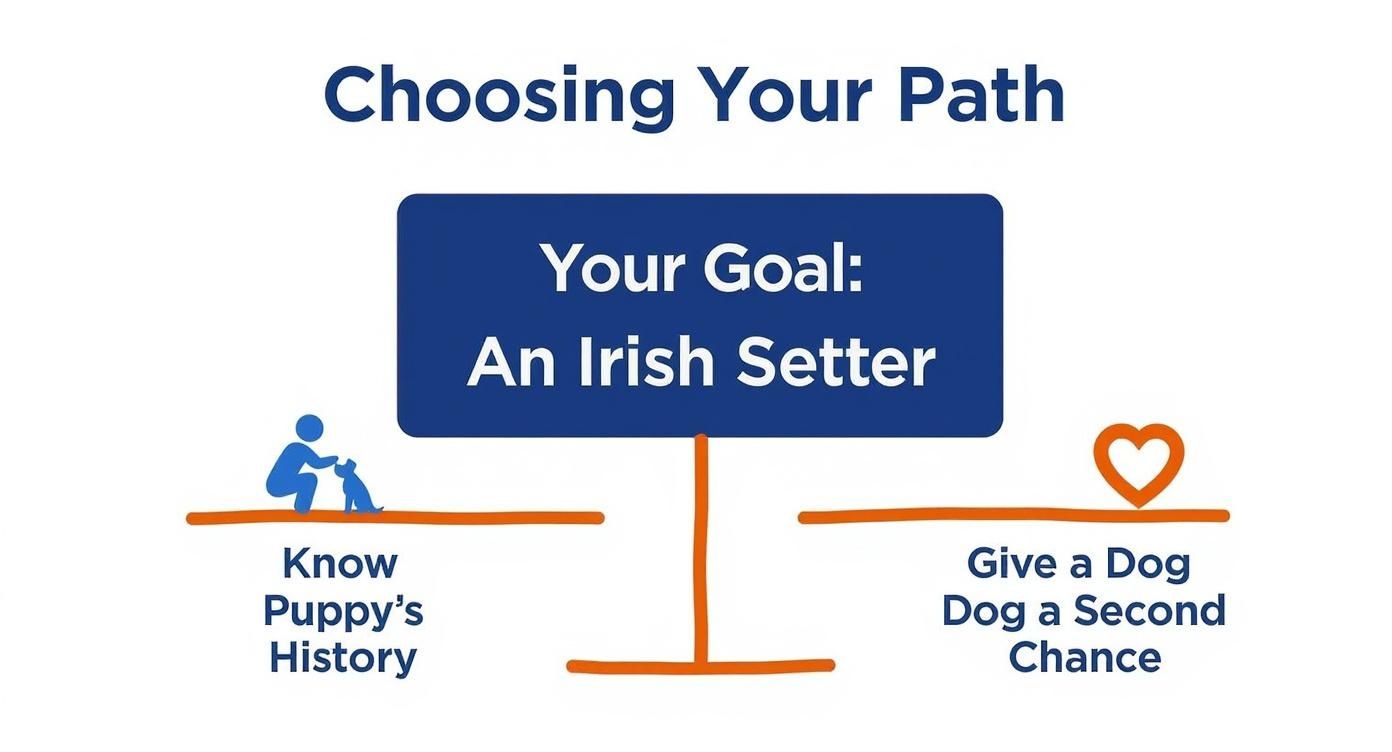
As you can see, the breeder route offers more predictability when it comes to a puppy's health and family history. On the other hand, rescue offers the incredible satisfaction of giving a wonderful dog a fresh start.
At SetterFren, we believe life's better with a wagging tail. The most important thing is finding a dog who will thrive with you. A happy dog makes a happy home, whether they come from a carefully planned litter or a loving rescue that saved their life.
To help you get a clearer picture, let's break down the key differences between these two fantastic options side-by-side.
Breeder vs Rescue: A Quick Comparison
This table summarizes what you can generally expect from each path. It's a great starting point for weighing the pros and cons as you begin your search.
| Factor | Reputable Breeder | Rescue Organization |
|---|---|---|
| Age of Dog | Typically an 8-12 week old puppy. | Can be any age, from puppies to seniors. |
| Background Info | Full health and lineage history for parents. | Often limited or unknown history. |
| Initial Cost | Higher upfront cost ($1,500 – $3,000+). | Lower adoption fee ($150 – $600). |
| Socialization | Puppy has been socialized from birth. | Varies; some may need extra training. |
| Training | You start from scratch with a blank slate. | May already be house-trained or know commands. |
| Health Screening | Parents are genetically tested for common issues. | Dog receives vet check, vaccines, and is spayed/neutered. |
| Predictability | High predictability of size, temperament, and health. | Less predictable, but you know the adult personality. |
| Wait Time | Often involves a waiting list for a litter. | Can be a quicker process, depending on the dog. |
Ultimately, choosing between a breeder and a rescue is a deeply personal decision. Both are valid ways to find your perfect Irish Setter. The most important thing is that you do it responsibly, with the dog's best interest at heart.
Let’s get started on this wonderful journey together.
Finding a Truly Reputable Irish Setter Breeder

Alright, let’s talk about the single most critical part of this whole process. When you decide to buy Irish Setter puppies, you’re doing more than just picking out a pet. You're choosing a breeder who has poured their heart and soul into raising healthy, stable, and happy dogs. This isn’t a quick Google search; it’s about doing some real homework to find a true partner in your journey.
Your mission is to find someone who sees their dogs as family, not inventory. These are the people who are true guardians of the breed.
Start with the Experts
Before you dive into the endless scroll of puppy websites, start with the organizations that live and breathe this breed. The Irish Setter Club of America (ISCA) is your best first stop. Their breeder directory is filled with people who have agreed to a strict code of ethics—that’s a huge vote of confidence right there.
Don't underestimate the power of old-fashioned networking, either. Getting in touch with local breed clubs or even just chatting with people at a dog show can give you incredible insight. These are the folks who can give you genuine, firsthand recommendations you simply can't find anywhere else.
What a Great Breeder Looks and Feels Like
The moment you land on a good breeder’s website, you should get a sense of who they are. It should feel personal, not like a slick e-commerce site. You’ll find tons of info about their dogs, their breeding philosophy, and plenty of pictures of their Setters living their best lives right inside their home.
And here’s a key tell: they should be interviewing you as much as you’re interviewing them.
A truly responsible breeder is vetting you just as hard as you're vetting them. They want to be absolutely certain that one of their beloved pups is going to a fantastic, forever home. If they're asking tough questions, that's a great sign.
They'll want to know all about your lifestyle, your home, what you do for fun, and why you feel an Irish Setter is the perfect dog for you. It should feel like a conversation, a partnership from the very beginning.
The Green Flags of a Trustworthy Breeder
As you start talking to breeders, you'll notice that the great ones have a lot in common. Keep your eyes peeled for these positive signs.
- They Have a Waitlist: Quality takes time. The best breeders don't have puppies available year-round. They plan their litters carefully and usually have a list of approved homes waiting. A waitlist isn’t an inconvenience; it’s a sign of a breeder in high demand for all the right reasons.
- They Insist You Visit: They will be eager for you to come to their home to meet the puppies and, crucially, the mom. If you’re too far away, they’ll set up extensive video calls. This transparency is non-negotiable—you need to see where these pups are being raised.
- They Talk Health, Openly: A great breeder will practically hand you the health clearances for the parents before you even ask. They’ll show you proof of testing for common breed issues like hip dysplasia and Progressive Retinal Atrophy (PRA).
The Red Flags That Should Make You Run
Just as there are good signs, there are also massive red flags that signal you should walk away—no, run. Protecting yourself from heartache and avoiding unethical operations is paramount.
- Always Has Puppies Available: This is the #1 warning sign of a puppy mill or an irresponsible breeder who is churning out litters without any regard for the dogs' well-being.
- No Access to the Parents or Home: If they make excuses about why you can’t meet the mother dog or see where the puppies are kept, hang up the phone. There is no good reason to hide this.
- The Conversation is All About Money: If their first questions are about payment methods and shipping, and they show zero interest in you or the life you can provide, their priorities are crystal clear. And they’re not in the right place.
The True Cost of an Irish Setter: What's Really on the Price Tag?
Let’s talk money. That initial price you see for an Irish Setter puppy is just the down payment on a long and wonderful friendship. Thinking about what it really costs to buy Irish Setter puppies will set you and your new companion up for success from day one. It’s a serious investment, but one that pays dividends in over a decade of love and loyalty.
So, what should you expect to see on that initial price tag? For a healthy, well-cared-for puppy from a dedicated breeder, you’re likely looking at a range of $1,500 to $3,000. And no, that number isn't just pulled out of thin air. It’s a direct reflection of the breeder's own investment: genetic health screenings for the parents, top-notch nutrition for the mom and pups, and crucial early socialization. Sure, prices can vary a bit depending on the puppy’s bloodline or where the breeder is located, but that’s a pretty solid ballpark.
But that’s just the beginning. The first year is easily the most expensive as you get your new best friend all set up.
Your Puppy's First Year: The "Welcome Home" Budget
Getting everything ready for a new puppy is a blast, but those "add to cart" clicks add up faster than you'd think. It's a bit like setting up a baby's nursery—you need all the essentials to make sure they're safe, comfortable, and healthy right from the start.
Here's a quick look at the big-ticket items you'll face right away:
- Initial Vet Visits: This isn't just one check-up. You're looking at a full series of puppy shots, deworming treatments, and wellness exams. This first round of healthcare can easily run between $300 and $500.
- Spay/Neuter Surgery: This is a cornerstone of responsible pet ownership. Depending on your vet and where you live, the procedure typically costs anywhere from $200 to $800.
- Microchipping: Think of this as a permanent "return to owner" tag. It's a one-time fee, usually around $50, that provides priceless peace of mind.
These health-related costs are non-negotiable. They're the foundation for a long and healthy life. Then, of course, you've got all the gear—the crate, bed, bowls, toys, leash, and collar—that you'll need before you even bring them home.
The Big Picture: Lifetime Costs
After you navigate the financial whirlwind of that first year, things do settle into a more predictable groove. But make no mistake, owning an Irish Setter is a significant long-term financial commitment.
When you zoom out, the lifetime cost of caring for one of these beautiful dogs can easily top $33,000. That figure accounts for everything from food and routine vet care to grooming, pet insurance, and those unexpected emergency visits. To put it in perspective, after that initial $3,500 first year, you should plan on budgeting at least $2,600 for every year that follows. For a deeper dive into these numbers, you can find some great breakdowns on a-z-animals.com that detail ongoing Irish Setter ownership expenses.
A key takeaway: Budgeting for the long haul is just as critical as saving up for the puppy's purchase price. A healthy dog is a happy dog, and that requires a consistent investment in their well-being for their entire life.
Remember, these aren't just numbers on a page. They represent the high-quality food that will fuel their boundless energy, the vet check-ups that catch problems early, and the training classes that build an unbreakable bond. Getting your finances in order is the first step toward a fantastic life with your new Irish Setter.
How to Pick a Healthy and Happy Puppy

Alright, the big day is finally here. You're going to meet the puppies! This is, without a doubt, the most exciting part of the whole process. But it can also be a little overwhelming. Faced with a tumbling pile of adorable red furballs, how in the world do you choose the one that's meant to be yours?
The secret is to look beyond the undeniable cuteness and focus on a few key things: the puppy's health, its budding personality, and the environment it's growing up in.
First things first, take a good look around. The place where the puppies are being raised should be clean, warm, and safe. A great breeder will have plenty of engaging toys and space for the little ones to explore—this kind of early stimulation is vital for their development. If the area feels sterile, cramped, or dirty, that's a huge red flag.
Watching the Litter in Action
Before you zero in on a single pup, just hang back and watch them play for a bit. You’ll be amazed at how quickly their individual personalities start to shine through. Some will be bold and adventurous, tumbling over their siblings to get to a new toy. Others will be more reserved, content to observe the chaos from a cozy corner.
There's no "right" or "wrong" personality here. It's all about finding the puppy that fits your life. That boisterous, confident pup might be the perfect adventure buddy for an active family. The quieter, more gentle soul could be an incredible companion for a more relaxed household.
The goal isn't to find the "best" puppy in the litter, but the one that is truly best for you. Think about your daily routine, energy levels, and what you're looking for in a companion.
Your breeder is your best friend in this process. They've spent weeks watching these little characters develop and can offer insights you’d never get in a single visit. This conversation is a crucial step when you set out to buy Irish Setter puppies.
Your Hands-On Puppy Health Check
Once you start interacting with the puppies individually, you can do a quick, gentle health check. This doesn't replace a proper vet visit, of course, but it can give you some valuable clues and peace of mind.
Here’s a simple checklist to run through as you cuddle a potential new family member:
- Eyes: They should be bright and clear. Look out for any goop, discharge, or cloudiness.
- Ears: Peek inside. They should be clean and not have any strong odors, redness, or gunk.
- Coat: A healthy puppy’s coat will be shiny and full. You shouldn’t see any bald spots, dandruff, or signs of fleas.
- Energy: Puppies sleep a ton, but when they're awake, they should be lively and playful. A puppy that seems sluggish or listless all the time might not be feeling their best.
The Importance of Meeting the Parents
This one is non-negotiable: always ask to meet the puppy's mother (the "dam"). Her temperament is one of the best predictors of how your puppy might turn out. Is she friendly and confident? Does she seem comfortable around you? A calm, well-adjusted mom is a fantastic sign.
This interaction, along with a puppy's early experiences, is so important. To really grasp how these first few weeks shape a dog for life, you should understand what puppy socialization truly means.
Navigating Contracts and Bringing Your Puppy Home
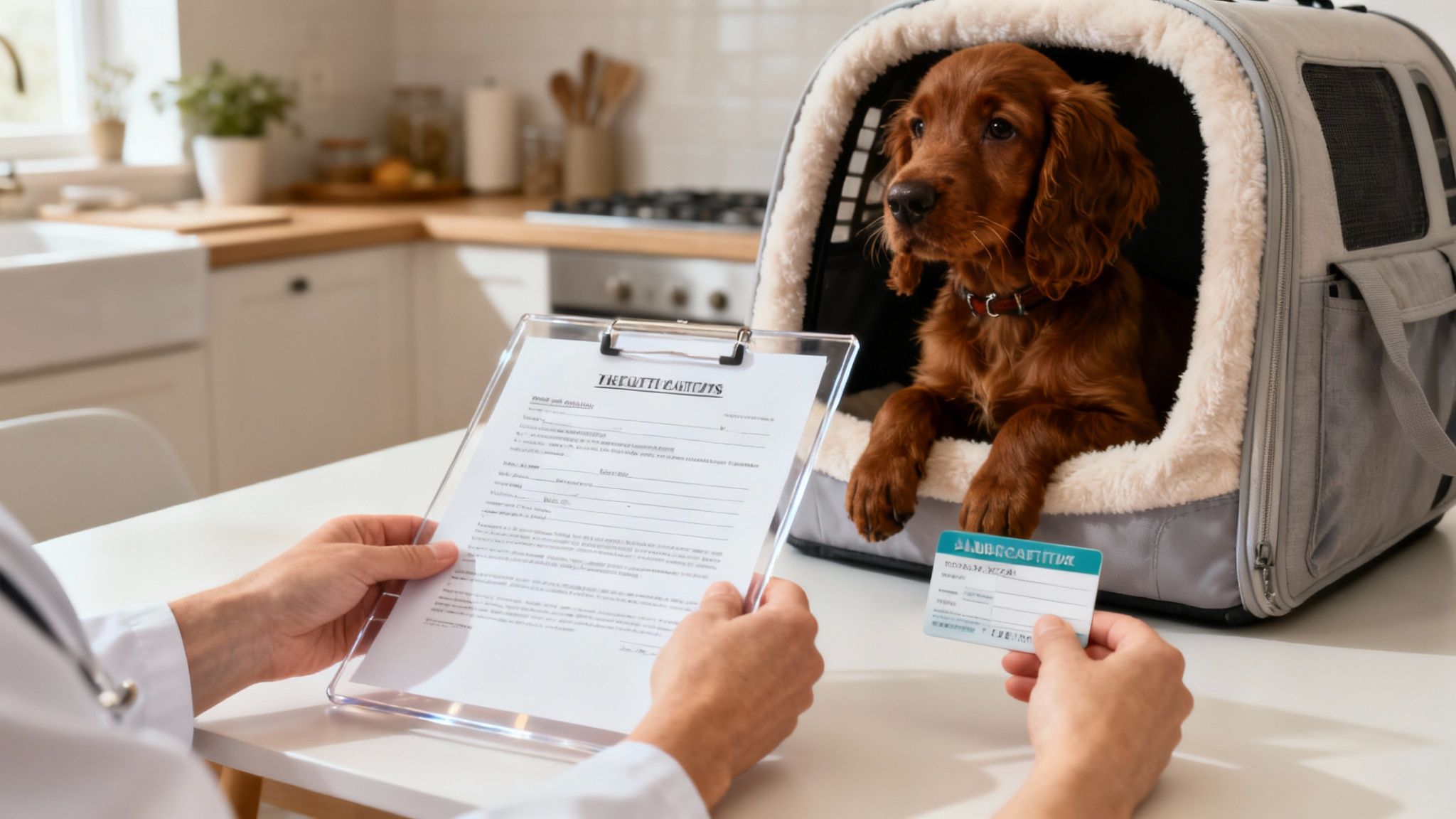
You’ve finally found the one! Now, before the real fun begins, there's one last crucial step: the paperwork. We know, we know—it’s not nearly as exciting as puppy cuddles, but this contract is one of the most important documents you’ll ever sign. It’s also a hallmark of a breeder who genuinely cares about where their puppies end up.
A truly reputable breeder will always have a detailed contract ready for you. This isn't just a formality; it's a safety net that protects you, the breeder, and most importantly, the puppy. Think of it as a roadmap for the dog's entire life, clearly laying out everyone's responsibilities.
Decoding the Puppy Contract
Don't just give this document a quick glance—sit down with a cup of coffee and read every single line. Seriously. It’s packed with vital information about your puppy’s background and the breeder's policies. There are a few key clauses you should always look for.
First, a solid contract will always include a health guarantee. This typically covers genetic conditions common to Irish Setters for a specific period, often the first two years. It’s the breeder's way of showing they stand behind the health of their dogs and have done their homework on parental health screenings.
You should also expect to see a spay/neuter agreement. Unless you're purchasing a show prospect, most breeders will require you to spay or neuter your puppy by a certain age. This is a standard and responsible practice to prevent accidental litters.
The real non-negotiable, though, is the return-to-breeder policy. A great breeder will always, without exception, agree to take the dog back at any point in its life if you can no longer care for it. This is their lifelong commitment to making sure none of their puppies ever see the inside of a shelter.
Your Take-Home Document Checklist
The day you pick up your puppy is pure chaos and excitement, but don't leave until you have a folder with all the essential documents. This is your new best friend's official start in the world, so make sure you’ve got everything.
Here’s what should be in that folder:
- A Signed Contract: Your copy, signed by both you and the breeder.
- Veterinary Records: This should detail every vaccination and deworming treatment the puppy has received so far. Your vet will need this.
- Registration Papers: You should get paperwork from a recognized kennel club, like the American Kennel Club (AKC), which allows you to officially register your puppy under your name.
- Feeding Instructions: A good breeder will send you home with specifics on the puppy’s current food, how much to feed, and when, to make the transition as smooth as possible.
Once all the papers are signed and in your hands, you’re officially ready to start your new life together. To get a head start on those first few crucial weeks, take a look at our guide on how to care for a new puppy.
Answering Your Top Questions About Irish Setter Puppies
As you get closer to bringing home your new best friend, it’s only natural for a few last-minute questions to pop up. We get it! We've talked with countless future Irish Setter owners, and a few questions come up again and again.
We’ve gathered them right here to give you the answers you need. Think of this as a friendly chat over coffee, where we can talk through those final "what ifs" so you can feel completely ready for the adventure ahead.
What’s The Real Cost Of An Irish Setter Puppy?
When you’re buying from a reputable breeder, you can expect the price to land somewhere between $1,500 and $3,000. That number isn't just pulled out of thin air—it reflects a massive investment from the breeder in top-notch care, extensive health testing, and crucial early socialization for both the puppies and their parents.
The final price tag can shift a bit depending on things like the puppy's specific bloodline, where the breeder is located, and whether the pup is destined to be a family companion or a show champion.
Be very cautious of any price that seems way too low. A puppy listed for a few hundred dollars is almost always a huge red flag, often pointing to a puppy mill or a backyard breeder who has likely skipped essential vet care and health screenings.
A fantastic and budget-friendly option is to adopt from a breed-specific rescue. Adoption fees usually run under $500. This fee typically covers initial vet visits, spay/neuter surgery, and a microchip—all while giving a wonderful dog a much-needed second chance.
Are Irish Setters Difficult To Find?
You might have noticed that Irish Setters aren't quite as common as Labradors or Golden Retrievers, so you probably won't find a breeder just down the street. While they aren’t considered a rare breed, their steady popularity means that finding a truly responsible breeder takes a little digging and a bit of patience.
It's actually very normal to be placed on a waiting list for a puppy from a great breeder. Don't let this discourage you! A waiting list is a good sign. It shows that the breeder is in high demand because of their excellent reputation and that they plan their litters carefully instead of constantly having puppies available. This thoughtful approach is a hallmark of someone looking to ethically buy Irish Setter puppies.
What Health Tests Should The Parents Have?
This is easily one of the most critical questions you can ask. Any breeder worth their salt will be an open book about health screenings and should be more than happy to show you official documentation. They are actively screening their dogs to prevent passing on genetic conditions common to the breed.
You’ll want to see proof of health clearances for both parent dogs. Specifically, ask for:
- Hips and Elbows: Results from the Orthopedic Foundation for Animals (OFA) that screen for dysplasia.
- Eyes: A recent exam from a board-certified veterinary ophthalmologist (often called a CAER or CERF exam).
- Genetic Tests: DNA tests for breed-specific issues like Progressive Retinal Atrophy (PRA) and Canine Leukocyte Adhesion Deficiency (CLAD).
A breeder who proudly shares these results is showing you their commitment to the lifelong health of every single puppy they bring into the world.
Ready to continue your journey into the wonderful world of dogs? At SetterFren, we're more than just a blog—we're a cozy online community built for dog lovers who believe life’s better with a wagging tail and a good book. Explore our curated selection of dog-themed books, honest product reviews, and practical how-to guides to help you care for your pup like a pro. Join our Puppicino Club to unlock member perks, book updates, and dog-friendly treats! Stay part of the fun by following @setterfrens on TikTok and Instagram for heartwarming dog moments, product tips, and behind-the-scenes content from our growing pack!
Learn more at https://setterfren.com.