Early literacy skills aren't about drilling flashcards or pushing your child to read before they're ready. Far from it! These are all the wonderful, foundational abilities kids pick up long before they can actually read and write on their own.
Think of it like building a house. You wouldn't put up the walls and roof without first laying a solid foundation. Early literacy skills are that foundation for a lifetime of reading, learning, and communication. They're built through everyday play, conversation, and connection—often with a wagging tail nearby.
The Building Blocks of a Lifelong Reader
So, what exactly are we talking about? When we say "early literacy," we're not talking about formal lessons. It’s all about creating joyful experiences that wire a child's brain for language and stories.
Imagine you're teaching a little pup a new trick. You don’t just expect them to get it on the first try! You start with simple steps, lots of praise, and a few tasty treats. Those fun, playful first steps are what early literacy is all about—making the whole process feel natural and exciting.
These skills are absolutely critical for a child's future. The importance of this early start is echoed in worldwide research. According to the World Bank, a staggering 90% of students in some low- and middle-income countries can't even identify letter names, sounds, or basic words after three years of school. This really drives home why experts focus so much on getting the foundation right.
To lay a strong foundation for reading, it's crucial to understand what is emergent literacy and its components. These pre-reading abilities are the roots from which all future reading skills grow.
The Six Core Early Literacy Skills
Getting to know the six core early literacy skills helps you see how all the pieces fit together. Each one is a different tool in the toolbox, and they all work in harmony to build a confident, happy reader.
Let's break them down.
Here’s a quick look at the six essential building blocks of early literacy and what each one means in simple, everyday terms.
The Six Core Early literacy Skills at a Glance
| Skill | Simple Explanation | Example Activity |
|---|---|---|
| Print Awareness | Understanding that printed words are meaningful and knowing how a book works. | Pointing to words as you read them aloud. |
| Narrative Skills | Being able to tell and understand stories, including their beginning, middle, and end. | Asking, "What do you think will happen next?" |
| Vocabulary | Knowing the names of things, ideas, and feelings to understand the world. | Naming objects you see on a walk with your dog. |
| Letter Knowledge | Recognizing that letters are different from each other and have names and sounds. | Singing the alphabet song or playing with letter magnets. |
| Phonological Awareness | Hearing and playing with the smaller sounds in words, like rhymes and syllables. | Clapping out the syllables in your dog's name. |
| Oral Language | The ability to listen, understand, and use spoken words to communicate. | Simply talking with your child throughout the day! |
Each of these skills builds on the others, creating a sturdy launchpad for reading and writing. As we dive deeper, you’ll discover how easy and fun it is to weave these into your daily routine.
For more parenting tips and guides, be sure to check out the other articles on our blog. Join our Puppicino Club to unlock member perks, book updates, and dog-friendly treats.
The 6 Building Blocks of Early Literacy
Now that we have a big-picture view, let's zoom in on the specific skills that get your child ready to read. Think of these six essential skills as the ingredients in a recipe for literacy. Each one is important, and they all work together to create a confident reader.
You're probably already nurturing these skills without even realizing it. They aren't formal school subjects; they're woven into the simple, playful moments you share every day. It's about how we talk, listen, and eventually connect spoken sounds to the letters on a page.
Let's break them down, one by one.
1. Oral Language: The Foundation of Communication
Long before a child can read a word, they need to be able to speak it and understand what it means. Oral Language is simply the ability to communicate—to chat, ask questions, share ideas, and connect with the world through spoken words.
This is the bedrock for everything else. A child with a strong foundation in oral language can follow along with a story, ask questions when they're confused, and ultimately make sense of the text they'll see on a page. Every conversation, from talking about your dog's floppy ears to describing what you see on a walk, is a powerful language lesson in disguise.
2. Phonological Awareness: Learning to Hear the Music in Words
Phonological Awareness sounds complicated, but it's really just about hearing and playing with the sounds in language. It has nothing to do with letters yet—it’s all about what we hear. Think of it as tuning a child's ear to the music of words.
It starts big, with things like recognizing rhymes ("hat" and "cat") or clapping out the syllables in a name (like Sa-man-tha). Over time, this skill gets more refined, and kids start to hear the individual sounds, or phonemes, inside words. They learn that "dog" is made up of three distinct sounds: /d/, /o/, and /g/. Singing silly songs and playing "I spy" with sounds are fantastic ways to build this crucial pre-reading skill.
The diagram below shows how these core skills, like oral language and phonological awareness, branch out to form a complete literacy foundation.
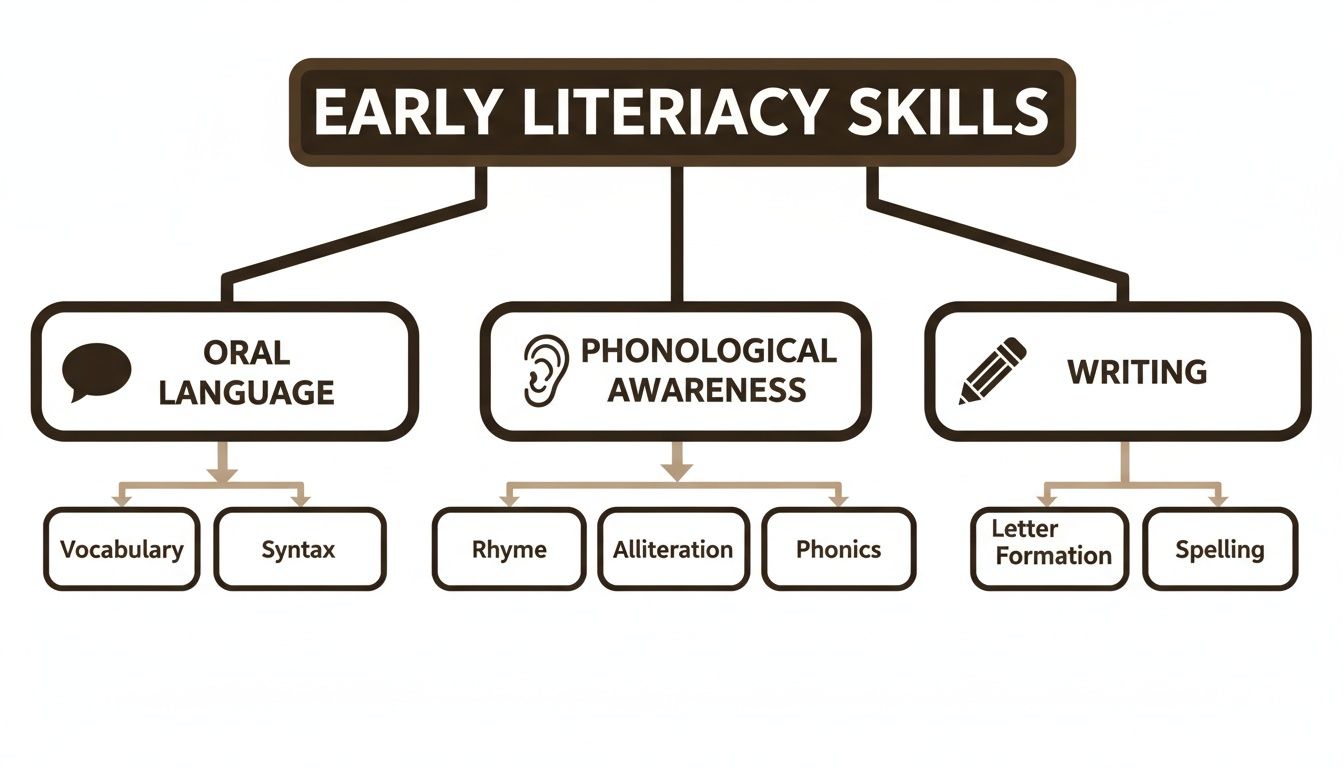
As you can see, literacy isn't a single skill but a beautiful blend of listening, speaking, and connecting those ideas to the printed word.
3. Print Awareness: Figuring Out How Books Actually Work
Ever watch a toddler hold a book upside down while "reading" aloud? That's not just adorable—it's an early sign of Print Awareness! This is all about a child's growing understanding that the print on a page has a purpose and that there are rules for how we use it.
It's the "aha!" moment when a child realizes:
- We read from left to right and from the top of the page to the bottom.
- Those little gaps between words are important. They're called spaces!
- A book has a front and a back.
- The squiggles on the page are letters, and those letters form words.
Every time you run your finger under the words as you read a story about a playful puppy, you're helping your child connect the sounds they hear with the symbols they see.
4. Vocabulary: Building a Word Bank
Vocabulary is the collection of words a child knows and can use. The more words they have in their mental "word bank," the better they can understand the world around them and the stories they encounter. Research suggests that a whopping 95% of students can learn to read well when they have a strong early foundation, and a rich vocabulary is a massive part of that.
5. Narrative Skills: The Art of Storytelling
This is all about understanding how stories are put together. Narrative Skills help a child grasp that stories have a sequence—a beginning, a middle, and an end. They learn to follow a plot, understand characters, and even predict what might happen next.
When you pause and ask, "What do you think the dog will do now?" you’re doing more than just reading a book; you're actively building their ability to think like a storyteller.
6. Letter Knowledge: Getting to Know the ABCs
This is the skill most people think of first: Letter Knowledge. It’s the ability to recognize that letters are distinct symbols, each with its own name and its own sound.
It often starts with the magic of spotting the letters in their own name and slowly grows until they can identify the whole alphabet. This is the final, crucial piece of the puzzle. It connects the sounds they've learned to hear (phonological awareness) with the symbols they see on the page (print awareness), paving the way for reading to finally click.
Your Child's Literacy Journey From Birth to Five
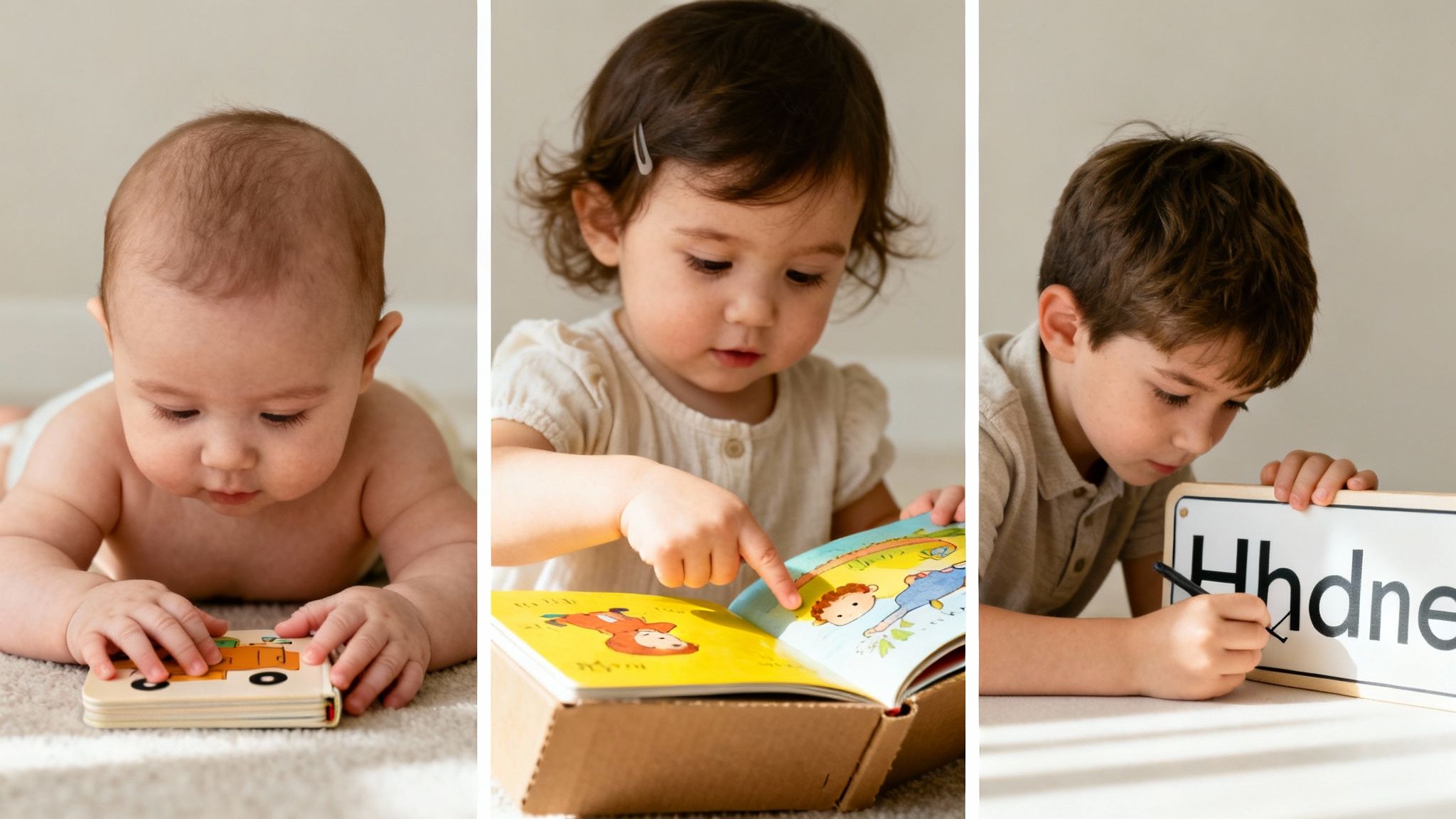
As a parent, you’ve probably asked yourself, "Is my child on track?" It’s a totally normal question! The thing is, every child's path to reading is as unique as they are. There isn't some rigid, one-size-fits-all timeline, but there are absolutely beautiful milestones to watch for and celebrate along the way.
It’s important to remember that these skills aren't about grades or formal achievements. They're about joyful discovery. When you understand the different stages, you can spot and cheer on the incredible progress your little one is making, turning everyday moments into powerful building blocks for literacy.
What Does "On Track" Even Mean?
Let's be clear: "on track" doesn't mean your one-year-old should be reading Shakespeare. It simply means they are developing the foundational skills appropriate for their age. Think of it less like a race and more like a scenic journey with exciting stops along the way.
To give you a clearer picture, here’s a breakdown of what early literacy development often looks like from those first few months all the way up to starting school.
Age-by-Age Early Literacy Milestones
This table is a simple guide to what you might see as your child grows. It’s not a strict checklist, but rather a way to appreciate the amazing progress happening at each stage.
| Age Group | Key Milestones | What You Might See |
|---|---|---|
| Birth – 12 Months | Sensory Exploration & Sound Awareness: Responds to your voice, explores books with hands and mouth, babbles. | Turning their head when you read, gumming a board book, cooing when you sing a song. |
| 1 – 2 Years | Vocabulary Burst & Interaction: Points to pictures, names objects, repeats words, turns pages (with help). | Shouting "Doggie!" while pointing at a picture, making animal sounds, wanting the same book over and over. |
| 2 – 3 Years | Concept Development & Participation: Answers simple questions about stories, finishes sentences in familiar rhymes, understands books are read from front to back. | Saying "and the piggy went wee wee wee!" at the right time, turning pages one by one, pointing out things they recognize from their own life. |
| 3 – 4 Years | Print Awareness & Narrative Skills: Recognizes some letters (especially their own), retells simple stories, asks "why" questions about the plot. | Pointing to the "A" in their name, telling you a jumbled but enthusiastic version of The Three Little Pigs, holding a book the right way up and "reading" to their toys. |
| 4 – 5 Years | Phonological Awareness & Pre-Reading: Recognizes rhyming words, claps out syllables in names, connects letters to sounds, writes some letters. | Saying "cat and hat rhyme!", trying to write their name, pretending to read a menu or a grocery list. |
As you can see, the journey starts long before a child can actually decode words on a page. Every coo, every pointed finger, and every silly rhyme is a step in the right direction. It's all about building a love for stories and language, one fun moment at a time.
Fun and Easy Ways to Build Literacy Skills at Home

You don’t need a perfectly organized classroom or a stack of flashcards to raise a confident reader. Your home is already the best literacy playground there is! The most profound learning happens in those simple, joyful moments you share every day.
Think of yourself as your child’s first and most important teacher. Every chat, every song, and every story you share builds a foundation for their understanding of language. The magic isn't in adding more to your already busy schedule, but in recognizing and celebrating the learning opportunities that are hiding in plain sight.
Unfortunately, not every child gets the same head start. Research highlights a gap based on household income; one study found that 62% of parents in high-income households read to their kids daily, compared to just 36% of parents in low-income homes. This is why making literacy fun and accessible for all families is so critical. You can learn more about how to support early literacy initiatives at the American Library Association.
Turning Everyday Moments into Literacy Wins
The real trick is knowing the why behind the what. When you understand that singing a silly rhyming song in the car is actually sharpening your child's phonological awareness, it transforms a simple distraction into a powerful teaching moment.
Here are a few simple ideas, broken down by the skills they support:
Oral Language & Vocabulary: Talk about everything you see and do. Describe the fluffy clouds on your walk, chat about the crunchy texture of the dog's food, and use interesting, vibrant words. A trip to the grocery store becomes a vocabulary lesson when you name all the colorful fruits and veggies.
Phonological Awareness: This is all about playing with sounds. Sing rhyming songs, make up silly words that start with the same sound as your child’s name, or clap out the beats (syllables) in people's names. Try it: "Grand-ma Ma-ry!"
Narrative Skills: Storytelling is way more than just what’s in a book. Recount your day in order: "First, we woke up and brushed our teeth. Then, we ate some yummy oatmeal." While reading, pause and ask fun questions like, "What do you think that sneaky puppy will do next?"
These small adjustments fold powerful learning into your daily life without any added stress.
Make Reading an Adventure with The Right Stories
Reading together is one of the single best ways to build all six early literacy skills at once. It’s a special time for connection, conversation, and discovery. To make it truly magical, find books that feel like a treat.
"The fire of literacy is created by the emotional sparks between a child, a book, and the person reading." — Mem Fox
When kids see themselves in a story, they connect on a deeper level. Books with relatable characters, like the adventurous pups in the SetterFrens collection, make reading feel more like playtime. A story about a dog learning a new trick can spark a great conversation about trying new things and celebrating small wins, building both vocabulary and storytelling skills.
Ready to get started? We’ve got a special gift for our community! You can grab a wonderful story to share with your little one by downloading our free SetterFrens e-book today. It's the perfect way to kick off your next reading adventure.
Choosing the Right Books for Your Little Reader
Walking into a bookstore can feel a bit overwhelming, can't it? All those colorful covers, all promising to be your child's next favorite. So, how do you pick one that will actually grab their attention and, just as importantly, help them grow?
Choosing the right stories is one of the most powerful things you can do. It transforms reading time from a simple activity into a launchpad for all those early literacy skills we've been talking about.
The real secret is matching the book to where your child is right now. For toddlers, books filled with rhymes and repetition are absolutely golden. Think about it—the predictable, sing-song pattern helps their brains start to recognize and play with the sounds in language. They're building phonological awareness without even knowing it.
What to Look for at Different Ages
As your little one gets older, what they need from a book changes. The goal is always to keep them engaged by sparking their curiosity and delighting their senses.
For the Littlest Readers (0-2 years): At this age, it's all about durability and sensory input. Look for sturdy board books with simple, high-contrast images that are easy for developing eyes to focus on. Interactive features are fantastic—things like lift-the-flaps, crinkly pages, or different textures to touch. These elements teach them that books are fun, hands-on objects, which is the very beginning of print awareness. If you're building that first library, getting some expert advice on the best board books for babies is a great place to start.
For Toddlers and Preschoolers (2-5 years): Now you can move into simple stories with a clear beginning, middle, and end. Books with relatable characters, especially friendly animals like dogs, help them connect emotionally to what's happening. A book with bright, detailed pictures is an amazing vocabulary builder—you can point to things and give them names. And of course, a good rhyming story is still one of the best ways to sharpen their awareness of sounds.
The right book does more than just tell a story; it opens a conversation. It becomes a shared experience that strengthens your bond and builds a foundation for a lifetime of learning.
Connecting Books to Skill Building
Try to think of every book as a playful tool in your toolkit. A simple story about a puppy’s first trip to the park is so much more than just a cute read.
It's a chance to ask, “What do you think the puppy will do next?” This simple question helps them practice their narrative skills. Pointing to the word "ball" on the page every time you say it helps them make that crucial connection between the sounds they hear and the letters they see.
Ultimately, choosing stories that genuinely delight your child is the single best way to nurture their growing mind. When you’re ready to find that next perfect story, feel free to explore our curated collection of dog-themed books at SetterFrens—they’re designed with young readers in mind.
Common Questions from a Reader's Best Friend
As you and your little one snuggle up with a good book (and maybe a furry friend by your side), it’s totally normal for questions to pop up. Understanding what early literacy skills are is one thing, but figuring out how to apply them in real life can feel like a whole new adventure.
Let's dig into some of the most common questions we hear from our community. Think of this as some friendly, practical advice from one book lover to another.
When Should I Start Teaching My Child to Read?
Honestly, the best thing you can do is focus on building a love for stories and language first, rather than pushing formal reading instruction too early. It's a lot like training a puppy—you don’t start with complex commands. You start with fun, positive experiences and lots of encouragement.
Right from birth, the most powerful tools you have are reading aloud, talking, singing, and just playing with sounds. You're building a rich, joyful foundation. That way, when your child is developmentally ready for more structured learning (usually somewhere between ages 5 and 7), reading will feel like a natural next step, not a chore.
What if My Child Just Isn't Interested in Books?
First off, take a deep breath and don't force it! The moment reading feels like a battle, we’ve lost the plot. The goal is to make it feel like a treat. If your child isn't captivated by traditional stories, it might be time to get creative and spark their curiosity in other ways.
- Follow Their Obsession: Does your kid live and breathe dinosaurs, dump trucks, or dogs? Find books about that. Colorful non-fiction books with big, bright photos can be an absolute game-changer.
- Make it an Experience: Try books they can interact with, like lift-the-flap or touch-and-feel books. Audiobooks are another fantastic option, especially for car rides.
- Create a Cozy Reading Fort: Build a special spot with comfy pillows and blankets. Making "book time" a cherished bonding activity, even if it’s just for five minutes, helps build a positive connection that can last a lifetime.
Are Screens and Apps Bad for Early Literacy?
Not inherently, but it's all about balance and how you use them. The most important thing is to be an active participant. Instead of handing over a tablet and walking away, sit with them and talk about what's happening on screen, just as you would with a physical book.
High-quality educational apps can be great for reinforcing things like letter sounds, but they're a supplement, not a replacement. Nothing can truly take the place of cuddling up with a real book. That shared, screen-free time is where the magic really happens and the deepest connections are formed.
How Do I Know if My Child Has a Literacy Delay?
Every child truly does develop at their own pace, but there are some gentle flags that might signal it's time for a chat with your pediatrician or teacher. For instance, if your preschooler consistently shows no interest in rhymes or playing with sounds, or if a 5-year-old struggles to recognize the letters in their own name, it’s worth checking in.
This journey is a global one, and it's important to remember that not all children get the same start. Shockingly, gender disparity in literacy is still a major issue worldwide. UNESCO reports that two-thirds of the 754 million adults who cannot read are women, a gap often rooted in a lack of early educational opportunities.
At the end of the day, you are your child's biggest and best advocate. Seeking professional guidance is never a sign of failure—it's a proactive and loving step.
At SetterFrens, we believe every story shared is a step toward a brighter, more connected world because life’s better with a wagging tail and a good book. We’re here to support your family with engaging books, helpful guides, and a community that celebrates the pure joy of reading together. Explore our resources and join our pack at https://setterfren.com. Stay part of the fun by following @setterfrens on TikTok and Instagram for heartwarming dog moments, product tips, and behind-the-scenes content from our growing pack