Welcome, fellow educators and dog lovers! If you believe life is better with a wagging tail and a good book, you're in the right place. At SetterFrens, we know that fostering a love for reading starts early, and what better way to do it than with engaging, hands-on activities that capture the hearts and minds of young learners? This article is your ultimate guide to creating vibrant, effective literacy centers that will have your kindergarteners begging for reading time.
We've rounded up 10 of our favorite literacy center ideas for kindergarten, each one classroom-tested and packed with actionable tips and differentiation strategies. Our goal is to help you build foundational skills in a way that feels less like work and more like play. These centers are designed to be more than just busy work; they are purposeful stations that encourage exploration, collaboration, and a genuine love for words.
To truly transform your classroom into a literacy playground, consider approaches that build genuine engagement, such as creating a comprehensive language arts curriculum focused on student agency. From a cozy, dog-themed reading nook inspired by our SetterFrens books to interactive digital stations, we’ll explore how to make your literacy block the most exciting part of the day. You’ll find clear descriptions, material lists, setup notes, and management tips for each idea. Get ready to unleash the fun, transform your space, and watch your little learners' skills soar
1. Dog-Themed Reading Nook
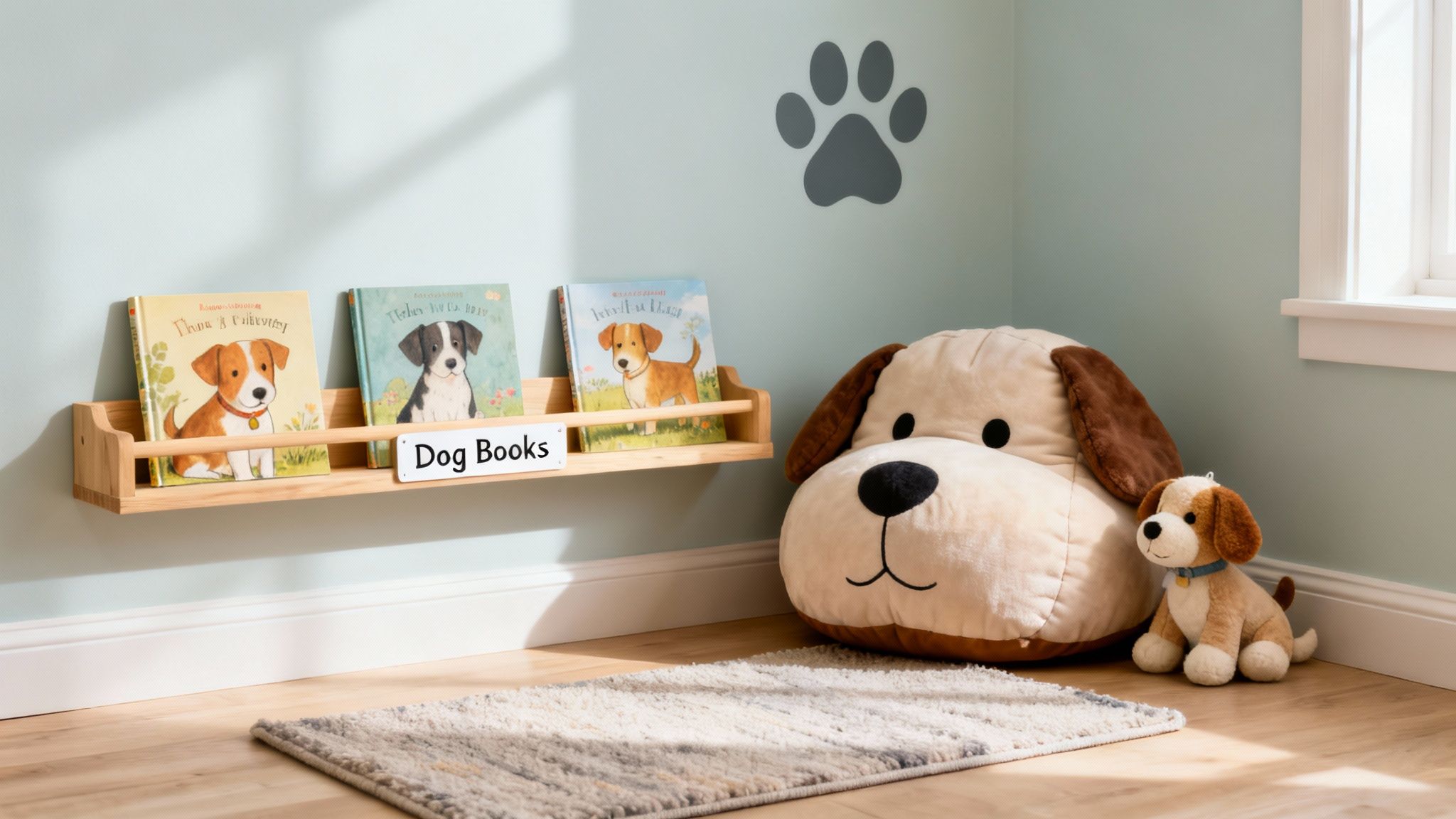
Transform a corner of your classroom into an irresistible reading retreat with a dog-themed reading nook. This literacy center idea for kindergarten combines comfort, whimsy, and the universal appeal of dogs to create a positive association with independent reading. By designating a special, cozy space filled with friendly plush pups and captivating stories, you invite young learners to curl up with a book and get lost in a story, making literacy practice feel less like a task and more like a treat.
Why It Works
A dog-themed reading nook taps into children's natural affection for animals, creating an emotionally safe and engaging environment. It provides a quiet, low-stimulus area for children who need a break from the bustle of the classroom, allowing them to focus on stories. This approach aligns perfectly with our belief at SetterFrens that life’s better with a wagging tail and a good book.
How to Set It Up
Setting up your nook is simple and fun. Start with comfortable seating like beanbags, floor pillows, or a small tent.
- Stock the Shelves: Fill a low, accessible bookshelf with a variety of dog-themed picture books. Be sure to include beloved stories from our curated selection to create a cohesive experience.
- Add Furry Friends: Scatter plush dog toys of various breeds and sizes for children to cuddle with while they read. A large SetterFrens plush can serve as the nook's friendly mascot.
- Decorate: Use dog-themed decor like paw-print decals, bone-shaped pillows, or posters of cute puppies. A "Puppicino Club" sign adds an exclusive touch, making children feel like part of our special reading community.
Tips for Success
To keep the center fresh and exciting, rotate the book selection monthly. You can also add themed reading logs or dog-shaped bookmarks. For another fun, themed activity that builds observational skills, you can download some printable road trip bingo cards that are perfect for quiet time. Create a "Wall of Fame" with photos of students reading to their plush puppy pals, celebrating their reading milestones and fostering a sense of community.
2. Interactive Letter and Sound Discovery Center
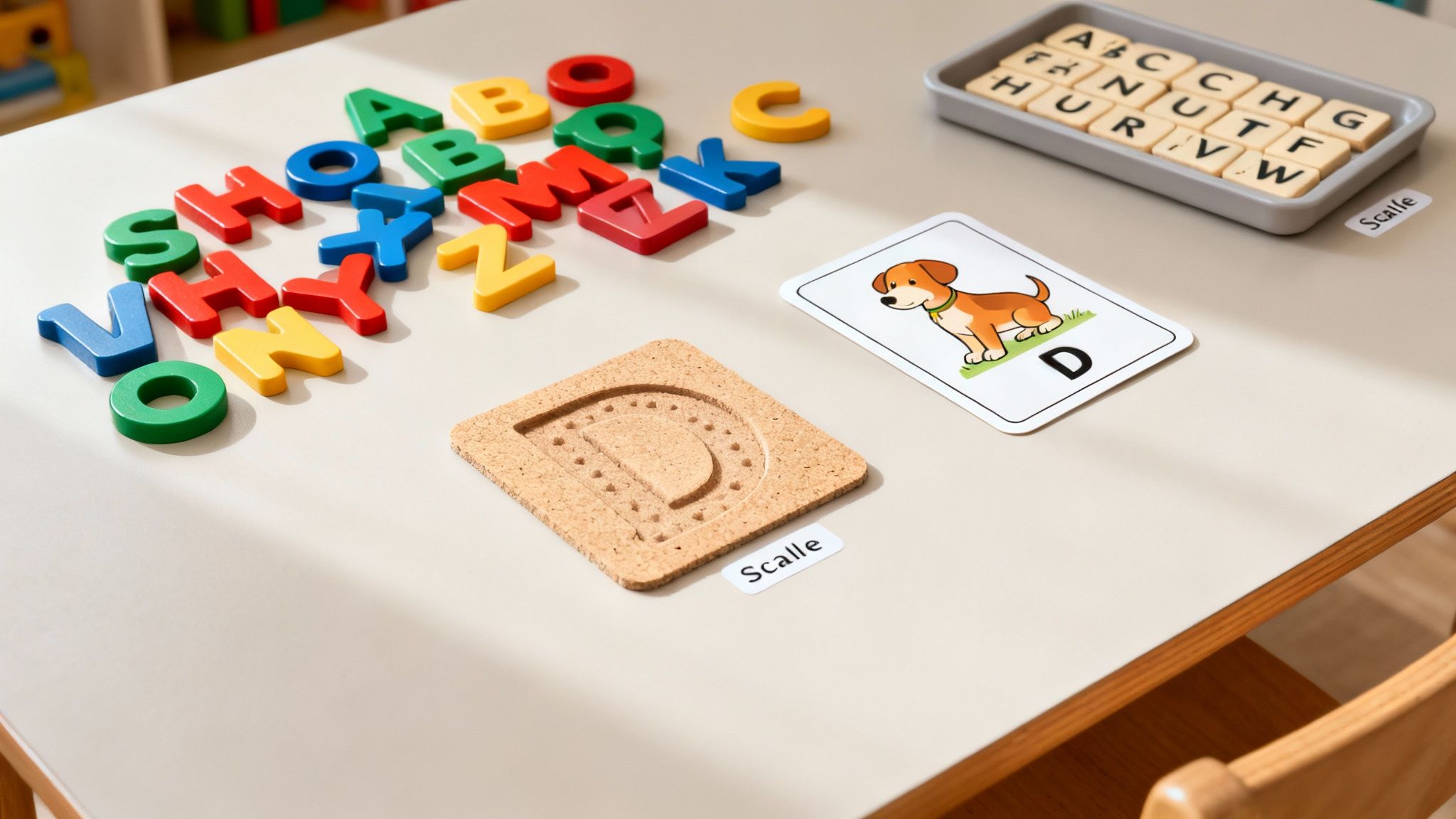
Create a vibrant, hands-on station where kindergarteners can connect letters to their sounds through touch, sight, and hearing. An interactive letter and sound discovery center allows children to manipulate magnetic letters, trace tactile letter shapes, and match them to corresponding picture cards. This foundational literacy center idea for kindergarten addresses phonemic awareness and letter recognition, which are crucial benchmarks for early readers, by making abstract concepts tangible and fun.
Why It Works
This center leverages multi-sensory learning, a powerful strategy for young children. By engaging their kinesthetic, auditory, and visual senses, students build stronger neural pathways for letter-sound correspondence. This approach, popularized by educators like Maria Montessori and championed by the Science of Reading movement, ensures that learning is deep and memorable, moving beyond simple rote memorization.
How to Set It Up
Setting up your discovery center is all about providing a variety of tactile materials. Start with a magnetic whiteboard or cookie sheets and a tub of magnetic letters.
- Gather Materials: Include different letter forms like sandpaper letters, letter tiles, and letter-building sticks. Add small objects or picture cards for students to sort by beginning sound.
- Create Matching Games: Design simple matching activities. For example, students can match uppercase to lowercase letters or match a letter to a picture card that starts with that letter's sound.
- Incorporate Your Theme: Use dog-themed images to reinforce sounds, such as a picture of a dog for the letter 'D'. Printable letter mats featuring adorable SetterFrens characters can make tracing and letter formation practice extra engaging.
Tips for Success
Introduce letters gradually, starting with uppercase before moving to lowercase. You can include a tablet or small audio player with recordings of proper letter-sound pronunciation for students to reference. Implement a simple checklist for students to track which letters they have practiced. This builds independence and gives you a clear snapshot of their progress, ensuring every pup in your pack is on the right track.
3. Book Tasting and Choice Center
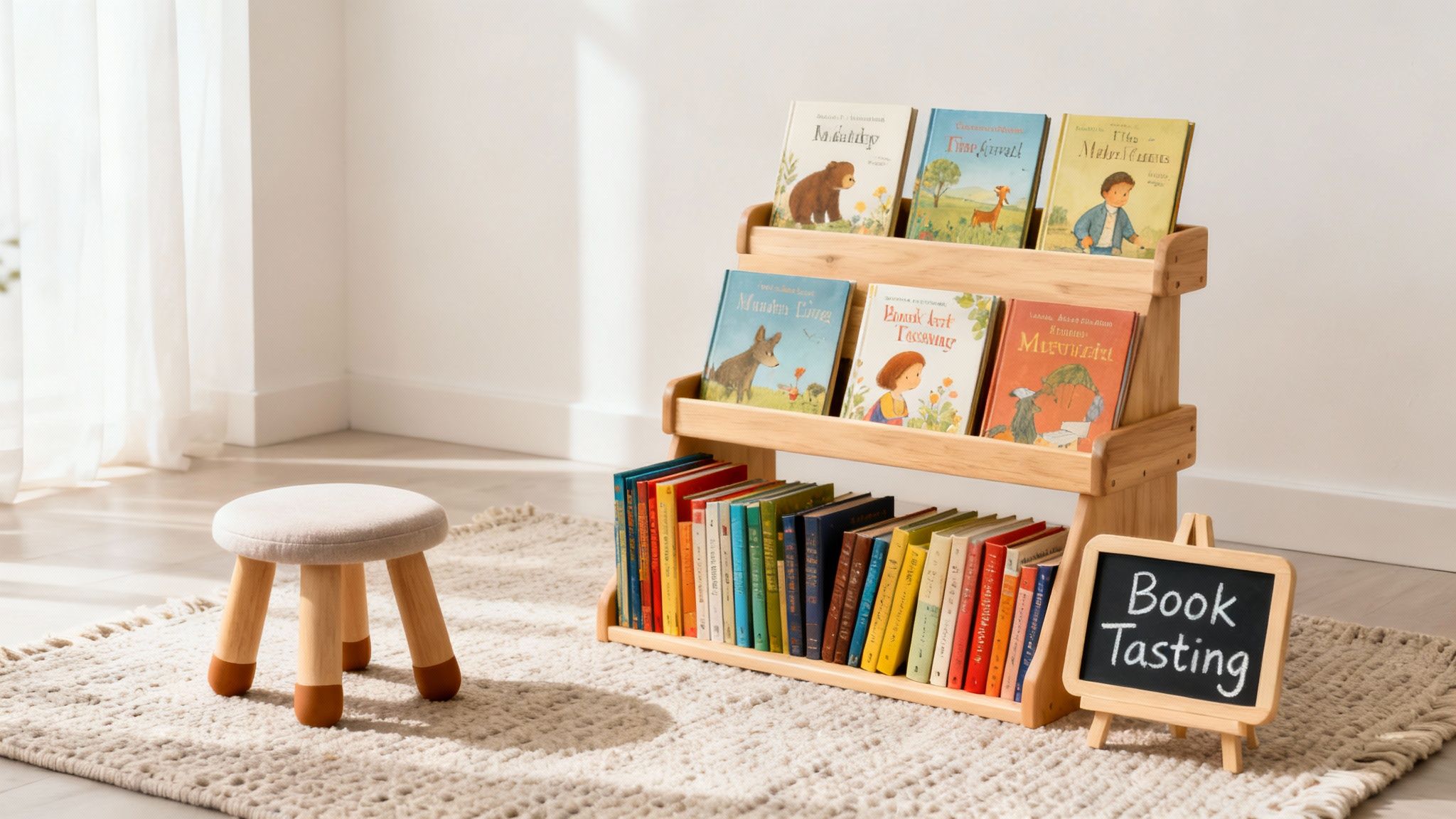
Turn your literacy center into a delightful book café with a "Book Tasting" theme. This concept organizes your classroom library like a restaurant or bistro, inviting kindergarteners to "sample" different books before choosing one to read. By displaying books face-out and organizing them by theme, genre, or reading level, you empower young learners to make their own reading choices, fostering a sense of ownership and genuine excitement for literacy. This approach transforms book selection from a routine task into an engaging, choice-driven adventure.
Why It Works
A Book Tasting and Choice Center builds crucial book selection skills by encouraging students to look at covers, illustrations, and topics that interest them. This model, inspired by successful reading workshop approaches from educators like Lucy Calkins and Pam Allyn, honors student choice, which is a powerful motivator for young readers. It creates a dynamic environment where children learn to identify their preferences and discover new literary worlds at their own pace.
How to Set It Up
Creating your book café is all about presentation and accessibility. Arrange your books on low shelves or tiered displays so the covers are clearly visible.
- Organize the "Menu": Sort books into categories that make sense for your students. Use fun, dog-themed genre labels like "Adventure Pups" for fiction, "True Tails" for non-fiction, and "Funny Fidos" for humorous stories.
- Create the Ambiance: Set up small tables or floor spaces with cushions to serve as "tasting" stations. You could even add checkered tablecloths and simple centerpieces to complete the café look.
- Spotlight Specials: Feature a "Book of the Week" on a special stand. Make books from our dog-themed collection the star of the show with a "New Release" or "Chef's Recommendation" display, sparking immediate interest.
Tips for Success
Keep the center vibrant by rotating the book selection regularly to offer fresh choices. Create simple "tasting menus" or checklists where students can rate the books they sample with smiley faces. To deepen the experience, you can create a "Wall of Fame" for book reviews, celebrating each child’s reading journey. This center is an excellent way to introduce diverse authors and stories, including books in multiple languages to reflect your classroom community.
4. Story Sequencing and Retelling Station
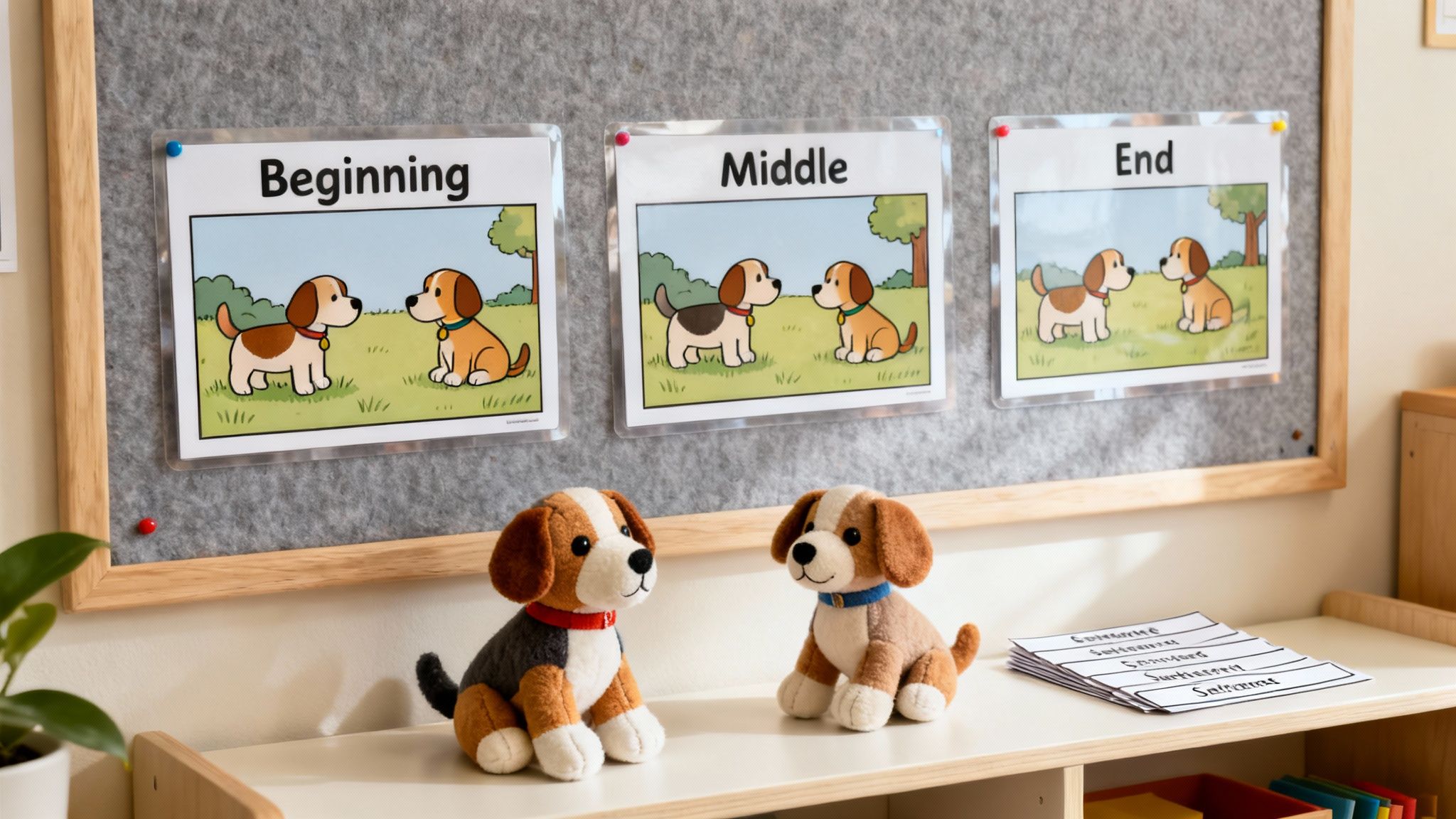
Help your little learners become master storytellers with a story sequencing and retelling station. This dynamic literacy center idea for kindergarten uses picture cards, props, and visual aids to help students grasp the fundamental structure of a narrative. By physically arranging events in order and retelling stories, children develop crucial comprehension, oral language, and vocabulary skills, transforming them from passive listeners into active participants in the storytelling process.
Why It Works
This center empowers children to make sense of stories by breaking them down into manageable parts: beginning, middle, and end. The hands-on nature of sequencing cards and props supports constructivist learning, allowing students to build their own understanding of how stories are constructed. This method is highly effective for visual and kinesthetic learners and strengthens both expressive and receptive language skills, which is why it's a cornerstone in many early childhood and speech-language programs.
How to Set It Up
Creating this station is about providing tangible tools for storytelling. Gather materials that allow children to interact with a narrative physically.
- Create Story Sets: Develop sequencing card sets for popular picture books, especially engaging stories that feature lovable dog characters. Each set should have 3-5 cards illustrating key plot points.
- Add Props and Characters: Use felt board characters, puppets, or small toys that correspond to the stories. Adorable dog character props can bring tales to life and encourage imaginative retelling.
- Provide Visual Guides: Include a simple "story map" mat that shows spaces for "First," "Next," and "Last." This visual guide helps children organize their thoughts and the sequence cards correctly. Laminate all paper materials for durability.
Tips for Success
To keep students engaged, rotate the story sets every few weeks to align with your curriculum or seasonal themes. Use Velcro dots on the back of props and felt board characters for easy attachment and reuse. You can also color-code the sequencing cards (e.g., green for the start, yellow for the middle, red for the end) to provide extra support for students who need it. Incorporating beloved characters from the Setterfrens book collection makes the activity instantly relatable and fun.
5. Name Recognition and Label Reading Center
Empower your kindergarteners by making literacy personal with a Name Recognition and Label Reading Center. This center leverages the most important word to a young child: their own name. It expands this concept to include the names of friends and familiar objects around the classroom, bridging the gap between abstract letters and meaningful words. By connecting print to their immediate environment, you make reading relevant, functional, and exciting for early learners.
Why It Works
This center builds on the foundational work of literacy pioneers like Marie Clay, who emphasized the importance of using a child’s name as their first reading word. It capitalizes on environmental print, helping students understand that print carries meaning everywhere. This personal connection boosts confidence and motivates them to decode other words, creating a solid foundation for sight word recognition and reading fluency.
How to Set It Up
Creating this powerful literacy center is straightforward and highly effective. Designate a table or a quiet corner for focused work.
- Personalize with Photos: Create a set of cards featuring each student's photo next to their name. Students can practice matching names to faces, building both literacy and community.
- Label Everything: Use clear, simple labels on bins, shelves, furniture, and supplies throughout the classroom. In the center, provide a "label hunt" activity where students find and read specific labels.
- Create Name Puzzles: Write each student's name on a sentence strip and cut it into a puzzle. Children can practice sequencing the letters to spell their name and their friends' names. For a step-by-step guide on creating durable and clear identifiers, check out this practical resource on how to make name labels.
Tips for Success
Keep the engagement high by introducing new activities and materials. Create an "Our Friends" chart featuring the names of all the students, and you can even include SetterFrens characters to add a playful touch. Introduce dog-themed sight words like "sit," "wag," and "bark" on flashcards. Offer various writing tools like sand trays, dry-erase boards, and markers for multi-sensory name-writing practice.
6. Rhyming and Word Play Center
Tune into the music of language with a Rhyming and Word Play Center. This dynamic station is dedicated to exploring phonological awareness through the joyful activities of rhyming, alliteration, and word games. Kindergarteners can match rhyming picture cards, sort objects by their beginning sounds, and chant playful tongue twisters, building a foundational understanding of how sounds in language work. This center makes critical pre-reading skill development feel like pure fun.
Why It Works
A Rhyming and Word Play Center directly targets phonological awareness, a key predictor of future reading success. By engaging with sounds through songs, chants, and games, children develop an ear for the patterns in language. This multisensory approach, celebrated in educational methods like Orton-Gillingham, helps make abstract phonological concepts concrete and memorable for young learners.
How to Set It Up
Creating this literacy center idea for kindergarten is all about hands-on, audible fun. Start with a designated table or carpet area with easy access to materials.
- Gather Rhyming Resources: Stock the center with rhyming picture card sets, word family sliders, and rhyming puzzles. You can easily create themed sets, like matching a picture of a "dog" with a "log" or a "frog."
- Incorporate Music and Sound: Include a small audio player with headphones for listening to nursery rhymes, songs, and recorded tongue twisters. This allows for independent practice and repetition.
- Add Manipulatives: Provide small objects for sorting by initial sounds (e.g., a basket with a ball, a block, and a boat). Magnetic letters and whiteboards are also great for manipulating sounds and building words.
Tips for Success
To keep the center engaging, rotate materials weekly based on themes or specific sounds you are focusing on in class. Create printable rhyme sheets featuring familiar characters, like the adorable pups from SetterFrens books, to connect the activity with beloved stories. You can also add a movement component, asking students to jump for each rhyming word they hear or clap out the syllables in a funny phrase. This kinesthetic element helps solidify learning and keeps energy levels positive.
7. Writing and Mark-Making Station
Encourage your budding authors and artists with a dynamic writing and mark-making station. This essential literacy center for kindergarten provides a dedicated space where children can explore the connection between spoken and written language. It's a hands-on area equipped with diverse tools for them to practice everything from early scribbles and fine motor skills to forming letters, labeling pictures, and composing their first simple stories. This station empowers students to see themselves as writers and communicators.
Why It Works
A writing and mark-making station is foundational to emergent literacy. It supports the development of crucial fine motor skills needed for handwriting and acknowledges that all marks, from squiggles to letters, are meaningful steps toward conventional writing. This center validates each child's efforts, aligning with our belief that every story, no matter how small, deserves to be told. It provides a low-pressure environment for children to experiment with print and express their ideas.
How to Set It Up
Creating an inviting writing station is all about providing choice and accessibility. Use low tubs or caddies to organize a variety of materials so children can easily select what they need.
- Offer Diverse Tools: Stock the station with a wide range of writing implements like chunky pencils, crayons, markers, colored pencils, and even sensory options like salt trays or gel bags for tactile letter formation.
- Provide Various Paper: Include lined paper, blank paper, colored construction paper, sticky notes, and small booklets. Adding fun dog-themed stationery or character letterheads can boost engagement.
- Create Prompts and Scaffolds: Provide alphabet charts, a word wall with high-frequency and themed words (like "dog," "bone," "play"), and sentence starters ("My dog can…"). Story-writing frames featuring SetterFrens characters can guide narrative creation.
Tips for Success
Rotate materials and prompts regularly to maintain student interest. Celebrate every student's work by creating a "Writer's Wall" to display their drawings and stories. For a fun, integrated activity, provide drawing prompts and templates. You can find some fantastic inspiration for this with our guide on how to draw dogs step-by-step, which is perfect for guiding young artists. Incorporate a digital station with a tablet and a simple writing app as another option for modern mark-making.
8. Comprehension and Discussion Circle
Elevate story time into a dynamic, interactive experience with a Comprehension and Discussion Circle. This powerful literacy center idea for kindergarten gathers a small group of students to talk about a book they have read. Guided by a teacher or peer-led with visual aids, children practice answering questions, sharing their thoughts and predictions, and making connections between the story and their own lives. It transforms passive listening into active, critical thinking and builds a strong foundation for reading comprehension and oral language skills.
Why It Works
A Comprehension and Discussion Circle makes thinking visible and encourages collaborative learning. As children articulate their ideas and listen to their peers, they learn that stories can be interpreted in multiple ways and develop deeper understanding. This center directly supports key speaking and listening standards, helping young learners become confident communicators. It’s a wonderful way to build a classroom community where every student's voice is valued.
How to Set It Up
Create a designated, comfortable space for your small group to meet, such as on a cozy rug or around a small table.
- Choose Engaging Books: Select high-quality picture books that spark curiosity and conversation. Our dog-themed books are perfect for this, as their heartfelt stories and relatable characters naturally inspire children to share their feelings and experiences.
- Create Question Prompts: Develop a set of discussion cards with visual cues. Use simple question stems like "Who…?", "What if…?", and "Why…?" featuring cute dog characters to make them more engaging.
- Establish Routines: Teach students the expectations for discussion, such as listening respectfully and taking turns. Use a "talking piece," like a small SetterFrens plush toy, that students can pass to signal whose turn it is to speak.
Tips for Success
Start with simple recall questions ("What happened first?") and gradually introduce higher-order thinking prompts ("Why do you think the puppy felt sad?"). Model how to share your own thoughts and connect the story to your life. To celebrate their progress, you can record a discussion and let the students listen to themselves being expert thinkers. This builds confidence and makes the learning process fun and meaningful.
9. Picture Walks and Visual Literacy Center
Unlock the power of storytelling hidden within illustrations with a Picture Walks and Visual Literacy Center. This literacy center idea for kindergarten shifts the focus from words to images, teaching students how to read pictures for meaning, make predictions, and infer plot details. By guiding young learners through a "picture walk," you empower them to build crucial comprehension skills and confidence, especially for pre-readers who can fully participate in the act of reading through visual interpretation.
Why It Works
Before children can decode words, they can decode images. This center validates illustration as a powerful literacy tool, tapping into a child's natural ability to observe and interpret their visual world. It builds a strong foundation for text-based comprehension by teaching students to look for clues, understand character emotions, and predict what might happen next, all skills directly transferable to reading printed text.
How to Set It Up
Create an inviting space for close observation. A small table with good lighting is perfect for this focused work.
- Gather Your Materials: Stock the center with a variety of beautifully illustrated picture books, such as those from the SetterFrens collection. Include tools for close looking like magnifying glasses and "story scopes" made from paper towel tubes.
- Create Guided Prompts: Develop simple, visual prompt cards. For example, use question marks to prompt predictions ("What do you think will happen next?") or thought bubbles for character feelings ("How is the puppy feeling here?").
- Feature Illustration Details: Print and laminate large excerpts from book illustrations. This allows children to get up close and notice details they might otherwise miss. Use these for a fun game of 'I Spy' to find specific objects or colors.
Tips for Success
Rotate the featured books weekly to keep the center fresh and engaging. You can also create simple observation sheets where students can draw a detail they noticed in a picture. For a fun extension, connect the visual storytelling to real-life events by discussing how you might capture moments in pictures, similar to planning a celebration with our puppy-themed party ideas. Featuring interviews with authors and illustrators can also bring the art to life, showing children the real people behind their favorite stories.
10. Digital and Multimodal Literacy Center
Embrace the modern classroom with a digital and multimodal literacy center, a tech-integrated station where kindergarteners explore stories in exciting new ways. This center uses audiobooks, educational apps, and animated videos to reinforce foundational reading skills. By introducing technology-enhanced learning, you cater to diverse learning styles and show students that literacy extends beyond the printed page, preparing them for a multimedia world.
Why It Works
A digital literacy center captures the attention of tech-savvy young learners, making practice feel like play. Interactive elements, audio support, and engaging animations help build comprehension, phonics skills, and vocabulary in a dynamic format. This approach aligns with SetterFrens' use of multimedia content to tell engaging stories, recognizing that great narratives can be enjoyed on and off the screen.
How to Set It Up
Creating a digital hub is all about selecting quality content and establishing clear routines. Designate an area with a few tablets or computers with headphones to minimize distractions.
- Curate Quality Apps: Load devices with trusted educational apps and websites like Epic!, Teach Your Monster to Read, or curated YouTube Storytime channels.
- Include Multimedia Content: Feature engaging video content, such as book trailers. Our heartwarming videos on TikTok and Instagram are perfect for generating excitement and building background knowledge before reading a physical copy.
- Establish Clear Guidelines: Post simple, picture-based instructions for logging in and accessing activities. Use a timer to manage screen time, typically around 15-20 minutes per session.
Tips for Success
Pair digital activities with offline tasks to reinforce learning. After watching a story, students can draw their favorite scene or write a sentence about the main character. Enable closed captions on videos to support word recognition for emerging readers. Remember to preview all digital content to ensure it is age-appropriate and aligns with your literacy goals, creating a safe and effective learning environment.
Kindergarten Literacy Centers: 10-Item Comparison
| Center | Implementation Complexity 🔄 | Resource Requirements ⚡ | Expected Outcomes ⭐📊 | Ideal Use Cases 💡 | Key Advantages ⭐ |
|---|---|---|---|---|---|
| Dog-Themed Reading Nook | Medium (space, decor setup) 🔄 | Moderate–High (shelves, seating, themed materials) ⚡ | 4⭐ — increases independent reading & engagement 📊 | Cozy reading corners, brand-aligned classrooms, libraries 💡 | Inviting, promotes independent reading; strong brand fit ⭐ |
| Interactive Letter & Sound Discovery | Medium (organization, prep) 🔄 | Low–Moderate (letters, tactile materials, recording) ⚡ | 5⭐ — improves phonemic awareness & letter recognition 📊 | Phonics lessons, interventions, multisensory instruction 💡 | Multisensory, highly effective for struggling learners ⭐ |
| Book Tasting & Choice Center | Low (display setup, rotation) 🔄 | Low (existing books + simple displays) ⚡ | 4⭐ — boosts motivation, selection skills, diverse engagement 📊 | Promoting choice, mixed-level classrooms, book fairs 💡 | Fosters autonomy and motivation; easy to implement ⭐ |
| Story Sequencing & Retelling Station | Medium (materials prep for stories) 🔄 | Low–Moderate (cards, props, recording) ⚡ | 5⭐ — strengthens comprehension, vocabulary, oral language 📊 | Comprehension work, SLP support, guided story lessons 💡 | Reinforces narrative structure and retelling skills ⭐ |
| Name Recognition & Label Reading | Low (simple setup) 🔄 | Low (labels, name cards, flashcards) ⚡ | 3⭐ — builds environmental print awareness & confidence 📊 | Emergent readers, classroom routines, personalization activities 💡 | Personal relevance, low-cost, confidence-building ⭐ |
| Rhyming & Word Play Center | Low–Medium (modeling required) 🔄 | Low (cards, songs, mats) ⚡ | 5⭐ — develops phonological awareness and engagement 📊 | Phonological practice, music-infused lessons, centers 💡 | Playful, research-linked to reading readiness ⭐ |
| Writing & Mark-Making Station | Low–Medium (material variety & management) 🔄 | Moderate (writing tools, replacement supplies) ⚡ | 4⭐ — improves fine motor skills and emergent writing 📊 | Writing workshops, fine-motor practice, differentiated tasks 💡 | Supports writing development; easily differentiated ⭐ |
| Comprehension & Discussion Circle | High (facilitation & planning) 🔄 | Low–Moderate (visual prompts, seating, recordings) ⚡ | 5⭐ — builds higher-order thinking and oral language 📊 | Small-group guided discussions, literature circles 💡 | Promotes critical thinking, collaboration, speaking skills ⭐ |
| Picture Walks & Visual Literacy Center | Low–Medium (book selection & prompts) 🔄 | Low (illustration-rich books, observation sheets) ⚡ | 4⭐ — enhances prediction, inference, descriptive vocabulary 📊 | Pre-readers, picture-book lessons, visual-thinking strategies 💡 | Leverages illustrations to deepen comprehension ⭐ |
| Digital & Multimodal Literacy Center | High (tech curation & management) 🔄 | High (devices, apps, connectivity, licenses) ⚡ | 4⭐ — increases engagement, adaptive practice; watch screen-time 📊 | Tech-integrated classrooms, individualized practice, multimedia exposure 💡 | Adaptive, multimodal supports and audio scaffolds; scalable ⭐ |
Join the Pack and Keep the Literacy Fun Going!
Whew, what a journey through the world of kindergarten literacy centers! We've sniffed out some incredible ideas, from building a cozy, dog-themed reading nook to exploring digital stories. Creating a classroom that buzzes with the excitement of reading and writing isn't just a dream; it's an achievable goal, one carefully planned center at a time. The ten literacy center ideas we’ve explored are more than just activities; they are foundational pillars for building a community of confident, curious, and joyful young learners.
Remember, the true magic of literacy centers lies in their ability to meet students exactly where they are. The journey from recognizing letters to retelling a complex story is a marathon, not a sprint. By offering a variety of engaging, hands-on activities, you empower every child to find their own "just-right" challenge and experience the thrill of success.
Your Key Takeaways for a Thriving Literacy Block
As you start planning, let's recap the most important principles we've covered. Think of these as your guiding stars for creating effective and engaging learning stations.
- Choice is King: Empowering kindergartners with choice is a game-changer. Whether it's selecting a book in the Book Tasting Center or choosing which tool to use at the Writing Station, autonomy builds ownership and boosts engagement. Students who feel in control of their learning are more likely to stay on task and develop a genuine love for the activities.
- Play is Powerful Work: The most effective literacy center ideas for kindergarten are rooted in purposeful play. Activities like the Rhyming and Word Play Center or the Story Sequencing Station feel like games to our little learners, but they are secretly packed with critical skill-building. Never underestimate the academic power of a good puppet show or a silly rhyming game!
- Differentiation is Non-Negotiable: A one-size-fits-all approach simply doesn't work. The real strength of these centers is their adaptability. By providing different levels of support, from picture-only cues to sentence stems, you ensure that every student can access the material and grow their skills. Your classroom is a diverse pack of learners, and your centers should reflect that.
Putting It All into Action: Your Next Steps
Feeling inspired? That's fantastic! The next step is to take these ideas and make them your own. Don't feel pressured to implement all ten centers at once. Start small and build momentum.
- Start with One or Two: Pick the center that excites you the most or the one that addresses the most immediate need in your classroom. Is name recognition a big goal? Start with the Name Recognition and Label Reading Center.
- Gather Your Materials: Raid your supply closet, visit the dollar store, or check out our linked resources. Many of the best materials are simple and can be made by hand.
- Model, Model, Model: Explicitly teach your students how to use each center. Model the expectations, show them what "finished" looks like, and practice the routines together until they become second nature.
The ultimate goal is to create an environment where literacy feels less like a subject and more like a joyful adventure. These literacy center ideas for kindergarten are designed to spark curiosity, build confidence, and lay a strong foundation for a lifetime of reading. You are cultivating not just skills, but a genuine, lasting love for stories and words. Your effort in creating these vibrant learning spaces will pay dividends for years to come.
We'd love to see what you create! Tag @setterfrens on TikTok and Instagram to show off your centers in action. Your creativity could inspire another teacher in our amazing community!
Ready to find the perfect, tail-waggingly good books for your new literacy centers? Explore the curated selection at Setterfrens LLC to discover charming, dog-themed stories that are perfect for engaging young readers and building classroom community. Visit us at Setterfrens LLC to join our pack and bring more fun into your reading block