Training a Blue Heeler is an incredible journey, but it’s one that demands you understand their brilliant mind and seemingly endless energy. Success isn't about just teaching commands; it’s about starting early, using positive reinforcement, and giving them a "job" to do, even if that job is just being your best reading buddy.
This isn't a dog you can train for a few weeks and call it a day. Think of it as a lifelong partnership built on a foundation of mutual respect, clear rules, and lots of activity, followed by a good cuddle on the couch.
Understanding Your Brilliant Blue Heeler

So, you've welcomed an Australian Cattle Dog into your life. Before you even think about "sit" or "stay," the most important thing you can do is get inside their head. These dogs are not your average couch potato; they are highly intelligent, purpose-bred working animals with hearts of gold.
Their entire history is tied to the rugged Australian cattle industry, a heritage that’s been honed for over a century. That background is the key to understanding why they act the way they do today. In fact, one study found that puppies who begin training before 16 weeks old are a whopping 70% less likely to develop serious behavior problems down the road. If you're curious about their origins, you can get a great overview by exploring the history of the Australian Cattle Dog.
Core Traits Forged by History
Those traits that made them legendary herders? They are alive and well in the pup curled up at your feet. Understanding these core characteristics is the secret to a training plan that works with their instincts, not against them.
- Scary Smart: Heelers are master problem-solvers. This is a double-edged sword. They learn new things in a flash, but they also get bored just as quickly, which is when they start inventing their own (often destructive) fun.
- Endless Energy: These dogs were bred to run all day in the Australian outback. They have a massive fuel tank. A tired Heeler is a happy, well-behaved Heeler; a bored one with pent-up energy is a recipe for chewed-up furniture and your favorite book.
- A Deep-Seated Need for a Job: That work ethic is hardwired into their DNA. If they don't have a task—like agility, nose work, or even complex trick training—they can easily become anxious and frustrated.
- Fierce Loyalty: They often bond intensely with one person, earning them the classic "velcro dog" nickname. While this is incredibly endearing, it can sometimes morph into over-protectiveness if not managed properly.
A common mistake is to treat a Blue Heeler like any other family dog. It’s far more effective to think of them as a brilliant, high-drive employee who needs clear direction and meaningful work to thrive—and who also happens to love a good belly rub.
Because Heelers can be naturally cautious, early and positive exposure to new sights, sounds, and places is absolutely essential. We have a whole guide that dives deep into this, so be sure to read up on what is puppy socialization to help build a confident, well-adjusted adult dog. When you embrace these core traits, you've already won half the battle.
Setting Up Your Heeler for Success

A great partnership with your Blue Heeler starts with a solid foundation. Those first few weeks and months are your golden opportunity to set up routines, build trust, and make the world a predictable place for your brilliant companion. This is where you lay the groundwork for a well-adjusted, confident dog, whether you're bringing home a little puppy or a wise adult rescue.
Think of it like building the frame of a house. If that frame isn't strong and square, everything you add later will feel a bit wobbly. Let’s get these foundational pieces right from day one.
Making the Crate a Safe Den
For a high-drive breed like a Heeler, a crate isn't a jail—it's their sanctuary. It's their personal space to decompress, feel secure, and stay out of trouble when you can't have eyes on them. The real goal is to make them love their crate, not just put up with it.
Start by placing the crate in a common area, like the living room, so your dog doesn't feel isolated. Then, make it the coziest spot imaginable with a soft bed and a special, high-value chew toy that they only get inside the crate. This creates an incredibly powerful positive association.
Begin by tossing treats inside and letting your Heeler wander in and out freely with the door wide open. Try feeding their meals in there, too. Once they seem comfortable, you can start closing the door for just a few seconds, gradually building up the time as they stay calm.
A Heeler’s crate should feel like their own private room—a predictable, safe haven where good things happen. It simplifies house-training, prevents destructive chewing, and gives them a quiet retreat from a busy household.
This process takes patience, especially with an older dog who might have a negative history with crates. For a detailed walkthrough, you can learn more about how to crate train an older dog in our guide. Consistency is your best friend here.
A Realistic House-Training Schedule
Blue Heelers are wicked smart, but they don't arrive knowing where the bathroom is. Successful house-training is less about the dog's intelligence and more about your management and consistency. A strict schedule is absolutely non-negotiable.
For puppies, a good rule of thumb is that they can hold it for about one hour per month of age, plus one. This means a three-month-old puppy needs a potty break at least every four hours—and even more often when they're awake and active.
Your Heeler's house-training schedule should be built around key moments:
- Immediately after waking up: From a long night's sleep or even a short nap.
- After every meal: Digestion gets things moving, making a trip outside essential.
- Following a play session: All that excitement can stimulate the bladder.
- Right before bedtime: One last chance to empty the tank for the night.
Take them to the same designated potty spot every single time. As they start to go, use a cue word like "Go potty." The second they finish, reward them with a party—enthusiastic praise and a tasty treat. This immediate positive reinforcement helps them connect the dots much faster.
Building Confidence Through Socialization
Socialization is the crucial process of exposing your Heeler to the world in a positive, controlled way. It's so much more than just meeting other dogs; it's about building a dog who is calm and confident no matter where they are. For this naturally wary breed, early and ongoing socialization is arguably one of the most important parts of training a Blue Heeler.
A well-socialized Heeler learns that new things aren't automatically scary. This is what prevents fear-based reactivity and aggression down the road. The prime socialization window for puppies is between 3 and 16 weeks, but the work truly continues for life.
Focus on introducing them to a wide variety of experiences:
- Sounds: Let them hear the vacuum cleaner, traffic noises, and thunderstorms from a distance, paired with lots of treats.
- Surfaces: Encourage them to walk on grass, pavement, carpet, and even slightly wobbly surfaces to build body awareness.
- People: Arrange positive, calm meetings with people of all ages, sizes, and appearances.
- Places: Take short, happy trips to pet-friendly stores, parks (once they're fully vaccinated), and quiet outdoor cafes where you can enjoy a puppicino together.
The key is to keep every new experience short, positive, and never overwhelming. Watch your dog's body language like a hawk. If they seem stressed or scared, get them out of there. You can always try again another day from a greater distance. Your job is to be their advocate and make sure they always feel safe.
Taming the Tornado: Core Obedience and Leash Manners
Alright, let's get down to business. You've got a Blue Heeler, which means you've got a four-legged supercomputer with boundless energy. This is where we channel that brilliance into a partnership. Think of obedience training less as giving commands and more as establishing a clear, two-way communication system. For a Heeler, knowing the rules of the road—Sit, Stay, Come, and Leave It—isn't just about good manners; it's about keeping them safe and mentally sound.
These dogs are born problem-solvers, and they genuinely want to work with you. The trick is to make training feel like a series of fun puzzles you solve together. When you tap into their natural desire to think and work, you're not just teaching commands; you're building an incredible bond.
The Foundation: Building Good Behavior Brick by Brick
First thing's first: your Heeler's attention span can be short, especially when they're young. Keep your training sessions brief and punchy—five to ten minutes is the sweet spot. Always, and I mean always, end on a good note. Finish with a command they know well so you can give them a big reward. This makes them eager for the next session, not dreading it.
Positive reinforcement is the only way to go with this breed. Heelers are tough, but they're also surprisingly sensitive. Rewarding the behavior you want to see with a high-value treat, a favorite toy, or even just some enthusiastic praise is far more effective than punishing what you don't. It builds their confidence and turns them into a dog that wants to please you.
Here are the non-negotiables:
- Sit: This is ground zero for impulse control. A solid "Sit" is your go-to for calming that Heeler brain before meals, heading out the door, or during exciting moments.
- Stay: Teaching a Heeler to stay is like teaching a toddler to meditate—it takes patience! Start with just a second or two from a foot away, and slowly build from there. It’s a masterclass in self-control for them.
- Come (Recall): A lightning-fast recall can literally save your dog's life. You need to make "Come!" the best word in the English language. Use your most excited voice and reward with the best stuff—think boiled chicken or freeze-dried liver. Never, ever use it to call them for something they hate, like a bath.
- Leave It: This one is another potential lifesaver. It teaches your dog to ignore that dropped pill, the sketchy thing on the sidewalk, or your dinner. The game is to teach them that ignoring the forbidden item gets them an even better reward directly from you.
Remember, consistency is your best friend. Everyone in the house needs to be on the same page with commands and rules. A confused Heeler is a frustrated Heeler.
The Art of the Loose-Leash Walk
Ever felt like you were trying to hold back a freight train on your walks? You're not alone. A Heeler's natural drive and power make leash pulling one of the most common headaches for owners. Our goal isn't a power struggle; it's a relaxed, loose-leash walk where you're both enjoying the stroll.
Forget about yanking on the leash. That just creates a battle of wills, and trust me, your Heeler is stubborn. The secret is teaching them that pulling makes the fun stop, while staying near you keeps the adventure going.
Try this the next time you're out:
- The second you feel that leash go taut, stop walking. Plant your feet like a tree and don't move.
- Just wait. Don't pull back, don't say a word.
- The moment your dog turns to look at you or takes a single step back toward you, making the leash go slack, praise them like they just won the lottery and immediately start walking again.
- You have to do this every single time they pull. Your first few walks might only make it to the end of the driveway, and that's okay! They'll quickly connect the dots: Pulling = Boring. Loose Leash = Fun.
Another game-changer is to randomly reward your dog for being in the right spot. Every few feet, when the leash is nice and loose, surprise them with a tasty treat right by your knee. This teaches them that your side is the best place to be on a walk.
Walking a Blue Heeler on a loose leash is a mental game, not a physical one. You have to be more interesting than the squirrel, the other dog, and that fascinating smell on the fire hydrant.
Keep It Fresh, Keep It Fun
Blue Heelers are too smart for boring drills. Do the same "Sit, Stay, Come" routine in the living room every day, and they'll mentally check out and go find their own fun (which usually involves chewing something you love). The key to successful training a Blue Heeler is to mix it up.
Vary your rewards. One day it’s a food treat, the next it’s their favorite squeaky toy or a quick game of tug-of-war. Change the environment, too. A "Sit" in the quiet kitchen is easy; a "Sit" at the park with dogs playing nearby is a whole different challenge. Practicing in new places helps them understand that the rules apply everywhere, not just at home.
By keeping your sessions short, fun, and unpredictable, you'll build a Heeler who doesn't just obey commands but is a truly engaged and joyful partner in crime for all of life's adventures.
Channeling Instincts With Mental Stimulation
If you think a long walk is enough to tire out a Blue Heeler, you're in for a surprise. Physical exercise is only half the battle. These dogs have brilliant minds that were bred to work, solve problems, and make decisions all day long. A Heeler that's physically exhausted but mentally bored is a dog that will absolutely invent its own (often destructive) job.
This is where mental stimulation and enrichment become your best friends. It’s all about giving that busy brain a proper outlet. When you provide your Heeler with a 'job,' you're satisfying a deep-seated need that's been wired into their DNA for generations. This isn't just a nice-to-have; it's a core part of successfully training a Blue Heeler.
Tapping Into Their Inner Herder
That powerful instinct to nip at heels and control movement? You can’t just scold it away. The key is to redirect it into fun, structured games that scratch that herding itch safely.
- Try Treibball (Urban Herding): This is a fantastic dog sport where you teach your Heeler to "herd" big, inflatable exercise balls into a goal. It's a perfect substitute for moving livestock, letting them push and direct to their heart's content without any actual farm animals.
- Level-Up Your Obedience: A simple "stay" can become a serious mental workout. Ask for a stay, walk out of sight for a moment, and then return. This forces them to practice impulse control and focus, which is incredibly draining for a high-drive dog.
- Play "Find It" & Scent Work: A dog's nose is a powerful tool. Hiding treats or a favorite toy around the house and encouraging them to "find it" engages their brain in a way a simple walk just can't. This game is a total lifesaver on a rainy day.
These kinds of activities do so much more than just wear your dog out. They build confidence, make your bond stronger, and prevent the kind of frustration that often leads to problem behaviors.
This simple flowchart nails a key concept for dealing with pulling on the leash—a physical behavior that often starts with mental boredom or overexcitement.
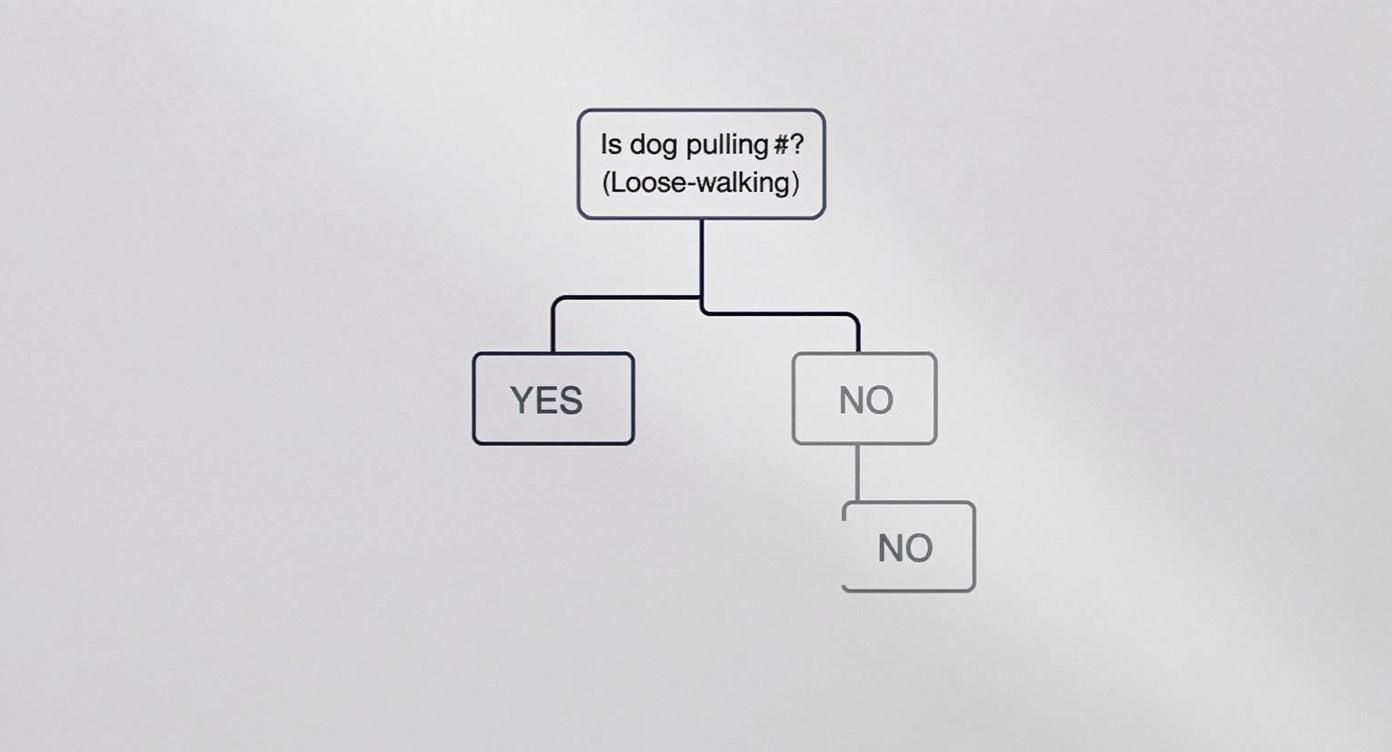
As you can see, the second the dog pulls, all forward progress stops. This quickly teaches them that the only way the exciting walk continues is on a loose leash.
Beyond Games: The Power of Enrichment
Enrichment is all about making your dog’s everyday life more interesting and challenging. It’s about creating opportunities for them to think, explore, and use their natural abilities. For a Heeler, this isn't a luxury—it's an absolute necessity.
The numbers don't lie. A remarkable 85% of owners say their Blue Heelers need at least 1-2 hours of physical activity every single day. But just as important, 75% of owners state that puzzle toys, trick training, and scent games are essential for preventing destructive behaviors. For a closer look at what these dogs need, you can discover more insights about Blue Heeler needs at Lemonade.com.
A Heeler’s brain needs a workout just as much as its body does. Enrichment isn't just about fun; it's a fundamental part of their mental health and well-being.
Adding enrichment to your routine can be surprisingly simple. Ditch the food bowl and use a puzzle feeder or a snuffle mat for meals. This forces them to slow down and use their brain to earn their dinner. Even something as easy as teaching a new trick like "wave" or "spin" provides a fantastic mental workout in just a few minutes.
Finding The Perfect Job For Your Dog
Not every activity is going to be the right fit for every Heeler. Some live for the high-octane energy of agility, while others might prefer the quiet, focused challenge of nose work. Your job is to experiment and see what truly lights your dog up.
To help you get started, here's a look at some of the most popular mental enrichment activities and what they bring to the table.
Blue Heeler Mental Enrichment Activities
| Activity | Primary Benefit | Equipment Needed | Effort Level for Owner |
|---|---|---|---|
| Puzzle Toys | Independent problem-solving, boredom busting | Puzzle feeder, Kong, treat ball | Low |
| Scent Work | Taps into natural sniffing ability, builds confidence | Scent kit or hidden treats | Medium |
| Treibball | Safe outlet for herding instinct, great exercise | Large inflatable balls, goal net | Medium |
| Agility | Builds focus, body awareness, and teamwork | Jumps, tunnels, weave poles (class or home setup) | High |
| Trick Training | Strengthens bond, teaches complex behaviors | Clicker, high-value treats | Medium |
By offering a rotating variety of these mental challenges, you'll keep your Heeler engaged, fulfilled, and out of trouble. A mentally stimulated Blue Heeler is a happy, well-behaved companion who's ready to take on any adventure with you.
Tackling Common Heeler Behavior Puzzles
Even the best-trained Blue Heeler will have moments where their powerful instincts take over. When you see these challenging behaviors pop up, don't think you have a "bad dog." What you have is a brilliant working dog trying to do its job in a world that doesn't always have sheep to herd.
Understanding why they do what they do is the key. Tackling these issues is a huge part of training a Blue Heeler successfully. It's all about channeling their incredible drive into outlets that work in our human world.
The Infamous Heel Nip: It's Not What You Think
Ah, the classic Heeler move. That little nip at your heels is probably the most misunderstood trait of the breed. It isn't aggression—it's instinct. In your dog's mind, they're not biting you; they're expertly moving stubborn "stock" (that’s you!) where it needs to go.
The second you feel those teeth, the game is over. Freeze in place. Become the most boring thing in the room. A sharp "Ouch!" can also help communicate that the fun has stopped.
Once your Heeler backs off, immediately redirect that herding impulse to something appropriate. Grab a tug toy or bring out a flirt pole. This teaches a vital lesson: human ankles are off-limits, but there are plenty of other fun things to "herd."
Addressing Resource Guarding
Heelers can get pretty possessive over their stuff—a favorite toy, their food bowl, or even their spot on the couch. This behavior, known as resource guarding, isn't about dominance; it’s about insecurity. They're worried someone is going to take their prized possession away.
Whatever you do, don't try to solve this with force. Just grabbing the item will only prove their fears right and make the guarding ten times worse. The secret is to play trading games.
Here’s how it works:
- Walk up to your dog when they have something they don't care too much about.
- Offer them something way better, like a small piece of cheese or chicken.
- When they drop the item to take your amazing treat, shower them with praise.
- Then, give them the original item right back.
This simple exercise completely changes their perspective. Your approach no longer means "I'm losing my thing!" It means "Oh, awesome, I'm about to get an upgrade!" Do this often, slowly working your way up to more valuable items. You're building trust, not conflict.
Resource guarding is rooted in fear. Your goal is to show your Heeler that you are the giver of good things, not a threat to what they have.
Managing Reactivity to Dogs and Strangers
Heelers are bred to be loyal and protective, but sometimes that can curdle into suspicion of unfamiliar people or dogs. Their natural wariness made them fantastic guardians on remote cattle stations, but it can be a challenge in a busy neighborhood.
Your first job is to be your dog's advocate. If you know your Heeler gets tense around strangers, don't force them into a crowded farmers' market. Create distance to help them feel secure.
The best long-term tools in your kit are desensitization and counter-conditioning. In plain English, you're going to change your dog's emotional response from "That's scary!" to "Oh, seeing that thing makes chicken appear!"
For instance, on a walk, the moment your Heeler sees another dog from far enough away that they're still calm, start feeding them a steady stream of high-value treats. The second that dog is out of sight, the treat bar closes. With time and repetition, your Heeler will start looking forward to seeing other dogs. This can be tricky to get right, and our complete guide on managing leash aggression in dogs walks you through a more detailed plan.
Knowing When to Call in a Pro
Look, some behaviors are just plain tough. They can be complex and overwhelming to handle alone, and there is zero shame in asking for help.
It's probably time to call a professional if:
- The behavior is getting worse, not better.
- You're seeing actual aggression, like growling, snarling, or snapping.
- You feel stressed out, anxious, or like you can't manage the situation safely.
A certified professional dog trainer or veterinary behaviorist can be a lifesaver. They can give you a plan tailored specifically to your dog, help you spot triggers you might be missing, and guide you through the process safely. Getting expert help is a sign of a great dog owner, and it can make all the difference for you and your brilliant Heeler.
Your Blue Heeler Training Gear Guide
Let's talk gear. When you're training a dog as smart and tough as a Blue Heeler, having the right tools isn't about buying fancy gadgets—it's about setting yourself up for success. The right equipment helps you communicate clearly and keeps your training sessions productive, safe, and even fun.
Think of it as building your toolkit. A small investment in quality, durable gear now will save you a world of frustration (and money) later on.
Leashes and Harnesses: Your Connection to Your Dog
Your leash and harness are your primary lines of communication on a walk, so let's get it right. While a standard flat collar is essential for holding ID tags, it’s a terrible choice for walking a Heeler, especially one that pulls. All that pressure goes straight to their throat, which is both dangerous and ineffective.
A front-clip harness, on the other hand, is a lifesaver for most Heeler owners. The leash attaches to a ring on their chest, so if they try to pull, it gently turns them back toward you. It’s a simple, humane way to teach them that pulling gets them nowhere. I always recommend finding one with padded straps to make sure it's comfortable and won't chafe during all those long hikes.
When it comes to the leash itself, keep it simple. A sturdy 6-foot nylon or leather leash is the gold standard for daily walks and training. Just do yourself a favor and stay away from retractable leashes. They're notorious for teaching dogs the exact opposite of what you want—that pulling extends their freedom—and they give you almost zero control when you actually need it.
Puzzle Toys and Chews: A Job for That Big Brain
A bored Heeler is a destructive Heeler. Their minds are constantly whirring, and if you don't give them a productive "job" to do, they'll invent one for themselves (and you probably won't like it). This is where enrichment gear becomes non-negotiable.
- Food Puzzles: Toys like the classic Kong or other treat-dispensing balls are fantastic. They make your dog use their brain to figure out how to get their meal. Pro tip: stuff a Kong with wet food or yogurt and freeze it. It'll keep even the most determined Heeler busy for a solid stretch of time.
- Snuffle Mats: These are genius. They're basically shag-rug-like mats where you can hide kibble, letting your dog tap into their natural instinct to forage and use their powerful nose.
- Tough Chews: Heelers have some serious jaw power. You absolutely need to provide a safe outlet for chewing. Look for durable rubber toys or tough, natural chews that are designed to stand up to a real workout.
Remember, enrichment isn't just about killing time. It's about giving your Heeler a fulfilling task that satisfies their deep-seated need to work and solve problems. This is a critical piece of the puzzle for a happy, balanced dog.
The Rhythm of the Day: Building a Solid Routine
Blue Heelers thrive on predictability. A consistent daily schedule helps them feel secure, reduces anxiety, and lets them know when it's time to work and when it's time to chill. You don't have to live by the clock, but a general flow to the day works wonders.
Here’s a look at what a balanced day might look like for an adult Heeler:
| Time | Activity | The "Why" Behind It |
|---|---|---|
| Morning | Quick potty trip, a 5-minute training session, then breakfast served in a puzzle toy. | Kicks off the day with purpose and a mental warm-up. |
| Mid-Day | The main event: a long walk, hike, or a good game of fetch with a flirt pole. | This is for burning off that major physical energy. |
| Afternoon | Quiet time. A durable chew in their crate or on their designated "place" bed. | This teaches the invaluable skill of settling down. |
| Evening | A shorter walk, another quick training session, dinner, and then family time with a good book. | Reinforces good habits and helps them wind down for the night. |
This kind of schedule hits all the key points—physical exercise, mental work, training reinforcement, and that all-important downtime. It's the recipe for a well-behaved companion you can truly enjoy.
At SetterFrens, we believe a well-equipped and informed owner is a confident one. For more honest reviews of top dog products and practical training guides that fit our cozy community vibe, come check out our resources at https://setterfren.com. Join our Puppicino Club for member perks and follow the fun with our pack on TikTok and Instagram @setterfrens