So, you want to write a children's book. It's a wonderful journey, but where do you even begin? It all starts with two fundamental questions: What's my big idea? and Who am I writing this for?
Before you fall in love with a quirky character or a clever plot twist, you have to get this foundation right. It’s the difference between a story that connects and one that misses the mark entirely.
The great news is that there’s a massive appetite for new stories. The children's book market is booming and expected to hit $16.431 billion by 2033. That tells us one thing: parents and kids are always hungry for their next favorite read.
Getting to Know Your Reader
First things first: who is your audience? I can't stress this enough. Writing for a two-year-old is a completely different world from writing for a seven-year-old. Your choice of age group will dictate everything—your word count, the complexity of your theme, sentence structure, and even the style of illustrations you'll need.
Think of it this way: a toddler needs simple, repetitive words and bold, clear pictures. An early reader, on the other hand, is ready for a bit more plot, longer sentences, and characters with more complex feelings.
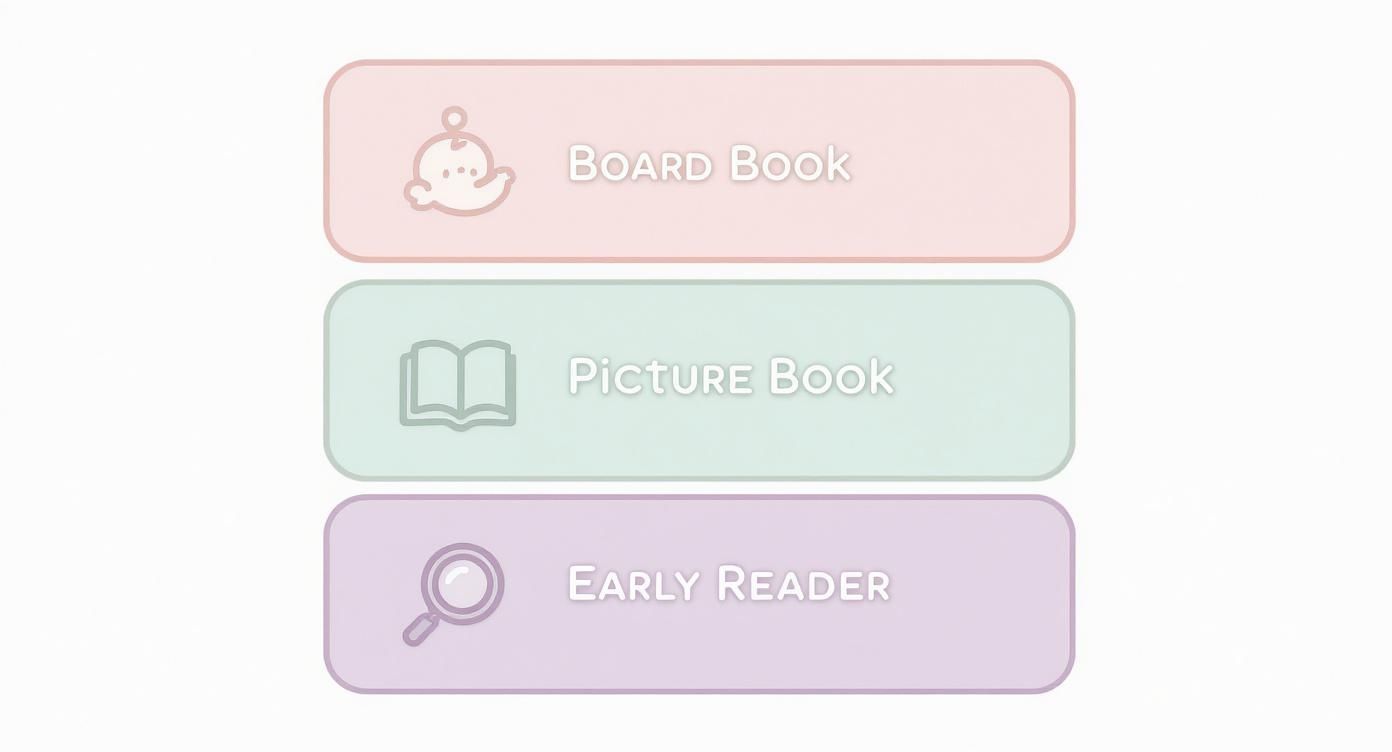
Each category you see here serves a unique developmental stage. It’s not just about age; it's about what a child is learning, feeling, and discovering at that moment in their life.
Finding the Perfect Home for Your Story
To help you pinpoint exactly where your idea fits, let's break down the main categories. This isn't just about rules; it's about understanding the reader's world so your story can become a part of it.
Understanding Children's Book Categories
| Category | Target Age | Typical Word Count | Core Focus |
|---|---|---|---|
| Board Book | Ages 0-3 | 0-100 words | Sensory experience. Simple concepts like colors, shapes, animals. Very rhythmic and repetitive. |
| Picture Book | Ages 3-8 | 200-800 words | A strong, clear story told through a marriage of text and illustrations. Explores a single, focused theme. |
| Early Reader | Ages 5-9 | 1,000-2,500 words | Helps build reading confidence. Simple plots, controlled vocabulary, and text broken into short chapters. |
| Chapter Book | Ages 7-10 | 5,000-15,000 words | Deeper character development and more complex plots. Illustrations are less frequent and support the text. |
| Middle Grade | Ages 8-12 | 25,000-50,000+ words | Rich themes of friendship, identity, and adventure. Focus is on the protagonist’s internal and external journey. |
Once you have a category in mind, you have a clear container for your idea. A story about a firefly afraid of the dark is probably a picture book. A story about a group of kids solving a neighborhood mystery sounds more like a chapter book or middle-grade novel.
Brainstorming Ideas That Actually Stick
Okay, you’ve picked your audience. Now, where do you find that magical idea?
Honestly, they’re usually hiding in plain sight. Think about those universal childhood moments: the jitters on the first day of school, the triumph of learning to tie your shoes, the fear of a monster under the bed. The most beloved stories tap into these shared experiences. In fact, if you asked our authors at SetterFrens, they’d tell you their best ideas often come from eavesdropping on their kids or remembering something funny from their own childhood.
A powerful story often comes from a simple premise with a lot of heart. Ask yourself: What feeling do I want a child to have after reading my book? Joy, comfort, curiosity, or confidence? Start there.
Specificity is your best friend here. Instead of a vague story about "friendship," what about a grumpy hedgehog who learns that sharing his favorite berry snack actually makes it taste better? See? That’s an idea with legs.
Need a little nudge to get the creative juices flowing? Try these:
- Go people-watching. Spend an afternoon at a playground or library. Just listen. Kids are hilarious, profound, and a constant source of inspiration.
- Twist a classic tale. What if the "big bad wolf" was just misunderstood and actually had a terrible cold? Rethinking a familiar story can lead to something wonderfully original.
- Solve a real-kid problem. Think about a common challenge for your target age group—like being scared of the doctor or not wanting to go to bed. How could a clever character solve it in a surprising, fun way?
By locking in your audience and nurturing a focused, heartfelt idea, you’re not just writing a story. You’re building the blueprint for a book that a child will pull off the shelf and ask for again and again.
Creating Characters Kids Will Never Forget
Okay, you've got your audience in mind and a spark of an idea. Now for the truly fun part—breathing life into your story by creating its hero.
Think back to the books that shaped your own childhood. You probably remember Max sailing off to the land of the Wild Things or the quiet determination of Ferdinand the bull. What makes these stories stick with us for decades? The characters. They are the heart of it all.
Your main character is the pair of eyes through which your young reader will see the world you've built. They don't need a cape or a crown; they just need to feel real and have a clear purpose. This is a non-negotiable step if you want to write a children's book that truly connects.
Giving Your Character a Goal
Every great character, from a brave little toaster to a shy little ghost, wants something. This "want" is the engine that drives your entire story forward. It can be something wonderfully concrete, like retrieving a lost teddy bear, or something more emotional, like figuring out how to make a friend.
For the youngest readers, keep this goal simple and instantly understandable. A complex quest to restore a magical kingdom is probably too much for a picture book audience. But helping a grumpy badger find his lost spectacles? That’s a perfect, kid-sized mission.
Let's take a character, a little puppy named Pip.
- Pip's Goal: He desperately wants to learn how to catch the big, bouncy red ball that always gets away.
- Why It Works: It’s visual, relatable (who hasn’t felt clumsy?), and sets up an immediate challenge. Every move Pip makes from this point on will be about that ball.
This simple desire creates a clear path for your story, making it easy for a child to follow along and, most importantly, root for your hero.
Crafting a Personality That Pops
A goal gives your character a mission, but their personality is what makes a reader fall in love. What makes them them? Are they comically clumsy? Endlessly curious? Stubbornly brave? These little quirks are what make a character leap off the page.
And please, show, don't tell. Instead of writing, "Barnaby the bear was courageous," try something like, "Barnaby took a deep breath, puffed out his chest, and marched toward the spooky cave, even though his knees knocked together like woodpeckers." See the difference? We feel his fear and his bravery all at once.
Our Favorite Trick: Give your hero one standout trait and a small, relatable flaw. A character who is perfect all the time is, frankly, a bit boring. A hero who is super brave but also terrified of spiders? Now that feels real. That feels endearing.
Don't forget about the supporting cast! A loyal best friend, a grumpy mentor, or a silly sidekick can be fantastic foils, helping to reveal different sides of your main character's personality through their conversations and actions.
Building a Simple Plot Around a Problem
Now that you have a character with a personality and a goal, they need one more thing: a problem. The plot of a children's book is really just the journey your character takes to solve this one big problem so they can finally get what they want.
For picture books, the classic three-act structure is your best friend. It’s simple, satisfying, and works like a charm.
- The Beginning: Introduce your character and what they want. We meet Pip the puppy, who sees the red ball and decides he must catch it.
- The Middle: Your character tries to solve the problem but hits a few snags. This is where the fun (and the tension) happens. Pip pounces, but the ball bounces right over his head. He chases it, but he trips over his own paws. Oh no!
- The End: Your character figures out a new way to solve the problem and finally succeeds, often learning a little something in the process. Pip realizes he can’t do it alone. He asks his friend, a wise old Setter, for help. Together, they corner the ball, and Pip gets his triumphant catch!
This formula gives the story a satisfying arc that feels complete. The key is that the solution shouldn't feel like magic; the character's own actions should lead to the win. That's what empowers young readers—showing them that a little grit and creative thinking can solve almost any problem.
Writing with Rhythm and Read-Aloud Magic

Here’s something every experienced children's author learns, often the hard way: your book isn’t just a story. It’s a performance.
Night after night, your words will be read aloud by parents, librarians, and teachers. The way your writing sounds is just as important as the plot it carries. So, as you write, don't just think like an author—think like a composer. Your job is to create a lyrical experience that’s an absolute joy to read out loud.
This isn’t just about making your prose sound nice. It’s about connection. A story with a great rhythm holds a child's attention, making the world you've built feel more real and engaging. The real magic happens when the sound of your story perfectly clicks with its meaning.
Crafting a Lyrical Flow
The best children's books have their own internal music. They use a natural cadence, simple sentence structures, and a touch of poetry to create a memorable, almost song-like quality that little ears are wired to love.
Think about a simple, classic line like, "The cat sat on the mat." It's predictable, satisfying, and easy on the ear. This doesn't mean your writing needs to be overly simplistic, but it absolutely needs to be intentional and clear.
Ready to find your story’s beat? Here are a few tools you can play with:
- Alliteration: This is just repeating the first sound in a string of words, like "Slowly, silently, the snail slid." It's fun to say and helps a phrase stick in a kid's brain.
- Repetition: Kids love repetition. It creates a predictable rhythm that makes them feel smart and lets them join in on the fun. Repeating a key phrase or a silly sound effect gives them something to look forward to with every page turn.
- Onomatopoeia: These are the fun words that sound like what they are—thump, buzz, meow, vroom. Sound words make your story feel more alive and interactive.
Weaving these into your story builds a richer sensory experience. Suddenly, your book isn't just something to look at; it's something to hear and feel.
Choosing Your Words with Care
Your vocabulary is your toolkit, and every single word has a job to do. You need to choose words that are both understandable for your target age group and packed with meaning. The goal is to find language that is simple without being bland.
For example, instead of just saying a character was "sad," you could show it with language that’s more descriptive but still easy to grasp. Maybe the character's "shoulders drooped" or a "lonely tear trickled down his cheek."
Choosing the right words is a balancing act. You want language that stretches a child’s vocabulary just a little, but not so much that it pulls them out of the story. If a child has to stop and ask what a word means every few sentences, you’ve lost the magic.
One of the best ways to test your word choice is to read your manuscript aloud to a child in your target audience. Watch their face. Are they captivated, or are they wiggling? Their genuine reaction is the most honest feedback you'll ever get.
Mastering the Art of the Page Turn
In a picture book, the page turn is your secret weapon. It's a physical pause, a tiny moment of suspense that you, the writer, have complete control over.
Think of each page turn as a mini cliffhanger. What's going to happen next? That anticipation is a huge part of the fun. You can use it to build suspense, create a surprise, or reveal the solution to a problem.
Let's go back to our puppy, Pip, who's chasing that bouncy red ball.
- Page 6-7: "Pip took a running leap, his little legs pumping… he was going to catch it this time for sure!"
- (Page Turn)
- Page 8-9: "…SPLAT! Right into a big mud puddle."
The page turn creates a moment of drama and a perfect beat for a little laugh. Learning to structure your story around these 15 or 16 page turns (in a standard 32-page book) is a fundamental skill. It forces you to think visually and pace your story for the biggest possible impact.
Finding the Perfect Illustrator for Your Story
The words are only half the battle in a children's book. Seriously. The illustrations do just as much heavy lifting, maybe even more. They're what turn your manuscript into a living, breathing world a kid can get lost in. Finding the right artist isn't just a step; it's a quest to find your story's other half.
The partnership between a writer and an illustrator is a special kind of magic. Your job is to find someone whose style doesn't just match your words but elevates them, adding layers of emotion and detail you could never capture with text alone. This visual storytelling is the secret sauce behind the most beloved picture books.
And believe me, the appetite for beautifully illustrated stories is massive. Picture books make up about 60% of all children's book sales worldwide. In 2022 alone, the U.S. children's book market pulled in around $690 million, with picture books leading the pack. If you want to dive deeper, check out the children's book sales statistics on zipdo.co—it really drives home how critical great art is.
Where to Find Talented Artists
So, where do you even start looking for this creative partner? The good news is, talented illustrators are everywhere. You just need to know where to look.
A great first step is to just browse the shelves, both in a real bookstore and online. Take a peek at the dog-themed books we love to get a sense of different artistic styles. When a style grabs you and makes you think, “Yes! That’s it! That’s the feeling!”, jot down the illustrator’s name.
Here are some of the best hunting grounds for illustrators:
- Social Media: Instagram and Behance are visual goldmines. Search hashtags like #childrensbookillustrator, #kidlitart, or #picturebookartist, and get ready to scroll through endless inspiration.
- Professional Groups: Organizations like the Society of Children's Book Writers and Illustrators (SCBWI) have member directories filled with vetted professionals who are actively looking for their next project.
- Freelance Platforms: Sites like Upwork and Fiverr have a huge pool of artists. It can take some digging to find a gem that fits your vision and budget, but they’re out there.
What to Look for in a Portfolio
As you're browsing, remember you aren't just looking for pretty pictures. You're scouting for a specific skill set that's vital for picture book illustration. A great portfolio is way more than a collection of static drawings.
Keep your eyes peeled for these key things:
- Consistency: Can they draw the same character from different angles, with different expressions, and still have it look like the same character? Your hero needs to feel like the same person (or puppy!) from page 1 to page 32.
- Emotional Range: Look for art that packs an emotional punch. Can the artist clearly show a character who is joyful, heartbroken, mischievous, or scared? This is how you connect with your young readers.
- Storytelling: Do the images tell a story all on their own? The best illustrations have little background details and secondary actions that add depth and reward kids who love to pore over the pictures.
Don't just look for an artist who can draw your main character. Look for an artist who can draw your character's world. A great illustrator builds a setting that feels just as alive and interesting as the hero of the story.
Creating an Effective Illustration Brief
Once you've found an illustrator (or a shortlist of a few you love), you have to communicate your vision. This is where the illustration brief comes in. Think of it as the roadmap you give the artist to make sure you both end up at the same destination. A solid brief prevents a world of misunderstanding.
Your brief should break down the story page by page. We like to put the text for each spread right next to our notes about the illustration. Don't just say, "Show the dog being sad." Get specific. Try something like, "Show Pip the puppy huddled under the big willow tree, ears drooping, with his favorite red ball lying untouched in the grass next to him."
Be specific, yes, but don't try to art-direct every single pixel. You hired this person for their talent and unique vision, so let them bring their magic to the table. Treat it like a true collaboration. The best ideas often come from the illustrator, sparking visual moments you never would have imagined on your own. That partnership is what will truly make your story shine.
Editing Your Manuscript Until It Shines
So, you’ve finished your first draft. Before you do anything else, take a moment to celebrate! Seriously. You’ve brought a story into the world, and that is a massive accomplishment. Now, the real magic begins. Editing is where you’ll polish that rough-and-tumble draft, turning a good story into a great one that feels like it was always meant to be.
This part of the process is so much more than just hunting for typos. It’s about taking a step back, looking at your story with fresh eyes, and making some tough but necessary decisions. The goal is to make sure every single word earns its place, delighting not just the child listening but also the grown-up who will be reading it aloud for the hundredth time.
Your Self-Editing Toolkit
Before another human being ever lays eyes on your manuscript, the first round of edits is all you. This is your chance to tackle the big-picture stuff and smooth out any awkward sentences.
Our number one, non-negotiable tip? Read your story out loud. It’s the single best way to catch weird phrasing, clunky rhythm, and pacing problems. You’ll hear instantly where the story drags or where the sentences are just too darn long.
To keep yourself on track, it helps to have a little checklist. Pour yourself a Puppicino, sit down with your manuscript, and ask yourself these questions:
- Pacing and Page Turns: How does the story feel? Does each page turn build a little bit of suspense or surprise, making the reader need to see what’s next?
- Character Arc: Is your main character’s goal clear from the get-go? Are they actively solving their own problems, or are they just along for the ride while things happen to them?
- Word Choice: Have you used punchy, active verbs? Look for any passive language you can tighten up. (For example, change "The ball was thrown by the dog" to "The dog threw the ball.")
- The Read-Aloud Factor: Are there any tongue-twisters or sentences that make you stumble? If you trip over them, a parent reading at bedtime definitely will.
Editing is often about subtraction, not addition. Be brave enough to cut a beautiful sentence if it doesn't actually move the story forward. A tight, focused story is always stronger.
The Power of Fresh Eyes
Once you’ve polished your manuscript as much as you possibly can, it’s time to step away. You’re simply too close to it now to spot all its flaws. Getting feedback is one of the most crucial parts of learning how to write a children's book.
Find a few people who you trust to be honest but kind. A writers' critique group, a fellow author, or even a local teacher or librarian can offer incredible insights. They’ll see the plot holes you’ve become blind to and point out moments where the emotional heart of the story isn't quite landing.
Remember, feedback is a gift—even when it stings a little. Listen with an open mind, take good notes, and thank them for their time. You don’t have to act on every single suggestion, but if two or three different people point out the same issue, that’s a big red flag that something needs fixing.
Choosing Your Publishing Path
With a polished, feedback-tested manuscript clutched in your hand, you’ve arrived at a major crossroads: how to get your book out into the world. There are two main paths you can take, and each one comes with its own unique set of pros and cons.
| Publishing Path | What’s Great About It | The Hard Parts |
|---|---|---|
| Traditional Publishing | No upfront cost for you, you get a professional team (editor, designer), access to bookstore distribution, and maybe even an advance payment. | It's incredibly competitive, the timelines can be very long (think years), you have less creative control, and you get a smaller cut of the profits (royalties). |
| Self-Publishing | You have 100% creative control, it's much faster to get your book to market, and you earn much higher royalty rates for every book sold. | It requires a significant upfront investment (editing, illustration, marketing), and you are responsible for every single aspect of production and promotion. |
There’s no "right" answer here—only what’s right for you.
Traditional publishing offers the prestige and marketing muscle of a big publisher but requires a superhuman level of patience. Self-publishing, on the other hand, gives you complete freedom and a bigger piece of the pie but puts all the financial risk and workload squarely on your shoulders.
Think about your personal goals, your budget, and how much time you have. Are you dreaming of seeing your book in major bookstores, or are you more excited about building your own brand and connecting directly with your readers? Your answer will point you down the path that makes the most sense for you and your wonderful story.
Got Questions? We’ve Got Answers
Stepping into the world of children's book writing is a thrilling adventure, but it's totally normal to have a map full of question marks. Think of this as a quick coffee chat where we clear up some of the most common things aspiring authors ask.
Getting these answers straight will give you the confidence to push forward, whether you’re just starting to daydream about characters or are deep in the editing weeds. Let's tackle those nagging questions.
How Long Should My Children's Book Be?
This is the big one, and for good reason! The answer is simple but absolutely critical: it all comes down to the age you're writing for. Word count isn't just a guideline; it's an industry standard that agents and publishers live by. Straying too far from these numbers can be a red flag.
-
Board Books (Ages 0-3): Think tiny. We're talking under 100 words. The magic here is in simple concepts, catchy rhythms, and maybe some fun textures—not a complex plot.
-
Picture Books (Ages 3-8): This is the sweet spot for most writers. You'll want to aim for 300-800 words. It’s just enough space to tell a complete, satisfying story without losing the attention of a fidgety little listener.
-
Early Readers (Ages 5-9): As kids begin to sound out words on their own, the count goes up. These books, often broken into short chapters, can run from 1,000 to 2,500 words.
Do I Need an Illustrator Lined Up Before I Submit to a Publisher?
Unless you happen to be a professional author-illustrator, the answer for traditional publishing is almost always a resounding no. I know it feels backward, but trust the process.
Publishers have dedicated art directors and editors who are masters at matchmaking. They have a roster of incredible illustrators they work with and take immense pride in finding the perfect artist whose style will make your story soar. Your job is to write a story so compelling, so full of heart, that they can't help but picture it as a beautiful book.
Now, if you're self-publishing, the tables turn completely. You'll be the one finding, hiring, and directing your illustrator.
Your manuscript is your audition. Focus all your energy on making the words sing. A polished, powerful story is what will catch an editor's eye, not an amateur illustration attached to it.
What Are the Biggest Mistakes First-Time Authors Make?
Learning how to write for kids often means learning what not to do. It’s okay—most of us stumble over the same hurdles when we’re starting out. Just knowing what they are is half the battle.
One of the most common traps is writing a "message" book that feels preachy. Kids are incredibly savvy; they can spot a lecture disguised as a story a mile away. Let your theme grow organically from your character’s journey instead of spelling it out.
A few other classic blunders? Using vocabulary that’s too complex, creating a main character who just lets things happen to them, and forgetting to read the manuscript out loud. You'd be amazed what your ear can catch that your eye misses. For more tips on sidestepping common writing pitfalls, check out our other how-to guides for writers.
What's the Real Cost to Self-Publish a Picture Book?
This is a huge question, and the answer can vary wildly, but it's crucial to go in with a realistic budget. When you self-publish, you’re the CEO, which means you're funding the entire project.
Your single biggest investment, by a long shot, will be the illustrations. A talented, professional illustrator can charge anywhere from $3,000 to upwards of $12,000 for a standard 32-page picture book. That number might make you gulp, but in the crowded children's market, fantastic art is simply non-negotiable. It’s what makes a child pick your book up in the first place.
Other costs to plan for include:
- Professional Editing: $500 – $1,500
- Book Design & Formatting: $300 – $1,000
- Marketing & Promotion: Varies widely
Investing wisely in top-notch illustration and editing is the most important financial decision you'll make. It’s what elevates a passion project into a professional-quality book and gives your story the best possible chance to find its audience.
SetterFrens is a cozy online community built for dog lovers who believe life’s better with a wagging tail and a good book. Along with our curated selection of dog-themed books, SetterFren.com features honest reviews of the top dog products and practical how-to guides to help you care for your pup like a pro. Join our Puppicino Club to unlock member perks, book updates, and dog-friendly treats. Stay part of the fun by following @setterfrens on TikTok and Instagram for heartwarming dog moments, product tips, and behind-the-scenes content from our growing pack