Welcome, educators! Just like training a beloved pup requires patience and the right techniques, helping students become confident readers means having a toolkit of effective reading comprehension strategies for teachers. In a world full of distractions, fostering deep reading comprehension is more crucial than ever. It's the bridge that connects decoding words to understanding worlds, building a foundation for lifelong learning and curiosity.
This guide is designed to be your go-to resource, moving beyond theory to offer practical, actionable steps you can use in your classroom tomorrow. We aren't just listing ideas; we're breaking down 10 powerful, evidence-based strategies that truly work. Think of it as a playbook filled with game-winning moves to boost your students' understanding and engagement. Each entry is packed with clear implementation steps, differentiation tips for diverse learners, and real-world examples to make learning stick—much like a good story sticks in the heart of a young reader.
Inside, you'll find everything from structured Guided Reading and the Think-Aloud Strategy to fostering metacognition and using graphic organizers. Our goal is to equip you with a comprehensive set of tools to transform your literacy block. To further enrich your instructional toolkit, you can also explore a variety of practical reading comprehension activities that complement these strategies perfectly. Get ready to unlock new levels of understanding and empower every student to become a confident, thoughtful reader who not only reads the text but also interacts with it.
1. Guided Reading Groups
Guided reading is a powerful, small-group instructional strategy where a teacher works with a handful of students who are at a similar reading level. Popularized by literacy experts like Irene Fountas and Gay Su Pinnell, this approach allows you to provide highly targeted support, helping learners tackle texts that are just slightly above their independent reading level, also known as their "instructional level." The goal is to build skills and confidence in a supportive, interactive setting.
This method is a cornerstone of effective reading comprehension strategies for teachers because it's so adaptable. You can focus on specific skills, from decoding to making inferences, all tailored to what that particular group needs. While you work with one group, other students engage in meaningful independent literacy tasks, creating a dynamic, differentiated classroom environment.

How to Implement Guided Reading
Getting started is all about organization and observation. Here’s a simple breakdown:
- Assess and Group: Use assessments like running records or informal reading inventories to place students into small, flexible groups based on their reading behaviors and comprehension needs.
- Select Texts: Choose a high-quality text that will be challenging but not frustrating for the group. The text should offer opportunities to practice the target skill.
- Introduce the Book: Before reading, briefly introduce the story, activate prior knowledge, and pre-teach any tricky vocabulary.
- Guide the Reading: Students read the text softly to themselves while you "listen in," offering immediate, quiet feedback and prompting.
- Discuss and Teach: After reading, facilitate a rich discussion about the text. This is your chance to explicitly teach a comprehension skill, using the text as your guide.
Tips for Success
- Keep Groups Flexible: Student needs change! Reassess regularly and don't be afraid to move students to a different group when their skills progress.
- Plan Engaging Centers: The success of your guided reading time heavily depends on what the other students are doing. Plan meaningful independent or partner activities. For younger learners, you can find inspiration in these fun kindergarten literacy activities that build foundational skills.
- Use Think-Alouds: Model your own thinking process to show students how good readers make sense of a text. Say things like, "Hmm, the author said the character stomped his feet. That makes me think he is feeling angry."
- Create Anchor Charts: Co-create simple anchor charts during your lessons that summarize a new strategy. Students can refer back to these during independent reading.
2. Think-Aloud Strategy
The think-aloud strategy is a powerful metacognitive tool where teachers verbalize their thoughts while reading aloud. By making your internal reading process visible and audible, you model for students how proficient readers interact with a text. This technique, championed by literacy experts like Stephanie Harvey and Anne Goudvis, helps students understand that reading isn't just about decoding words; it's an active process of making predictions, asking questions, clarifying confusion, and making connections.
This method is one of the most direct and effective reading comprehension strategies for teachers because it demystifies the act of comprehension. It transforms abstract cognitive processes into concrete, observable steps that students can learn to imitate. From a picture book in kindergarten to a complex scientific article in high school, the think-aloud makes the invisible work of reading visible, building students' confidence and metacognitive awareness.
How to Implement a Think-Aloud
Implementing a think-aloud is all about planning your cognitive "stops" ahead of time. Here’s how to get started:
- Select a Short Text: Choose a brief, engaging passage that offers rich opportunities for modeling a specific comprehension skill (e.g., predicting, visualizing, questioning).
- Plan Your Thinking: Read the text beforehand and mark specific points where you will pause to think aloud. Jot down notes on what you'll say to model your thinking.
- Introduce the Strategy: Explicitly tell students what you are doing. Say, "Today, I'm going to show you what good readers do inside their heads. I'll be sharing my thoughts out loud as I read."
- Model the Process: Read the text aloud and pause at your pre-planned spots to share your thoughts. Use "I" statements, such as "I'm wondering why…" or "This part makes me picture…"
- Encourage Student Participation: After modeling, invite students to try thinking aloud with a partner or share their own thoughts about a different passage.
Tips for Success
- Be Authentic: Your think-alouds should sound natural, not scripted. It’s okay to model genuine confusion and how you work through it.
- Focus on One Skill: Don't overwhelm students by modeling five different strategies at once. Start by focusing on just one, like making connections, before adding another.
- Use Sentence Starters: Provide students with sentence stems on an anchor chart to support their own think-alouds. Phrases like "I predict that…" or "This reminds me of…" can be very helpful.
- Keep it Brief: Model for just a few minutes at a time, especially with younger learners, to maintain engagement and ensure the core lesson is absorbed.
3. Reciprocal Teaching
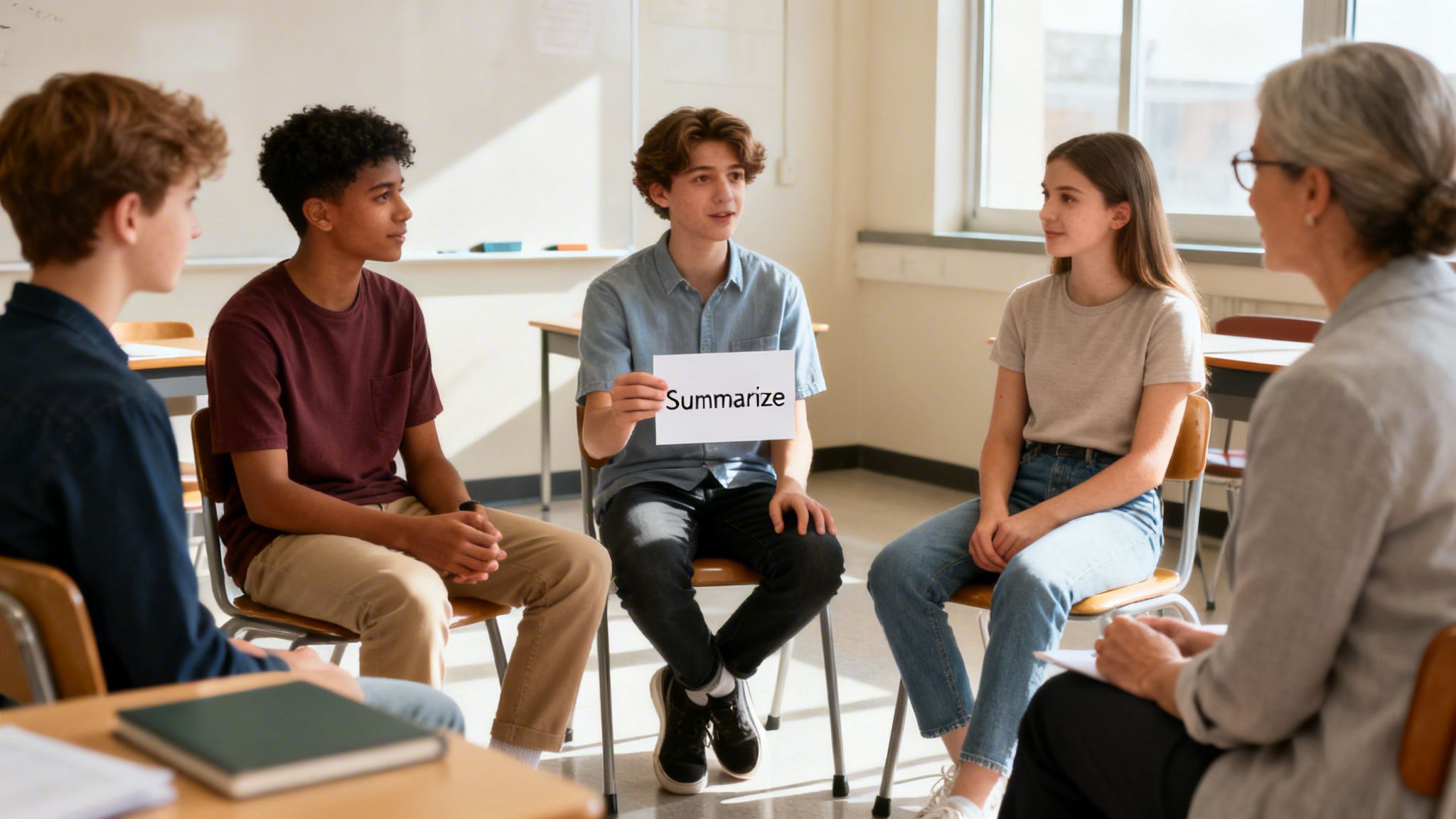
Reciprocal teaching is a dynamic, collaborative strategy where students become the teachers. Developed by Annemarie Palincsar and David Brown, this dialogue-based approach empowers students to lead discussions about a text using four key comprehension strategies: questioning, clarifying, summarizing, and predicting. The teacher initially models these roles, then gradually releases responsibility to the students, fostering a student-led environment that builds deep comprehension and critical thinking.
This method is a standout among reading comprehension strategies for teachers because it transforms passive readers into active participants. By taking on leadership roles, students internalize how proficient readers think and interact with a text. It's highly effective for building metacognitive skills, as students learn to monitor their own understanding while engaging in meaningful conversation with their peers.
How to Implement Reciprocal Teaching
The core of this strategy lies in structured dialogue and shared responsibility. Here's how to introduce it in your classroom:
- Introduce the "Fab Four": Explicitly teach the four strategies one at a time. Model how a "Questioner" asks meaningful questions, a "Clarifier" identifies confusing parts, a "Summarizer" retells the main ideas, and a "Predictor" makes evidence-based guesses about what's next.
- Model the Process: Conduct a whole-group read-aloud where you take on all four roles, thinking aloud to demonstrate how each one works.
- Form Small Groups: Divide students into groups of four, assigning each member one of the roles. Provide them with a short, engaging passage.
- Facilitate the Discussion: Students read a section of the text silently. Then, the designated leader for that section guides the group through the four strategies in order.
- Rotate Roles: After completing a section, students rotate roles, giving everyone a chance to lead and practice each of the four strategies.
Tips for Success
- Use Scaffolds: Provide students with role cards, discussion guides, and sentence starters ("I'm confused about…", "The most important idea was…", "I predict that… because…") to support them as they learn their roles.
- Start Small: Begin with short, high-interest texts to help students focus on mastering the process before moving on to more complex, chapter-length material.
- Model, Model, Model: Consistently model each role, even after students have started working in groups. Your think-alouds are the most powerful tool for showing them what effective comprehension looks like.
- Give Specific Feedback: Circulate and listen in on group discussions. Provide targeted feedback not just on the content of their discussion, but on how well they are fulfilling their roles.
4. Question-Answer Relationships (QAR)
Question-Answer Relationships (QAR) is a powerful framework that demystifies how to answer comprehension questions by showing students where to find the information. Developed by Taffy Raphael, this strategy teaches learners to categorize questions into four types, clarifying the relationship between the question asked and the text itself. It moves students beyond simple "search and find" missions, equipping them to tackle complex inferential questions.
This strategy is an essential component of effective reading comprehension strategies for teachers because it makes the invisible process of thinking visible. By explicitly teaching students to identify whether an answer is "in the book" or "in their head," you give them a concrete roadmap for comprehension. This reduces frustration and builds the metacognitive skills necessary for tackling everything from picture books to dense informational articles.
How to Implement QAR
Introducing QAR is about providing clear definitions and lots of practice. Here’s how to get started:
- Introduce the Four Types: Explain the two broad categories ("In the Book" and "In My Head") and the four specific question types within them.
- Right There: The answer is explicitly stated in a single sentence.
- Think and Search: The answer is in the text, but requires pulling information from multiple places.
- Author and Me: The answer combines clues from the text with the reader's own background knowledge.
- On My Own: The answer comes entirely from the reader's own experience and does not require the text.
- Model with a Shared Text: Read a short text aloud and present pre-written questions of each type. Model how you identify the question type and locate the answer.
- Provide Guided Practice: In small groups or pairs, give students a new text with questions. Have them work together to label each question's QAR type before they answer it.
- Promote Independent Application: Encourage students to use the QAR framework during independent reading, creating their own questions for a text or labeling questions from worksheets.
Tips for Success
- Create Anchor Charts: Develop a visual, color-coded anchor chart for the four QAR types. This gives students a constant reference point during literacy activities.
- Use Consistent Language: Stick to the established names for each question type ("Right There," "Think and Search," etc.) to build a shared vocabulary in your classroom.
- Start with Sorting: Before asking students to answer questions, give them a list of questions and have them simply sort them into the four QAR categories.
- Integrate into All Subjects: QAR isn't just for reading class. Apply this strategy to questions in science, social studies, and even math word problems to reinforce the skill across the curriculum.
5. Predicting and Inferencing Instruction
Teaching students to predict and infer transforms them from passive readers into active detectives. This strategy, championed by literacy experts like Stephanie Harvey and Anne Goudvis, explicitly guides students to make educated guesses about what will happen next and to understand what the author implies but doesn't state directly. Predicting and inferencing are critical reading comprehension strategies for teachers to foster because they build engagement and teach students to look for evidence.
By combining prediction with inference, you empower students to read between the lines and draw conclusions using textual clues. This moves them beyond literal, surface-level understanding and into the realm of higher-order thinking. Students learn to question, connect ideas, and actively engage with the material, whether it's a mystery novel or an informational science text.
How to Implement Predicting and Inferencing
This strategy works best when modeled explicitly and practiced consistently. Here’s how to integrate it into your classroom:
- Introduce with Visuals: Start with a "picture walk." Before reading, show students the book's cover and a few illustrations. Ask, "What do you think this book will be about based on these pictures?"
- Model Your Thinking: Use a think-aloud to demonstrate the process. Say, "The title has the word 'mystery,' and the character on the cover is holding a flashlight. I predict she is going to solve a puzzle."
- Create an Anchor Chart: Make a T-chart with "What I Predict" on one side and "What Really Happened (My Evidence)" on the other. Fill it out together as you read.
- Teach Inferencing: After reading a passage, stop and ask questions that require inference. For example, "The character slammed the door. The text doesn't say he's angry, but how can we infer that he is?"
- Practice with Different Texts: Use this strategy across genres, from suspenseful narratives to informational articles where students infer meaning from data charts or photographs.
Tips for Success
- Use Prediction Journals: Have students keep a simple journal where they write down predictions before reading and then verify or adjust them as they go.
- Teach Clue-Searching: Explicitly show students how to find textual clues. Highlight sentences or phrases that support an inference and explain your reasoning.
- Start with the Obvious: Begin with texts that have very clear clues to build confidence. As students become more skilled, introduce more subtle and complex texts.
- Connect to Prior Knowledge: Encourage students to use what they already know about the world to help them make logical predictions and inferences. Selecting engaging titles, like some of the best books for early readers, can make this process more natural and fun.
6. Vocabulary Instruction and Context Clues
A rich vocabulary is the bedrock of reading comprehension. This strategy involves deliberately pre-teaching essential words and showing students how to use context clues to decipher unfamiliar terms. Developed by experts like Isabel Beck and Margaret McKeown, this dual approach ensures students can both understand the text at hand and develop the skills to independently tackle challenging words in the future.
This two-pronged attack on vocabulary is one of the most effective reading comprehension strategies for teachers because it builds student independence. Instead of just memorizing definitions, learners become word detectives, actively using clues within the text to construct meaning. This process not only improves comprehension but also boosts confidence when facing complex, grade-level material.
How to Implement Vocabulary and Context Clues
Successful implementation moves beyond simply handing out a word list. It’s an interactive, ongoing process.
- Select Tier 2 Words: Before a lesson, scan the text for high-utility (Tier 2) words that are crucial for understanding the story but aren't common in everyday conversation.
- Pre-Teach with Intent: Introduce these words using student-friendly definitions, images, and simple movements or gestures. Connect them to students' prior knowledge.
- Model Context Clue Usage: During a read-aloud, stop at an unknown word and model a think-aloud. Say, "I'm not sure what this word means, but the sentence says… That makes me think it must mean…"
- Teach Clue Types: Explicitly teach different types of context clues (definition, example, contrast) using an anchor chart for visual support.
- Practice and Apply: Provide short, focused passages where students can practice identifying and using context clues with partners before applying the skill independently.
Tips for Success
- Focus on a Few Words: Don't overwhelm students. Pre-teaching 3-5 essential words is far more effective than giving them a list of 15.
- Use Student-Friendly Language: Avoid copying dictionary definitions, which can be more confusing than the word itself. Explain words in a way kids can understand and relate to.
- Encourage Multiple Exposures: One introduction isn't enough. Weave new vocabulary words into classroom discussions, writing prompts, and games throughout the week.
- Build Academic Language: To further support students' ability to decode complex texts, a strong foundation in academic vocabulary is essential for deeper comprehension across all subjects.
7. Close Reading and Text-Dependent Questions
Close reading is an analytical strategy where students dive deep into a short, complex text, reading it multiple times to uncover layers of meaning. Instead of relying on outside knowledge, the focus is squarely on the text itself. This approach, heavily emphasized by the Common Core State Standards, teaches students to become textual detectives, using evidence to understand not just what an author says, but how and why they say it.
This method is a vital part of any teacher's toolkit for reading comprehension strategies because it builds critical thinking and evidence-based reasoning. By guiding students with carefully crafted text-dependent questions, you move them from a surface-level summary to a rich analysis of author's craft, structure, and purpose. It's a powerful way to prepare students for the complex texts they'll encounter in higher education and beyond.
How to Implement Close Reading
Success with close reading hinges on selecting the right text and planning purposeful questions. Here’s a typical sequence:
- Select a Worthy Text: Choose a short, high-quality passage that is rich with meaning, has complex ideas, or uses interesting language. It should be a text that rewards rereading.
- Plan Text-Dependent Questions: Design a series of questions that guide students through the text. Start with general understanding questions (what does the text say?) and move toward questions about structure (how does it work?) and author's purpose (what does it mean?).
- First Read: Get the Gist: Have students read the text independently to get a basic understanding. Ask a general question like, "What is the main idea of this passage?"
- Second Read: Dig Deeper with Annotations: Guide students to reread with a pencil in hand. Use annotation marks to circle key words, underline important phrases, or note confusing parts. Ask more specific, detail-oriented questions.
- Third Read: Analyze and Synthesize: The final read focuses on analysis and synthesis. Ask "why" questions that prompt students to make inferences, analyze author's craft, and draw conclusions based entirely on textual evidence.
Tips for Success
- Model Extensively: Use think-alouds to show students how you read closely. Model how you find evidence, question the author's choices, and connect ideas within the text.
- Use Annotation Guides: Provide students with a simple set of annotation symbols (e.g., a star for a key idea, a question mark for confusion). This makes the process less intimidating.
- Scaffold with Partners: Let students discuss text-dependent questions with a partner before sharing with the whole class. This builds confidence and allows them to rehearse their thinking.
- Keep it Short and Focused: Close reading should be done with brief passages. The goal is depth over breadth. You don't need to close read an entire novel.
8. Comprehension Monitoring and Metacognition
Comprehension monitoring is the ultimate goal of reading instruction: teaching students to think about their own thinking. This metacognitive approach empowers students to become active, self-aware readers who can recognize when their understanding breaks down and know how to fix it. Championed by literacy experts like David Pearson and Debbie Miller, this strategy shifts the responsibility from teacher to student, fostering independence and deeper learning.
This is one of the most vital reading comprehension strategies for teachers because it creates lifelong learners. Instead of just decoding words, students learn to have an internal dialogue with the text, asking questions and applying "fix-up" strategies when they get stuck. This internal monitoring is the secret ingredient that separates passive readers from truly engaged, proficient ones.
How to Implement Comprehension Monitoring
Teaching metacognition is about making the invisible process of thinking visible. Here’s how to get started:
- Introduce the Concept: Explain that good readers are always thinking and checking if they understand. Use a simple analogy, like a "mental checklist" or a "comprehension traffic light" (green for understanding, yellow for confusion, red for stop and fix).
- Explicitly Teach Fix-Up Strategies: Don't just tell students to "reread." Teach a menu of specific strategies: reread, slow down, read ahead, visualize, ask a question, or check a keyword.
- Model with Think-Alouds: Read a passage aloud and intentionally stop when you hit a confusing part. Voice your thought process: "Wait, I'm not sure what that word means. I'm going to reread the sentence to look for clues."
- Provide Scaffolds: Give students tools to practice, like bookmarks with fix-up strategy icons, comprehension monitoring checklists for independent reading, or reading journals to reflect on their thinking process.
- Encourage Reflection: After reading, have students share moments when they felt confused and what strategy they used to clear it up.
Tips for Success
- Create Visual Reminders: Post an anchor chart in the classroom that lists the fix-up strategies. Students can refer to it when they get stuck during independent work.
- Use Metacognitive Journals: Have students keep a simple journal where they jot down their thoughts, questions, and the strategies they used while reading.
- Celebrate the "Aha!" Moments: When a student shares how they successfully monitored their own comprehension, celebrate it! This reinforces the value of being a strategic reader.
- Start Small: Introduce just one or two fix-up strategies at a time. Once students are comfortable with those, add more to their toolkit.
9. Structured Literacy Discussions and Book Clubs
Structured literacy discussions, often taking the form of book clubs or literature circles, are a dynamic, student-centered strategy that transforms reading into a social and collaborative act. Championed by educators like Harvey Daniels and Lucy Calkins, this approach moves beyond simple Q&A sessions. It empowers students to take ownership of their learning by engaging in purposeful, in-depth conversations about a shared text.
This method is a fantastic addition to your toolkit of reading comprehension strategies for teachers because it builds both academic and social-emotional skills. By providing clear roles, prompts, and expectations, you guide students to think critically, listen actively, and build on each other's ideas. The result is a vibrant classroom culture where students learn to articulate their thoughts, defend their interpretations with textual evidence, and appreciate diverse perspectives.
How to Implement Structured Discussions
Success with book clubs lies in clear expectations and intentional scaffolding. Here’s a framework to get started:
- Form Groups and Select Texts: Create small groups (4-5 students) and allow them to choose from a curated selection of books. Offering choice is a huge motivator.
- Assign Roles and Teach Protocols: Introduce specific roles like "Discussion Director," "Word Wizard," or "Summarizer." Explicitly teach the responsibilities of each role and the protocols for respectful conversation.
- Set a Reading Schedule: Break the book into manageable sections and create a reading and meeting schedule. Students read their assigned section and prepare their role notes before each meeting.
- Facilitate, Don't Dominate: During discussions, your role is to be a facilitator. You can float between groups, listen in, and pose clarifying or extending questions, but let students lead the conversation.
- Encourage Reflection: After each meeting, have students briefly reflect on their group's discussion. What went well? What could be improved for next time?
Tips for Success
- Provide Sentence Starters: Support all learners by offering discussion frames and sentence starters on anchor charts or table cards. Phrases like, "I agree with… because…" or "I wonder why the author chose to…" can be very helpful.
- Keep Groups Intentional: Mix students with different reading strengths and personalities to create balanced, dynamic groups that can learn from one another.
- Model, Model, Model: Before launching, conduct a "fishbowl" discussion where you and a few students model what a productive book club conversation looks and sounds like.
- Organize Your Library: A well-organized classroom library makes book selection easier and more exciting for students. You can explore creative classroom library organization ideas to make your book collection inviting and accessible.
10. Graphic Organizers and Visual Comprehension Tools
Graphic organizers are visual frameworks that help students organize, analyze, and retain information from a text. Popularized by educators like David Hyerle with his "Thinking Maps," these tools translate complex ideas into simple, manageable formats. From story maps and Venn diagrams to cause-and-effect charts, they provide concrete structures for abstract thinking, making them a cornerstone of reading comprehension strategies for teachers.
These tools are incredibly effective because they provide scaffolding for students, helping them see the relationships between concepts, characters, and events. By visually mapping out a text's structure, learners can more easily identify main ideas, track plot development, and compare and contrast key details. This makes comprehension accessible for diverse learners, including visual thinkers and those who struggle with organizing information.

How to Implement Graphic Organizers
Integrating visual tools into your lessons can be done before, during, or after reading to support different comprehension goals.
- Select the Right Tool: Choose an organizer that matches your learning objective. A Venn diagram is perfect for comparing two characters, while a timeline works best for a historical biography.
- Model Extensively: Introduce the organizer by completing one together as a class using a familiar text. Use a think-aloud process to explain why you are placing information in specific sections.
- Provide Guided Practice: Have students work in pairs or small groups to fill out an organizer for a new text. Provide a partially completed organizer to scaffold for students who need extra support.
- Promote Independent Use: As students become more comfortable, encourage them to choose or even create their own organizers to process information during independent reading.
- Use as a Springboard: Don't let the organizer be the final step. Use the completed visual as a pre-writing tool for a summary paragraph, a class discussion starter, or a study guide.
Tips for Success
- Be Consistent: Use a core set of organizers throughout the year so students become experts in using them, reducing the cognitive load required to learn a new format.
- Go Digital: Incorporate digital graphic organizer tools using tablets or interactive whiteboards to increase engagement and make them easy to save and share.
- Display Student Work: Post high-quality completed organizers on a bulletin board. This validates student effort and creates a reference point for the entire class.
- Connect to Writing: Explicitly teach students how to turn the organized information from a chart into a well-structured paragraph or essay.
10-Strategy Reading Comprehension Comparison
| Strategy | Implementation (🔄) | Resources & Prep (⚡) | Expected outcomes (📊 ⭐) | Ideal use cases | Key advantages (💡) |
|---|---|---|---|---|---|
| Guided Reading Groups | High 🔄: detailed planning, flexible grouping, strong classroom management needed | Moderate–High ⚡: leveled texts, materials, significant teacher time | Differentiated comprehension gains; strong formative assessment — ⭐⭐⭐⭐ | K–6 small-group instruction; targeted interventions | Targeted support; immediate feedback; increased engagement |
| Think-Aloud Strategy | Low–Medium 🔄: simple to model but requires teacher practice for fluency | Low ⚡: no special materials; minimal prep | Greater metacognitive awareness and strategy use — ⭐⭐⭐ | Any grade for modeling comprehension strategies | Makes thinking visible; low-cost; highly transferable |
| Reciprocal Teaching | High 🔄: explicit instruction, student training, ongoing facilitation | Moderate ⚡: discussion protocols, practice time | Improved critical thinking and student-led comprehension — ⭐⭐⭐⭐ | Upper elementary–secondary literature circles; collaborative lessons | Builds student leadership; multi-strategy practice; peer learning |
| Question-Answer Relationships (QAR) | Low–Moderate 🔄: explicit teaching of question types and routines | Low ⚡: anchor charts, question sets, brief modeling | Better question strategy and answer-location skills; test performance gains — ⭐⭐⭐ | Elementary–middle test prep; strategy instruction across texts | Clear framework; improves independence; easy to visualize |
| Predicting & Inferencing Instruction | Moderate 🔄: scaffolded lessons, modeling, verification routines | Moderate ⚡: texts, prediction journals, organizers | Stronger higher-order thinking and engagement — ⭐⭐⭐⭐ | Narrative units, mystery/suspense, informational inference practice | Develops inference skills; increases engagement; widely transferable |
| Vocabulary Instruction & Context Clues | Moderate 🔄: deliberate pre-teaching and repeated exposures | Moderate–High ⚡: word walls, visuals, sustained prep | Enhanced academic language and reading fluency — ⭐⭐⭐⭐ | All grades, ELL support, complex content-area texts | Removes vocab barriers; supports ELLs; boosts comprehension |
| Close Reading & Text-Dependent Questions | High 🔄: careful text selection, multiple readings, crafted questions | Moderate ⚡: high-quality texts and substantial teacher prep | Deep analytical skills; evidence-based responses — ⭐⭐⭐⭐ | Middle–high school standards-aligned analysis; author’s craft study | Teaches textual evidence; levels playing field; critical analysis |
| Comprehension Monitoring & Metacognition | Moderate 🔄: explicit strategy instruction and repeated practice | Low–Moderate ⚡: checklists, journals, modeling materials | Greater reader independence and self-regulation — ⭐⭐⭐ | Independent reading, intervention, across grades | Promotes self-monitoring; concrete fix-up strategies; transferable |
| Structured Literacy Discussions & Book Clubs | Moderate–High 🔄: role structures, facilitation, classroom norms | Moderate ⚡: multiple copies, discussion guides, prep time | Improved oral comprehension, perspective-taking, motivation — ⭐⭐⭐ | Upper elementary–middle social reading and sustained discussion | Social learning; multiple interpretations; increases engagement |
| Graphic Organizers & Visual Tools | Low–Moderate 🔄: choose/create appropriate organizers; model use | Low–Moderate ⚡: templates (paper/digital), occasional prep | Better organization, retention, and visible thinking — ⭐⭐⭐ | All grades; visual learners; pre/during/post-reading activities | Visual scaffolding; supports diverse learners; reusable across texts |
Building Your Classroom's Comprehension Toolkit
We’ve journeyed through ten powerful, evidence-based reading comprehension strategies, from the focused collaboration of Guided Reading Groups to the visual clarity of Graphic Organizers. Each strategy represents a unique tool, a specific way to help students deconstruct text, make meaningful connections, and ultimately, build a more profound understanding of what they read. Think of these strategies not as a checklist to be completed, but as a dynamic and flexible toolkit you can customize for your classroom's unique needs.
The true magic happens when these approaches are woven together into the daily fabric of your literacy instruction. A Think-Aloud can model the very inferencing skills you're targeting in a Predicting and Inferencing mini-lesson. A student-led Book Club discussion can become a powerful forum for applying the Question-Answer Relationships (QAR) framework. The goal isn't to master one strategy in isolation; it's to create a rich, layered ecosystem where students see comprehension as an active, engaging, and achievable process.
From Strategy to Instinct
The ultimate aim of teaching these reading comprehension strategies for teachers is to move students from conscious application to automatic, instinctual use. We want them to internalize these processes so they can independently monitor their own understanding, ask insightful questions, and tackle complex texts with confidence long after they've left your classroom.
This is a gradual process, built on consistent modeling, guided practice, and meaningful feedback. Remember these key takeaways:
- Explicit Instruction is Non-Negotiable: Never assume students will discover these strategies on their own. Each one, from Reciprocal Teaching to Close Reading, requires direct, explicit instruction and modeling.
- Flexibility is Your Superpower: Just as every dog has its own personality, every student brings a unique set of skills and challenges. Be prepared to differentiate, adapt, and select the right tool for the right text and the right learner.
- Make it Collaborative: Many of the most effective strategies, like Book Clubs and Reciprocal Teaching, are built on social interaction. Creating a classroom culture where students feel safe to discuss ideas, share confusion, and build meaning together is foundational to deep comprehension.
Your Next Steps as a Literacy Leader
Feeling inspired? The best way to build momentum is to take small, intentional steps. You don't need to implement all ten strategies by next Monday. Instead, choose one or two that resonate with you and address a specific need you see in your students.
Perhaps you start by incorporating more Think-Alouds into your daily read-alouds to model metacognition. Or maybe you introduce a simple graphic organizer to help students track character development in your next novel unit. The key is to start, experiment, and reflect. Observe your students. What’s working? Where are they still struggling? Let their progress guide your instructional decisions.
By intentionally building your comprehension toolkit, you are doing more than just teaching students how to read words on a page. You are empowering them to become critical thinkers, curious learners, and confident navigators of an information-rich world.
This journey is a marathon, not a sprint. Celebrate the small victories, the "aha!" moments when a student successfully uses a strategy to unlock a difficult passage. Your passion and dedication are the catalysts that transform these techniques from abstract concepts into lifelong skills. Continue fostering that love of reading, and you'll be giving your students a gift that will serve them for years to come, creating a world filled with more confident, capable, and joyful readers. And what's a good reading session without a furry friend? The best stories are often shared with a loyal pup by your side.
SetterFrens is a cozy online community built for dog lovers who believe life’s better with a wagging tail and a good book. Along with our curated selection of dog-themed books, SetterFren.com features honest reviews of the top dog products and practical how-to guides to help you care for your pup like a pro. Join our Puppicino Club to unlock member perks, book updates, and dog-friendly treats. Stay part of the fun by following @setterfrens on TikTok and Instagram for heartwarming dog moments, product tips, and behind-the-scenes content from our growing pack