
Welcome to the world of endless imagination! For kids, a blank page isn't just empty space; it's a gateway to new worlds, heroic adventures, and talking dogs with a story to tell. But sometimes, even the most creative minds need a little nudge to get started. That's where this guide comes in, offering a huge collection of creative writing prompts for kids designed to banish writer's block and ignite a passion for storytelling.
As a cozy online community for dog lovers who believe life's better with a wagging tail and a good book, SetterFrens believes storytelling is one of life's greatest joys. This article is packed with ideas to get those pencils (and paws!) moving. We've organized our prompts into distinct categories that grow with your child's skills, including:
- Pet Adventure Stories
- Story Starters & Picture Prompts
- Dialogue-Only Challenges
- Collaborative "Build-a-Story" Games
You'll find everything from simple sensory exercises for young writers to more advanced perspective-shifting challenges for older kids. We've even included special prompts inspired by our own growing pack and the dog-friendly world we adore. To truly foster a love for writing and unlock a child's imagination, explore resources that delve into the creative writing magic behind crafting compelling tales.
Our goal is to provide practical, fun, and easy-to-implement ideas for parents, teachers, and anyone looking to help a child discover their voice. Ready to turn "I don't know what to write!" into "I can't wait to write more!"? Let's dive in.
1. Pet Adventure Stories
Few things capture a child's imagination quite like the secret life of their pets. Pet adventure stories are a fantastic category of creative writing prompts for kids that center animals as the main characters. Instead of just being sidekicks, pets become the heroes who solve mysteries, explore magical lands, or save the day. This approach, popularized by beloved authors like Beatrix Potter, invites children to see the world from a completely different, four-legged perspective.
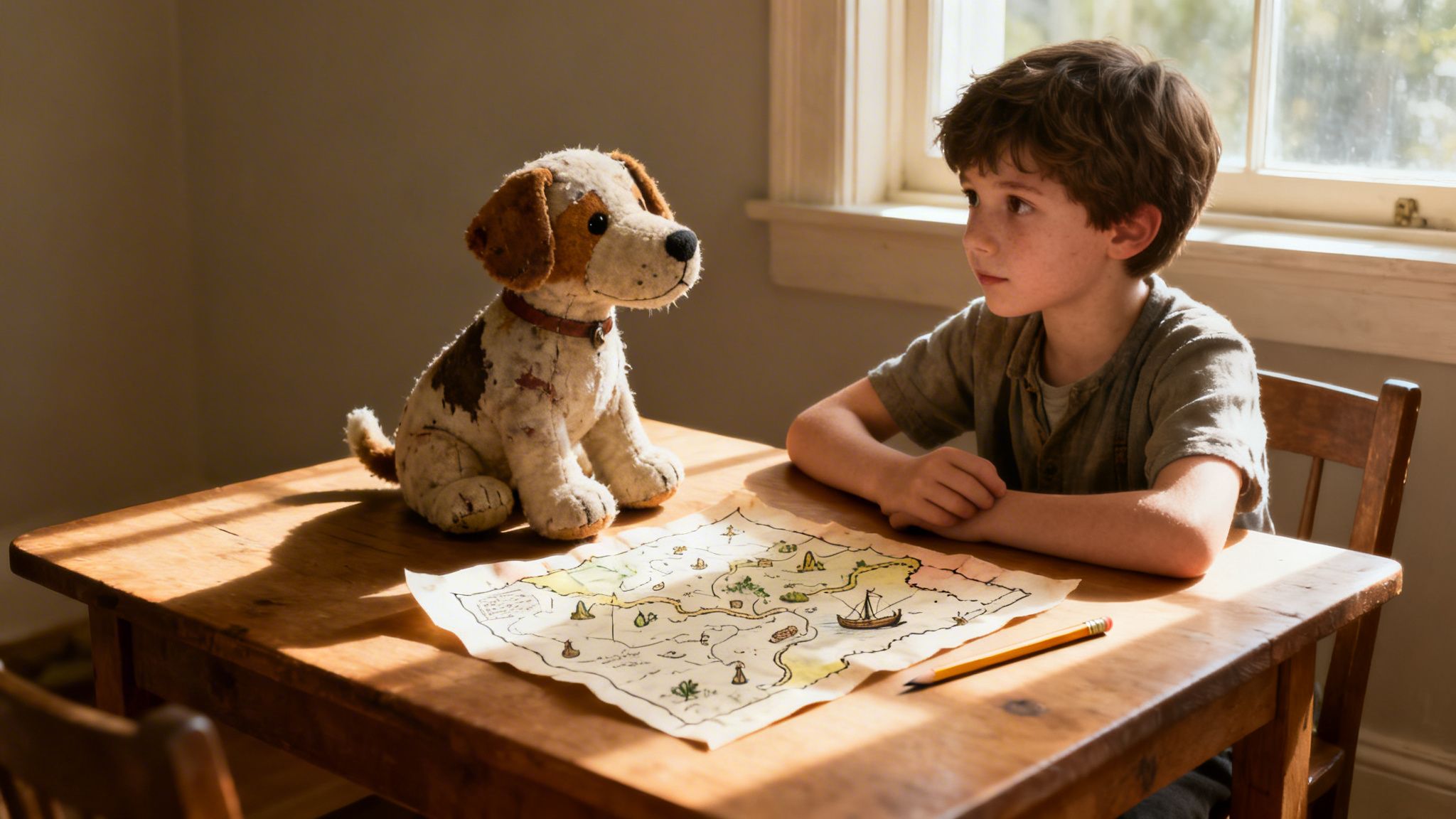
These prompts work so well because they blend the familiar (a beloved family dog or cat) with the fantastic (a quest for a legendary squeaky toy). For SetterFrens, a community that celebrates the bond between people and dogs, this type of storytelling is a perfect fit. It encourages kids to build deeper emotional connections with animal characters, turning their own furry friends into protagonists of epic tales.
How to Get Started with Pet Adventure Prompts
The goal is to provide just enough structure to spark an idea without limiting creativity. A simple "what if" question is often the best starting point.
- For Younger Kids (Ages 5-7): Keep prompts simple and sensory-focused.
- Prompt Example: "Your dog finds a magical collar that lets him talk for one day. What is the first thing he tells you, and what adventure do you go on together?"
- For Older Kids (Ages 8-12): Introduce more complex plots like mysteries or challenges.
- Prompt Example: "The neighborhood cats have all been acting strangely, gathering at midnight in the old oak tree. Your brave pup decides to disguise himself as a cat to find out their secret. What does he discover?"
Pro-Tip: Encourage kids to think about the world from a pet’s point of view. What does the mail carrier's truck sound like to a dog? What does the backyard smell like after it rains? Adding these sensory details makes the story feel more alive.
Why This Prompt Works So Well
Pet-focused prompts tap directly into a child's existing love for animals, making the writing process feel less like homework and more like play. It’s an effective way to introduce core storytelling elements like character, setting, and plot in a context that kids already understand and adore. Many of the best dog-themed books for early readers use this exact method to draw young minds into the world of reading. These stories validate a child's bond with their pet, making their furry friend feel even more special and heroic.
2. If I Could Be a Character Prompts
What kid hasn't dreamed of stepping into their favorite book or movie? This category of creative writing prompts for kids lets them do just that by writing themselves into existing stories or interacting with beloved characters. It's a powerful exercise that encourages children to explore their own identity, agency, and values by reimagining familiar narrative situations. This approach, made popular by interactive fiction and Choose Your Own Adventure books, builds a deep investment in storytelling.
These prompts are exceptionally effective because they start with a world and characters a child already knows and loves. For SetterFrens, which features dog-themed books and honest product reviews on Setterfren.com, this is a perfect way to deepen reader engagement. It invites kids to imagine "What would I do if I met a character from my favorite dog book?" or "How would I help in a dog rescue story?" turning them from passive readers into active participants.
How to Get Started with Character Prompts
The key is to place the child at a critical decision point within a story they recognize. This lets them explore plot and character motivation firsthand.
- For Younger Kids (Ages 5-7): Focus on simple interactions and feelings.
- Prompt Example: "You get to join the SetterFrens Puppicino Club for a day! What new game do you teach the dogs, and what flavor of puppicino do you invent for them?"
- For Older Kids (Ages 8-12): Introduce moral dilemmas or complex problem-solving.
- Prompt Example: "You find out a character in your favorite book is about to make a huge mistake. You can magically send them a one-sentence warning. What do you write, and how does it change the story?"
Pro-Tip: Encourage kids to think about why they would make a certain choice. Ask follow-up questions like, "What would be the brave thing to do?" or "What would be the kindest choice?" This pushes them to consider the consequences and their own values.
Why This Prompt Works So Well
Placing a child inside a story they love removes the pressure of building a world from scratch, freeing them to focus on character and plot. It’s a brilliant way to teach critical thinking and empathy, as they must consider another character's perspective before acting. It validates their opinions about the stories they consume and gives them a sense of agency. For children who enjoy stepping into different shoes, exploring Character AI alternative platforms can provide rich, interactive role-playing experiences to develop their characters. These prompts make writing a personal and meaningful adventure.
3. Sensory Description Exercises
Strong writing isn't just about what happens; it's about what the reader experiences. Sensory description exercises are powerful creative writing prompts for kids that train them to "show, don't tell" by engaging all five senses. The core challenge is to describe a scene, object, or experience without ever naming it, forcing young writers to rely on vivid details of sight, sound, smell, touch, and taste. This method helps children build a rich descriptive vocabulary and understand how to immerse their audience in a story.

These prompts are fantastic because they turn writing into a fun guessing game. For a community like SetterFrens, which connects kids with the world of dogs through books and practical guides, sensory exercises are a perfect match. Imagine a child describing the experience of getting a warm, frothy Puppicino treat or the feel of a puppy's soft fur without using those exact words. It deepens their observational skills and appreciation for the small, wonderful details of life with a dog.
How to Get Started with Sensory Description Prompts
The goal here is to make observation a fun and focused activity. Start with familiar subjects and encourage kids to close their eyes and list everything they can sense.
- For Younger Kids (Ages 5-7): Focus on a single object or a simple experience. Use a "mystery box" or have them describe a familiar treat.
- Prompt Example: "You have a yummy snack in your hand. Without saying what it is, describe it. Is it cold? Smooth? What does it smell like? How does it sound when you take a bite?"
- For Older Kids (Ages 8-12): Challenge them with more complex scenes or abstract concepts.
- Prompt Example: "Describe a dog park on a sunny afternoon, but you cannot use the words 'dog,' 'ball,' or 'bark.' Focus on the sounds of happy yelps, the feeling of wet noses, and the sight of wagging tails."
Pro-Tip: Before they write, encourage physical interaction with the subject if possible. Let them hold the object, smell the flower, or feel the texture of a dog's leash. This direct sensory input provides a much richer foundation for their descriptions.
Why This Prompt Works So Well
Sensory exercises build a fundamental writing skill that applies to every story, poem, or essay a child will ever write. It shifts their focus from simply listing events to crafting an atmosphere and an emotional tone. This type of descriptive writing is a cornerstone of classic children's literature, like Where the Wild Things Are, where the environment feels just as alive as the characters. These prompts give kids the tools to make their own stories equally captivating and memorable.
4. Story Starters and Picture Prompts
Sometimes the hardest part of writing is staring at a blank page. Story starters and picture prompts are powerful creative writing prompts for kids because they offer a gentle nudge into a narrative, breaking the initial barrier to getting started. Instead of defining the whole plot, they provide a compelling opening line or a visually rich image to kickstart a child's imagination, giving them the freedom to take the story in any direction they choose.
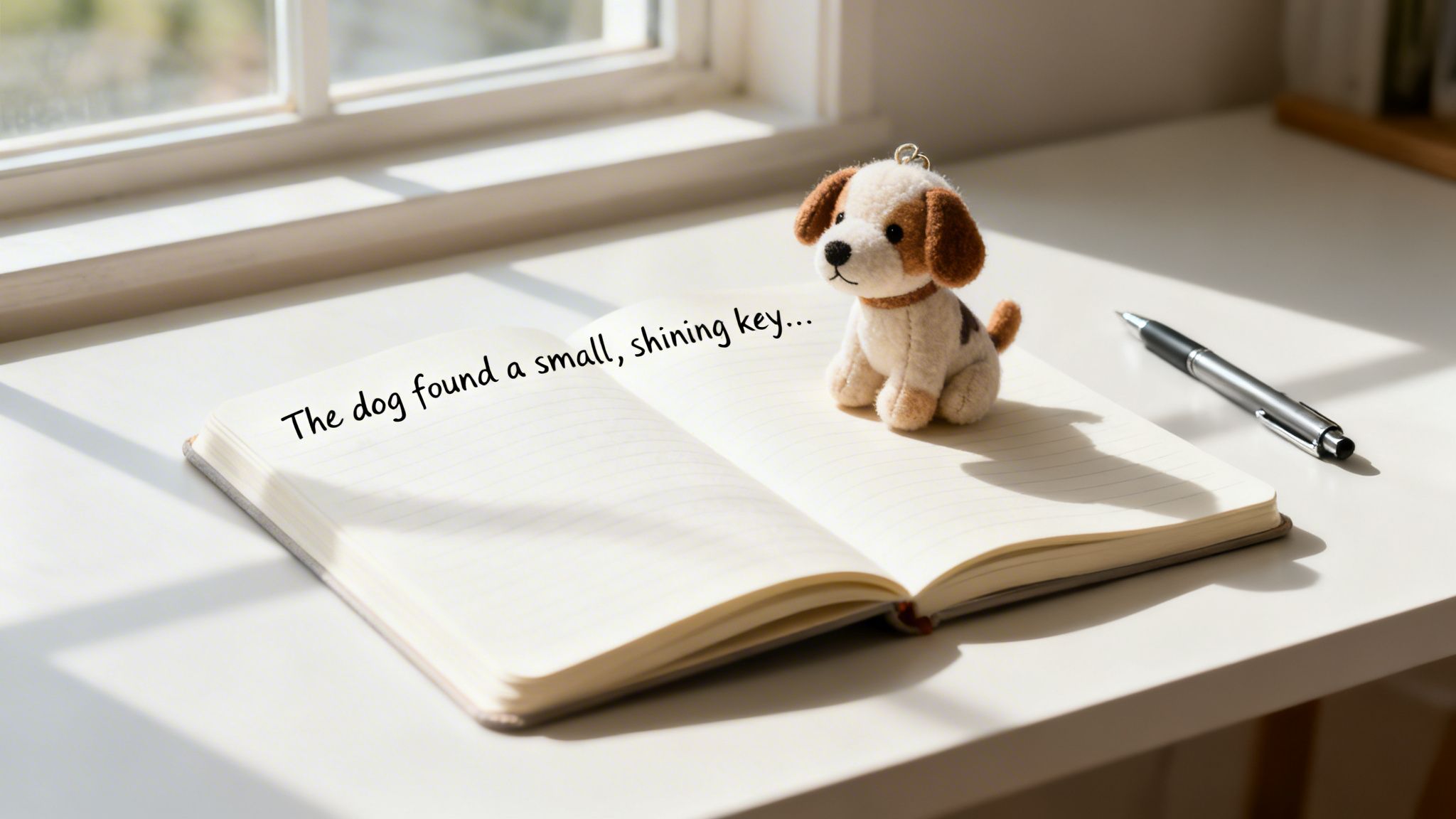
This method works because it lowers the pressure while maintaining creative control. A simple sentence or a striking picture can be the launchpad for an incredible adventure. SetterFrens can use this format effectively by featuring our adorable merchandise in unexpected photos or crafting opening lines centered around our book updates. This not only sparks creativity but also builds a deeper connection with our community.
How to Get Started with Story Starters and Picture Prompts
The key is to offer an intriguing beginning without giving away the middle or end. Pairing a visual with a textual prompt can be especially effective.
- For Younger Kids (Ages 5-7): Use clear, simple images and direct opening sentences.
- Prompt Example: Show a photo of a Setterfrens plushie sitting alone on a park bench. Pair it with the starter, "The little dog waited patiently. He was looking for…"
- For Older Kids (Ages 8-12): Introduce more mysterious or complex scenarios.
- Prompt Example: Use an illustration of a dog park at night. Add the starter, "The first snow of the year revealed something surprising in the dog park. Hidden beneath the swing set was…"
Pro-Tip: Offer multiple sentence starters for a single picture. One child might be inspired by "The dog show was about to begin when the grand prize vanished," while another might prefer, "From the audience, a small puppy saw something no one else did." This gives kids more agency in their storytelling.
Why This Prompt Works So Well
Starters and picture prompts are fantastic tools for building writing confidence. They provide just enough structure to prevent a child from feeling lost, making them one of the most accessible forms of creative writing prompts for kids. This approach is championed by educators because it makes writing feel less like an assignment and more like a puzzle to be solved. By turning visuals and opening lines into story seeds, you can help young authors find their voice, one sentence at a time.
5. Dialogue-Only Stories
Imagine a story told entirely through conversation. Dialogue-only stories are compelling creative writing prompts for kids that challenge them to build a narrative using only what characters say to each other. By removing narration and description, this technique forces young writers to show, not tell, revealing plot, character, and emotion purely through speech.
This constraint-based exercise is brilliant for teaching the nuances of communication and developing authentic character voices. For a brand like SetterFrens, which brings characters to life in our curated dog-themed books, this is a perfect way for kids to step into the minds of their favorite pups. A conversation between two dogs at the park or a chat between a child and a new friend becomes an exciting puzzle to solve through words alone.
How to Get Started with Dialogue-Only Prompts
The key is to give kids a clear scenario and let them build the world through conversation. Starting with just two characters helps simplify the process before moving on to more complex scenes.
- For Younger Kids (Ages 5-7): Focus on simple, relatable exchanges with clear emotions.
- Prompt Example: "Write a conversation between a squirrel who lost his favorite acorn and a kind puppy who wants to help him find it. What do they say to each other?"
- For Older Kids (Ages 8-12): Introduce more complex situations like disagreements, secrets, or misunderstandings.
- Prompt Example: "Two best friends are arguing. One wants to tell a secret, but the other doesn't. Write their conversation without explaining what the secret is."
Pro-Tip: Encourage kids to read their dialogues aloud. Hearing the words helps them understand the rhythm of conversation and whether a character's voice sounds believable. Have them act it out to truly feel the story.
Why This Prompt Works So Well
Dialogue-only prompts are a fantastic tool for developing an ear for how people (and animals!) really talk. It shifts a child’s focus from describing action to creating it through speech, a skill essential for strong storytelling. This method directly supports the development of characterization and conflict, two cornerstones of any good narrative. It makes writing feel like a performance, turning a simple exercise into a fun, dramatic activity.
6. Writing from Different Perspectives
Stepping into someone else’s shoes is a powerful tool for developing empathy, and this category of creative writing prompts for kids does just that for their storytelling skills. Writing from different perspectives asks children to retell a familiar story or event from an entirely new viewpoint. This could be a villain, a bystander, an animal, or even an inanimate object, like a forgotten toy. This technique challenges kids to think critically about how one character’s motivations and knowledge can completely change a narrative.
These prompts are exceptionally good at building social-emotional skills alongside writing abilities. By exploring an antagonist’s side of the story or an object’s limited view, children learn that every story has more than one side. For a community like SetterFrens, which is built on a shared love of dogs, this is a natural extension. A child could rewrite an adventure from their favorite book from the perspective of the mischievous squirrel or even describe the joy of a Puppicino treat from the point of view of the treat itself.
How to Get Started with Perspective Prompts
The key is to give children a clear alternative lens through which to view a known situation. Start with characters that are easier to sympathize with before moving to more complex viewpoints.
- For Younger Kids (Ages 5-7): Focus on simple, relatable shifts in perspective.
- Prompt Example: "You just got back from the dog park. Now, write the story of your trip from your dog's perspective. What did they smell, see, and think was the most exciting part?"
- For Older Kids (Ages 8-12): Introduce more complex scenarios and unreliable narrators.
- Prompt Example: "Rewrite the story of your dog’s visit to the veterinarian, but from the vet's point of view. Were they trying to be mean, or were they trying to help? What did they think about your dog?"
Pro-Tip: Ask guiding questions to help kids get into character. What does this character want more than anything? What do they not understand about the situation? What do they see that the main character misses?
Why This Prompt Works So Well
Perspective-shifting prompts are fantastic creative writing prompts for kids because they add a layer of intellectual and emotional depth to the writing process. They encourage children to analyze, question, and infer, turning them from passive readers into active story analysts. This exercise directly supports social-emotional learning by teaching that different viewpoints are valid, even if they conflict. It’s a wonderful method for showing that characters, like people, are complex, and their actions are driven by their own unique feelings and goals.
7. Timed Writing Sprints and Flash Fiction
For a burst of high-energy creativity, timed writing sprints are an incredible tool. These sessions challenge children to write continuously for a short, set period (often 5-20 minutes) without stopping to edit or second-guess. The result is often flash fiction, a complete story under 500 words, that feels immediate and authentic. The time constraint is key; it helps kids bypass perfectionism and focus purely on getting ideas onto the page.
This method turns writing into an exciting game against the clock. It’s perfect for building writing fluency and confidence. The emphasis on speed over polish encourages a raw, unfiltered flow of ideas, which can be shaped and refined later.
SetterFrens could use this format for fun community engagement, such as hosting weekly 5-minute "Puppicino-inspired" fiction challenges on our social media channels. The quick, energetic nature of these sprints is a great match for the fast-paced content found on platforms like TikTok and Instagram, creating a sense of community and shared fun. You can follow @setterfrens to stay part of the fun!
How to Get Started with Timed Writing Sprints
The goal is to create a low-pressure, high-output environment. A visible timer and a single, focused prompt are all you need to kick things off.
- For Younger Kids (Ages 5-7): Use very short sprints (3-5 minutes) with simple, imaginative prompts.
- Prompt Example: "You have 5 minutes! Your dog just swallowed a bouncy ball and now he can fly. What happens next? Go!"
- For Older Kids (Ages 8-12): Increase the time (10-15 minutes) and introduce prompts with a bit more of a hook.
- Prompt Example: "The timer is set for 10 minutes. A mysterious package arrives for your dog, sealed with a paw print. Write the story of what's inside and who sent it."
Pro-Tip: Make it a celebration of quantity first. Use upbeat music to keep the energy high and praise the word count or the effort of writing continuously. Editing and polishing can happen in a separate, dedicated session later.
Why This Prompt Works So Well
Timed sprints effectively lower the stakes of writing, making it less intimidating for reluctant writers. By removing the pressure to be perfect, these creative writing prompts for kids give them permission to just play with words. It's a fantastic way to generate a large volume of story ideas quickly, proving to kids that they have countless stories inside them waiting to be told. The resulting flash fiction pieces are satisfyingly complete, giving children a sense of accomplishment in a short amount of time.
8. Build-a-Story Collaborative Writing
Writing doesn't have to be a solo activity. Build-a-story collaborative writing turns storytelling into a team sport where kids contribute parts to a larger narrative. One child writes the opening, another continues the plot, and so on, creating a wonderful, unpredictable story filled with collective creativity. This approach teaches compromise, creative problem-solving, and the joy of building something together.
These prompts excel at fostering a sense of community around storytelling. Instead of just creating in isolation, kids learn to adapt to and build upon others' ideas, making the final product a true group achievement. For a community-focused brand like SetterFrens, which encourages connection through our Puppicino Club, this type of shared adventure is a fantastic engagement tool. It brings young writers together to co-author tales, strengthening social bonds through a shared love for stories.
How to Get Started with Collaborative Writing Prompts
The key is to establish a clear starting point and simple rules for contributing. The fun comes from seeing where the group takes the initial idea.
- For Younger Kids (Ages 5-7): Use a simple "pass the story" format in a classroom or at home.
- Prompt Example: "Start a story with this sentence: 'A tiny puppy with floppy ears found a mysterious, sparkling key.' Each person adds one sentence to continue the adventure."
- For Older Kids (Ages 8-12): Organize a more structured project, like a comment-chain story on a social media post or a shared document.
- Prompt Example: "Let's write a story together! Our main character is a clever dog detective. Chapter 1, Scene 1: The detective gets a call about a missing diamond dog collar. Your job is to write the next paragraph. Follow @setterfrens on Instagram to join in!"
Pro-Tip: Set basic guidelines to maintain narrative consistency, such as keeping the main character's personality the same. Celebrate the process as much as the final story and give credit to all contributors to make everyone feel valued.
Why This Prompt Works So Well
Collaborative prompts remove the pressure of having to come up with an entire story alone. They are excellent creative writing prompts for kids who might feel intimidated by a blank page, as they only need to contribute a small piece of a larger puzzle. This method emphasizes listening, adaptation, and teamwork, skills that are just as important as writing itself. By seeing how their small contribution fits into a bigger narrative, kids gain confidence and learn that the process of creation can be a shared and joyful one.
8-Way Comparison: Creative Writing Prompts for Kids
| Prompt Type | 🔄 Implementation complexity | ⚡ Resource requirements | 📊 Expected outcomes | 💡 Ideal use cases | ⭐ Key advantages |
|---|---|---|---|---|---|
| Pet Adventure Stories | Moderate — needs character guidance and plot scaffolding | Low–Moderate — character sheets, prompt templates, occasional art/props | High engagement; brand-aligned, shareable multi-chapter content | Pet-loving kids, brand tie-ins, merchandise storytelling | Strong emotional connection; easy merchandising crossover with our Etsy.com shop |
| If I Could Be a Character Prompts | Moderate — facilitation required to keep focus and coherence | Low — prompts, decision trees; potential copyright vetting for external characters | High personal investment; builds empathy and narrative agency | Interactive activities, choose‑your‑path projects, confidence-building tasks | Centers the child; encourages self-reflection and ownership |
| Sensory Description Exercises | Low–Moderate — needs modeling and examples | Low — everyday objects, sensory cards, teacher demonstration | Improved descriptive vocabulary and observation skills | Classrooms, reluctant writers, vocabulary and writing lessons | Transferable skillset; engages multiple learning styles |
| Story Starters and Picture Prompts | Low — produce visuals and starter lines; scalable | Moderate — quality images/illustrations and starter libraries | Reduces writer’s block; consistent, repeatable outputs | Visual learners, social campaigns, seasonal prompt sets | Low barrier to entry; highly shareable and adaptable |
| Dialogue-Only Stories | High — requires explicit instruction and speaker clarity | Low — example scripts, speaker-attribution cards | Stronger character voice and dramatic pacing | Theater exercises, intermediate writers, voice-focused lessons | Teaches voice through speech; produces concise, dynamic pieces |
| Writing from Different Perspectives | Moderate–High — needs guided discussion and maturity | Low–Moderate — perspective prompts, character motivation sheets | Builds empathy, critical thinking, and nuanced narration | SEL lessons, advanced classrooms, retellings and debates | Deepens narrative complexity; encourages viewpoint analysis |
| Timed Writing Sprints & Flash Fiction | Low — simple to run but needs clear structure | Low — timers, focused prompts, space for writing | Increased fluency, high content volume, reduced perfectionism | Classroom warmups, social challenges, fluency practice | Fast-paced, fun, and confidence‑building; produces lots of short content |
| Build-a-Story Collaborative Writing | High — logistical coordination, moderation, quality control | Moderate–High — platform tools, moderation, guidelines, editing phase | Strong community engagement; unexpected, diverse narratives | Online fan communities, classroom relay stories, club projects | Fosters collaboration and shared ownership; very shareable |
Keep the Stories and Wagging Tails Coming!
You've officially reached the end of our adventure through the world of creative writing prompts for kids, but this is just the beginning of your child’s storytelling journey. We’ve packed this guide with everything from detailed picture prompts that spark the imagination to quirky dialogue starters that get characters talking. Think of this collection not as a rigid set of rules, but as a giant, overflowing toy box filled with endless possibilities. The real magic happens when your young author opens it up and starts to play.
Remember, the most important takeaway is that writing should be a joyful act of discovery, not a tedious chore. The goal is to build confidence and show kids that their ideas have value. Whether they're crafting an epic quest for their favorite pup, describing the world from a dog's point of view, or laughing through a collaborative story with a friend, every word they put on paper is a step forward.
Your Action Plan for Endless Creativity
Feeling inspired? Here’s how you can keep the momentum going and turn these ideas into a regular part of your routine. Don't try to do everything at once. Just pick one or two things to try this week.
- Create a "Prompt Jar": Take 15 minutes to write down some of your child's favorite prompts from this article on small slips of paper. You can use our printable cards or just make your own! Keep them in a jar on the kitchen counter for an easy, screen-free activity whenever you hear "I'm bored!"
- Schedule "Story Time Sprints": Choose a regular, low-pressure time for a 10-minute writing sprint. Maybe it’s right after school or while you're waiting for dinner to cook. Set a timer, pick a prompt, and see what happens. The only rule is to keep the pen moving.
- Connect Stories to Real Life: Did your dog do something funny at the park? Turn it into a story! Use the Pet Adventure Stories prompts to fictionalize your daily walks. This helps kids see that inspiration is all around them, not just in books or on screens.
- Share and Celebrate: The act of sharing a story makes it real. Create a special "author's chair" where your child can read their work aloud. Post their stories on the fridge or create a dedicated binder for their collection. Join our Puppicino Club to share your stories with fellow dog lovers!
A Key Insight: The power of these creative writing prompts for kids isn't just about improving grammar or vocabulary. It's about teaching them how to think creatively, solve problems, and express their unique inner world. A child who can imagine a dog flying to the moon can also imagine a new solution to a real-world problem.
By making writing a playful and consistent practice, you're giving your child a powerful gift. You're showing them that their voice matters and that they have the ability to create entire worlds with just their imagination and a few words. This is a skill that will support them not just in English class, but in every area of their life. It builds empathy, strengthens communication, and fosters a sense of wonder.
So, go ahead and dive in. Mix and match the prompts, adapt them to your child's interests, and most importantly, have fun. The next great bedtime story or kitchen-table masterpiece is just a single, exciting prompt away. We can't wait to see what amazing tales your young writers come up with. The world needs more heartwarming stories, and their voices are ready to be heard.
Ready to find the perfect story to inspire your young author? SetterFrens LLC offers a curated selection of beautiful, dog-themed children's books that are perfect for sparking imagination and a love for reading. Visit Setterfrens LLC to explore our bookstore, find honest reviews of top dog products, and discover your next family-favorite adventure.