Welcome to the SetterFrens family, where we believe life’s better with a wagging tail and a good book! Training your dog goes far beyond basic commands; it's a powerful way to build an unbreakable bond, boost your pup's confidence, and have a ton of fun together. This how-to guide is your ultimate resource for teaching 10 awesome dog tricks, transforming everyday training into an exciting shared activity.
This list covers everything from foundational skills like a rock-solid "Stay" to show-stopping performances like "Play Dead," perfect for your next viral @setterfrens TikTok or Instagram post. Whether you're a new puppy parent or a seasoned pro looking for fresh ideas, these tricks provide essential mental stimulation that can curb boredom and improve overall behavior. We'll break down each trick with simple, actionable steps, clear difficulty ratings, and pro tips to ensure your sessions are rewarding and successful. As you unlock your pup's potential with these exciting skills, you might also want to explore practical solutions for keeping your home tidy, such as effective waterproof couch covers for dogs.
We believe every dog has a superstar inside them waiting to be discovered. Our goal is to give you the tools to create those heartwarming, "wow" moments you'll both cherish forever. From building reliable recall with "Come" to teaching adorable stretches with "Bow," you'll find everything you need to get started right here. Are you ready to turn your clever companion into a certified trick star and have a blast doing it? Let's dive in
1. Sit – The Foundation Trick with Step-by-Step Training
While it might seem basic, the "Sit" command is one of the most foundational and awesome dog tricks you can teach. It’s the cornerstone of obedience and the gateway to more complex commands. Think of it as your dog's "please" or "I'm ready to listen." This simple action helps build focus, reinforces your role as a leader, and gives your pup a constructive way to show they're paying attention.
Mastering "Sit" is essential for safety, helping to prevent jumping on guests or bolting out the door. It’s a trick popularized by renowned trainers like Victoria Stilwell and Karen Pryor, who champion positive reinforcement methods to build a strong, happy bond between pet and owner.
How to Train "Sit" in 3 Simple Steps
Teaching this trick is straightforward and rewarding. Keep sessions short and fun, around 5-10 minutes, to maintain your dog’s enthusiasm.
- Lure the Motion: Hold a high-value treat (like a tiny piece of cheese or chicken) near your dog's nose. Slowly move your hand upward and over their head. As their nose follows the treat up, their rear end will naturally lower into a sitting position.
- Mark and Reward: The moment their bottom touches the floor, say your marker word (like "Yes!" or "Good!") and immediately give them the treat and lots of praise. Repetition is key here.
- Add the Cue: Once your dog reliably sits with the lure, start adding the verbal cue. Say "Sit" just before you begin the luring motion. With practice, you can phase out the hand motion until they respond to the word alone.
Pro Tip: Train before mealtimes when your dog is most motivated by food. A hungry pup is an eager student! Consistency with both your verbal cue and hand signal will speed up the learning process.
This first step into training sets the stage for a lifetime of learning together. For more guidance on those crucial early days, check out our complete guide on how to train a puppy.
2. Come (Recall) – Building Reliable Response with Step-by-Step Training
Of all the awesome dog tricks you can teach, a reliable "Come" or recall is arguably the most important. It's more than just a trick; it's a life-saving command that builds a deep connection and trust. This command ensures your dog will return to you, even when faced with exciting distractions, keeping them safe from traffic, unexpected dangers, or getting lost.
A solid recall gives your dog the freedom to enjoy off-leash adventures while giving you complete peace of mind. Training experts like Emily Larlham (Kikopup) and Susan Garrett have revolutionized recall training by emphasizing making the return to the owner the most rewarding and exciting choice a dog can make.
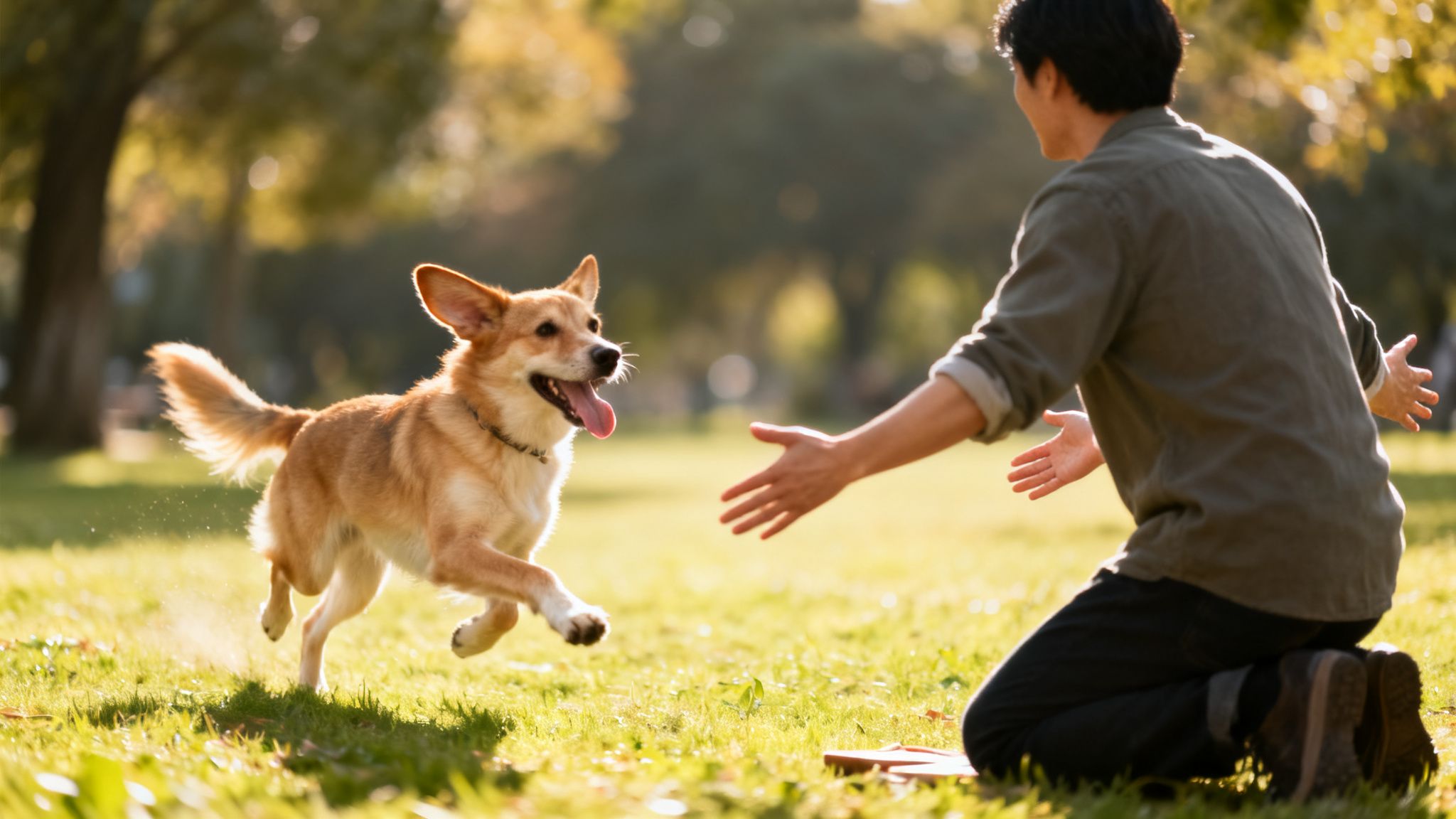
How to Train "Come" in 3 Simple Steps
Building a lightning-fast recall is about making it a fun, positive game. Always start in a low-distraction environment and keep your energy high and encouraging.
- Build Value Up Close: Start in a quiet room. Say your dog's name and the cue "Come!" in an excited tone. When they turn or move toward you, praise them enthusiastically and give them a high-value treat. Keep it easy and repeat often to build a strong positive association with the word.
- Add Distance and Movement: Once your dog responds consistently up close, start adding distance. Have a partner hold your dog or wait for them to be distracted, then call them from across the room. Move backward as they run to you to make it a fun chase game, rewarding them with a "jackpot" of multiple treats upon arrival.
- Introduce Distractions Gradually: Slowly start practicing in more distracting environments, like your backyard, and eventually a quiet park on a long leash. Always ensure the reward you offer is more enticing than the distraction.
Pro Tip: Never use "Come" to call your dog for something they dislike, like a bath or nail trim. This will poison the cue. The recall command must always lead to a wonderful, positive experience.
A reliable recall is heavily influenced by a strong bond and positive experiences, which begin with early training. For more on building a confident and well-adjusted companion, explore our guide on what is puppy socialization.
3. Down – Teaching Calm Behavior with Step-by-Step Training
Moving beyond "Sit," the "Down" command is another one of the most practical and awesome dog tricks you can teach. It’s a powerful tool for managing your dog's energy and promoting a state of calm. Unlike a temporary sit, a "Down" encourages your dog to truly settle, making it invaluable for relaxing at home, waiting patiently at a café, or managing excitement when guests arrive.
This trick is fundamental for impulse control and is a building block for more advanced commands like "Stay." Prominent trainers like Cesar Millan and Patricia McConnell emphasize "Down" as a key exercise in teaching dogs to be calm and relaxed on cue. It establishes a clear structure and gives your dog a default behavior for when they're unsure what to do.
How to Train "Down" in 3 Simple Steps
Patience is key with this trick, as some dogs are hesitant to lie down on command. Keep sessions positive and short, ideally 5-10 minutes, and start on a soft surface like a rug or grass.
- Lure the Motion: Start with your dog in a "Sit" position. Hold a high-value treat near their nose, then slowly lower your hand straight down between their paws. As their head follows the treat, their body will naturally lower into a down position.
- Mark and Reward: The instant their elbows and belly touch the floor, use your marker word ("Yes!" or "Good!") and immediately give them the treat and enthusiastic praise. This precise timing helps them understand exactly what action earned the reward.
- Add the Cue: Once your dog is consistently following the lure into a down position, begin saying "Down" just before you start the hand motion. Over time, you can fade the lure so they respond to the verbal cue and a simple hand signal (like a flat palm moving downward).
Pro Tip: If your dog pops up right away, try rewarding them while they are still lying down to encourage them to hold the position a little longer. This helps build the foundation for the "Stay" command later on.
Teaching calm is just as important as teaching action. For more practical tips on building a balanced and well-behaved pup, explore our other how-to guides here at Setterfren.com.
4. Stay/Wait – Building Duration Control with Step-by-Step Training
Teaching your dog to "Stay" or "Wait" is a monumental step in building their impulse control, making it one of the most practical and awesome dog tricks in any owner’s toolkit. While often used interchangeably, "Wait" typically means a brief pause, while "Stay" asks for a longer hold until you give a release cue. This command is the ultimate test of focus and a cornerstone of safety, preventing your dog from dashing into a busy street or greeting guests too enthusiastically.
Mastering this skill fosters patience and deepens the trust between you and your pup. Renowned trainers like Karen Pryor and Victoria Stilwell emphasize "Stay" as a critical command for real-world situations, using positive reinforcement to teach a dog to control its own impulses for a reward, which builds a reliable and thoughtful companion.
How to Train "Stay" in 3 Simple Steps
Patience is key for both you and your dog. Start with very short sessions in a distraction-free area to set your pup up for success.
- Introduce the Concept (Duration): Ask your dog to "Sit" or "Down." Put your hand up in a "stop" signal, say "Stay," and wait for just one or two seconds before saying your marker word ("Yes!") and giving them a treat. At this stage, you are rewarding them for not moving for a brief moment.
- Add Distance and Duration Slowly: Gradually increase the time you ask them to hold the position, rewarding them for success. Once they can stay for several seconds, take one small step back before returning to reward them. If your dog breaks the stay, don't scold them; simply guide them back to the starting spot and try again with an easier duration.
- Add the Release Cue: Once your dog is reliably holding the "Stay," introduce a release word like "Free!" or "Okay!" in an upbeat tone. Toss a treat a short distance away to encourage them to move out of the position. This teaches them they must wait for your specific cue to be done.
Pro Tip: Always return to your dog to deliver the treat instead of calling them to you. This reinforces that "Stay" means remaining in that exact spot until you come back or give the release cue. Consistency with your hand signal and release word is crucial for clarity.
5. Leave It – Teaching Impulse Control & Safety with Step-by-Step Training
Of all the awesome dog tricks you can teach, "Leave It" might just be the most important. More than just a neat command, it’s a potentially life-saving skill that teaches crucial impulse control. This trick instructs your dog to ignore a dropped item, whether it's a piece of food on the kitchen floor or something hazardous they find on a walk.
Mastering "Leave It" is essential for preventing your dog from ingesting toxic foods, garbage, or other dangerous objects. It builds a foundation of safety and reinforces your guidance in high-stakes situations. Trainers like Zak George and Emily Larlham (Kikopup) have popularized this command using positive reinforcement, emphasizing its role in creating a safe and trusting partnership.
How to Train "Leave It" in 3 Simple Steps
Building a reliable "Leave It" command takes patience and consistency. Remember to keep training sessions positive and short to hold your dog's interest.
- Introduce the Cue with a Low-Value Item: Place a boring, low-value treat (like a piece of kibble) in your closed fist. Let your dog sniff and paw at your hand. The moment they pull their nose away, even for a second, mark the behavior with "Yes!" and give them a much better, high-value treat from your other hand.
- Increase the Challenge: Once your dog ignores the treat in your closed fist, open your hand. If they lunge for it, close your fist again. When they successfully ignore the treat in your open palm, mark and reward from your other hand. This teaches them that leaving the item earns them something even better.
- Add the Verbal Cue and Generalize: When your dog is reliably ignoring the item in your open hand, start saying "Leave It" just before you present it. Gradually progress to placing the item on the floor (covered by your hand at first) and practice in different locations with various objects to solidify their understanding.
Pro Tip: Never let your dog "win" by getting the item you told them to leave. The reward should always come from you, reinforcing that you are the source of all good things. A strong "Leave It" can also help manage reactions to other dogs or triggers on walks.
This command is a cornerstone of responsible ownership. For dogs that get overly excited or reactive on walks, mastering impulse control is key. You can find more strategies for managing these behaviors in our guide on handling dog aggression on a leash.
6. Play Dead – Building Theatrical Behavior with Step-by-Step Training
For a trick that’s guaranteed to get a laugh, "Play Dead" is one of the most awesome dog tricks you can teach. This command combines obedience with a flair for the dramatic, teaching your dog to lie on their side and remain perfectly still. It’s a fantastic way to build on foundational commands like "Down" and "Stay," taking your dog's impulse control and focus to the next level.
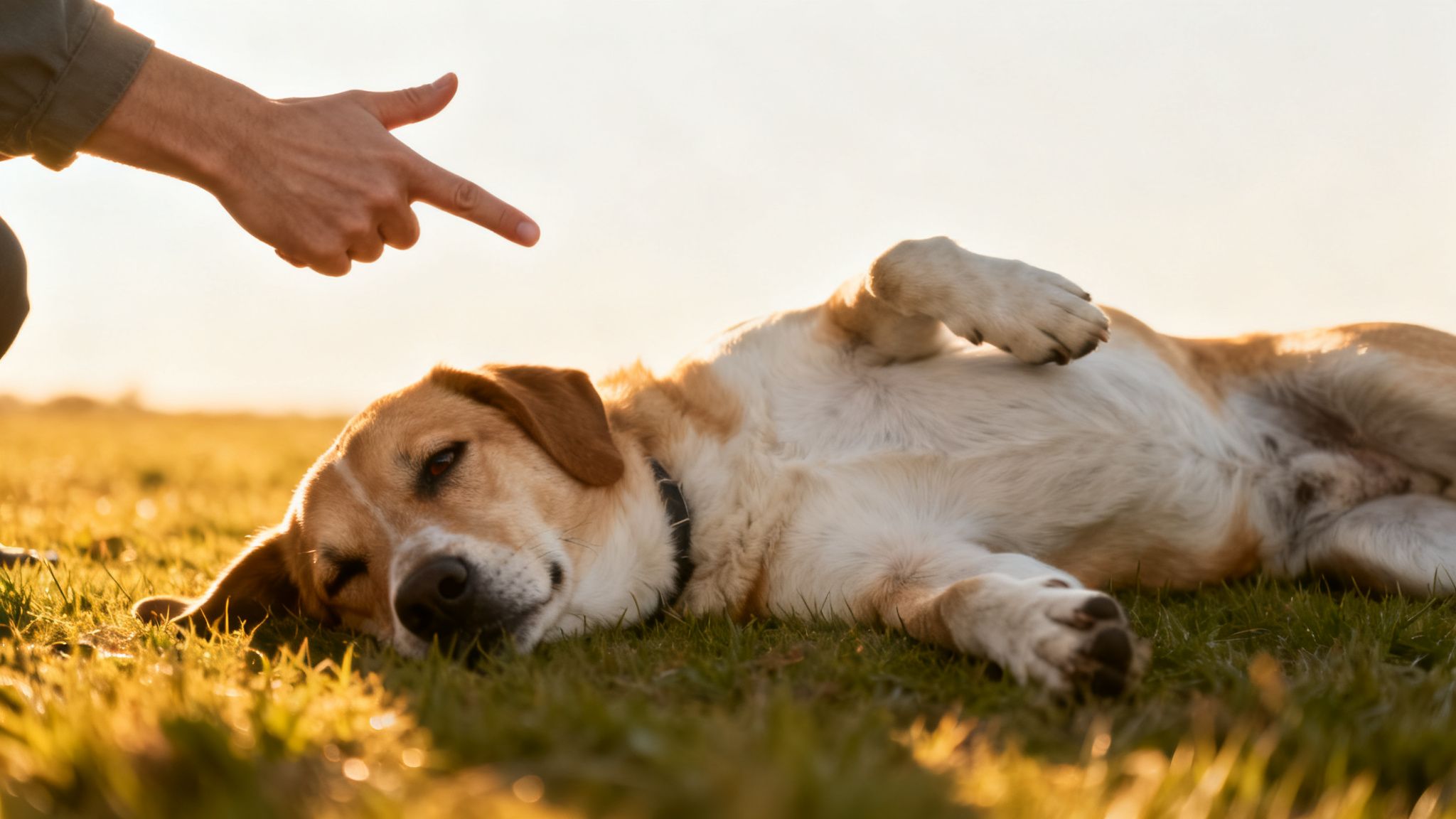
This trick is a favorite among social media creators and dog trick competition participants because of its high entertainment value. Beyond the fun, teaching "Play Dead" strengthens your dog's ability to hold a position, remain calm on cue, and listen intently for their release command. It’s a brilliant exercise in discipline disguised as a silly game.
How to Train "Play Dead" in 3 Simple Steps
Patience is key for this multi-part trick. Ensure your dog has mastered "Down" before you begin, and keep your training sessions upbeat and rewarding to build confidence.
- Lure the Roll: Ask your dog to lie down. With a high-value treat near their nose, gently guide their head to the side and toward their shoulder. This will encourage them to shift their weight and roll onto their side.
- Mark and Reward: The instant your dog is lying on their side, even for a second, say your marker word ("Yes!") and give them the treat. Practice this until they comfortably roll over with the lure.
- Add the Cue: Once the motion is fluid, add your verbal cue ("Play Dead!" or "Bang!") and a fun hand signal, like a finger gun. Gradually increase the time they must stay still before rewarding them. Introduce a release cue like "Okay!" or "Alive!" with equal enthusiasm.
Pro Tip: Start on a soft surface like a rug or grass to make it more comfortable for your dog to roll onto their side. Build the duration of the "dead" pose slowly, starting with just one second and gradually working your way up to longer holds.
This theatrical trick is a crowd-pleaser and a fun way to show off your pup’s skills. For more heartwarming dog moments and product tips, follow @setterfrens on TikTok and Instagram.
7. Spin/Twirl – Building Coordination & Exercise with Step-by-Step Training
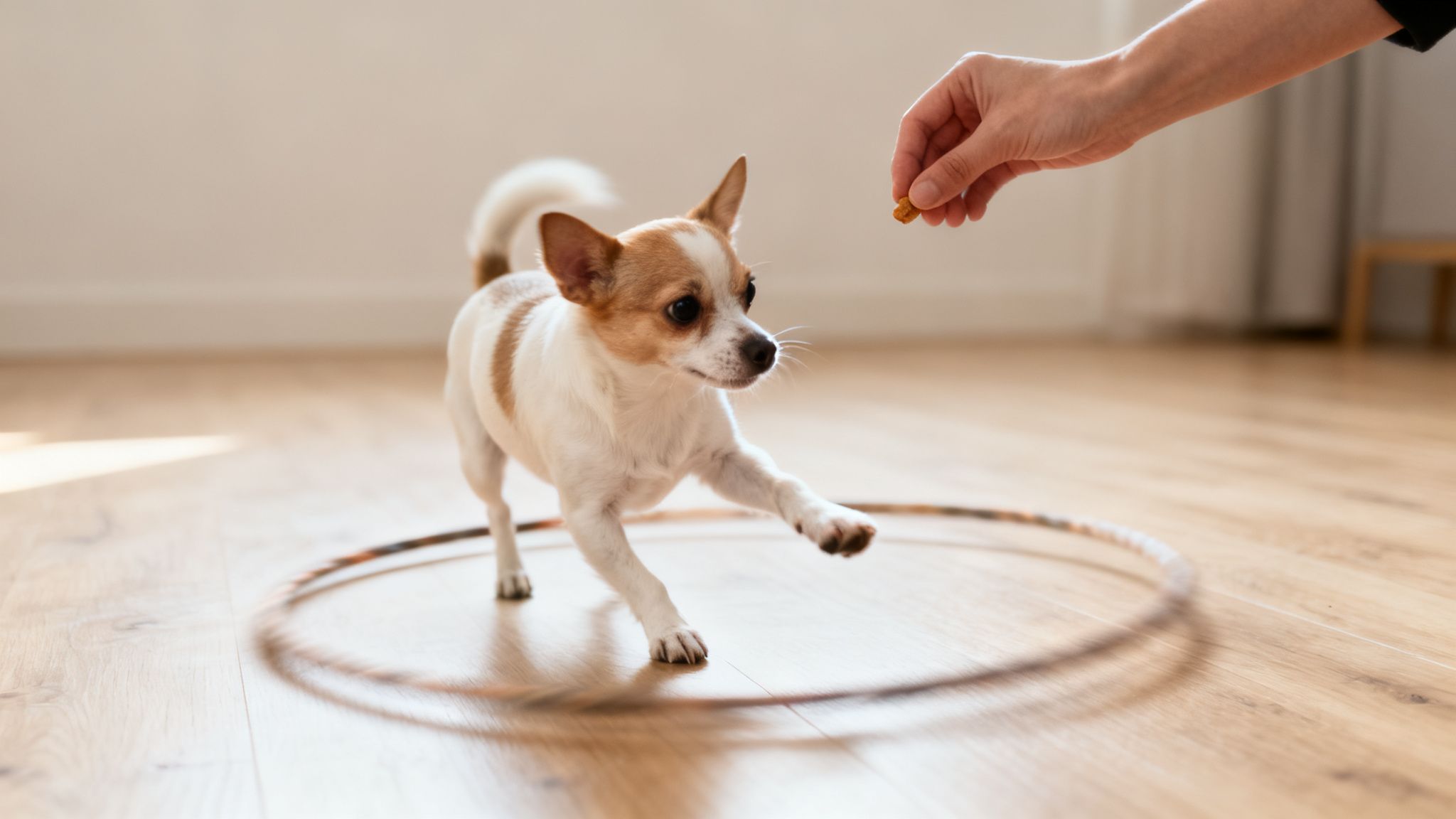
Beyond the basics, "Spin" or "Twirl" is one of the most fun and visually impressive awesome dog tricks you can teach. This dynamic move encourages your dog to turn in a full circle on command, providing fantastic mental stimulation and a light physical workout. It’s perfect for burning off a little extra energy indoors and helps improve your dog’s body awareness and coordination.
This trick is a favorite among modern trainers like Zak George and Emily Larlham (Kikopup), who showcase how simple, positive steps can lead to amazing results. Teaching "Spin" isn't just about the cool factor; it's about engaging your dog's mind and body in a joyful, collaborative way, strengthening your bond with every rotation.
How to Train "Spin" in 3 Simple Steps
Get ready for some dizzying fun! Keep your training sessions upbeat and brief to ensure your dog stays excited and focused.
- Lure the Motion: With your dog standing in front of you, hold a smelly, high-value treat near their nose. Slowly guide their nose in a circle, moving your hand from their nose toward their tail. This will encourage them to turn their head and body to follow it.
- Mark and Reward: The instant your dog completes a full 360-degree circle, say your marker word ("Yes!") and immediately give them the treat and praise. In the beginning, you can reward smaller turns to build momentum, but quickly work up to the full spin.
- Add the Cue: Once your dog is reliably following the treat lure in a full circle, start adding the verbal cue. Say "Spin" right before you begin the luring motion. Over time, make your hand signal smaller until your dog can perform the trick with just the verbal command.
Pro Tip: Always practice on a non-slip surface like a rug or grass to prevent injuries. Once they master spinning in one direction, teach the opposite direction with a different cue, like "Twirl," for an extra challenge!
This trick is a fantastic way to keep training exciting. For more fun ideas and dog-friendly content, follow the SetterFrens pack on @setterfrens on TikTok and Instagram.
8. Bow – Teaching Stretching & Yoga Poses with Step-by-Step Training
The "Bow" command is more than just an adorable party trick; it's one of the most functional and awesome dog tricks that doubles as a healthy stretch. This pose, where your dog lowers their chest to the floor while keeping their rear end up, mimics a natural play bow dogs use to invite interaction. It's a fantastic way to improve your dog's flexibility and body awareness.
Teaching "Bow" is a great entry into the world of canine wellness and "doga" (dog yoga). It has been popularized by wellness-focused trainers like Emily Larlham (Kikopup) and is a favorite among Instagram dog influencers who showcase the healthy, happy bond they share with their pets. It’s a trick that looks impressive while genuinely benefiting your dog’s physical well-being.
How to Train "Bow" in 3 Simple Steps
Patience is key for this trick, as it requires more coordination than a simple "Sit." Keep your training sessions positive and short to build your dog’s confidence and muscle memory.
- Lure the Motion: Start with your dog in a standing position. Hold a high-value treat near their nose, then slowly lower it down and slightly back between their front paws. The goal is for their head to follow the treat, causing their elbows to bend and their chest to lower.
- Mark and Reward: The instant their chest dips and their rear stays in the air, say your marker word ("Yes!") and give them the treat. Initially, reward even a small dip. Gradually, only reward deeper bows with the correct form to shape the behavior.
- Add the Cue: Once your dog is reliably following the lure into a bow, begin saying "Bow" just before you start the hand motion. With practice, you can fade the lure until they respond to the verbal cue alone, perhaps paired with a subtle downward hand signal.
Pro Tip: Train on a soft, non-slip surface like a rug or grass to make the stretch more comfortable for your dog's joints. If your dog keeps lying down completely, try luring the treat forward slightly after they dip instead of just down. This will help keep their rear end up.
9. Touch/Target – Building Focus & Leadership with Step-by-Step Training
The "Touch" or "Target" command is one of the most versatile and awesome dog tricks you can teach, acting as a secret key to unlocking your dog's focus. It teaches your pup to bop a target, typically your open palm, with their nose on command. This simple action is a powerful tool for building engagement, directing your dog’s movement without physical handling, and laying the groundwork for more advanced tricks like closing doors or turning off lights.
This trick is a favorite among modern trainers like Zak George and Emily Larlham (Kikopup) because it’s a positive, choice-based way to guide behavior. Instead of pushing or pulling your dog into position, you're inviting them to participate. "Touch" can be used to redirect a nervous dog in a new environment, guide them onto a scale at the vet, or simply build a strong, attentive bond.
How to Train "Touch" in 3 Simple Steps
This trick is fun and quick to learn. Keep your training sessions upbeat and short, aiming for just 5 minutes at a time to keep your dog excited and engaged.
- Present the Target: Hold your hand out, palm open, about an inch or two from your dog’s nose. Most dogs will naturally investigate a new object with their nose. Be patient and wait for them to make a move toward it.
- Mark and Reward: The very instant your dog's nose makes contact with your palm, say your marker word ("Yes!") and immediately give them a high-value treat from your other hand. Timing is critical here to ensure they connect the action with the reward.
- Add the Cue: Once your dog is reliably bopping your hand, start adding the verbal cue. Say "Touch" just as you present your hand. With a few successful repetitions, your dog will begin to associate the word with the action, and you can start moving your hand to different positions to guide them.
Pro Tip: Use a distinct, single-syllable cue word like "Touch" or "Tap" for clarity. Once your dog masters touching your hand, you can transfer the skill to other objects, like a sticky note or a targeting stick, to expand its usefulness.
"Touch" is more than just a trick; it's a communication tool that deepens your partnership. For more ways to build a strong bond with your furry friend, follow @setterfrens on TikTok and Instagram for daily tips and heartwarming moments.
10. Rollover – Teaching Multi-Step Behavior with Step-by-Step Training
Taking the "Down" command to a whole new level, "Rollover" is one of the most classic and awesome dog tricks you can teach. This impressive maneuver showcases your dog's ability to follow a multi-step sequence, building on their understanding of body awareness and trust in your guidance. It requires your dog to lie down, shift their weight, and complete a full 360-degree turn.
The "Rollover" trick is a staple in the repertoire of famous trainers, from classic circus performers to modern positive reinforcement advocates like Zak George. Mastering it not only looks fantastic but also strengthens your communication, teaching your dog to link smaller actions together to achieve a bigger goal. It's a true crowd-pleaser that demonstrates incredible teamwork.
How to Train "Rollover" in 3 Simple Steps
Patience is key for this trick. Always train on a soft, comfortable surface like a rug or grass, and keep your energy positive and encouraging.
- Lure the Side Flop: Start with your dog in a "Down" position. Hold a high-value treat near their nose and slowly guide it towards their shoulder, encouraging them to turn their head and eventually lie flat on their side. Mark and reward this "side flop" position several times until they are comfortable with it.
- Guide the Full Roll: Once they are on their side, continue luring them with the treat over their back to encourage them to roll completely over to their other side. You may need to use your free hand to gently guide their body at first. Reward even partial rolls to build their confidence.
- Add the Cue: After your dog can reliably follow the lure through the full motion, begin saying "Rollover" just before you start the luring movement. Over time, you can fade the hand lure so they respond to the verbal cue alone.
Pro Tip: Break it down! Reward your dog for each part of the sequence: lying on their side, rolling onto their back, and completing the roll. This helps them understand each component and prevents them from getting frustrated. A happy learner is a quick learner!
For more training inspiration and heartwarming dog moments, be sure to follow the @setterfrens pack on TikTok and Instagram
10 Awesome Dog Tricks Comparison
| Trick | 🔄 Implementation Complexity | ⚡ Resources & Time | ⭐ Expected Outcomes | 📊 Ideal Use Cases | 💡 Key Tips |
|---|---|---|---|---|---|
| Sit – Foundation Trick | Beginner — natural movement, few steps | Minimal treats, 3–5 days, short 5–10 min sessions | ⭐ Reliable basic obedience; builds impulse control | Everyday obedience, prevent jumping, public safety | 💡 Use high-value treats, consistent cues, short sessions |
| Come (Recall) | Intermediate — distance & distraction progression 🔄 | High-value rewards, long line, weeks→months | ⭐⭐ Potentially life‑saving; enables off‑leash freedom | Off‑leash play, traffic safety, lost‑dog prevention | 💡 Make recall more rewarding than distractions; never punish arrival |
| Down – Calm Behavior | Beginner–Intermediate — more physical steps | Treats, soft surfaces, ~1–2 weeks | ⭐ Promotes calmness and settling; pairs with Stay | Vet/grooming, managing excitement, household calm | 💡 Lure slightly toward body, use soft surface, pair with Stay |
| Stay/Wait – Duration Control | Intermediate — build duration & distance 🔄 | Patience, many short sessions, weeks→months | ⭐⭐ Strong impulse/duration control when reliable | Doors/gates, multi‑dog homes, formal training scenarios | 💡 Use a clear release word; increase duration gradually |
| Leave It – Impulse & Safety | Intermediate–Advanced — varied scenarios 🔄 | Varied objects, high‑value rewards, weeks of practice | ⭐⭐ Prevents ingestion hazards; improves impulse control | Walk safety, avoiding dangerous items, multi‑pet homes | 💡 Always reward with something better; never allow grabbing |
| Play Dead – Theatrical Skill | Advanced — requires Down + duration 🔄 | Soft surface, 2–4 weeks, consistent reinforcement | ⭐ Entertaining, advanced impulse control, showmanship | Performances, social media, demonstrations | 💡 Teach hand‑signal, build duration slowly, reward “wake up” cue |
| Spin/Twirl – Coordination | Beginner–Intermediate — simple lure mechanics | Treats, non‑slip surface, 5–7 days | ⭐ Fun mental/physical outlet; improves coordination | Energy burn, tricks for videos/photos, agility warm‑ups | 💡 Move lure smoothly, start slow to avoid disorientation |
| Bow – Stretch & Wellness | Intermediate — form matters | Treats, soft surface, 1–2 weeks | ⭐ Improves flexibility; visually distinctive | Doga/wellness, warm‑ups, photogenic content | 💡 Reward proper form, avoid letting it become a Down |
| Touch/Target – Focus & Direction | Beginner — very quick foundation skill | Minimal treats, hand or target stick, 2–3 days | ⭐ Builds handler focus; foundation for many behaviors | Agility, mat training, redirection, door navigation | 💡 Use open palm, reward immediately, keep sessions short |
| Rollover – Multi‑Step Trick | Advanced — multi‑stage progression 🔄 | Soft surfaces, prerequisite skills, 2–4 weeks | ⭐ Impressive multi‑step control; trust building | Performances, demonstrations, advanced trick routines | 💡 Break into halves, ensure comfort on back, reward frequently |
Keep the Tail Wagging: Your Journey as a Trick-Training Pro
Congratulations, you've officially graduated from dog owner to trick-training maestro! You now have a full playbook of ten foundational, fun, and truly awesome dog tricks designed to do more than just entertain. From the life-saving reliability of "Come" and "Leave It" to the delightful theatrics of "Play Dead" and "Bow," you've explored the building blocks of a well-rounded and deeply connected canine partnership. This journey isn't just about teaching your pup to perform on cue; it's about building a shared language, strengthening your bond, and unlocking your dog's incredible potential one positive reinforcement at a time.
Remember, the "how-to" steps for each trick are just the beginning. The real magic happens in the moments between the commands, the "almosts," and the breakthroughs. It’s in celebrating that first hesitant "Spin" or the moment "Stay" finally clicks for more than a few seconds. These are the victories that forge an unbreakable bond, built on trust, communication, and a whole lot of delicious treats.
Your Most Important Takeaways
As you move forward, keep these core principles at the forefront of every training session. They are the true secret ingredients to mastering any awesome dog trick you decide to tackle next.
- Patience is Your Superpower: Every dog learns at a unique pace. Some might pick up "Rollover" in an afternoon, while others might take weeks to master a solid "Down." Never compare your dog's progress to others. Focus on your own journey, celebrate small wins, and always end on a positive note.
- Consistency is King: The commands you use, the hand signals you pair them with, and the rewards you offer should be consistent. This clarity helps your dog understand exactly what you're asking, reducing frustration for both of you and accelerating the learning process.
- The Bond is the Goal: Ultimately, teaching awesome dog tricks is a tool for connection. The purpose isn't to have a perfectly obedient robot but to engage your dog's mind, build their confidence, and have fun together. The wagging tail and trusting eyes are far more valuable than a flawless performance.
Actionable Next Steps: What to Do Now
You're armed with knowledge and enthusiasm, so where do you go from here? Don't let this momentum fade! Here’s a simple plan to put your new skills into action and continue your growth as a training team.
- Choose Your "First Three": Don't try to teach all ten tricks at once. Review the list and pick three that excite you the most. Perhaps start with a foundational skill like "Touch," a safety cue like "Leave It," and a fun one like "Spin."
- Schedule Short, Fun Sessions: Dedicate just 5-10 minutes, two or three times a day, to training. Short, frequent sessions are far more effective than long, draining ones. Keep it light, positive, and engaging.
- Create a "Trick-Training Toolkit": Gather your supplies! This includes high-value treats (small, smelly, and delicious), a clicker if you’re using one, and any props you might need, like a target stick. Having everything ready makes it easy to jump into a quick session. As you continue your journey as a trick-training pro, remember to celebrate the special bond with your furry friend, perhaps by exploring some thoughtful gifts for dog owners that make your life together even more special.
By embracing this adventure, you're not just teaching tricks; you're building a smarter, happier, and more confident dog. The mental stimulation from learning new behaviors can curb boredom, reduce anxiety, and channel your dog’s energy in a positive direction. Every successful "Bow" or "Play Dead" is a testament to your incredible partnership. So, go ahead and show off those new skills to friends and family, and take pride in the amazing teamwork you and your pup have achieved. Your journey has just begun.
Ready to dive even deeper into the world of canine enrichment and find more ways to celebrate your furry friend? At Setterfrens LLC, we believe every day with your dog is an adventure waiting to happen. Explore Setterfrens LLC for our curated selection of dog-themed books and honest product reviews to keep your training journey fun, fresh, and full of tail wags. Join our Puppicino Club to unlock member perks, book updates, and dog-friendly treats