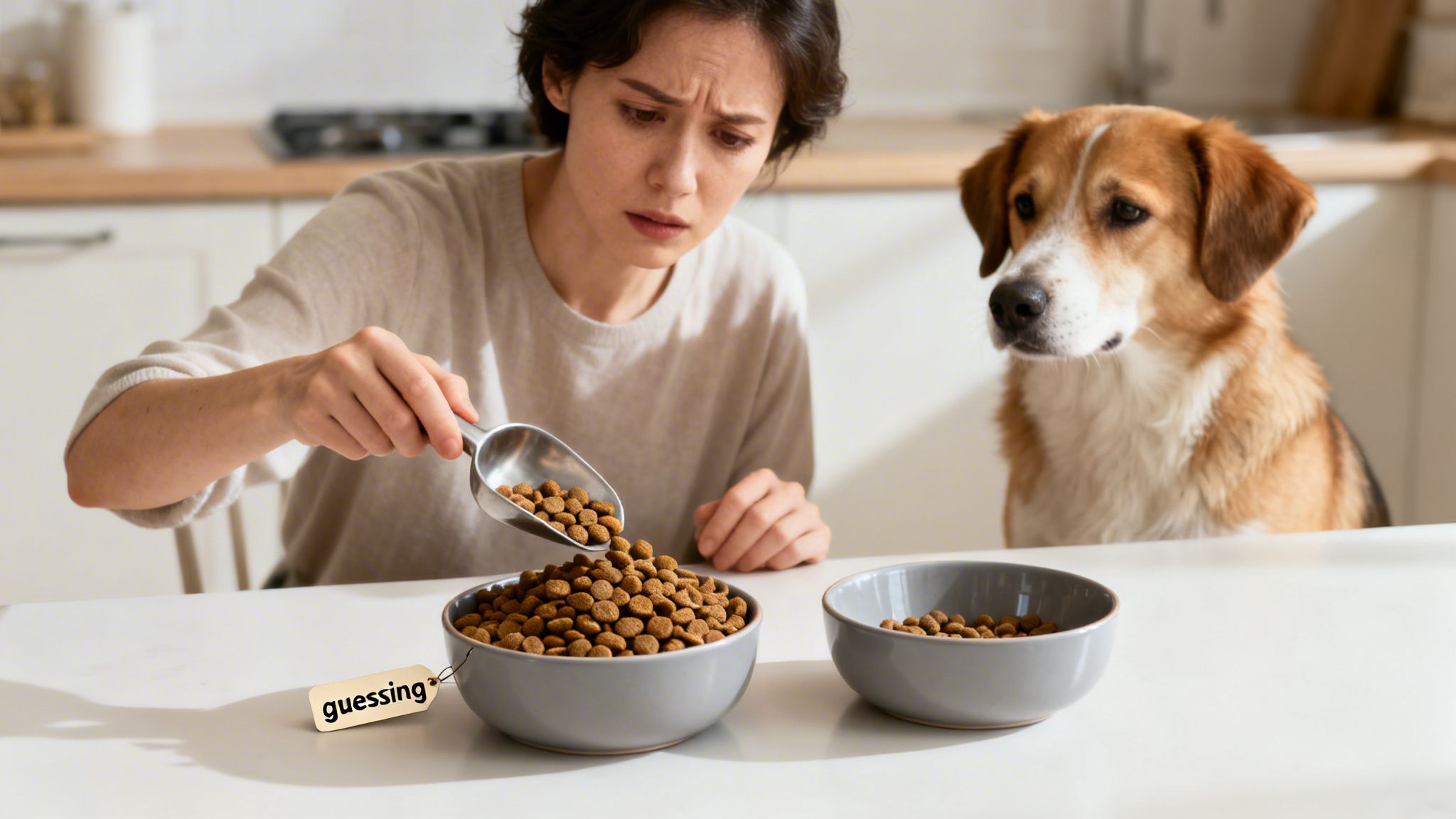
We've all been there—eyeballing the kibble, giving the scoop a little shake, and hoping we got it right. It feels quick and easy, but that casual scoop-and-hope method is a huge gamble with your dog's health over the long run. To really nail the exact amount of food your pup needs, a dog food portion calculator is your best friend.
Why Guessing Your Dog's Food Portions Is a Big Risk
Here at SetterFrens, we believe life's better with a wagging tail and a good book. That happiness is rooted in good health, and good health always starts in the food bowl.
The problem is that today’s dog foods are incredibly calorie-dense. A small misjudgment in portion size can have a big impact. When you just eyeball it, it’s all too easy to overfeed, which is a leading cause of pet obesity. That extra weight puts a massive strain on their joints and can open the door to a host of other serious health issues down the line.
That's why a dog food portion calculator isn't just some fancy gadget; it’s a practical tool for moving from guesswork to precision. We’re all investing more in our dogs' well-being—the global dog food market hit $77.17 billion in 2023. You can explore the latest dog food market trends from Fortune Business Insights, and you'll see just how much focus is shifting toward better nutrition. Getting the portions right is a critical piece of that puzzle.
Understanding Your Dog's Unique Needs
No two dogs are the same, and their dietary needs are just as individual. The generic feeding chart on the back of a kibble bag is a starting point at best—it can't possibly account for all the unique factors that drive your dog's metabolism. To get it right, you have to dig a little deeper.
Your dog's daily calorie requirement is a moving target. It changes with age, activity, and even after being spayed or neutered. What worked for them a year ago might not be right for them today.
It all starts with their Resting Energy Requirement (RER). Think of this as the baseline number of calories your dog needs just to keep their body running—powering their breathing, blood circulation, and digestion while they're just lounging around.
But that's just the baseline. Several key factors dramatically change that number:
- Age: A tiny, growing puppy needs way more calories per pound than a mellow senior dog snoozing the day away.
- Activity Level: My lazy lap dog has completely different needs than my friend's high-octane pup who joins him on daily runs.
- Spay/Neuter Status: This one is a biggie. A neutered dog's metabolism often slows down, meaning they might need up to 25% fewer calories to maintain a healthy weight.
Trying to feed your dog without considering these details is like flying blind. A dog food portion calculator gives you the clarity you need, ensuring every meal is helping your best friend live a long, vibrant life right by your side.
The 4 Details You Need to Accurately Calculate Your Dog's Calories
Alright, before you can use a dog food portion calculator—or even tackle the math yourself—you need to have a few key details about your dog handy. Getting these four pieces of information right is the most important part of the whole process.
Think of it as gathering your ingredients. Without the right inputs, you simply won't get an accurate result. Let's walk through exactly what you'll need.
Your Dog's Current Weight
First things first: you need an accurate, current weight. This is the cornerstone of any calorie calculation, so guessing isn't going to cut it.
The best way to get a precise number is by using the scale at your vet’s office. If that’s not an option, you can try the old weigh-in trick at home: weigh yourself, then weigh yourself holding your dog, and do the math. It’s not perfect, but it's much better than a wild guess.
Life Stage: Puppy, Adult, or Senior
A dog’s age isn't just a number; it’s a direct reflection of their metabolic needs. What their body is doing—growing, maintaining, or slowing down—dramatically changes how much food they require.
- Puppies: These guys are growth machines. They burn through energy building everything from bones to brains, so they need a calorie-dense diet packed with specific nutrients.
- Adults: For most adult dogs, the goal is maintenance. They need enough fuel for their daily activities without putting on extra weight.
- Seniors: As dogs get older, their metabolism naturally slows down. They often become less active, meaning they require fewer calories to stay at a healthy weight.
With nearly 23% of dogs now considered seniors, a lot more attention is being paid to their unique dietary needs. It's a big reason why accurate portioning has become so critical. You can read more about how pet food market trends are adapting to our aging dog population.
Spay and Neuter Status
This is the one detail I see pet owners overlook most often, and it's a huge factor. The hormonal shifts that happen after a dog is spayed or neutered almost always cause their metabolism to slow down.
A neutered dog's metabolism can slow significantly, sometimes requiring up to 25% fewer calories than an intact dog of the same size and age. Ignoring this can quickly lead to unwanted weight gain.
It’s not a small difference. A 60-pound, active Golden Retriever who is intact will have different energy requirements than his neutered brother, even if they have the exact same lifestyle. You have to account for it.
Activity Level
Finally, it’s time for an honest assessment of your dog’s daily activity. A Border Collie working on a farm has vastly different fuel needs than a Basset Hound who has perfected the art of the 12-hour nap.
And be realistic here! A couple of casual walks around the block doesn’t make for a "highly active" dog. Most pets we see in family homes are in the "typical" or "moderately active" range. This input is what fine-tunes the final number, ensuring you’re fueling their life, not just their laziness.
If you enjoy making your dog's meals from scratch, don't miss our practical guide on creating balanced homemade dog food recipes for more helpful advice.
Calculating Your Dog's Daily Calories by Hand
While our calculator is a fantastic shortcut, I always encourage dog lovers to understand the math behind it. Knowing how to calculate your dog's needs yourself is incredibly empowering. It gives you the confidence to make adjustments on the fly and truly get a feel for their unique metabolism.
Don't worry, the math isn't as scary as it looks. We'll walk through it together.
It all starts with a baseline number called the Resting Energy Requirement, or RER. Think of this as the number of calories your dog needs just to keep the lights on—powering their breathing, circulation, and other basic functions while they’re snoozing on the couch.
The Core RER Formula
The gold standard for find a dog's RER is this little formula:
RER = 70 x (Your Dog's Body Weight in kg) ^ 0.75
That "^ 0.75" part might look a bit intimidating, but it's just an exponent. Your phone’s calculator almost certainly has this function (look for a button like "xʸ"). Before you can use it, though, you need to convert your dog's weight from pounds to kilograms.
It's simple: just take their weight in pounds and divide it by 2.2. For instance, a 40-pound dog comes out to about 18.18 kg (40 / 2.2 = 18.18).
Once you have that kilogram figure, you can plug it right into the formula. This gives you the foundational number we'll build on.
From Resting to Real Life
Your dog isn't just lying around all day (well, most aren't!), so their RER is just the starting point. To find their true Daily Energy Requirement (DER), we have to multiply the RER by a factor that accounts for their specific lifestyle.
These multipliers, which we touched on earlier, consider everything from their age and activity level to whether they've been spayed or neutered.
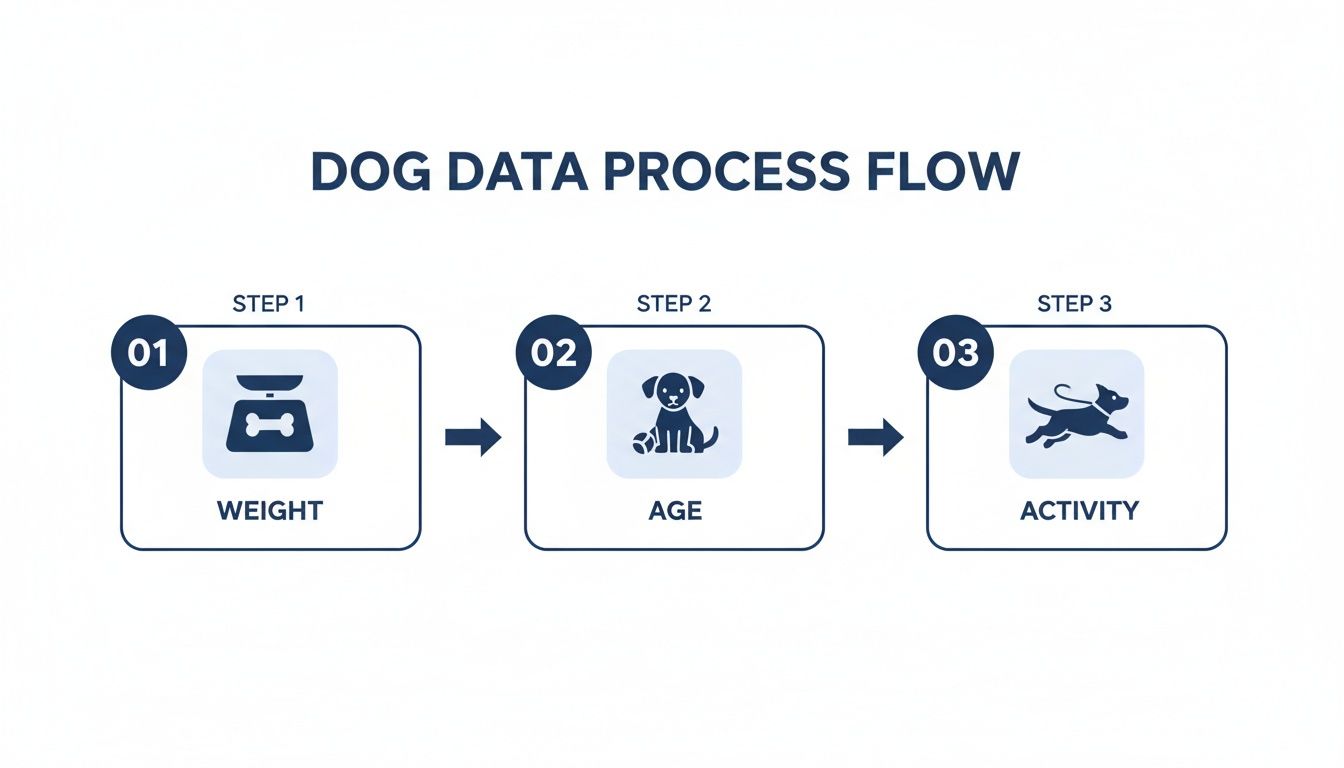
These three data points—weight, age, and activity—are the absolute essentials for getting an accurate picture of what your dog needs.
Let's make this real. Seeing the numbers in action makes it all click.
A Real-World Calculation: Meet "Scout"
Let’s run the numbers for a hypothetical dog named Scout. Here’s his profile:
- Weight: 40 pounds
- Status: Neutered adult
- Activity Level: Active (he gets long daily walks and loves weekend hikes)
Alright, first up is his RER.
- Convert his weight: 40 lbs ÷ 2.2 = 18.18 kg.
- Calculate his RER: 70 x (18.18 ^ 0.75) = 70 x 8.8 = 616 calories.
So, Scout needs 616 calories a day just to exist. Now, let's figure out what he needs for his active life.
Next, we find his DER.
For an active, neutered adult dog, the standard multiplier is 1.6.
- Calculate his DER: 616 (RER) x 1.6 (Multiplier) = 986 calories per day.
And there you have it. Scout needs about 986 calories every day to fuel his adventures and stay in great shape. This is a much more reliable number than the vague feeding chart on a bag of kibble.
This manual calculation is exactly what a good dog food calculator does behind the scenes. By doing it yourself, you can see how much of a difference factors like activity and neuter status really make. It turns feeding from a guessing game into a practical science, ensuring your SetterFrens companion gets the perfect amount of fuel to thrive.
Converting Calories to Cups for Any Dog Food Brand
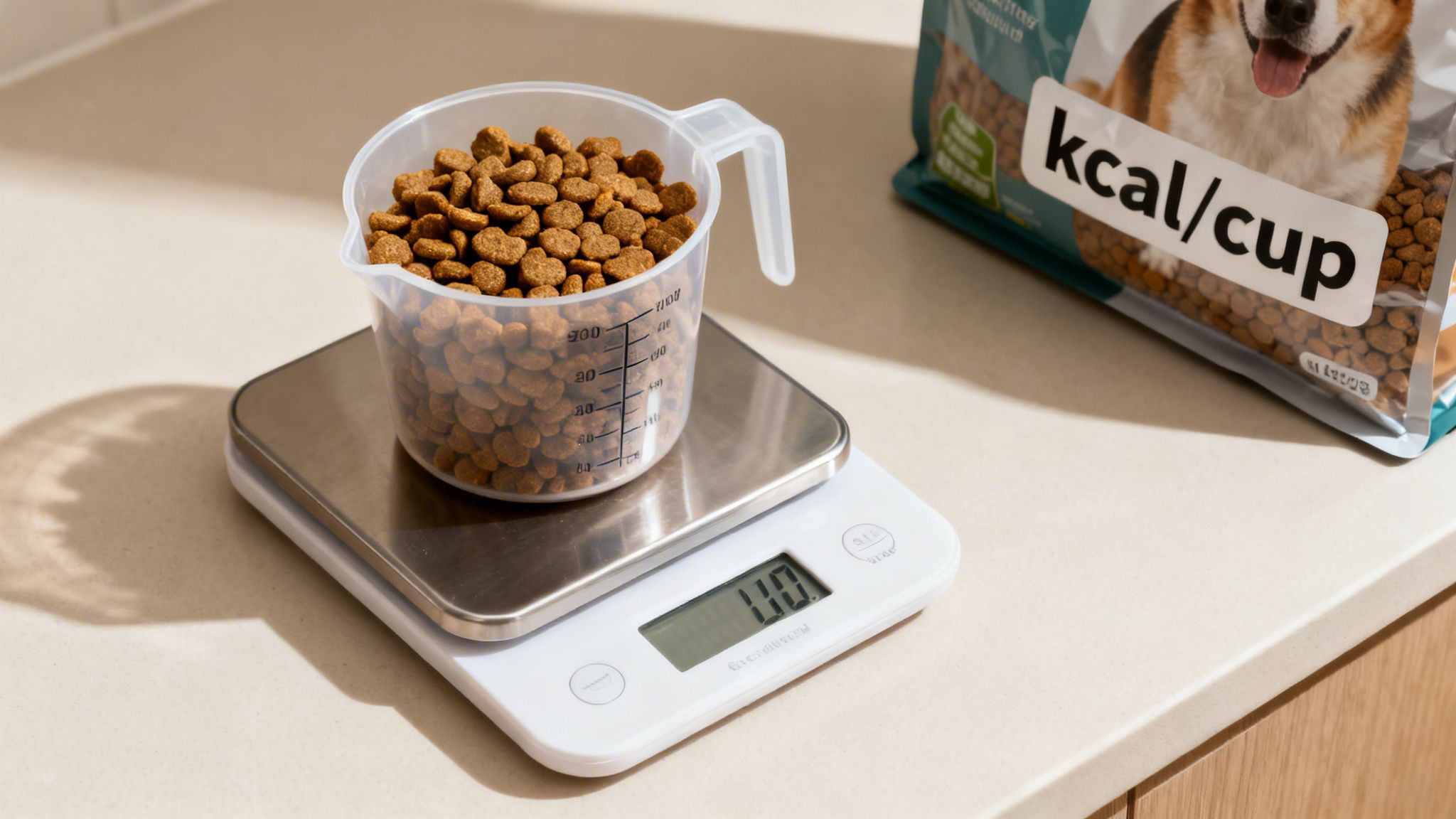
Alright, you've nailed down the daily calorie target for your dog. For our example pup, Scout, that magic number is 986 calories. So, what’s next? Now we have to figure out how that number translates into the food that actually goes into their bowl.
This is where you’ll need to grab your dog's food bag and do a little detective work. Every brand is required to list its calorie content, usually in a small box labeled "Calorie Content (ME)". Inside, you'll find two crucial pieces of information:
- kcal/kg: The number of kilocalories per kilogram of food.
- kcal/cup: The number of kilocalories per standard 8-ounce measuring cup.
That "kcal/cup" figure is your key to turning those calculated calories into a scoopable portion.
Cups vs. Grams: Why Your Kitchen Scale Is a Game-Changer
Now, here’s a piece of advice I give to every dog lover I meet: ditch the measuring cup and invest in a simple digital kitchen scale. It might seem like a small change, but it makes a world of difference.
Why? Because "a cup" is surprisingly unreliable. The size, shape, and density of kibble can vary dramatically from one brand to another—and even from one bag to the next. Relying on a scoop can lead to a portion variance of 20-30%. That's a massive margin of error that can easily throw off your dog's weight management goals.
Weighing the food in grams is the gold standard. It’s precise, repeatable, and takes all the guesswork out of feeding time. This is especially vital when dealing with calorie-dense puppy food or precise therapeutic diets where every piece of kibble counts.
Using a digital kitchen scale to weigh your dog’s food is the single best way to guarantee portion accuracy. It’s a simple change that makes a massive difference in managing your dog's long-term health.
This move toward precision is also reflected in the broader pet food industry. The demand for personalized nutrition plans is booming, with the market projected to grow at a rate of 9.6% annually from 2025 through 2034. As more of us switch to highly tailored feeding plans, a portion calculator and a trusty scale are becoming must-have tools. You can dive deeper into this trend by exploring the latest insights into the personalized pet food market.
Let's Do the Math: From Calories to a Full Bowl
Let's bring it all back to Scout and his daily goal of 986 calories. Let's say his food bag states it has 390 kcal/cup.
To figure out his daily serving, the formula is simple:
Daily Calories ÷ kcal/cup = Daily Cups
986 ÷ 390 = 2.5 cups per day
Easy enough, right? Scout gets 2.5 cups of that specific food each day.
Most vets suggest splitting the daily amount into two meals to help with digestion and keep hunger at bay. So, you’d simply give Scout 1.25 cups in the morning and another 1.25 cups in the evening. This final, simple step connects all the dots, ensuring your dog gets the exact fuel they need to thrive.
Common Dog Feeding Mistakes to Avoid
Getting the numbers right with a dog food calculator is a fantastic start. But even with perfect math, a few sneaky habits can completely undo all your careful planning. Here at SetterFrens, we see it all the time—well-intentioned diets that get derailed by one major culprit: treat inflation.
It’s that little piece of cheese that "accidentally" falls off the counter, the crust of your toast, or those extra training rewards. They seem so small, right? The thing is, they add up incredibly fast, throwing your dog's calorie budget way off. A couple of hundred extra calories a day from "harmless" extras is often the real reason behind mysterious weight gain.
Adjusting Portions for Life's Changes
Your dog's calorie needs aren't static; they're constantly changing as your pup grows and ages. A big mistake we see is calculating their portions once when they're a young adult and then never looking back. Life happens, and when it does, you need to revisit the math.
Be ready to re-evaluate their food bowl during these key moments:
- After Spaying or Neutering: This one is huge. A dog's metabolism can slow down significantly after the procedure, sometimes requiring up to 25% fewer calories to stay trim.
- Entering the Golden Years: As dogs get older, their activity levels naturally decrease. They simply don't need the same amount of fuel they did in their prime.
- Shifts in Activity: Have you two started a new running routine together? Or has a minor injury put your dog on couch rest for a few weeks? Their food intake needs to reflect that change, up or down.
Forgetting to make these adjustments is one of the most common ways dogs become overweight. It doesn't make you a bad pet parent—it's just easy to fall into a routine and forget that their needs evolve. And if you're dealing with challenging behaviors around the food bowl, our guide on addressing food aggression in dogs might offer some helpful solutions.
Using Your Eyes and Hands as the Final Check
While a calculator gives you a brilliant, science-backed starting point, your dog is the real expert here. The best way to know if you’ve nailed it is by learning to do a quick Body Condition Score (BCS) check. This is just a hands-on way to feel if your dog is at their ideal weight.
You should be able to easily feel their ribs under a thin layer of fat, but you shouldn't be able to see them sticking out. When you look down at your dog from above, you should see a nice, defined waist—a bit like an hourglass.
Think of the calculator's number as your starting hypothesis. Your dog's body condition is the experiment's result, telling you if your hypothesis was right or needs a tweak.
If you notice your dog is getting a little pudgy or, on the flip side, looking too lean, don't panic and make drastic changes. A good rule of thumb is to adjust their daily food portion by about 10% and see what happens. Monitor them for a couple of weeks, then check their body condition again. This slow, steady approach is the safest and most effective way to dial in that perfect portion size and keep your best friend happy and healthy.
Answering Your Top Questions About Dog Food Portions
We get some fantastic questions from fellow dog lovers in the SetterFrens community, so I’ve pulled together the ones that pop up most often. Let's clear up some of the common points of confusion so you can feel totally confident about what’s going in your pup’s bowl.
How Often Should I Recalculate Their Food?
Think of your dog's food portion as a moving target, not something you set just once. You’ll definitely want to run the numbers again during those big life shifts. A major one is the jump from puppyhood to adulthood, which happens around 12-18 months for most dogs.
Another key moment is after they get spayed or neutered—this can slow their metabolism right down. It's also wise to revisit the dog food portion calculator when they hit their senior years (usually around age 7-8) or if their activity level changes significantly. A good rule of thumb? An annual check-in around their vet visit is a perfect way to stay on track.
What If My Dog Still Acts Hungry After a Meal?
Ah, the classic puppy-dog eyes. We've all seen them! Before you toss another scoop in the bowl, take a second to double-check your math. If the portion size is correct, remember that some dogs are just eternally optimistic about their next meal.
You can make their food feel more substantial without over-feeding.
- Slow them down: A slow-feeder bowl is a game-changer. It turns gobbling into a fun puzzle, making them feel more satisfied.
- Add some healthy bulk: A spoonful of plain pumpkin puree or a few chopped green beans adds volume and fiber without a ton of extra calories.
Of course, if your dog is actually losing weight or seems lethargic, that’s a different story. In that case, a call to the vet is your best next step.
Can I Use the Same Scoop When I Switch Foods?
This is such a common trip-up, but the answer is a hard no. Using the same scoop for different foods can throw your dog’s diet completely off course.
Think of it this way: a cup of dense granola has way more calories than a cup of light, puffed rice cereal. Dog food is exactly the same.
One cup of Brand A kibble might have 350 calories, but the exact same-sized cup of Brand B could pack in 500 calories. Always, always check the "Calorie Content (ME)" on the new bag and recalculate how many cups or grams your dog needs for their daily goal.
Should I Split Their Daily Food Into Two Meals?
For almost all adult dogs, yes! Splitting their total daily portion into two separate meals—one in the morning, one in the evening—is the way to go. It’s easier on their digestive system, helps keep their energy stable, and can prevent them from feeling ravenous between feedings.
This is especially crucial for deep-chested breeds prone to bloat, where smaller, more frequent meals are strongly recommended. Puppies are another story; their tiny tummies and huge energy needs mean they should be eating even more often, typically three or four times a day. If you're curious about different feeding styles, you might find our guide on the pros and cons of a raw dog food diet helpful for more insights.
SetterFrens is a cozy online community built for dog lovers who believe life’s better with a wagging tail and a good book. Along with our curated selection of dog-themed books, https://setterfren.com features honest reviews of the top dog products and practical how-to guides to help you care for your pup like a pro. Join our Puppicino Club to unlock member perks, book updates, and dog-friendly treats. Stay part of the fun by following @setterfrens on TikTok and Instagram for heartwarming dog moments, product tips, and behind-the-scenes content from our growing pack! Setterfrens merchandise can be found on Etsy.com.