Picture this: you're at the park, a good book in hand, your best furry friend enjoying a happy romp. But then, a squirrel dashes by, and your pup is gone. That heart-sinking moment is something every dog parent dreads. Here at SetterFrens, where we believe life’s better with a wagging tail and a good book, we know that a reliable recall isn't just a party trick—it's a lifeline. It is the ultimate trust exercise between you and your dog, ensuring their safety and your peace of mind.
But where do you even start? Getting a dog to come back every single time, especially with tantalizing distractions, can feel like an impossible task. Don't worry, we've got your back. This cozy guide cuts through the noise with eight specific, actionable dog recall training tips designed to build a rock-solid connection. We'll break down the exact steps to follow, from building a solid foundation with high-value rewards to troubleshooting common problems and even making it a fun game.
Forget shouting your dog's name into the wind. We are going to show you how to build a recall so strong that your pup chooses you over that pesky squirrel. Get ready to transform your dog's 'selective hearing' into an enthusiastic, reliable return, so you can both enjoy more freedom and fun together. For more heartwarming moments and pup-approved guides, follow us @setterfrens on TikTok and Instagram! We share product tips and behind-the-scenes content from our growing pack that you won't want to miss.
1. High-Value Reward Systems
Ready to become the most exciting thing in your dog's world? The secret is creating a high-value reward system. This is one of the most foundational and effective dog recall training tips because it teaches your pup that coming back to you is always the best choice, no matter what else is going on. Think of it this way: your dog’s daily kibble is their salary, but these special recall rewards are their lottery winnings.
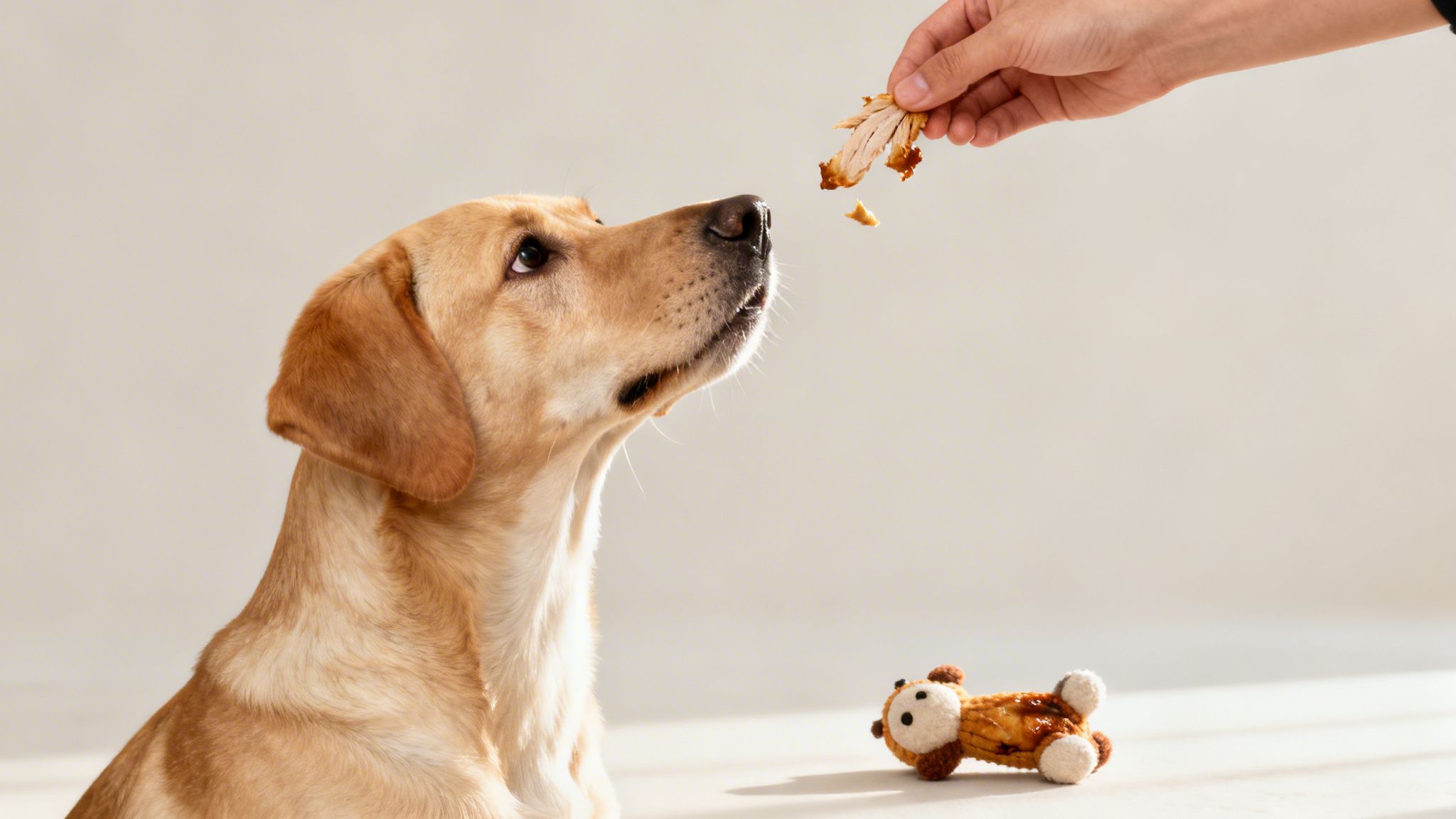
This method isn't about just any treat; it's about finding what truly motivates your dog on a deep level. A high-value reward is something so special that it overrides the temptation of a squirrel, another dog, or an interesting smell. This entire approach is rooted in the idea of positive reinforcement, where you add something wonderful to make a behavior (like coming when called) more likely to happen again. You can learn more about the science behind positive reinforcement to see why it's so powerful for building a strong bond.
How to Implement a High-Value Reward System
Identify Your Dog's "Jackpot": What does your dog go absolutely wild for? For some, it might be tiny pieces of cooked chicken, freeze-dried liver, or smelly cheese. For others, a specific squeaky toy that only appears during recall practice is the ultimate prize. Finding the best training treats for dogs can make a huge difference in their focus and enthusiasm.
Keep It Exclusive: Reserve these top-tier rewards only for recall training. If your dog gets cheese all the time, it loses its special power. The goal is to create an "oh wow!" moment every time they hear your recall cue.
Practice "Jackpot" Moments: When your dog has an especially fast or difficult recall (like coming away from another dog), reward them with a "jackpot." This means giving them a handful of treats instead of just one. This reinforces that extra effort pays off big time!
Key Tip: Start your training in a low-distraction environment, like your living room or backyard. Keep sessions short, fun, and upbeat, around 5-10 minutes. As your dog's recall becomes more reliable, you can gradually introduce more distractions and practice in new places.
2. The 'Name Game' Foundation Building
Ever call your dog’s name and get nothing but a brief ear twitch before they go back to sniffing? Before you can master recall, your dog first needs to learn that their name means "stop what you're doing and look at me because something amazing is about to happen." The Name Game is a simple but powerful exercise that builds this exact foundation. It's one of the most important dog recall training tips because it creates an automatic, positive reflex to their name.

Popularized by training pioneers like Dr. Ian Dunbar, this game teaches your dog that orienting toward you when they hear their name is highly rewarding. It’s the essential first step before you can expect them to come running from a distance. By making their name a predictor of wonderful things, you ensure they are already focused on you when you give the actual recall cue. This is especially useful for puppies or newly adopted dogs who are still learning the ropes of their new life with you.
How to Implement the 'Name Game'
Start Simple and Reward Instantly: Sit on the floor near your dog in a quiet area. Say their name in a happy, upbeat tone just once. The moment they look at you, mark the behavior with an enthusiastic "Yes!" and immediately give them a high-value treat. The key is rewarding within one second of getting eye contact to build a strong association.
Keep Sessions Short and Frequent: You don't need long, formal training blocks. Practice in short bursts of 5-10 repetitions throughout the day. Try playing during commercial breaks on TV, while waiting for the kettle to boil, or during meal prep. These mini-sessions keep your dog engaged without causing burnout.
Don't Poison the Cue: Avoid using your dog's name for things they don't like, such as calling them for a bath or to scold them. You also want to avoid repeating their name if they don’t respond. Chanting "Fido, Fido, Fido!" only teaches them to ignore the first few attempts. Say it once, and if you don't get a response, make a small kissy noise or clap to get their attention, then reward the head turn.
Key Tip: Once your dog is a pro at the Name Game, you can begin to fade the food treats and use praise, a favorite toy, or life rewards (like permission to go outside). This turns their name into a powerful tool for grabbing their attention in any situation, setting the stage for rock-solid recall.
3. Distance and Distraction Gradual Progression
Have you ever wondered why your dog’s perfect recall in the living room disappears the second you step outside? The solution is a gradual progression of distance and distractions. This is one of the most essential dog recall training tips because it sets your dog up for success by building skills incrementally, preventing them from feeling overwhelmed. It’s like learning to swim: you start in the shallow end, not by jumping into the deep end during a storm.
This systematic approach, championed by animal behaviorists like Sophia Yin and Patricia McConnell, teaches your dog to generalize their recall command. It ensures they understand that "come" means the same thing whether they are five feet away in a quiet house or fifty feet away at a busy park. By carefully managing the difficulty, you build a reliable recall that holds up in the real world.
How to Implement Gradual Progression
Increase One Variable at a Time: This is the golden rule. Only make one thing harder at a time: either distance or distraction, but never both at once. For example, if you are moving from your living room to your backyard (increasing distraction), start with a very short recall distance again.
Follow a Phased Approach: Create a clear plan for your training. A sample progression might look like this:
- Weeks 1-2: Practice from 5 feet away in a quiet room.
- Weeks 3-4: Increase distance to 15-20 feet in the same room.
- Weeks 5-6: Go back to a 5-foot distance but add a minor distraction, like a favorite toy on the floor.
- Weeks 7-8 & Beyond: Move to your fenced yard on a long line, then eventually to quiet public spaces, always managing distance and distractions carefully. As your dog's skills improve, knowing how to master the perfect walk becomes the next step in applying their training.
Read Your Dog's Cues: Pay close attention to your dog's focus. If they seem hesitant, distracted, or fail a recall, the current step is likely too difficult. Understanding their signals is key; you can learn how to read dog body language to better gauge their comfort and readiness.
Key Tip: Aim for at least a 90% success rate (9 out of 10 successful recalls) at your current level before increasing the difficulty. If your dog starts to regress, don't get discouraged! Simply take a step back to the previous level where they were successful and build their confidence back up before trying again.
4. Long Line Training for Safety and Confidence
Dreaming of off-leash adventures but worried your dog might bolt? A long line is the perfect tool to bridge that gap safely. This simple piece of gear, essentially a 15 to 30-foot lightweight leash, is one of the most crucial dog recall training tips for building real-world reliability. It gives your dog the freedom to explore, sniff, and make choices, while you maintain a foolproof safety net to ensure they can't ignore your recall cue.
The magic of a long line is that it teaches genuine compliance. Instead of relying on the physical restraint of a short leash, your dog learns to respond to your voice even when they feel "free." This method is a favorite among professional trainers, including those in search and rescue, because it builds confidence in both the dog and the handler before taking the final step to being fully off-leash.
How to Implement Long Line Training
Choose the Right Gear: Opt for a lightweight line, often made of nylon or biothane, that won't get tangled easily or weigh your dog down. A harness is recommended over a collar to prevent any sudden yanking on your dog's neck if you need to step on the line to stop them.
Let It Drag: In a safe, open area, let the line drag on the ground behind your dog. Avoid holding it like a regular leash. The goal is for them to almost forget it's there, allowing you to practice in a more natural state. You can simply step on the end of the line if your dog starts to run off or ignores your recall.
Practice, Practice, Practice: Start with short distances and gradually work your way up to the full length of the line. Call your dog back with your happy recall cue and reward them enthusiastically every single time they return, even though the line provided a backup. For a fun twist, turn it into a game by hiding behind a tree and calling them, making their successful recall a fun discovery.
Key Tip: Never use the long line to reel your dog in like a fish or to deliver a sharp "correction." Its purpose is purely as a safety measure to prevent them from self-rewarding by running off. True progress comes from your dog choosing to come back for the amazing rewards you offer.
5. Release Word and Boundary Training
Ever had your dog recall perfectly, grab their treat, and then immediately bolt away? Teaching a specific "release word" is the solution to this common recall hiccup. This training tip creates clear communication, teaching your dog that coming when called means staying with you until they are given permission to leave. It adds structure and predictability, transforming a frantic grab-and-go into a calm, connected check-in.
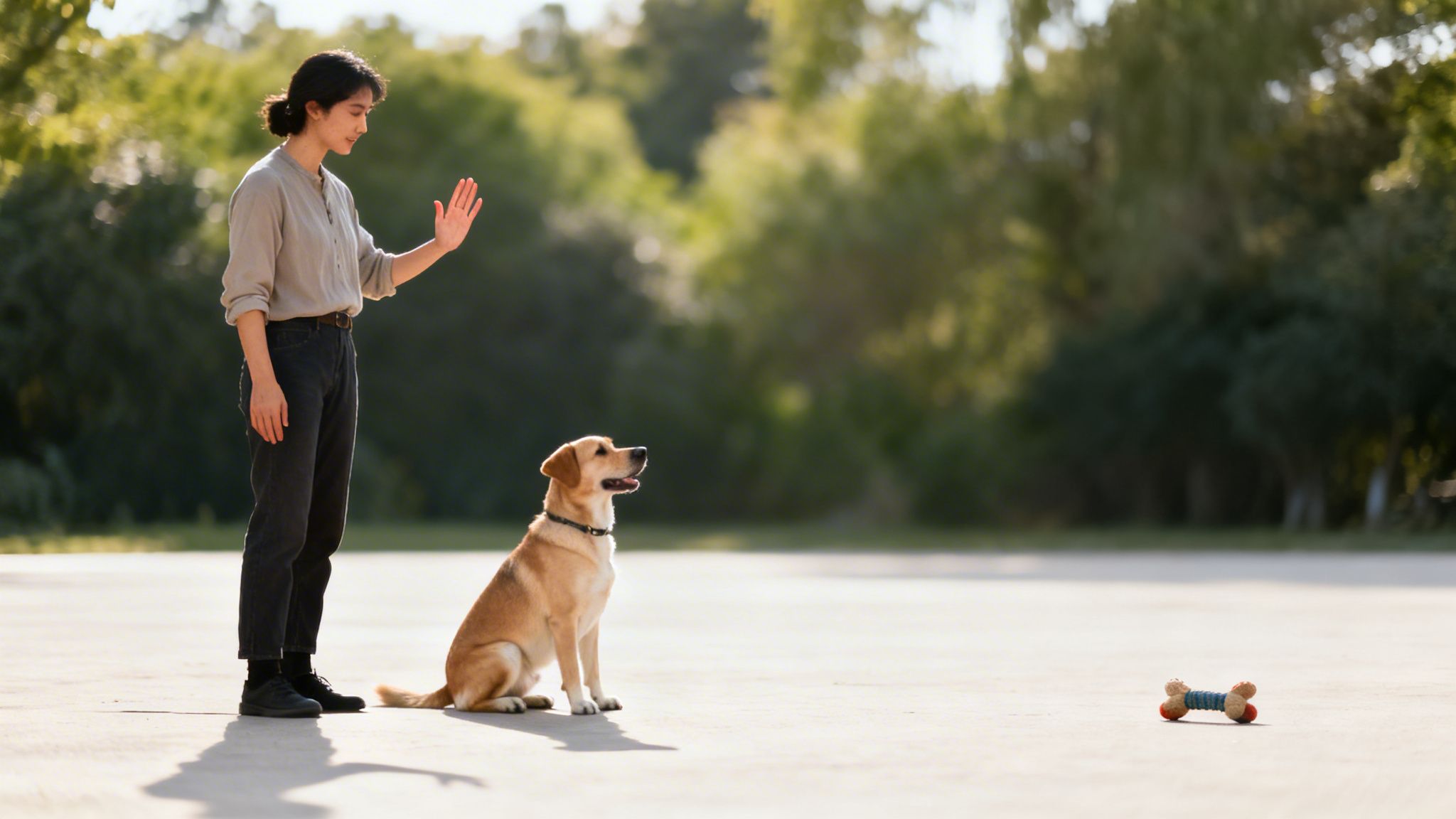
This method, popular with professional trainers in sports like obedience and agility, establishes clear boundaries around your recall cue. Your dog learns that "Come!" doesn't just mean "run to me," it means "run to me and wait for the next instruction." By rewarding them for staying close before giving the release word, you reinforce the value of sticking by your side. This is one of the dog recall training tips that truly builds a cooperative partnership, making your pup look to you for guidance.
How to Implement a Release Word
Choose a Distinct Word: Pick a short, upbeat word you don't use in everyday conversation. "Okay," "Free," "Break," or "Go play" are great options. Consistency is key, so once you choose one, stick with it.
Practice the 'Stay Close' Moment: After your dog comes to you, reward them with their high-value treat while they are still close. You can ask for a sit to add extra structure. Initially, keep this 'hold' period very short, just a second or two.
Give the Release and Encourage Fun: After rewarding them for staying, say your release word in a cheerful tone and toss a toy or another treat away from you to encourage them to leave. This teaches them that the release itself is also a reward. For example, at the park, recall your dog, reward them for staying, then say "Okay!" and let them go back to sniffing or playing.
Key Tip: Use your release word in other daily routines to solidify its meaning. For instance, have your dog wait at the door until you say "Okay" to go outside, or wait for their food bowl to be placed down until you give the "Free" cue to eat. This consistency makes the concept crystal clear.
6. Consistency Across All Caregivers and Environments
Have you ever felt like your dog’s recall is amazing with you but falls apart with your partner or dog walker? You're not alone. Ensuring consistency across everyone who handles your dog is one of the most overlooked yet critical dog recall training tips. Dogs are situational learners, meaning they don't automatically generalize commands from one person to another or from one place to the next. If training isn't unified, your dog may learn that "come" means "run back for a chicken treat" with you, but "here boy!" from Grandpa just means his walk is ending.
This principle is all about creating a clear, predictable structure for your dog, no matter who is holding the leash. When every person uses the same cue, offers the same level of rewards, and upholds the same expectations, your dog learns that recall is a non-negotiable, always-rewarding behavior. This approach is heavily emphasized by certified professional dog trainers and is a core protocol for reputable board-and-train facilities because it eliminates confusion and speeds up reliable learning.
How to Implement Consistency Across Your Team
Hold a Family Training Meeting: Get everyone who lives with or cares for the dog in one room. Decide on one verbal cue (like "Come!" or "Here!"), one hand signal, and the specific high-value rewards to be used. Put it in writing so there's no confusion.
Create a Caregiver Protocol: Type up a simple one-page guide for any dog walkers, pet sitters, or visiting family members. Include the recall cue, what treats to use (and provide them!), and what to do if the dog doesn't listen. This empowers them to support your hard work.
Demonstrate, Don't Just Tell: Show every caregiver exactly how a recall session works. Let them see your enthusiastic tone, the quick reward delivery, and the party you throw when your dog comes back. Positive reinforcement works for people, too, so praise them for getting it right!
Check In Regularly: Don't just hand over the guide and hope for the best. Casually ask your dog walker or sitter how recall is going. This opens the door for them to ask questions and ensures everyone stays on the same page for long-term success.
Key Tip: The goal is to make your dog's recall cue a universal language spoken by their entire "pack." When the rules and rewards are the same with everyone, your dog’s reliability will skyrocket because they understand that coming back is always the best decision, no matter who is calling.
7. Randomized Rewards and Variable Schedules
Ready to make your dog’s recall behavior as persistent as a slot machine addiction? Once your dog has a solid recall foundation, introducing a randomized reward schedule is one of the most powerful dog recall training tips to make the behavior last for life. This technique, rooted in behavioral psychology, teaches your dog that coming back to you might result in an amazing prize, keeping them motivated and hopeful every single time. Instead of a predictable paycheck for every recall, you're turning it into an exciting lottery where they never know when they'll hit the jackpot.
This method works because the unpredictability of the reward is more engaging than a guaranteed outcome. The dog learns that while not every recall earns a treat, the next one could be a massive win. This is known as a variable schedule of reinforcement, and it’s a secret weapon for dog sports trainers who need unshakable reliability. It prevents the behavior from fading away, as the dog is always chasing that potential big reward. You can explore how behavior science applies to our canine companions on the Setterfren blog, where we dive into practical training topics.
How to Implement Randomized Rewards and Variable Schedules
Vary the Reward Value: The core of this strategy is unpredictability. One recall might earn enthusiastic praise, the next a single piece of kibble, and the third a "jackpot" of five pieces of freeze-dried liver plus a game of tug. Mix in food, toys, and affection to keep your dog on their toes.
Keep It Truly Random: Don't fall into a pattern. One easy way to stay random is to put a mix of high, medium, and low-value treats in your pouch. Reach in without looking and deliver whatever you grab. For every recall where you don't give a food treat, always give genuine, exciting praise.
Know When to Transition: Do not start this too early. Your dog should be reliably coming back to you (at least 90% of the time) on a consistent reward schedule for 2-3 months first. Moving to a variable schedule before the behavior is solid can cause confusion and make the recall weaker.
Key Tip: The goal isn't to stop rewarding your dog; it's to make the rewards unpredictable. Always maintain a high rate of reinforcement overall, but vary the type and value of that reinforcement. Keep those jackpot moments frequent enough to maintain your dog's excitement and drive to come running when you call.
8. Emergency Recall Training and 'Leave It' Integration
Imagine your dog is about to run into a busy street. This isn't the time for your everyday "come" command; this is a moment that demands an immediate, non-negotiable response. This is where an emergency recall cue comes in. It’s a special, life-saving command that you'll hopefully never need, but will be eternally grateful for if you do. It functions as a panic button for your dog's brain, trained to override every other distraction.
This advanced technique is different from your standard recall. It uses a unique word or sound that is reserved only for true emergencies, teaching your dog that this cue means "drop everything and get back to me right now, no questions asked." When paired with a strong "leave it" command, it creates a powerful safety net, stopping your dog from ingesting something dangerous or running toward harm. This is one of the most critical dog recall training tips for total peace of mind.
How to Implement an Emergency Recall
Choose a Unique Cue: Select a word or a specific whistle tone that you will never use in any other context. Words like "ZAP!," "TOUCHDOWN!," or "HERE!" work well because they are distinct and easy to say with urgency. The goal is to avoid any association with your regular, lower-stakes recall.
Integrate "Leave It": Practice having your dog abandon something amazing (like a piece of steak) for an even better reward from you. Start with the "leave it" command, then immediately use your emergency recall cue. When they turn and run to you, they get the ultimate jackpot reward. This teaches them that leaving a tempting item to return to you is always the more rewarding choice. For more foundational commands, you can explore other dog training tips and tricks that build a solid obedience base.
Practice, But Don't Overuse: Set up mock emergency scenarios in a safe, controlled area. For example, have a friend roll a ball toward a "street" (your driveway) and use your emergency cue. The key is to practice enough for it to be reliable but use the actual cue so rarely that it never loses its power.
Key Tip: The reward for a successful emergency recall must be the absolute highest value possible. This isn't the time for a single treat. Think a handful of cooked chicken, a brand new squeaky toy they’ve never seen, and a huge celebration. The reward must outweigh the temptation they just left behind.
8-Point Dog Recall Training Comparison
| Technique | 🔄 Implementation Complexity | ⚡ Resource Requirements | ⭐ Expected Outcomes | 📊 Ideal Use Cases | 💡 Key Advantages / Tips |
|---|---|---|---|---|---|
| High-Value Reward Systems | Low–Moderate — easy to start but needs individualization | Moderate — high-value treats/toys, short focused sessions | High ⭐⭐⭐⭐ — rapid enthusiastic recalls in distraction | Food-motivated dogs, starting recall in distracting areas | Reserve best rewards for recall; transition gradually |
| The "Name Game" Foundation Building | Low — simple, repeatable daily exercise | Low — small treats, few minutes several times/day | High for attention-building ⭐⭐⭐⭐ — foundation for recall | Puppies, newly adopted dogs, beginners | Reward eye contact within 1s; don’t overuse name |
| Distance & Distraction Gradual Progression | Moderate–High — systematic staged approach | Moderate — multiple locations, time and patience | Very High ⭐⭐⭐⭐⭐ — generalized reliable recall | Dogs needing transfer from home to parks/real world | Advance one variable at a time; 10+ successes before moving on |
| Long Line Training for Safety & Confidence | Low–Moderate — basic handling skills required | Moderate — 15–30 ft line, open spaces, supervision | High ⭐⭐⭐⭐ — safe off-leash practice and confidence building | Transition to off-leash, anxious or rescue dogs | Use lightweight line, let it drag, reward even when it backs you up |
| Release Word & Boundary Training | Moderate — consistent timing and cues needed | Low–Moderate — consistent handler practice | High ⭐⭐⭐⭐ — reduces “touch-and-go” behavior | Parks, play sessions, doorway/safety control | Choose a distinct word; always reward stays before release |
| Consistency Across All Caregivers & Environments | Moderate — coordination and buy-in required | Low–Moderate — written protocol, shared treats/tools | Very High ⭐⭐⭐⭐⭐ — prevents mixed signals and failures | Multi-person households, sitters, daycare/boarding | Create written protocol and train all caregivers; demo methods |
| Randomized Rewards & Variable Schedules | Moderate–High — tracking and timing required | Moderate — occasional jackpots, planning tools | Very High long-term durability ⭐⭐⭐⭐⭐ — resists extinction | Advanced/maintenance phase for reliable dogs | Only after high reliability; keep praise for unrewarded recalls |
| Emergency Recall & "Leave It" Integration | High — specialized, sparing use and long-term practice | High — highest-value rewards, scenarios, possibly pro help | Very High (life‑saving) ⭐⭐⭐⭐⭐ — instant response when it counts | Off-leash in hazardous areas, search & rescue, high-risk dogs | Use separate cue rarely; train only after solid basics; consider pro trainer |
Keep the Wags Coming: Your Journey to Recall Mastery
Whew, what a journey! We’ve dug into the nitty-gritty of what makes a dog come running back with a wagging tail, and it’s about so much more than just shouting a name. You’ve now got a full toolkit of dog recall training tips to build a connection with your pup that’s as strong as it is safe. From discovering their five-star, drool-worthy high-value rewards to mastering the foundational 'Name Game,' you're setting the stage for success.
Think of this process as a beautiful tapestry you're weaving together. Each thread represents a different skill or concept we've covered. The vibrant colors of your high-value rewards system make the whole picture appealing. The strong, foundational threads of the 'Name Game' and consistent release word usage create the structure. The intricate patterns of adding distance and distractions, managed safely with a long line, add complexity and strength. Every single element is essential to the final masterpiece: a dog who chooses to come back to you, not because they have to, but because you are the best, most exciting, and safest place to be.
Your Path Forward: From Practice to Perfection
The real work begins now, but it's also where the real fun starts. Your mission, should you choose to accept it, is to integrate these dog recall training tips into your daily life. Don't think of it as a chore. Instead, see it as an opportunity for connection.
- Make It a Game: Turn your training sessions into playtime. Use the "Ping-Pong Recall" or "Hide-and-Seek" games we discussed to keep the energy high and the learning fun. A happy, engaged dog is a dog who wants to participate.
- Be the Scientist: Observe and adapt. Is your dog’s recall faltering at the park? It might be time to take a step back, lower the distraction level, and increase the reward value. Your ability to troubleshoot is just as important as the initial training.
- Celebrate the Tiny Victories: Did your pup turn their head toward you from across the room when you said their name? Celebrate! Did they come running from the other end of the yard on their long line? Throw a party! Positive reinforcement isn't just for your dog; it's for you, too. Acknowledging progress keeps you motivated.
Remember, the goal isn't just obedience; it's building a safety net. A reliable recall can prevent your dog from running into a busy street, getting into a scuffle with another animal, or ingesting something dangerous. It’s one of the most important gifts you can give them.
Mastering this skill strengthens the invisible leash of trust and respect between you and your dog. It opens up a world of off-leash adventures, peaceful hikes, and worry-free afternoons at the park. You’re not just teaching a command; you are investing in a lifetime of freedom and safety for your best friend. The consistency you bring today is the reliability you can count on tomorrow.
So, take a deep breath, grab your tastiest treats, and start practicing. Be patient with your pup, and be kind to yourself. Every single repetition, every successful "come," and even every little mistake is a step forward on your journey to recall mastery. Keep those wags coming!
Ready to continue enriching your pup's life beyond training drills? At Setterfrens LLC, we believe that a well-rounded dog is a happy dog. We feature honest reviews of top dog products and practical guides to help you care for your pup like a pro. For book lovers, our curated selection of dog-themed books is a treat! Join our Puppicino Club to unlock member perks, book updates, and dog-friendly treats by visiting us at Setterfrens LLC. And don’t forget to check out our official merch on Etsy.com