Bringing a new dog into your home is an adventure filled with joy, cuddles, and-let's be honest-a few chewed-up shoes. At SetterFrens, we believe that a strong bond, like a good book, is built on understanding and communication. That's why we've put together these essential dog training tips for beginners. This guide is more than just a list; it’s a roadmap to help you build a foundation of trust and communication with your new furry family member.
As you embark on your journey to welcome a new pup, preparing your home environment is key; consider resources like finding the best flooring for a dog to ensure durability and ease of cleaning. Once your space is ready, the real fun begins. Whether you have a tiny puppy or a newly adopted adult dog, these actionable strategies are designed to be effective, humane, and easy for the whole family to implement.
Forget confusing jargon and overwhelming advice. We're breaking down the science-backed methods used by pros into simple, manageable steps. You will learn how to use positive reinforcement effectively, establish a solid routine, and master basic commands that are crucial for a happy, well-behaved companion. Inside, you’ll discover clear guidance on everything from early socialization to fixing common training mistakes. Let’s get that tail wagging and start building a beautiful life together, one 'sit' at a time.
1. Start with Positive Reinforcement and High-Value Rewards
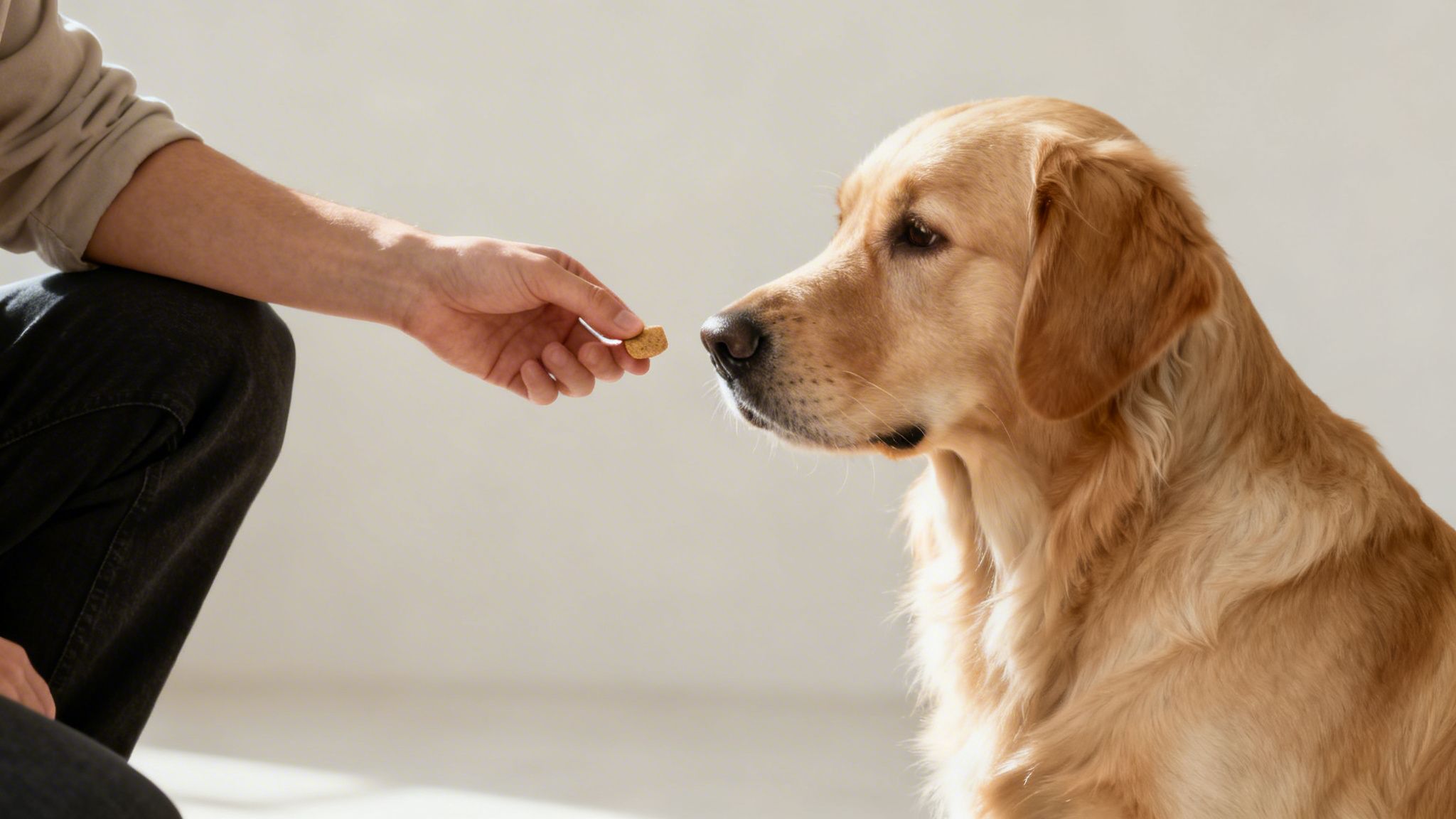
If you only remember one thing from this list, let it be this: the most effective, humane, and enjoyable way to train your dog is through positive reinforcement. This scientific approach is the gold standard used by top trainers and organizations, from service dog trainers at Guide Dogs for the Blind to the experts at the American Veterinary Society of Animal Behavior. The concept is simple: you reward your dog for behaviors you want to see, making them more likely to repeat those actions. This builds a strong bond based on trust and fun, rather than fear and intimidation.
How It Works in Practice
Think of it like a game. When your dog sits, you immediately say "Yes!" and give them a treat. The "Yes!" becomes a marker that tells them, "That exact thing you just did earned you this reward." Over time, your dog learns that sitting when asked leads to good things. This method creates a dog that is an eager and confident student, excited to figure out what you want next. To dive deeper into the science and application, you can learn more about the core principles of positive reinforcement training.
Finding Your Dog’s “Paycheck”
The key to making this work is finding what truly motivates your dog. Not all rewards are created equal in your dog’s eyes. A piece of their regular kibble might work in a quiet room, but it won't stand a chance against the excitement of a squirrel at the park. This is where "high-value" rewards come in.
Key Insight: A high-value reward is anything your dog goes absolutely bonkers for. It should be small, soft, and extra special, reserved only for training sessions to keep it exciting.
Here are a few tips to find and use the best rewards:
- Experiment: Try tiny pieces of boiled chicken, string cheese, or small, soft training treats. You’ll know you’ve found a winner when their eyes light up.
- Supercharge the Reward: For some pups, even the best treats need an extra boost. A fantastic tip for picky or easily distracted dogs involves using a dog food topper in training; a small sprinkle can make their regular treats irresistible.
- Keep Sessions Short: Train in energetic, 5-10 minute bursts. This keeps your dog engaged and prevents them from getting bored or frustrated.
- Praise is a Reward, Too! Don't forget the power of an enthusiastic "Good boy!" or a happy ear scratch. Combine praise with treats for maximum effect.
2. Establish a Consistent Training Schedule and Routine
Just as children thrive with a predictable schedule, so do our canine companions. Dogs are creatures of habit who find comfort and security in routine. By establishing a consistent training schedule, you create a predictable framework that helps your dog understand when it’s time to learn, making the process more efficient and less stressful for everyone involved. This consistency in timing and expectations is a cornerstone of professional training, from puppy kindergarten pioneers like Dr. Ian Dunbar to modern obedience clubs. It turns training from a random event into a cherished daily ritual.
How It Works in Practice
A routine removes the element of surprise and helps your dog’s brain switch into “learning mode” more easily. When training happens at the same time and in the same way each day, your dog starts to anticipate it with excitement. For instance, a short training session before breakfast not only works with their natural energy levels but also reinforces the idea that good things (like their meal) happen after a fun learning activity. This structure builds a focused and ready-to-learn mindset, which is one of the most valuable dog training tips for beginners.
Building Your Daily Training Ritual
The goal isn't to run a military-style boot camp but to create small, manageable pockets of learning throughout the day. Consistency trumps intensity every time; short, frequent sessions are far more effective than one long, exhausting session on the weekend.
Key Insight: A successful training routine is one that fits seamlessly into your existing daily life. Don't try to overhaul your schedule; instead, find the small windows of opportunity that already exist.
Here are a few tips to build a consistent and effective routine:
- Pick Peak Times: Schedule training for when your dog is most alert and ready to engage, typically mid-morning or early evening, and not immediately after a big meal or a long nap.
- Keep It Short and Sweet: Start with just 5-10 minute sessions once or twice a day. This keeps your dog from getting bored or frustrated and ensures training always ends on a positive note.
- Create a Pre-Training Cue: Simple rituals, like putting on a specific treat pouch or going to a certain spot in the house, can signal that a fun training session is about to begin. This helps your dog get mentally prepared to focus.
- Track Your Progress: Use a simple calendar, a notebook, or a training app to jot down what you worked on. Seeing your progress over time is a huge motivator to stay consistent, and it can help you pinpoint what's working best.
3. Master the Art of Timing and Clarity in Commands
Imagine trying to follow instructions in a language you barely understand, where the rules and words change constantly. It would be confusing and frustrating, right? That’s exactly how your dog feels when commands are inconsistent. Effective training hinges on clear, concise communication and perfect timing, two elements that are just as crucial as the reward itself. Dogs don’t process language and context like we do; they connect a specific sound (the command) with a specific action, but only if the timing is precise.
How It Works in Practice
The foundation of this principle, rooted in classical conditioning, is that your dog learns through immediate association. The command must happen just before or as the desired behavior occurs, and the reward must follow within one or two seconds. For example, as you see your puppy starting to lower its rear, you say "Sit" in a calm voice. The moment their bottom touches the floor, you mark it with an enthusiastic "Yes!" and deliver a treat. The sequence of "Sit" -> sitting -> reward creates a powerful mental link. This is why police K9 units and guide dogs are trained with single-word commands; in high-stakes situations, there is no room for ambiguity.
Speak Your Dog’s Language
Clarity means choosing one word per command and sticking to it. If "down" means lie down, don't also use it when you want your dog to get off the couch; use a different word like "off." This avoids confusion and helps your dog build a reliable vocabulary of cues. Think of it as creating a clear, simple dictionary for your dog to understand.
Key Insight: Never repeat a command over and over if your dog doesn't respond. This teaches them that the "real" command is "Sit, sit, sit, sit!" Instead, if they don't respond, reset by taking a step back, get their attention again, and then give the command once more.
Here are some tips to improve your timing and clarity:
- One Word, One Action: Choose a single, clear word for each command. "Sit," not "Sit down, please." "Come," not "Come on over here, boy!"
- Tone is Key: Use a calm, confident, and neutral tone. An excited voice can overstimulate your dog, while an angry tone can cause fear and anxiety, both of which shut down learning.
- Pair with a Hand Signal: Dogs are highly visual. Consistently pairing a verbal command with a distinct hand signal (like a flat palm moving down for "sit") gives them a second way to understand what you're asking.
- Reward Instantly: The treat should appear within 1-2 seconds of the correct behavior. Any longer, and your dog might associate the reward with something else they did in the meantime, like sniffing the ground. This is one of the most important dog training tips for beginners to get right.
4. Use Clicker Training for Precision and Clarity
To take your positive reinforcement training to the next level, consider adding a clicker. This small, handheld device makes a distinct 'click' sound and acts as a powerful communication tool. Clicker training, popularized by pioneers like Karen Pryor, allows you to mark the exact moment your dog performs the correct behavior. This precision makes it one of the most efficient dog training tips for beginners who want to build clear communication from the start.
How It Works in Practice
The click acts as a "reward marker" or a bridge that tells your dog, "Yes! That exact action you just did is what earned you a treat." Because the click is faster and more consistent than saying "Good boy," it removes any ambiguity. Your dog learns to associate the sound with a reward, making them eager to repeat the behavior that caused the click. This method is used by professional trainers to teach everything from complex service dog tasks to impressive agility course maneuvers. For a deeper look into this approach, you can explore the principles of Fear Free training methods that often incorporate clickers.
Getting Started with a Clicker
Before you can use the clicker to teach commands, you need to "charge" it. This process gives the click its meaning. It’s simple: sit with your dog in a quiet area, click the device, and immediately give them a high-value treat. Repeat this 10-15 times. Your dog will quickly learn that the sound of the click predicts a delicious reward.
Key Insight: The clicker is not a remote control to get your dog's attention. Its sole purpose is to mark a desired behavior. Never click to call your dog or get them to look at you.
Here are a few tips for effective clicker training:
- Click for the Behavior, Treat for the Click: The click ends the behavior; the treat is the reward for the click. Always follow a click with a treat, even if you clicked by accident.
- Timing is Everything: The click must happen at the precise moment your dog performs the action. For a "sit," click the instant their rear touches the floor.
- Start with Simple Behaviors: Begin with easy wins like "touch" (having your dog touch their nose to your hand) to build their confidence and understanding of the game.
- Keep it Positive: Like all good training, sessions should be short and fun. If you or your dog gets frustrated, take a break.
- Gradually Fade Treats: Once a behavior is reliable, you can start rewarding intermittently. Continue to click for the correct behavior, but you might follow it with a treat only two out of every three times, then one out of every two. This keeps them motivated to try.
5. Socialize Your Puppy Early (Critical 3-16 Week Window)
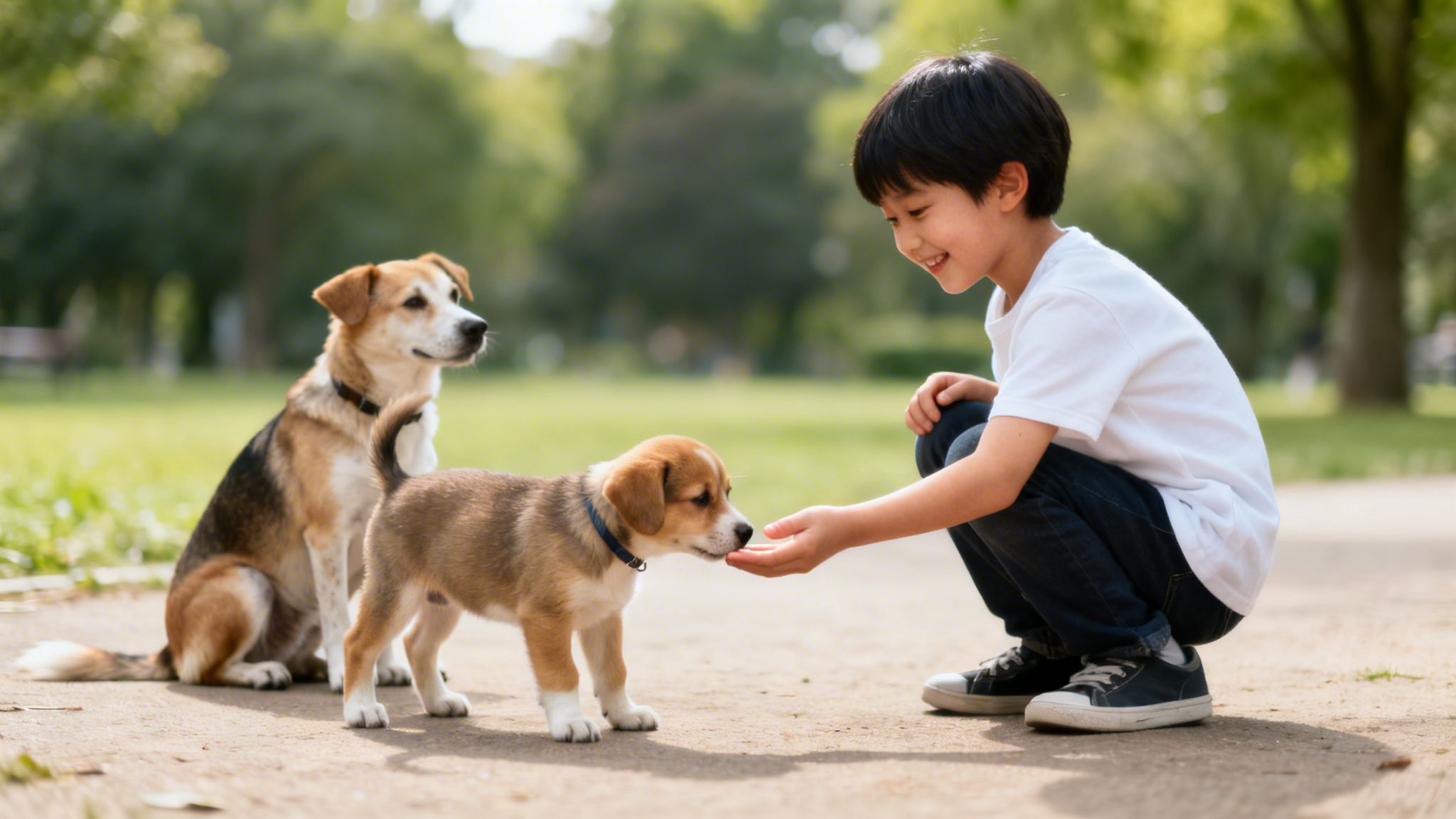
If obedience training builds the skills, early socialization builds the entire foundation for a happy, well-adjusted dog. The time between 3 and 16 weeks of age is a crucial developmental window where your puppy’s brain is uniquely wired to accept new things. Positive experiences with different people, sounds, sights, and other animals during this period teach them that the world is a safe, fun place. This is the single most important thing you can do to prevent fear-based aggression, anxiety, and other behavioral problems down the line.
How It Works in Practice
Socialization isn't about throwing your puppy into a crowded dog park and hoping for the best. It's about creating a series of controlled, positive, and gentle introductions to new stimuli. When your puppy calmly watches a garbage truck from a distance and gets a treat, they learn that loud trucks are no big deal. When they meet a person in a hat and have a good experience, they learn that hats aren't scary. These small, positive encounters add up, building a resilient and confident adult dog. This approach is a cornerstone of our SetterFrens philosophy, where a happy pup starts with a great foundation. For a deeper look, you can explore the essentials of puppy socialization.
Building a Confident Canine Citizen
The goal is to expose your puppy to a wide variety of experiences without overwhelming them. Quality over quantity is key, and every interaction should be a positive one. This process is so important that pioneers like Dr. Ian Dunbar and organizations like the American Veterinary Society of Animal Behavior consider it more critical than early obedience for long-term behavioral health.
Key Insight: The goal of socialization is not interaction, it's positive exposure. Your puppy doesn't need to play with every dog or greet every person; they just need to learn to be calm and confident in their presence.
Here are a few tips to socialize your puppy safely and effectively:
- Start Immediately: Ask your breeder what socialization they've already done. Once you bring your puppy home, continue the process by carrying them to new places before they are fully vaccinated.
- Enroll in Puppy Class: A well-run puppy kindergarten is one of the best dog training tips for beginners. It provides a safe, clean environment for puppies to interact with their peers and learn basic manners.
- The Rule of 100: Aim to introduce your puppy to 100 different things by 16 weeks: people of all ages, surfaces (grass, pavement, carpet), sounds (vacuum cleaner, traffic), and locations.
- Go at Their Pace: Never force your puppy into a situation that scares them. If they seem nervous, create more distance and pair the scary thing with high-value treats and praise until they are comfortable. A fearful experience can do more harm than good.
6. Practice the 'Sit' and 'Leave It' Commands First
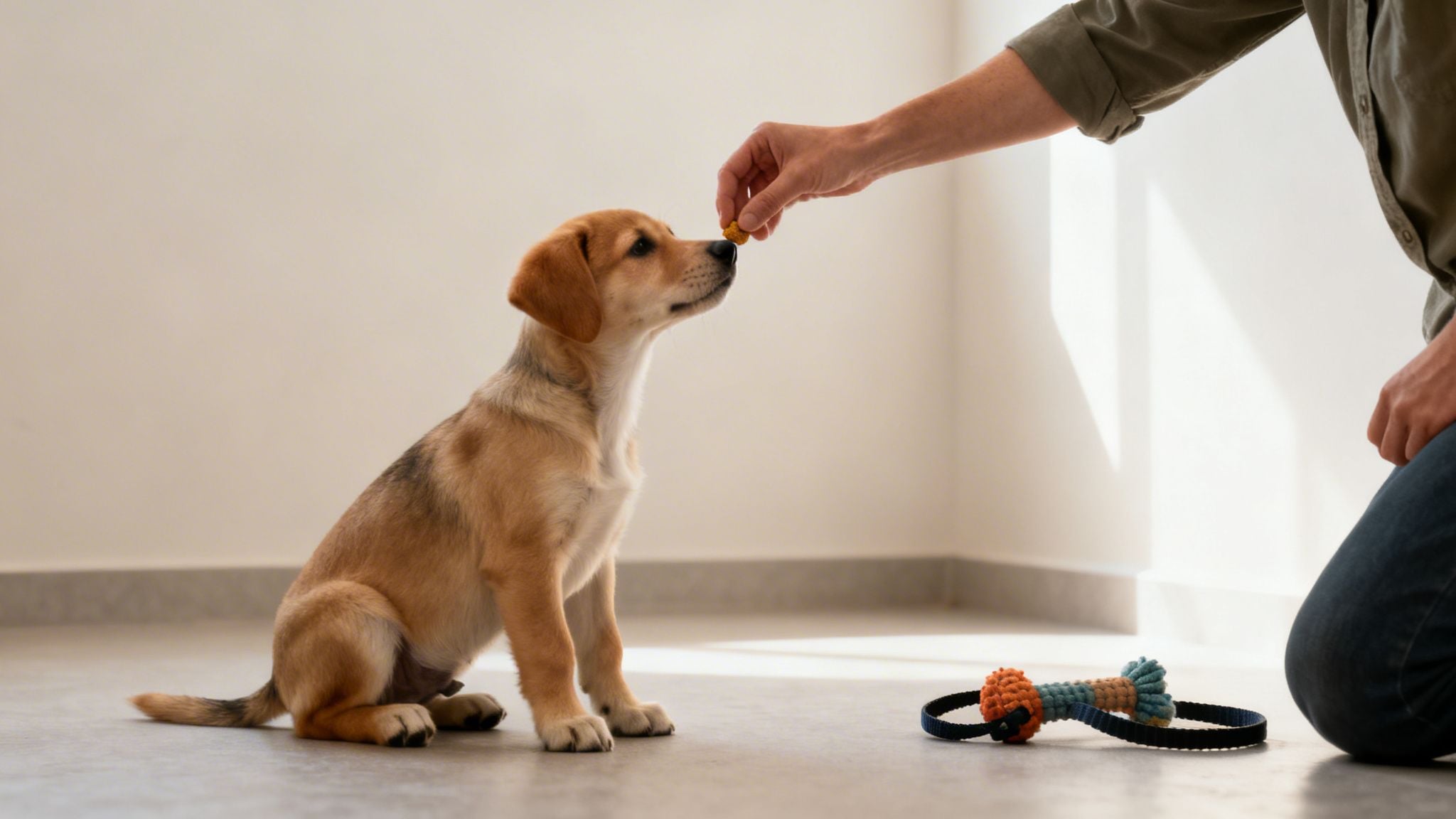
When you first bring a dog home, the list of potential commands can feel overwhelming. Where do you even begin? Smart training starts with two foundational cues that build confidence and ensure safety: 'sit' and 'leave it'. Mastering these two commands first gives you a reliable way to manage your dog's impulses and prevent common behavior problems. 'Sit' is a simple, confidence-boosting starting point, while 'leave it' is a potentially life-saving skill that every dog must know.
How It Works in Practice
These two commands form the bedrock of good manners and safety. 'Sit' is your go-to for polite greetings, preventing jumping on guests, and teaching your dog to be patient before meals or walks. 'Leave it' is your emergency brake, stopping your dog from eating dropped pills, toxic foods, or dangerous objects on the street. By focusing on these two essential skills, you are proactively addressing the most frequent challenges new dog owners face.
The Building Blocks of Good Behavior
Think of 'sit' as your dog’s default polite behavior. Instead of jumping or barking for attention, they learn that sitting gets them what they want. 'Leave it' teaches crucial impulse control that will save you endless stress. For a visual guide on teaching these fundamental commands, this video offers clear, step-by-step instructions.
Key Insight: Use 'sit' as a "please" for everything your dog wants. Want to go outside? Sit first. Want dinner? Sit first. This simple rule reinforces your leadership and teaches your dog a polite way to ask for things.
Here are some essential tips for teaching these core commands:
- Teach 'Sit' with a Lure: Hold a high-value treat near your dog’s nose and slowly move it up and back over their head. Their nose will follow the treat up, and their bottom will naturally lower into a sit. The moment their rear hits the floor, say "Yes!" and give them the treat.
- Teach 'Leave It' in Stages: Start by placing a low-value treat (like kibble) in your closed fist. Let your dog sniff and paw at it. The instant they pull their nose away, even for a second, mark with "Yes!" and reward them with a different, high-value treat from your other hand.
- Integrate into Daily Life: Practice 'sit' before every meal, before you clip on the leash for a walk, and before you throw a toy. This makes training a natural part of your day.
- Build on Success: Once your dog masters these skills, you'll have a solid foundation for teaching more advanced skills. In fact, many owners find this success inspiring and decide to explore other awesome dog tricks that are both fun and useful.
7. Eliminate Common Training Mistakes (Punishment, Inconsistency, Comparison)
As a new dog parent, you’re bound to make some mistakes, and that’s perfectly okay. However, certain common errors can unintentionally sabotage your progress and, more importantly, damage your relationship with your dog. Understanding these pitfalls is one of the most powerful dog training tips for beginners because it allows you to sidestep frustration and build a stronger, more trusting bond. The most frequent missteps involve using punishment, being inconsistent, and comparing your dog’s journey to others.
How It Works in Practice
Avoiding these mistakes means consciously choosing communication over conflict. Instead of reacting with frustration when your dog doesn't understand, you learn to see it as a communication breakdown. For example, if your dog chews on a shoe, using punishment like yelling or hitting only creates fear and anxiety. The dog learns that you are unpredictable and scary, not that chewing shoes is wrong. They might simply learn to hide when they chew, or develop other stress-related behaviors. The key is shifting your mindset from "correcting bad behavior" to "teaching good behavior."
Avoiding the Top Training Saboteurs
Recognizing and actively avoiding these common errors will make your training sessions more effective and enjoyable for both you and your pup. Every dog learns differently, so patience and a consistent, positive approach are your best tools.
Key Insight: Training isn't about getting your dog to obey; it's about teaching them how to live successfully in our human world. Punishment creates fear, while inconsistency creates confusion, both of which are major roadblocks to learning.
Here are a few tips to steer clear of these common training traps:
- Say No to Punishment: Never yell at, hit, or physically intimidate your dog. It permanently damages trust and can lead to anxiety or aggression. Instead, focus on redirecting them to an appropriate activity and rewarding them for it.
- Ditch Delayed Reactions: Dogs live in the moment. Punishing a dog for an accident they had hours ago is useless; they cannot connect the punishment to their earlier action. Just clean it up and focus on more frequent potty breaks.
- Stop Repeating Commands: Saying "Sit, Sit, Sit!" teaches your dog that the command is "Sit, Sit, Sit!" Say the cue once. If they don’t respond, gently guide them into the position and then reward them.
- Create a United Front: Ensure every person in the household is on the same page with rules and rewards. If one person lets the dog on the couch and another doesn't, you are creating a very confusing environment for your pup.
- Ditch the Comparisons: Your friend's dog might have learned "stay" in a week, while yours is still working on it after a month. That’s fine! Every dog learns at a different pace. Celebrate your dog's small wins and focus on their individual progress.
8. Practice Patience, Celebrate Small Wins, and Adjust Expectations
If positive reinforcement is the engine of dog training, then patience is the fuel that keeps it running. It's incredibly easy to watch a highly trained dog on Instagram and assume your puppy should be perfectly house-trained in two weeks. This is one of the most common pitfalls for new owners and a fast track to frustration for both you and your dog. Successful training is a marathon, not a sprint, and understanding this from day one is one of the most important dog training tips for beginners.
Every dog learns at their own pace, influenced by breed, age, personality, and past experiences. A fearful rescue dog learning to make eye contact is a monumental victory, just as a stubborn Basset Hound finally choosing to come when called is cause for a celebration. Progress is rarely a straight line; there will be good days and bad days, and that's completely normal.
How It Works in Practice
Instead of getting discouraged when your pup doesn't master "stay" in one afternoon, focus on the small steps forward. Did they hold the stay for half a second longer than yesterday? That's a win! Did they only have one accident in the house instead of three? That's progress! This mindset shift keeps you motivated and turns training into a positive journey of discovery rather than a stressful chore. When you feel yourself getting frustrated, it’s a sign to stop, take a break, and maybe just go for a fun walk.
Putting Realistic Expectations into Action
The key to staying patient is to reframe what success looks like. It’s not about instant perfection; it's about gradual improvement over time. Don't compare your dog's journey to anyone else's. Your bond and their progress are unique.
Key Insight: Progress isn't always perfect execution. A dog who tries to follow a command but gets it wrong is still an engaged and willing student. Celebrate the effort, not just the final result.
Here are some practical ways to cultivate patience and celebrate the small wins:
- Set Long-Term Goals: Aim for behavior changes over an 8-12 week period, not a 1-2 week one. This gives you and your dog a realistic timeline to learn and adapt.
- Keep a Training Journal: Write down what you worked on and any small improvements you noticed. When you feel stuck, look back a month and you’ll be amazed at how far you've both come.
- Film Your Sessions: It's hard to be objective in the moment. Recording a short training session allows you to go back and see the subtle progress you might have missed.
- Adjust Your Methods: If a specific technique isn't working after a few weeks, don't just push harder. It’s a sign to try a new approach, not a sign of failure.
- Focus on the "Can Do": End every session on a positive note. If your dog is struggling with a new cue, ask them for something they already know well, like "sit," and give them a big reward. This builds their confidence and ends the session with a win for everyone.
8-Point Comparison: Beginner Dog Training Tips
| Method | Implementation Complexity 🔄 | Resource Requirements ⚡ | Expected Outcomes 📊 | Ideal Use Cases 💡 | Key Advantages ⭐ |
|---|---|---|---|---|---|
| Start with Positive Reinforcement and High-Value Rewards | Moderate — requires consistent timing and patience | Low–moderate — treats, praise, time | Strong obedience, reduced stress, improved bond | Family pets, rescues, general obedience | Humane and scalable; broad effectiveness ⭐⭐⭐⭐ |
| Establish a Consistent Training Schedule and Routine | Low–moderate — needs owner discipline and routine | Low — fixed times, location, brief sessions | Faster learning, predictable behavior, habit formation | Busy families, puppies, house-training | Improves retention and daily integration ⭐⭐⭐ |
| Master the Art of Timing and Clarity in Commands | Moderate — demands precise timing and consistency | Minimal — clear cues and practice time | Reliable responses, faster learning, transferable skills | Recall training, multi-handler environments, safety-critical work | High reliability and clarity in responses ⭐⭐⭐⭐ |
| Use Clicker Training for Precision and Clarity | Moderate — learn click timing and coordination | Low cost — clicker + treats; practice sessions | Accelerated learning, precise behavior shaping | Puppies, rescue dogs, trick/agility training | Very efficient and precise; speeds learning ⭐⭐⭐⭐ |
| Socialize Your Puppy Early (3–16 week window) | High — time-sensitive and requires careful planning | Moderate–high — classes, vetted interactions, supervision | Confident adult dog, reduced fear/aggression, adaptable | New puppies, service/therapy dog rearing, urban living | Prevents long-term behavior problems; foundational ⭐⭐⭐⭐ |
| Practice the "Sit" and "Leave It" Commands First | Low — straightforward to teach basic commands | Low — treats, short focused sessions | Immediate safety benefits, impulse control, owner confidence | Beginners, families, safety-focused scenarios | Quick wins with high practical value ⭐⭐⭐ |
| Eliminate Common Training Mistakes (Punishment, Inconsistency) | Moderate — requires owner behavior change and alignment | Low — education, family coordination | Greater training effectiveness, preserved trust, fewer setbacks | Multi-person households, owners switching methods | Improves long-term success and relationship quality ⭐⭐⭐⭐ |
| Practice Patience, Celebrate Small Wins, and Adjust Expectations | Low–moderate — requires emotional regulation and persistence | Low — time, simple tracking, occasional adjustments | Sustained progress, reduced burnout, better retention | Long-term training, rescues, slow-to-learn dogs | Increases adherence, morale, and realistic outcomes ⭐⭐⭐ |
Continue the Fun and Learning with SetterFrens
You’ve made it! By exploring these foundational dog training tips for beginners, you have taken the most important step in building a strong, positive, and lasting relationship with your new best friend. You’re now equipped with the knowledge to create a happy, well-behaved companion who feels secure, understood, and loved. This journey is about so much more than just teaching commands; it’s about learning to communicate with another species, building mutual trust, and creating countless moments of joy.
Let’s quickly revisit the core principles we've covered. The entire process starts with positive reinforcement, using high-value treats and enthusiastic praise to show your dog exactly what you want them to do. This approach builds confidence and makes learning a fun game rather than a chore. Paired with a consistent training schedule, this positive method helps your dog understand expectations and thrive within a predictable routine. Remember, a few focused five-minute sessions each day are far more effective than a single, exhausting hour-long drill.
Your Path to Success: Key Takeaways
The true art of dog training lies in the details. Mastering timing and clarity is what separates a confusing interaction from a crystal-clear lesson. Your ability to mark and reward a behavior the instant it happens is your superpower. Tools like a clicker can help sharpen this precision, creating an unmistakable signal that tells your pup, "Yes, that's it!"
We also emphasized some crucial pillars of canine development:
- Early Socialization: That critical window between 3 and 16 weeks is your one-time opportunity to introduce your puppy to the world in a safe, positive way, shaping a confident and friendly adult dog.
- Essential First Commands: Starting with foundational skills like 'Sit' and 'Leave It' provides a practical base for safety and management, making all future training easier.
- Avoiding Common Pitfalls: Steering clear of punishment, maintaining consistency across all family members, and resisting the urge to compare your dog’s progress to others will protect your bond and keep training productive.
The most important dog training tip for beginners is simply this: Be patient with your pup, but be even more patient with yourself. There will be moments of frustration and days when it feels like you've taken a step backward. This is normal. Celebrate every small win, whether it's a quicker 'Sit' or a moment of calm on a walk.
What's Next on Your Training Adventure?
Your journey doesn't end here. Think of these tips as the first, exciting chapter in a long and rewarding story you're writing with your dog. As you and your pup master these basics, you'll discover new challenges and joys. Perhaps you’ll move on to advanced obedience, try a fun dog sport like agility, or simply perfect your loose-leash walking skills for more peaceful neighborhood strolls.
The key is to keep learning and stay connected with a community that shares your passion. That's where we come in. At SetterFrens, we believe life is better with a wagging tail and a good book. Our cozy online space is built for dog lovers just like you.
To keep the fun going, join our Puppicino Club to unlock exclusive member perks, get updates on our curated dog-themed books, and receive delicious, dog-friendly treat recipes to use as high-value rewards. And don't forget to follow @setterfrens on TikTok and Instagram for your daily dose of heartwarming dog moments, more training tips, and behind-the-scenes content from our growing pack! For cozy, dog-themed merchandise for you and your furry friend, be sure to check out our shop on Etsy.com. We are so excited to be a part of your pack and can't wait to see where your training journey takes you.
Ready to dive deeper into a world of dog-loving fun and resources? At SetterFren.com, you'll find honest reviews of top dog products and more practical how-to guides to help you care for your pup like a pro. Join our cozy community of dog lovers today