Ever wonder how your child will learn to read? The journey doesn't start on the first day of kindergarten with flashcards and letter drills. It begins much, much earlier, right from birth, in the everyday moments you share together. This beautiful, gradual process is what experts call emergent literacy.
Think of it as all the foundational knowledge a child gathers about reading and writing before they can actually read and write on their own.
What is Emergent Literacy, Really?
Have you ever seen a toddler grab a book, turn the pages (even if they're upside down), and start "reading" to you in their own special language? Or maybe you've watched them scribble with a crayon and proudly announce, "That's my name!"
These aren't just adorable antics. These are the very first, crucial steps into the world of literacy. This is emergent literacy in action—the slow and steady unfolding of skills that build the scaffolding for everything that follows.
Picture it like building a house. You wouldn't put up the walls and roof without first laying a solid foundation. Emergent literacy is that foundation. It's all the critical work happening below the surface—the listening, speaking, and thinking skills that need to grow strong long before your child can sound out their first word.
It’s So Much More Than the ABCs
It’s a common misconception that learning to read is all about memorizing the alphabet. While that's part of it eventually, the real process is far richer and begins the moment they're born. At its heart, emergent literacy is based on the idea of what is constructivist learning theory, which basically means kids actively build their own understanding of the world through their experiences.
This is great news for parents! It means the most powerful learning happens during simple, joyful, everyday moments. Things like:
- Sharing Stories: Cuddling up with a good book (especially one with a wagging tail on the cover!) and just talking about the pictures.
- Singing Songs: Clapping along to rhymes and silly songs helps kids hear the smaller, individual sounds in words—a skill called phonological awareness.
- Everyday Conversations: Just chatting with your child about their day, asking them questions, and listening to their stories builds a massive vocabulary.
- Playful Scribbling: Letting them "write" a grocery list or a letter to the family dog shows them that those squiggles on a page actually carry meaning.
The journey kicks off right from birth, laying the groundwork for all future reading and writing adventures. The period from birth to age eight is the most critical for literacy development, with these early skills directly boosting elementary school success.
For a quick overview of these foundational skills, check out the table below. It breaks down the core components of emergent literacy in a simple, easy-to-scan format.
Quick Guide to Emergent Literacy Skills
| Skill Area | What It Looks Like | Why It Matters |
|---|---|---|
| Print Awareness | Holding a book the right way up, pointing to words, understanding that text is read from left to right. | This is the "rules of the road" for reading. It shows they understand how books and print work. |
| Oral Language | Having back-and-forth conversations, telling stories, asking questions, using a growing vocabulary. | A strong vocabulary and an ability to form sentences are direct predictors of future reading comprehension. |
| Phonological Awareness | Clapping out syllables in a name, rhyming words, recognizing that "ball" and "bat" start with the same sound. | This is the ability to hear and play with the sounds in language, which is essential for learning to decode words. |
| Letter Knowledge | Recognizing the letters in their own name, singing the alphabet song, pointing out familiar letters on signs. | Knowing letter names and sounds is the bridge between spoken and written language. |
| Narrative Skills | Retelling a simple story in their own words, describing a past event, understanding that stories have a beginning, middle, and end. | This builds comprehension and the ability to follow a plot, which is key to enjoying books. |
Ultimately, understanding emergent literacy takes the pressure off. It’s not about formal lessons or drills. It’s about leaning into the magic of simple, shared experiences. For our SetterFrens community, this means every dog-themed story you read together and every chat about your furry best friend is another strong root planted for a lifelong love of reading.
Exploring the Five Core Pillars of Early Literacy
To really get what emergent literacy is all about, I like to think of it like building a fortress out of LEGOs. You can't make an amazing castle without having all the essential bricks. In the same way, a child’s ability to read and write is built on five fundamental pillars—each one a crucial piece of the puzzle.
Let's break them down. As we go, you'll start to see how these big ideas show up in your child's everyday play and how you're already nurturing them, probably without even realizing it.
This little map shows how simple, joyful activities like singing, storytelling, and playing all connect to build a strong foundation for a future reader.
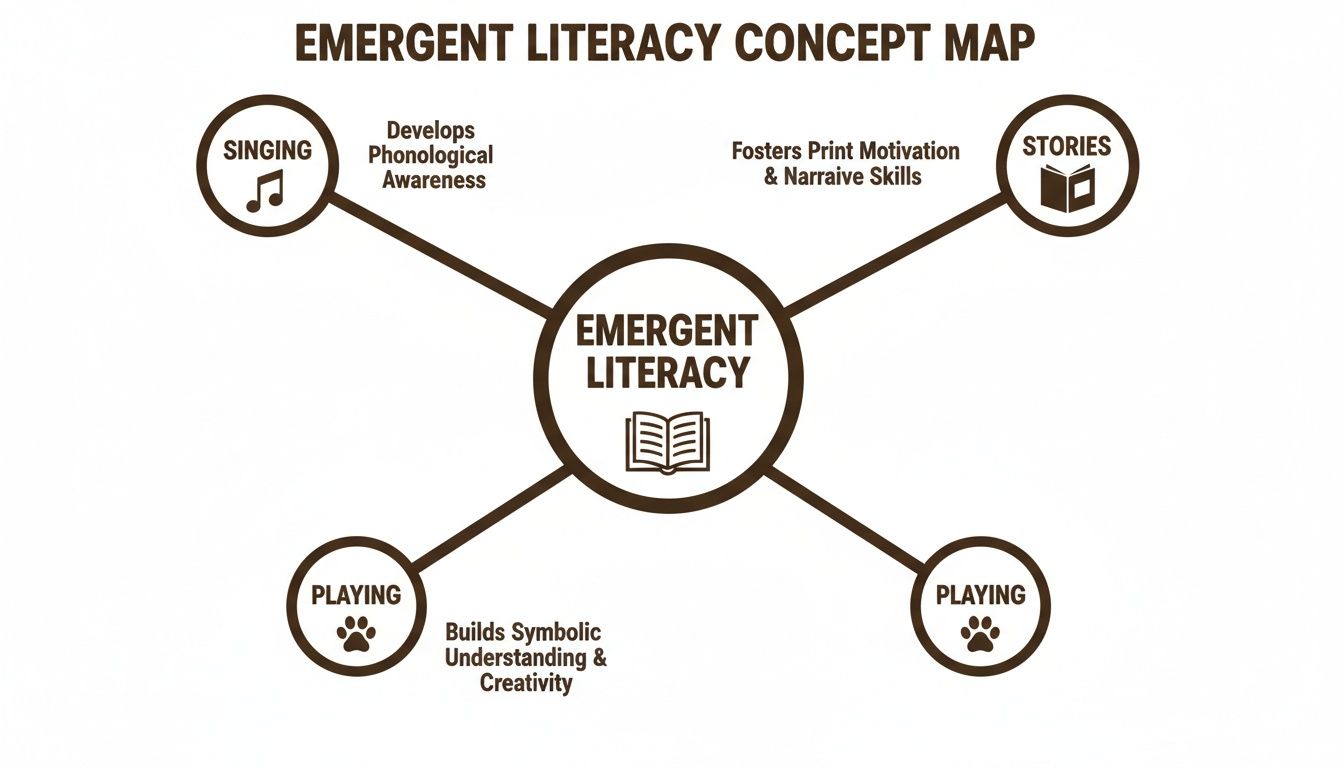
As you can see, these core experiences aren’t separate from learning; they are the learning. They feed directly into the skills a child needs to one day pick up a book and read it on their own.
Print Awareness: The Rules of the Book
First up is print awareness. This is your child’s dawning realization that all those squiggles on a page actually mean something—that they represent the words we speak. It's also about figuring out that books have a special way of working.
You see it when your little one holds a book the right way up, even if they can't read a single word. It’s them pointing to the text as you read, showing they know the story comes from those marks on the page, not just from the pictures. This is how they start to grasp that in English, we read from left to right and top to bottom.
Narrative Skills: The Art of Storytelling
Next, we have narrative skills, which is all about understanding and retelling stories. This is the magic that happens when your child can tell you about their day at the park or summarize a simple book you just read together, like a favorite SetterFrens adventure.
This pillar is about recognizing that stories have a sequence—a beginning, a middle, and an end. When they act out a scene with their toys or tell you a jumbled-up tale about what the family dog did, they're practicing this essential skill. They're building the foundation for reading comprehension later on.
Vocabulary: The World of Words
The third pillar is one you’re building every single day: vocabulary. This is the collection of words your child understands and can use. A rich vocabulary is one of the most powerful predictors of reading success down the road.
Every time you name the "fluffy" clouds, point out a "scampering" squirrel, or talk about the dog's "wagging" tail, you are depositing new words into their mental bank. Reading books together is a total vocabulary powerhouse, introducing them to words they might not hear in everyday conversation.
A child’s vocabulary size in kindergarten is a major clue to their reading comprehension in later grades. Expanding their word bank now is like giving them a map to understand the world and all the books they'll one day read.
Phonological Awareness: Playing with Sounds
This one might sound technical, but phonological awareness is simply about playing with sound. It’s a child's ability to hear, identify, and mess around with the sounds in spoken language, long before they ever connect those sounds to letters on a page.
This is all the fun stuff, like:
- Clapping out syllables: Breaking a name into beats, like "Set-ter-Frens."
- Rhyming: Giggling over words that sound the same, like "dog" and "log."
- Hearing first sounds: Noticing that "puppy" and "park" both start with that "puh" sound.
These playful sound games are building the auditory skills they'll need to eventually sound out words when they learn to read.
Alphabet Knowledge: Recognizing the Letters
Finally, we have alphabet knowledge, which is exactly what it sounds like. It's the ability to recognize and name the letters of the alphabet, both uppercase and lowercase. This is where the classic ABC song really shines!
This skill often starts small, usually with the letters in their own name. Spotting the 'A' for "Anna" on a sign or pointing out the 'B' on a block is a huge milestone. These letters are the puzzle pieces that, when combined with phonological awareness, will unlock the entire code of reading.
Some of these skills, like phonological awareness and letter knowledge, are often called "inside-out" skills because they relate to the mechanics of decoding words. A fascinating longitudinal study that followed 243 children found powerful links between these inside-out abilities and other pillars like narrative skills, showing how they all work together to boost early reading success. You can see more on how these skills connect in our guide to early literacy skills in our related guide.
Spotting Milestones Along the Literacy Journey
Every parent, caregiver, and dog lover has that moment of wonder: "Is my little one on the right track?" When it comes to emergent literacy, the journey isn't a straight line. It's more like a winding, joyful trail filled with small, wonderful discoveries. Just like every puppy has its own unique personality, every child develops at their own pace.
Think of these milestones not as strict rules, but as friendly guideposts along the way. They're there to help you see and celebrate the incredible growth happening right before your eyes. From a baby gumming a board book to a preschooler proudly "writing" a story for the family dog, each stage is a building block for a lifetime of reading.
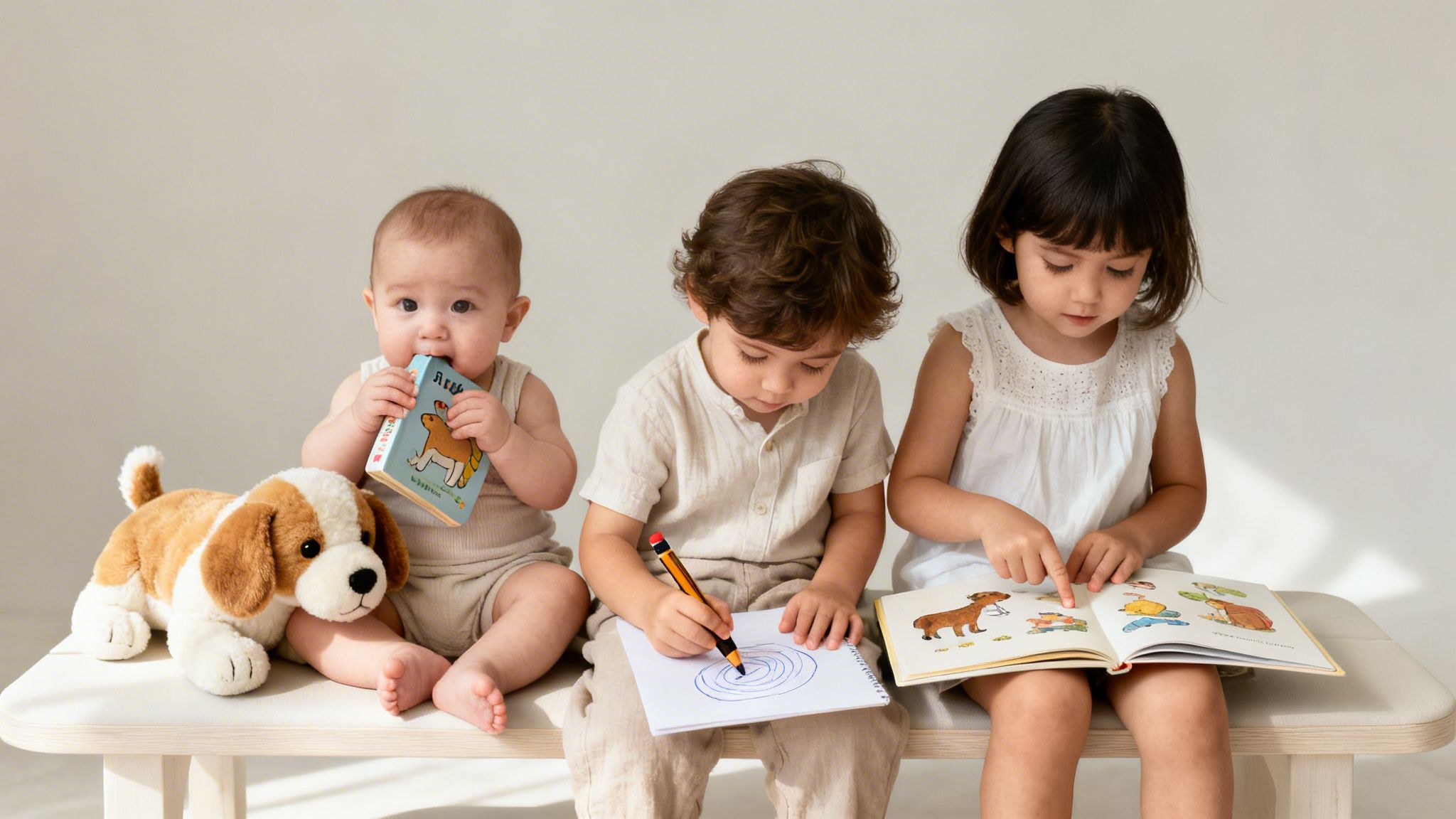
Let's explore what this beautiful journey looks like, breaking it down by age to help you spot these exciting moments as they unfold.
The First Year: Birth to 12 Months
The very first year is all about sensory exploration and building connections. Literacy at this stage doesn't look like reading—it looks like feeling, hearing, and seeing the world of language. A baby’s brain is wiring itself for communication with every coo, gurgle, and giggle they share with you.
You’ll start to see them:
- Respond to sounds: They'll turn their head toward your voice or the crinkle of a soft book. This is the very beginning of listening skills.
- Explore books with their senses: Babies will pat, touch, and yes, even chew on sturdy board books. This is how they figure out what a book is.
- Make sounds back at you: This "conversation" is their first foray into oral language, building the back-and-forth rhythm of communication.
- Enjoy songs and rhymes: Their eyes might light up when you sing a familiar tune, showing they recognize patterns in language.
A soft, chew-safe plushie, like one of our SetterFrens characters, can become a fantastic first "reading buddy." You can use it to act out sounds or point to pictures, making storytime a multi-sensory experience.
Remember, the most important thing at this stage is creating warm, positive feelings about books and language. Every cuddle and story shared builds a foundation of love that will last a lifetime.
The Toddler Years: 1 to 2 Years
This is the age of incredible discovery, where language begins to explode! Toddlers are like little sponges, soaking up new words and connecting them to the world around them. They're starting to understand that pictures represent real things and that books hold amazing stories.
During this stage, you might notice your toddler:
- Pointing to pictures: When you ask, "Where's the puppy?" they can point to the dog on the page. This shows they are making connections between words and images.
- Turning pages: They’re developing fine motor skills and an understanding of how to handle a book, even if they turn several pages at once.
- "Reading" to their toys: You might overhear them babbling to a stuffed animal while holding a book, mimicking your reading routine.
- Filling in words: In a familiar, rhyming story, they might shout the last word of a sentence, showing they're memorizing and anticipating language.
This is the perfect time for simple, engaging storybooks with bright pictures and repetitive text. A book about a playful pup can capture their attention and connect the story to their own furry friend at home.
The Preschool Years: 3 to 4 Years
Preschoolers are becoming master communicators and storytellers. They're starting to grasp more complex ideas about print and sound, and their "scribbles" are taking on real meaning. This is when the foundational pillars of emergent literacy truly start to shine.
Look for these exciting developments:
- Telling their own stories: Their narratives become more detailed, often with a clear beginning, middle, and end.
- Recognizing letters: They might proudly point out the first letter of their name on a sign or in a book.
- Scribble writing: Their scribbles will start looking more like lines and circles as they try to imitate the writing they see. They might even tell you what their "writing" says!
- Asking questions about the story: They’ll start asking "why?" and connecting the events in the book to their own experiences.
This is a wonderful age to introduce activity books that playfully reinforce letter knowledge and narrative skills. The key is to keep it fun and pressure-free, celebrating their efforts and creativity every step of the way.
Practical Ways to Nurture Reading Readiness at Home
Alright, you understand the milestones, and that’s a huge relief. Now for the fun part. Building those early literacy skills isn't about expensive flashcards or rigid lesson plans. Forget the complicated apps. It’s all about weaving playful, connection-building moments into the beautiful, messy rhythm of your everyday life.
You already have everything you need to be your child’s best first teacher. The real secret is learning to see your daily routines—from trips to the grocery store to that last story before bed—as golden opportunities to build a rock-solid foundation for reading.
Weaving Literacy into Everyday Moments
The most powerful way to support your little learner is by turning ordinary activities into extraordinary learning experiences. This is less about carving out a specific "learning time" and more about being intentional during the time you already share. Think of yourself as a friendly tour guide to the world of words.
Here are a few simple ways to get started:
- The Grocery Store Game: Your shopping trip is now a letter safari. Ask your preschooler, "Can you find the letter 'A' for apple?" or "Hey, this cereal box starts with a 'C' just like your name!"
- Kitchen Conversations: Chat about what you're doing while you cook. Use rich, interesting words like "whisk," "knead," and "sprinkle." Point to words on recipe cards or spice jars to show them that words are literally everywhere.
- Neighborhood Walks: That daily walk with the dog? It’s a classroom on the move. Point out street signs, talk about the letters on license plates, and read the signs in shop windows. Every walk is a brand-new adventure in print.
These tiny interactions really add up. They show your child that reading and writing are useful, interesting, and just a natural part of being alive.
Play-Based Activities for Core Skills
Play is the official language of childhood, and it's by far the most effective way to teach the five pillars of emergent literacy. When you create a playful environment, you can boost these critical skills without your child ever feeling like they're being "taught."
Boosting Phonological Awareness
This one is all about playing with sounds. The goal is to help your child hear the smaller parts that make up spoken words, all through fun and games.
- Rhyme Time: Make up goofy rhymes during bath time or on car rides. "Can you think of a word that sounds like bug?" (rug, hug, mug). Seriously, the sillier, the better!
- Syllable Claps: Clap out the syllables in the names of family members, pets, and favorite foods. "Let's clap your name: Em-i-ly. Three claps! Now let's do our puppy's name: Lu-na. Two claps!"
- "I Spy" with Sounds: This game is a classic for a reason! Instead of colors, play "I spy with my little eye, something that starts with the 'buh' sound." It's a fantastic way to help them isolate the first sound in a word.
Building Alphabet Knowledge
Getting familiar with letters is a huge step toward reading. The focus should always, always be on playful recognition, not stressful memorization drills.
- Magnetic Letters: Stick magnetic letters on the fridge and just let them play. You can spell out their name, your dog's name, or simple, happy words like "love."
- Alphabet Puzzles: A simple wooden alphabet puzzle is a fantastic, hands-on tool for learning letter shapes and names in a super low-pressure way.
- Create a Family Album Storybook: Print out some photos of family members, pets, and fun activities. On each page, write a simple sentence and highlight a specific letter. For example, a picture of your dog could say, "D is for dog!" This makes learning personal, meaningful, and fun.
The key is to make letters feel like friendly characters your child gets to know over time. When they see the first letter of their own name, it feels like spotting an old friend.
The Power of a Reading Routine
Creating a consistent and cozy reading ritual is maybe the single most important thing you can do. It transforms reading from a potential chore into a treasured moment of connection. This is where the SetterFrens community really shines, because we're all about celebrating that special bond between a good book and a wagging tail.
Make storytime a highlight of the day. Find a comfy spot, snuggle up with your child and your pup, and dive into a story together. Our dog-themed books at SetterFren.com are specifically crafted to capture young imaginations and make these moments even more magical. For members of our Puppicino Club, you’ll get updates on new releases and even some fun, dog-friendly treats to make reading time extra special.
Ultimately, by filling your home with conversation, play, and wonderful stories, you're not just preparing your child for school. You're giving them the priceless gift of a lifelong love for reading. And for even more ideas, check out our guide to fun kindergarten literacy activities that you can easily adapt for your preschooler.
The Power of Shared Reading and Storytelling
Out of all the ways you can help your child on their literacy journey, one simple activity packs the biggest punch: shared reading. This is so much more than just reading words on a page to your child. It’s about turning a book into a bridge for connection, conversation, and shared discovery.
Shared reading is really the heart of what we believe at SetterFrens—that life is just better with a wagging tail and a good book. It’s all about those cozy moments, snuggled up on the couch with your little one and your furry best friend, making storytime a family ritual to look forward to. The real magic happens when reading stops being a passive activity and becomes a shared, active event.
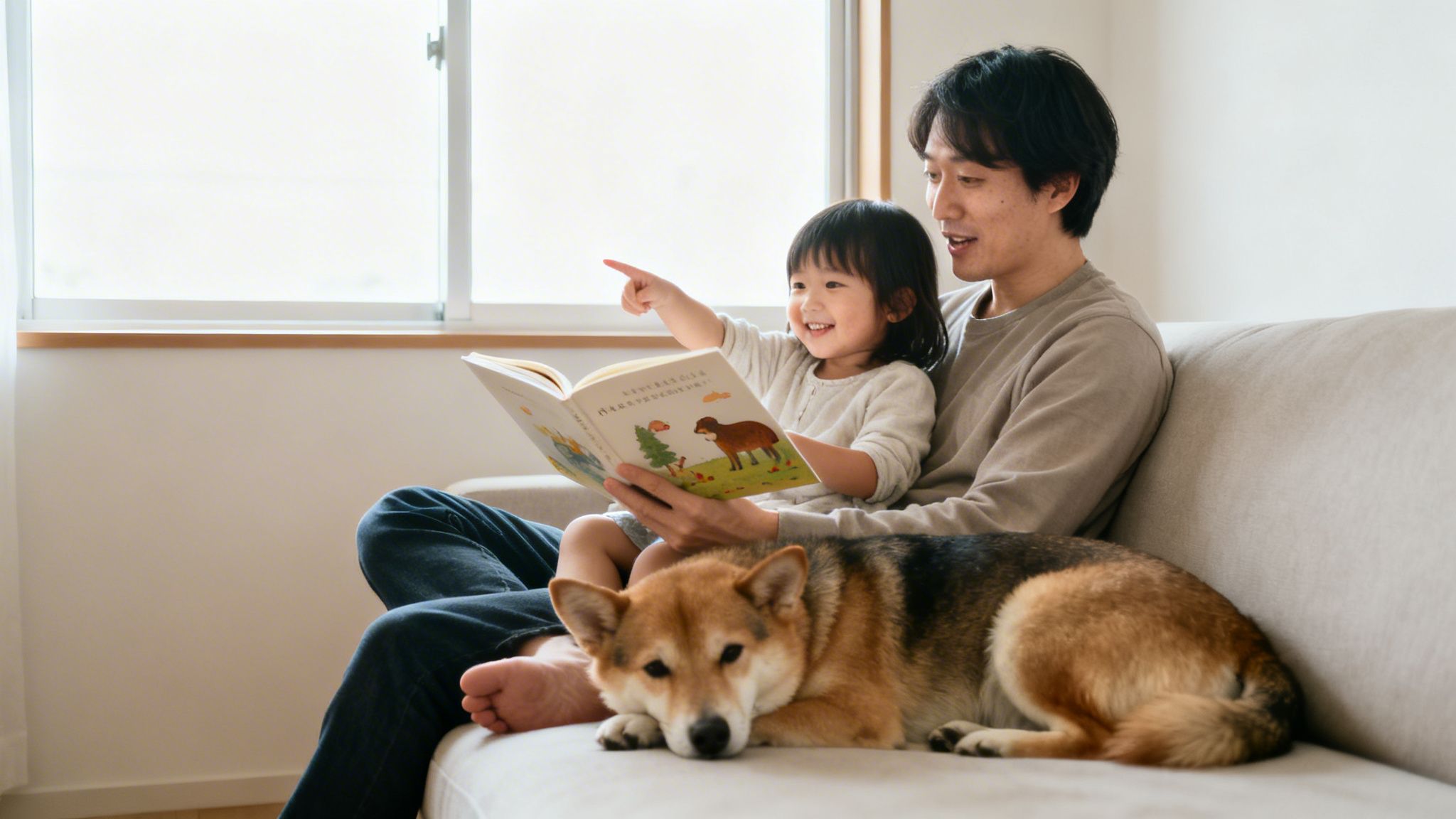
This approach is so effective because it turns a simple story into a dynamic back-and-forth. There’s actually a name for this: dialogic reading.
Turning Storytime into a Conversation
Dialogic reading might sound like a fancy, academic term, but it’s a simple idea that can completely change your read-alouds. It just means you and your child become storytelling partners. Instead of you doing all the reading, you invite your child into the story by asking questions and encouraging them to chime in.
Think of it like this: you’re not just delivering the story, you’re exploring it together. It’s the difference between quietly watching a movie and having a lively discussion about it right after.
Here’s how you can easily sprinkle some of this magic into your next storytime session:
- Ask "Wh-" Questions: Try to move beyond simple "yes" or "no" questions. Ask things like, "What do you think is going to happen next?" or "Why do you think the puppy is hiding under the table?"
- Connect to Their World: Build a bridge between the story and your child’s own life. You could say something like, "Look, that dog is playing with a red ball, just like Fido does at the park!"
- Encourage Retelling: After you finish a page or a short chapter, ask them to tell you what just happened in their own words. This is a fantastic way to build their narrative skills.
This conversational style helps build their vocabulary and comprehension in a huge way. More importantly, it shows them that their thoughts and ideas matter, making them an active part of the reading experience.
By turning reading into a conversation, you are actively building your child’s brain. This interactive process helps them develop critical thinking and language skills that are essential for becoming a strong, confident reader.
The Untapped Power of Your Own Stories
While books are incredible tools, don't forget about the storytelling superpower you already have: your own family stories. Storytelling is one of humanity’s oldest traditions for a reason—it’s how we make sense of the world and connect with each other.
Telling your child stories, whether it's a funny recap of what the dog did that morning or a memory from your own childhood, flexes the same literacy muscles as reading a book.
It teaches them about:
- Narrative Structure: They learn that stories have a beginning, a middle, and an end.
- Vocabulary: You can introduce new words in a personal, meaningful way.
- Imagination: They get to create vivid pictures in their minds based on your words alone.
A big part of this is also exposing them to rhythm and rhyme. A fun way to do this is with classic nursery rhymes books, which help build language skills in a playful, memorable way. When you fill your home with both books and personal tales, you create an environment that’s rich with language and connection.
And if you need some fresh ideas for your bookshelf, check out our guide to the best read-aloud books for first-graders to find your next family favorite.
Why Emergent Literacy Is a Gift for Life
All those little moments you share with your child are so much more than just sweet memories. The silly rhymes you make up, the bedtime stories you read over and over, even the chats about your dog's goofy antics—they're all weaving together the very foundation of your child's future. You're laying the groundwork for school success, personal confidence, and a genuine, lifelong love of learning.
Think of emergent literacy less as another task on your to-do list and more as a wonderful opportunity. Every time you talk, sing, or read together, you're giving your child an incredible head start. And the best part? It all happens through joyful, everyday activities that make your family bond even stronger. This isn't about pressure; it's about celebrating the profound power of your presence.
The Lasting Impact of Early Skills
The ripple effects of a strong start in literacy are huge, stretching far beyond the first day of kindergarten. Research consistently shows that kids who enter school with solid emergent literacy skills tend to pick up reading more easily. This, in turn, gives their confidence a major boost and keeps them engaged across every single subject.
A strong foundation in early literacy is one of the greatest predictors of future academic success. It’s the gift that keeps on giving, opening doors to new worlds, ideas, and opportunities throughout a person’s life.
It's a positive cycle that just keeps building on itself, creating curious and capable learners. This is such a well-known fact that countries all over the world are now developing better tools for early screening. For instance, a massive 2021 study in Portugal screened 1,379 children to test new, low-cost ways to support early literacy for everyone. You can read the full research about these screening tools to see how the science is evolving.
This whole journey is really at the heart of what we do here at SetterFrens. We truly believe that by creating fun, dog-themed books and building a supportive community, we're helping you give your child that priceless gift—a love for stories that will light up their entire life.
Got Questions About Early Literacy? We've Got Answers.
Even when you feel like you've got this, questions are bound to pop up on your child's journey to literacy. You're definitely not alone in wondering about the little day-to-day things. Think of this section as a chat with a trusted friend, here to give you clear, reassuring answers to some of the most common worries parents have.
Our hope is to help you feel confident and supported as you guide your little reader. Remember, every child’s path is their own, and it's all about progress, not perfection.
"My Toddler Wants Nothing to Do With Books. What Can I Do?"
First off, don't worry! This is incredibly common. The trick is to make books a fun, no-pressure part of their world. If traditional stories aren't clicking, try shaking things up with interactive books—the ones with flaps to lift, textures to feel, or buttons that make silly sounds.
Another great strategy is to follow their lead. Are they obsessed with dogs? A lively story about a goofy puppy might just be the thing that sparks their interest. Keep reading sessions short, sweet, and let them be in charge, even if it just means flipping pages or pointing at pictures. The goal here is building a positive association with books, not forcing them to sit through a story.
"Are Reading Apps Okay for My Child to Use?"
Absolutely, as long as you're thoughtful about it. The right kind of technology can be a fantastic tool to have in your back pocket. Look for high-quality apps or shows that are interactive and get your child to participate, rather than just zoning out.
The best way to do this is together. Sit down and play the game or watch the show with them so you can talk about what's happening. This turns screen time into another moment for connection and conversation. Just remember, digital tools should always be an addition to, not a replacement for, the irreplaceable magic of cuddling up with a real, physical book.
"When Should I Start Teaching My Child the Alphabet?"
You can start weaving letters into your daily life from a very young age, long before you think about "teaching." This can look as simple as singing the Alphabet Song during bath time, playing with colorful alphabet puzzles, or pointing out the first letter of their name on a birthday card.
There's absolutely no need for formal drills or flashcards with toddlers and preschoolers. The whole idea is to make letters a fun, familiar, and friendly part of their world. Trust that their natural curiosity will be the best teacher they'll ever have.
At SetterFrens, we believe the most powerful learning happens when it's wrapped in love and fun. Our hand-picked collection of dog-themed books is designed to spark joy and curiosity, turning storytime into the best part of your day. Explore our shop to find the perfect adventure for your little one and their furry best friend. Discover your next favorite book at Setterfren.com.