When it comes to getting book reviews, the secret isn't some complicated formula. It's all about strategic outreach before your book even hits the shelves. The whole process starts with creating professional Advance Reader Copies (ARCs), finding the right reviewers for your genre, and then reaching out with a personal touch. Your goal isn't just to get a review; it's to build a real connection that might just turn a casual reader into a dedicated fan.
Why Book Reviews Are Your Secret Marketing Superpower
I get it. Asking for book reviews can feel a little awkward, even intimidating. But what if you started thinking of them less as a chore and more as your single most powerful marketing tool? A good review is like a friend leaning in and saying, "You have to read this book." It's instant trust and social proof, and having a steady stream of them is the lifeblood of your book's success.
For our cozy community at SetterFrens, authentic reviews from fellow dog lovers are what turn a simple purchase into a sense of belonging. It’s a genuine connection that no amount of advertising can replicate, like a happy tail wag for your author brand.
The Power of Social Proof in Book Sales
Reviews have a direct, tangible impact on whether a potential reader clicks that "buy" button. They also feed the algorithms on sites like Amazon, which absolutely love to see books with consistent review activity. This kind of social proof is a total game-changer.
The numbers don't lie. Books with 100+ Amazon reviews can see 4x higher conversion rates, and a whopping 85% of top-selling books have a rating of 4 stars or higher. In our niche—think heartwarming, dog-themed books—we've seen that Instagram posts featuring a snippet from a great review get 3.2x more engagement.

Think about your own experience on Goodreads. The first thing you probably look at is the star rating and the number of reviews. It's a quick, visual cue that helps you decide if a book is worth your time.
Building Your Author Brand One Review at a Time
A smart, consistent review strategy is how you build a loyal fanbase and a strong author brand from the ground up. Every single review adds another layer to your book's story and helps solidify its place in the market.
"Reviews are more than just feedback; they are conversations. They're the pulse of your readership, telling you what resonates and building a bridge between you and your audience."
This is precisely why you need a solid plan for getting those reviews. It’s not an afterthought; it’s a critical piece of your overall marketing puzzle. For a deeper dive into boosting your book's visibility, you can learn more about how to promote your book.
And when you weave your review strategy together with other marketing efforts, you create a powerful momentum that will fuel your book's success for the long haul.
Getting Your Book Ready for Reviewers
Before you even dream of hitting "send" on that first review request, you need to make sure your book is ready for its close-up. Think of it like prepping a stage before the big show—a little work now makes a world of difference in how seriously a reviewer will take you.
This whole process is about showing you're a professional who respects their time. When you make it easy for a busy reviewer to say "yes" and get lost in your story, you’re already miles ahead of the game.
Polishing Your Advance Reader Copies (ARCs)
An Advance Reader Copy (ARC) is simply a pre-release version of your book that you send out to snag those crucial early reviews. While it doesn't need to be the absolute final print file, it absolutely must be professionally edited and formatted.
Trust me on this: reviewers are readers first. Nothing yanks them out of a great story faster than a manuscript riddled with typos or weird formatting glitches. A clean, easy-to-read ARC isn't just a nice-to-have; it's a requirement.
These days, most reviewers prefer digital copies. The two formats you'll want to have on hand are:
- ePub: This is the gold standard for e-readers like Kindle, Nook, and Kobo. It’s a "reflowable" format, which means the text automatically adjusts to fit the screen, making for a much better reading experience.
- PDF: While not as flexible as an ePub, a PDF is a great backup. It's universally accessible on just about any device and is perfect if your book has a fixed layout with lots of illustrations, like many of the awesome children's books we feature at SetterFrens.
Putting Together Your Reviewer Kit
A reviewer kit is your secret weapon. It’s a simple, organized digital folder with everything a reviewer could possibly need to know about you and your book. By doing the legwork for them, you're showing you value their time—and they’ll definitely appreciate it.
Just create a folder in Dropbox or Google Drive and load it up with the essentials.
What to Include in Your Reviewer Kit:
- Your ARC: Be a hero and offer both ePub and PDF versions.
- High-Res Cover Image: A crystal-clear JPG or PNG of your book cover.
- The Book Blurb: The same polished, punchy description you’d put on the back of the book.
- Author Bio & Headshot: Keep your bio short and sweet (around 100-150 words) and pair it with a professional-looking photo. This helps them connect a face to the name.
- Important Links: Make it easy for them to find your website, social media (like our @setterfrens Instagram!), and any pre-order pages.
This simple step of creating a reviewer kit immediately signals that you're an organized professional. It shows you're serious about your work and makes a reviewer far more likely to give your book a look.
Putting in this effort upfront makes the entire outreach process so much smoother. When you’re ready to start contacting reviewers, you'll have everything you need, all in one place. And if you're writing for a younger audience, our guide on how to write a children's book has even more tips that can help you prepare.
Where to Find Your First Wave of Reviewers
So, where do you actually find these wonderful people willing to read and review your book? The internet is overflowing with options, and trying to be everywhere at once is a surefire way to burn out. A focused strategy is your best friend here.
Instead of casting a super-wide net, the goal is to pick two or three platforms that perfectly align with your book's genre and your personal goals. For our SetterFrens community, that means finding platforms where readers who love dogs, kids' books, and heartwarming stories already hang out.
Let's dig into the best spots to focus your energy.
Paid Review Services: Investing in Speed and Reach
Sometimes, investing a little money can save you a whole lot of time. Paid platforms are specifically designed to connect authors with a large, established pool of reviewers who are actively looking for their next read.
Here are a few of the most popular options:
NetGalley: This is one of the heavy hitters, often used by traditional publishers. It gets your book in front of librarians, booksellers, educators, and influential reviewers. The catch? It comes with a higher price tag, which might not be feasible for every author starting out.
BookSirens: A more budget-friendly alternative, BookSirens is fantastic for indie authors. You have control over who gets your ARC, and the platform gently reminds reviewers to post their thoughts, which really helps boost your review rate.
Booksprout: This platform is another great option that helps you manage your ARCs and track your reviews. They offer both free and paid tiers, allowing you to scale up as your needs grow.
These services can be a huge help, but they aren't a magic bullet. You're paying for access and convenience, not guaranteed positive reviews. Always weigh the cost against the potential return for your specific book.
Tapping into Free Reader Communities
If you have more time than money, free communities are an incredible resource for connecting directly with passionate readers. It takes more hands-on effort, but the relationships you build here can be invaluable.
Goodreads is the largest social network for readers on the planet. You can join genre-specific groups, participate in discussions, and run giveaways to get your book on people's "to-read" shelves. Building a genuine presence here is key—it’s about being a member of the community, not just dropping links to your book.
Think of it this way: Paid services are like running an ad in a popular magazine, while building a presence on Goodreads is like joining a local book club. Both can work, but they require different approaches.
LibraryThing is another wonderful community, especially popular with dedicated catalogers and serious readers. It has a slightly older, more academic feel than Goodreads but is full of people who genuinely love discovering new books.
These platforms are powerful because they're built on reader trust. Participants in reader communities are highly influential; reviews from engaged users on sites like Goodreads can significantly sway purchasing decisions. For a niche like dog-themed books, finding your pack in these communities is key.
A Quick Glance at Your Options
Deciding where to focus can be tough, so here's a quick comparison to help you figure out where to best invest your time and money.
| Platform | Best For | Typical Cost | Key Feature |
|---|---|---|---|
| Amazon | Reaching a massive audience of buyers | Free (ARC distribution) | The most influential reviews for sales |
| Goodreads | Building community and engaging with avid readers | Free (giveaways cost money) | Huge, active user base and genre groups |
| NetGalley | Reaching industry professionals (librarians, booksellers) | $$$$ | Prestige and access to pro reviewers |
| BookSirens | Indie authors on a budget | $$ | High review-through rate and author control |
Ultimately, the best strategy is a mix-and-match approach. Start with one or two platforms, see what works for your book, and then expand from there.
Don't Get Banned: Understanding Amazon's Review Policies
Amazon is, without a doubt, the most important marketplace for book reviews. It also has the strictest rules. Not following them can get your book's reviews wiped or, in worst-case scenarios, your account suspended.
Here’s the golden rule: You can never, ever compensate someone for a review. This includes offering money, gift cards, or entry into a contest. Providing a free ARC in exchange for an honest review is perfectly acceptable and the industry standard.
You also can't ask friends, family members, or anyone with a close personal relationship to review your book. Amazon's algorithm is surprisingly good at sniffing out these connections.
Navigating these rules is crucial for your book's long-term health. Whether you're getting reviews from direct outreach or a summer reading initiative, making sure they comply with Amazon’s guidelines is essential. To get some inspiration for engaging readers, check out our guide on fun summer reading program ideas.
Mastering Your Outreach to Reviewers
A generic, copy-pasted email is the fastest way to get your request deleted. If you want to master how to get book reviews, you have to connect with people on a human level. It’s about transforming a cold pitch into a warm invitation. The secret isn't some magic template; it's genuine, thoughtful personalization.
This personal touch shows reviewers you've actually done your homework and that you respect their work. It's the difference between asking a stranger for a favor and starting a real conversation with someone who shares your passions. For a brand like SetterFrens, this is gold—it means finding fellow dog lovers and framing your request as a chance to share a story they'll genuinely adore.
This process flow gives you a bird's-eye view of the main pathways for finding reviewers, from paid services to free community engagement.
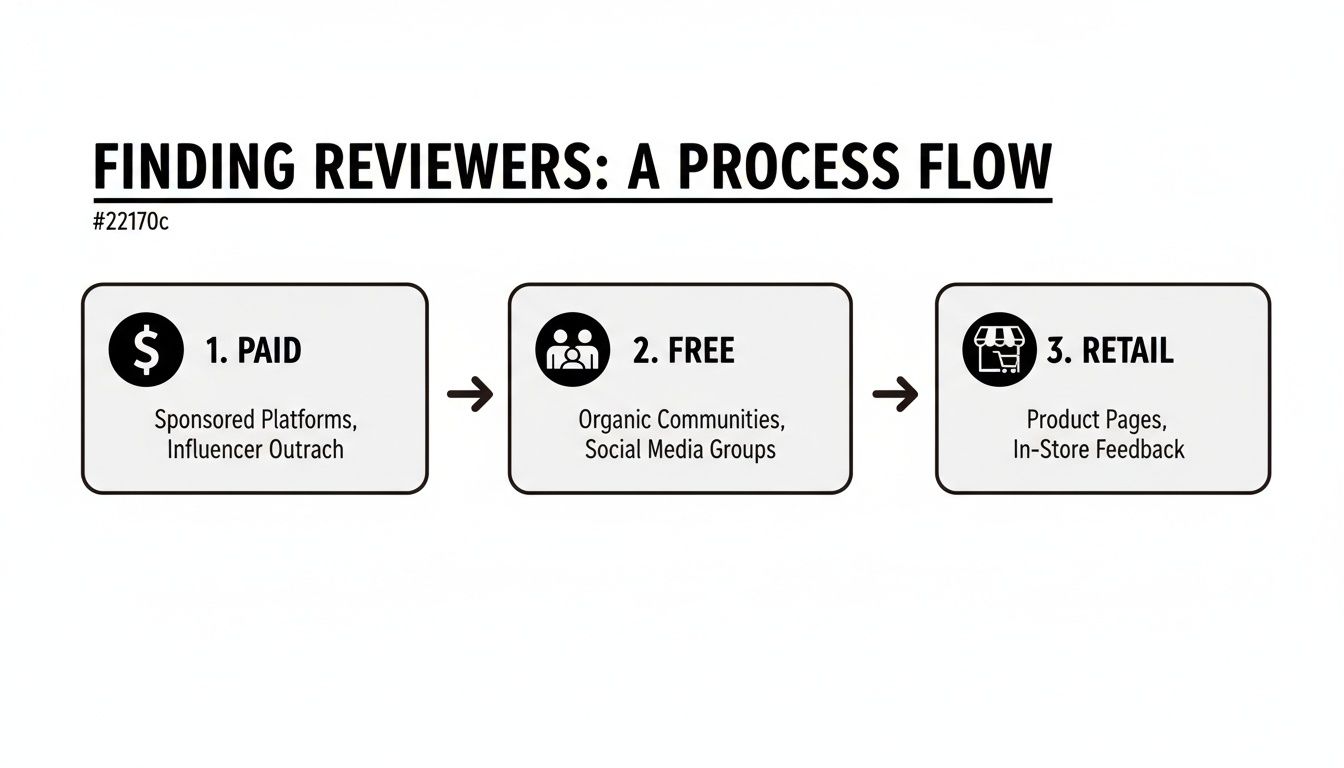
As you can see, a solid strategy often blends paid platforms for speed, free communities for building real relationships, and direct engagement for authentic feedback from readers.
The Art of the Personalized Pitch
Before you even think about drafting your email, take five minutes to research the reviewer. Seriously, just five minutes. This small investment of time pays off in a huge way.
Your goal is to find a specific, genuine point of connection. It doesn’t need to be elaborate, but it absolutely must be authentic.
- Read Their Recent Work: Have they recently reviewed a book similar to yours? Mention it! A simple, "I really enjoyed your take on…" shows you're actually paying attention.
- Check Their Socials: Do they post endless photos of their golden retriever? If you've written a dog-themed book, that’s your perfect opening. "As a fellow dog lover, I thought your pup might get a kick out of my new book…"
- Note Their Preferences: So many book bloggers and creators list their favorite genres or topics right in their bio. Acknowledging this shows you've chosen them for a reason, not just because they have a "contact me" button.
A personalized pitch isn’t about flattery; it's about demonstrating relevance. It tells the reviewer, "I see what you do, I value it, and I believe my book is a great fit for you and your audience." That respect is often what earns you a "yes."
As you get better at outreach, it's also helpful to understand the psychology behind the ask itself. Learning the right way to ask for customer reviews can really boost your success rate across the board.
Crafting Your Friendly Outreach Template
Look, I get it. Personalizing every single email is a lot of work. So while every message should be unique, you can definitely start with a flexible template to save time. Just think of this as your blueprint, not a script you copy and paste.
Here’s a structure that I’ve seen work really well:
- A Compelling Subject Line: Be clear and intriguing. Something like "Review Request: [Your Book Title] – A Story for Dog Lovers" works so much better than a generic "Book for Review."
- The Personalized Opener: This is where your five minutes of research shines. Start with that specific compliment or connection you found.
- The Elevator Pitch: Quickly describe your book in one or two sentences. Make sure to include the genre, a key hook, and why it might appeal to their audience specifically.
- The Clear Ask: Be direct about what you're hoping for. "I'd be thrilled to send you an advance copy in your preferred format in exchange for an honest review."
- An Easy "Out": Always, always give them a polite way to decline. A simple "I know you're incredibly busy, so no worries at all if your schedule is full" removes the pressure and keeps the interaction positive.
This approach turns your outreach from a simple transaction into a genuine opportunity to build a relationship.
Building Your Launch Team for Lasting Support
A launch team is your secret weapon. It’s a dedicated group of your most enthusiastic fans who get early access to your book. Their mission? To read it and leave an honest review on or around release day. This strategy is hands-down one of the most effective ways to get book reviews right when they matter most.
These aren't just random reviewers; they're your core community. They’re the people who’ve joined your Puppicino Club, follow @setterfrens on TikTok, and are genuinely excited about what you create. Building this team turns casual readers into passionate advocates for your work.
In the fast-paced world of publishing, this early momentum can make or break your launch. Data shows that books hitting 50 reviews can sell 20-30% more copies. For a brand like SetterFrens, this means tapping into pet communities on Instagram and TikTok—where dog-related content gets billions of views—to find authentic reviewers. It’s a smart move, especially when you consider that a large percentage of social media users trust influencer endorsements.
By nurturing these relationships, you’re not just asking for reviews; you're building a community that will champion your work long after launch week is over.
Staying on the Right Side of Review Ethics and Platform Rules
Getting reviews for your book means playing by a few important rules, but don't let that intimidate you. Honestly, staying on the right side of platform policies and legal guidelines is much simpler than it sounds. It all boils down to being transparent, honest, and respectful of a reviewer's time and opinion.
Think of it as building a foundation of trust with both your readers and the platforms where you sell your books. When you follow the rules, you’re not just protecting your author account—you’re showing the community you're a professional who takes their craft seriously.
The Golden Rule of Book Reviews
If you remember one thing, make it this: you can never, ever pay for a positive review. This is the absolute cornerstone of review ethics and a non-negotiable policy on major platforms like Amazon. Offering money, gift cards, or even contest entries in exchange for a review is a surefire way to get those reviews yanked or, even worse, your account penalized.
But here’s the crucial distinction: providing a free Advance Reader Copy (ARC) is a completely different ballgame. This is the standard, accepted practice across the entire publishing industry. You're not paying for a review; you're offering a complimentary sneak peek of your work, hoping to get an honest, unbiased opinion in return. It's a gift, not a transaction.
Why "Honest Feedback" is Your Best Friend
When you reach out to potential reviewers, the specific words you use matter. Always, always frame your request around asking for their "honest feedback" or an "honest review."
This phrasing is your secret weapon. It does two critical things:
- It immediately removes any pressure on the reviewer to only say nice things.
- It protects you by showing you’re not trying to manipulate your ratings, which keeps you in line with platform policies.
It’s also a fantastic practice to encourage reviewers to include a simple disclaimer in their review. A quick line like, "I received a free copy of this book in exchange for my honest review," builds a massive amount of transparency and trust with other potential readers.
A quick word of advice: Your goal isn't just to collect a pile of five-star ratings. It's to build a credible reputation. A mix of reviews, even with a little constructive criticism, often looks far more authentic to savvy readers than a flawless wall of nothing but praise.
Keeping Your Review Campaign Organized
Once you start sending out ARCs, you’ll thank yourself later for having a simple system to keep track of everything. A basic spreadsheet is your best friend here—no need for fancy software. A Google Sheet or Excel file will do the job perfectly.
Set up a few columns to track the essentials:
- Reviewer Name: The name of the blogger, influencer, or reader.
- Contact Info: Their email or social media handle.
- Date Sent: When did you send the ARC?
- Follow-Up Date: A reminder for when to send a gentle nudge.
- Review Status: Note if the review is pending, posted, or if they declined.
- Link to Review: Once it's live, paste the URL here for easy access.
This simple setup will save you from accidentally sending duplicate requests or forgetting who you need to follow up with.
The Gentle Art of the Follow-Up
So, you sent your ARC out into the world. Now what? A good rule of thumb is to wait about two to three weeks before sending a follow-up. Remember, reviewers are often juggling a mountain of books and have their own schedules.
When you do reach out, keep it brief, polite, and completely pressure-free. A simple note like, "Just wanted to check in and see if you had any trouble accessing the file. No rush at all, just making sure everything came through okay!" is perfect. If you don't hear back after one polite nudge, it’s usually best to let it go and move on.
Turning Good Reviews into Marketing Gold
Positive reviews are powerful marketing assets, so don't just let them sit on a product page! When you get a great one, pull out the most compelling quote and shout it from the rooftops. Turn it into a beautiful graphic for your Instagram or a quick post for your TikTok. For us at @setterfrens, a glowing review from a fellow dog lover is pure gold for our social media content.
And what about the inevitable not-so-great review? It’s bound to happen to every author. The best response is usually no response at all. Engaging can make you look defensive. Instead, take a deep breath, see if there's any valid criticism you can learn from for your next book, and then pour your energy back into securing more positive, honest reviews.
Got Questions About Book Reviews? We’ve Got Answers.
Diving into the world of book reviews can feel a little like trying to navigate a new city without a map. There are tons of unwritten rules, and it's easy to get lost. So, let's clear up some of the most common questions authors wrestle with.
Think of this as your personal cheat sheet for those tricky "what if" moments. We’ll cover everything from the magic number of reviews you should aim for to the gut-wrenching moment you get a bad one.
How Many Reviews Does a Book Really Need?
Ah, the million-dollar question. The honest-to-goodness answer is that it really depends on what you're trying to achieve. There’s no single number that guarantees success, but there are definitely some key milestones that can give your book a serious boost.
Right out of the gate, your first mission should be to get at least 10-15 reviews. This seems to be the tipping point where Amazon’s algorithms start to take notice and show your book to more people. It also gives you that crucial social proof that tells early shoppers, "Hey, this book is worth a shot."
Once you've hit that first target, here are a few other numbers to keep in your sights:
- 50 Reviews: This is where many authors feel a real shift. Your book starts looking more established, and that extra credibility can translate into a nice little bump in sales.
- 100+ Reviews: Hitting triple digits is a huge milestone. It signals to potential readers that your book is a proven winner, which can do wonders for your conversion rate.
Your review count is a marathon, not a sprint. A book that keeps getting fresh reviews months or even years after its release tells both readers and algorithms that it’s still relevant. Focus on that steady trickle.
What's the Big Deal with Verified vs. Unverified Reviews?
You've seen it a million times on Amazon: that little orange "Verified Purchase" tag. It might seem small, but that label packs a surprising punch with both readers and Amazon's system. Knowing the difference is a game-changer for your review strategy.
A Verified Purchase review is exactly what it sounds like—Amazon has confirmed the reviewer bought the book directly from them. The algorithm gives these reviews more weight, and readers tend to trust them more.
An unverified review, on the other hand, comes from someone who didn't buy the book on Amazon. Maybe they got an ARC, picked it up at a local bookstore, or borrowed it. These reviews are still valuable social proof, but they don't move the needle as much on your book's ranking. This is why encouraging your launch team to actually buy a copy (even if you gave them one for free) is such a powerful move.
Can I Just Ask My Mom and My Best Friend for Reviews?
It’s so tempting, isn't it? A quick and easy way to get some 5-star praise. But the answer here is a hard, unequivocal no. Amazon's rules are crystal clear: they strictly forbid reviews from anyone you have a close personal relationship with. We're talking family, close friends, even your business partner.
Why so strict? It all comes down to trust. Amazon’s whole review system is built on the idea of unbiased feedback. They know your mom thinks you’re a genius, and while that's lovely, it's not exactly an impartial opinion.
And don't think you can outsmart them. Their algorithms are scarily good at sniffing out these connections by looking at things like shipping addresses, purchase histories, and even linked social accounts. If you get caught, the review will be zapped. If it happens repeatedly, you could face bigger problems. It's just not worth the risk. Pour that energy into finding real readers who will become genuine fans.
Oh No, a 1-Star Review! What Do I Do?
First things first: breathe. A bad review feels personal, but it's a rite of passage for every single author. The single most important thing you can do is do not engage. Seriously. Step away from the keyboard. Replying, even if you’re trying to be polite and professional, almost always backfires. It makes you look defensive and just draws more attention to the negative comment.
Instead, try to see it as data.
- Is there a kernel of truth? If you see several reviews pointing out the same thing—maybe a confusing plot point or a bunch of typos—that's valuable feedback you can use for your next book.
- Is it just a matter of taste? A lot of negative reviews simply boil down to "this wasn't for me." And that's okay! No book is for everyone. Your goal isn't to please every person on the planet.
Honestly, a few less-than-perfect reviews can even make your book look more credible. A page of nothing but glowing 5-star raves can sometimes feel a bit suspicious to savvy readers. The best way to deal with a negative review is to simply bury it under a fresh wave of positive, honest ones.
At SetterFrens, we believe life's better with a wagging tail and a good book. Our cozy online community is built for dog lovers, featuring a curated selection of dog-themed books, honest product reviews, and practical guides to help you care for your pup. Join our Puppicino Club to unlock member perks and stay part of the fun by following @setterfrens on TikTok and Instagram! Explore more at https://setterfren.com.